How do bacteria make light?
- They make light via the bacterial luminescence reaction.
- FMNH2 + RCHO + O2 → FMN + RCOOH + H2O + light
- luciferase is the enzyme that carries out the reaction.
- RCHO = long-chain fatty aldehyde RCOOH = long-chain fatty acid
- Bacterial luminecence is an enzyme mediated activity.
- It is dependent on oxygen.
How does the luminescence reaction work? What conditions need to be met? What needs to be reoxidized?
- The reaction uses oxygen as a substrate.
- Bacterial luciferase can function when oxygen levels are high and even when oxygen levels are very low, too low for the normal electron transport chain to function.
- By reoxidizing NADH to NAD+, luminescence acts like a secondary respiratory chain, one that can operate when oxygen levels are too low for the normal electron transport chain to function.
What kinds of bacteria make light?
- There are approximately 30 species that make light.
- They are in the genera Aliivibrio, Photobacterium, Vibrio, and Shewanella, which are marine, and Photorhabdus, which is terrestrial.
What is the phylogeny of luminous bacteria? Domain? Phylum? Class? Families?
- 16S rRNA and gyrB genes
- Domain: Bacteria
- Phylum: Proteobacteria
- Class: Gammaproteobacteria
- Families: Enterobacteriaceae, Shewanellaceae, Vibrionaceae
What are the lifestyles of marine luminous bacteria?
- “free-living”, in seawater, marine sediment.
- commensal, in the intestines of marine animals.
- saprophytic, on detritus, skin of marine animals, surfaces of marine algae.
- pathogenic, in hemolymph and exoskeletons of marine crustaceans.
- bioluminecent sybionts, in light organs of certain fish and squids - a highly specific life style of only a few species of luminous bacteria.
What is bioluminescent symbiosis? What provides the oxygen for the bacteria? What is the light used for?
- Each fish or squid cultures a large population of light-emitting bacteria in a specialized tissue complex, called a light organ.
- The animals provides the bacteria with oxygen for luminecence and nutrients for reproduction, and uses the bacterial light for signaling, avoiding predators, and attracting prey.
- These associations are highly specific, typically involving individual species of bacteria.
- The bacteria are extracellular and in many cases can be grown in the laboratory.
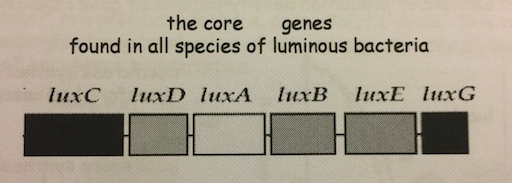
What are the genes that give bacteria the ability to produce light?
1) What does luxA and luxB produce?
2) What does luxC, luxD, and luxE produce?
3) What does luxG produce?
1) bacterial luciferase
2) fatty acid reductase (synthesis of RCHO)
3) flavin reductase
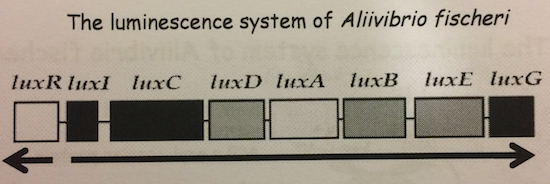
What genes are contained in the luminescence system of Aliivibrio Fischeri?
1) What are the two transcriptional units?
2) What does luxI code for?
3) What does luxR code for?
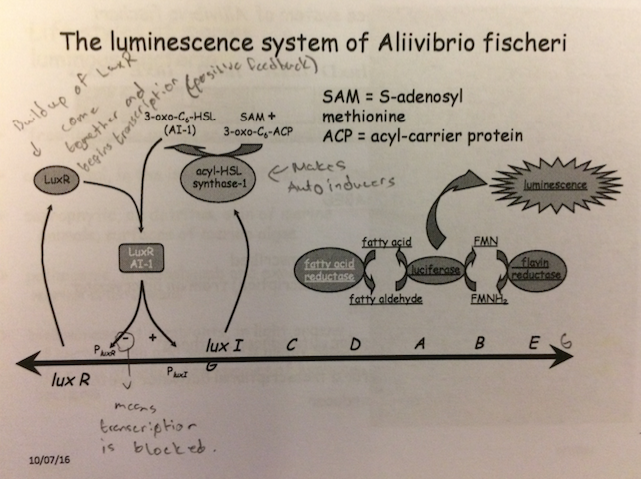
1) the lux operon - luxICDABEG and the luxR gene. Both are divergently transcribed from an intervening regulatory region.
2) A regulatory gene, codes for autoinducer synthase
3) regulatory gene, codes for a transcriptional activator protein that bind autoinducer.
1) What is autoinduction and luciferase synthesis an example of?
2) Is luciferase synthesis regulated?
3) When is luciferase synthesis induced?
4) What happens during growth?
5) What does increased luciferase activity suggest?
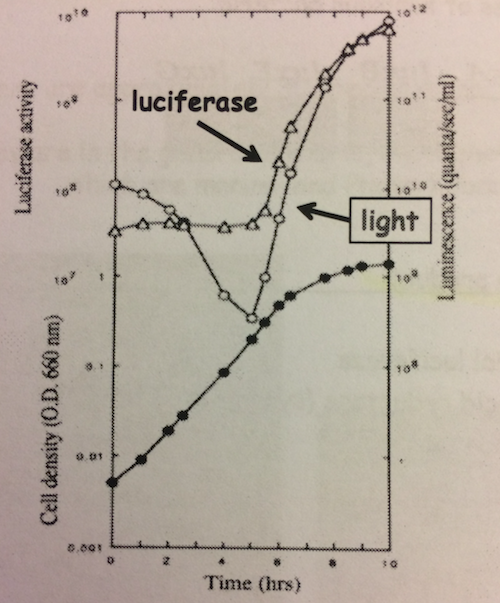
1) an example of population density-dependent gene regulation.
2) Luciferase synthesis (and therefore luminescence) is regulated.
3) Luciferase synthesis (and therefore luminescence) is induced at high population density.
4) During growth, the cells release a molecule into the growth medium. Autoinducer (effector)
5) Increase in luciferase activity suggest the activity is induced.
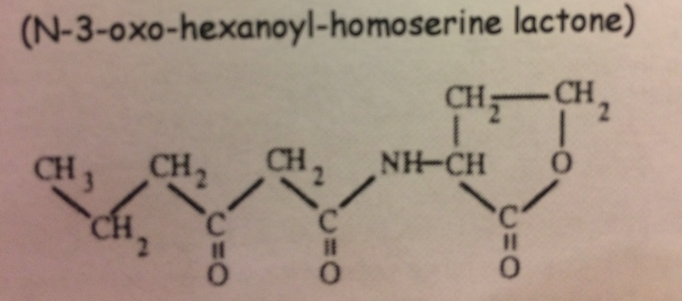
1) What is the Aliivibrio fischeri autoinducer?
2) What catalyzes the synthesis of this compound?
3) Where does this inducer go?
4) What happens when a large enough amount accumulates?
1) Acyl-homoserine lactone
2) The luxI protein (acyl-HSL synthase) catalyzes the synthesis.
3) It diffuses out of the cell.
4) When it accmulates in the environment and in cells to a high enough concentration, it induces luciferase synthesis and luminescence.
What does the luminecence system of Aliibibrio fischeri involve?
- At low population density, there is a low level of transcription of the lux operon (luxICDABEG)
- A small amount of LuxI protein is made, and it catalyzes the snythesis of a small amount of autoinducer.
- As the local population of cells increases, the local concentration of autoinducer also increases, inside and outside of the cell.
- When the level of autoinducer reaches a threshold, it interacts with luxR protein, forming a complex that binds at the lux operon promoter.
- This helps RNA polymerase recongnize the lux operon promoter, bind to it, and begin transcription.
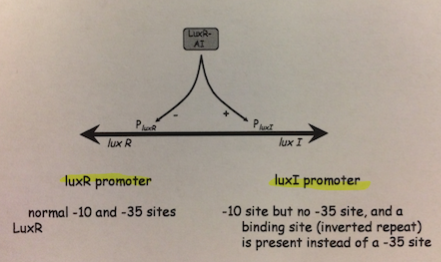
What makes the luxI promoter different from the luxR promoter?
- LuxR has normal -10 and -35 sites.
- LuxI has a -10 site but no -35 site, and a binding site (inverted repeat) is present instead of a -35 site.
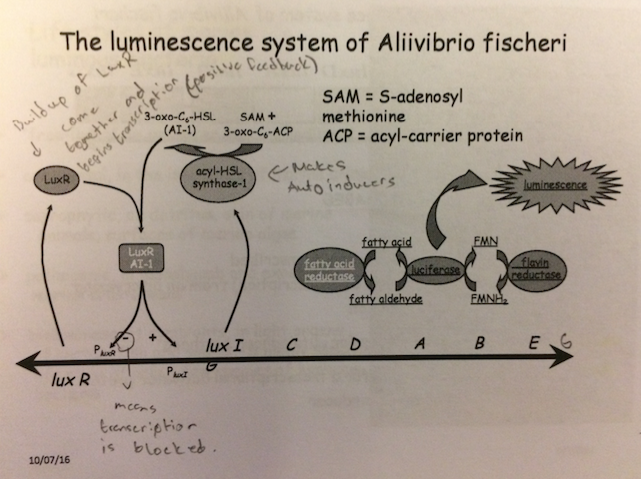
What does increased levels of transcription of the Lux operon do? Is it a positive feedback system, or negative?
- Increasing levels of lux operon transcription lead to increasing synthesis of autoinducer, in a positive-feedback, autocatalytic cycle. This results in an increasingly strong production of autoinducer and very strong induction of lux operon transcription.
- This kind of regulation can be called “autoinduction”, and it is now also called “quorum-sensing”.
1) Do non-luminous Gram-negative bacteria have a similar system?
2) What do these systems do?
3) Give an example of the a bacterial species that uses this system?
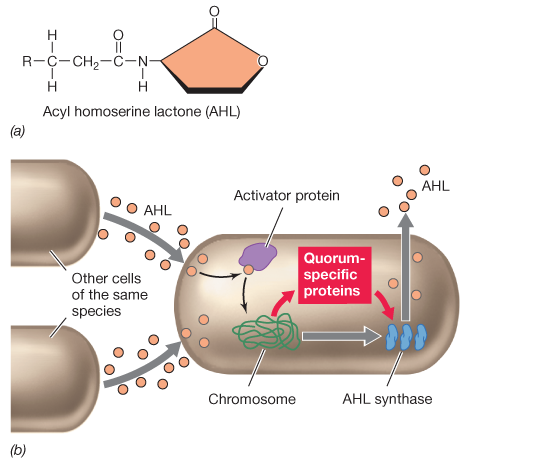
1) Many non-luminous Gram-negative bacteria have been found to have genes homologous to the Aliivibrio fischeri luxR and luxI genes and to produce acyl-HSLs chemically similar or identical to the A. fischeri autoinducer.
2) The autoinduction (quorum sensing) systems in non-luminous bacteria, several of which are pathogens, control many sets of genes involved in host association and synthesis of virulence determinants.
3) An example is Pseudomonas aeruginosa, an opportunistic pathogen of humans that is found in burn wounds of people with cystic fibrosis. Quorum sensing controls te expression of many virulence determinants in P. aeruginosa.
-
Lecture 1014
-
Lecture 1116
-
Lecture 1221
-
Lecture 1314
-
Lecture 1415
-
Lecture 1511
-
Lecture 1623
-
Lecture 1720
-
Lecture 1812
-
Lecture 1913
-
Lecture 2013
-
Lecture 2117
-
Lecture 2212
-
Lecture 2316
-
Lecture 2415
-
Lecture 2512
-
Lecture 2613
-
Lecture 2718
-
Lecture 2821
-
Lecture 2918
-
Lecture 3014
-
Lecture 3116
-
Lecture 3215
-
Lecture 3316
-
Lecture 3417
-
Lecture 356



