1) How does transformation operate?
2) It it natural, artificial, or both?
3) What is a plasmid?
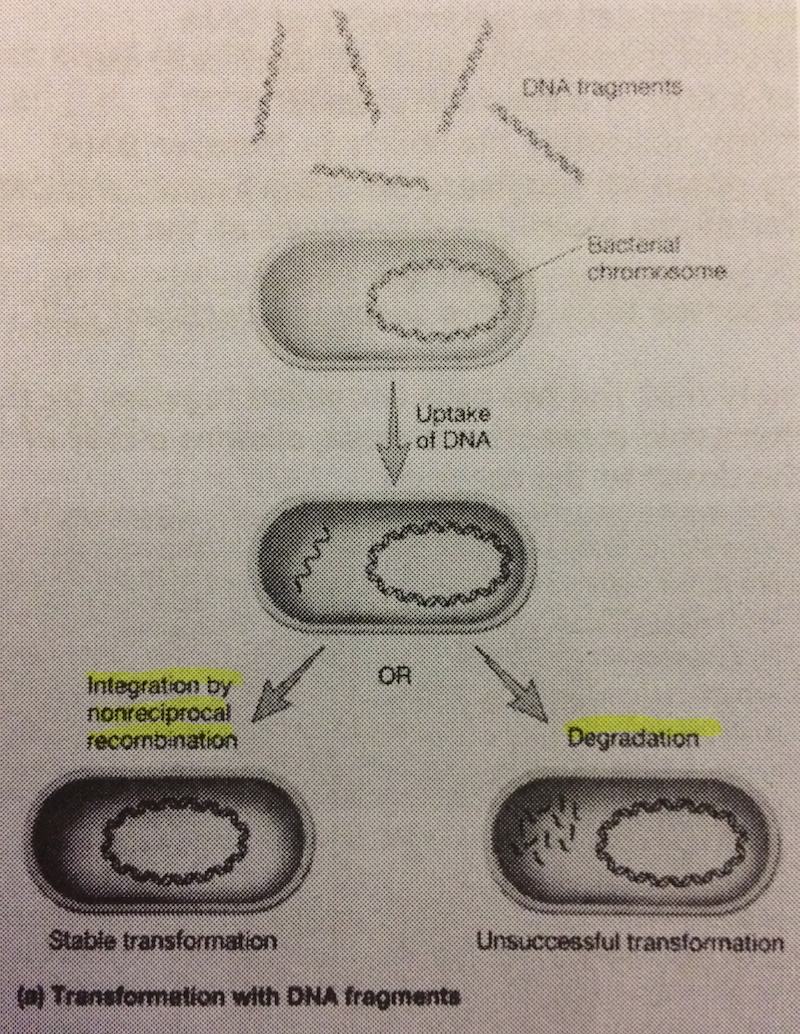
1) Transformation occurs when naked DNA enters the cell directly.
- If the incoming DNA is a plasmid, it can remain separate from the recipient chromosome (does not recombine)
- If the incoming DNA is a linear fragment of DNA, then it must recombine into the chromosome to survive.
2) It is a natural process in certain bacteria at certain stages of growth. Can be artificially forced by treatment of cells with high levels of divalent ions and heat-shock.
3) ds DNA, covalently closed circle of DNA that replicates autonomously in the cell; contains a few to several various genes, and sometimes those genes confer on a cell new capabilities; examples - genes for antibiotic resistance, genes for catabolic enzymes.
What is transduction and how does it work?
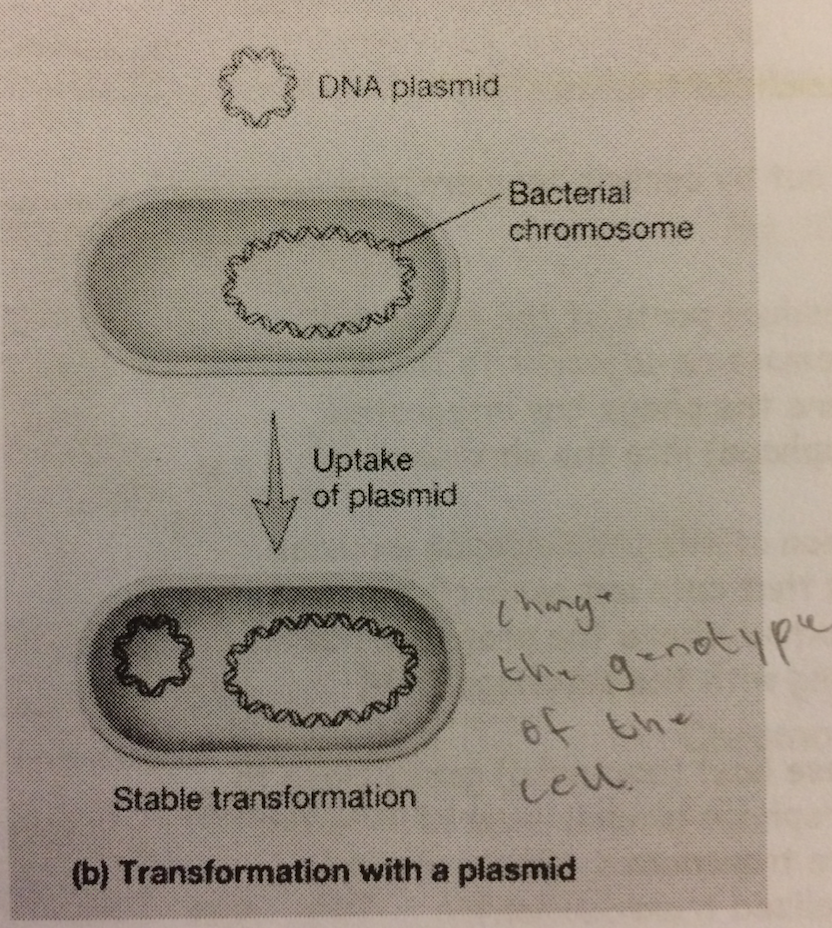
- Mediated by phages, transfer of fragment of the chromosome.
- Certain viruses, during their development in a bacterial cell, make mistakes in packaging their DNA.
- A piece of the bacterial chromosome is packaged into the phage particle instead of phage DNA.
- These “defective” phages (defective because they are unable to cause lysis of the next bacterial cell they infect) are called transducing particles; the protein capsid of the phage still functions in attachment of the phage to a cell and in injecting the DNA into the cell, but the DNA injected is partly or completely bacterial DNA.
1) What is generalized transduction?
2) What kind of phage carries this process out?
1) Can “transduce” any part of the bacterial chromosome (donor) to a recipient cell; as the phage is cutting up the host DNA, some of that host DNA gets packaged in to a few of the phage particle.
- No transduction without recombination.
2) Carried out by lytic phages.
1) What phages carry out specialized transduction?
2) Describe this process.
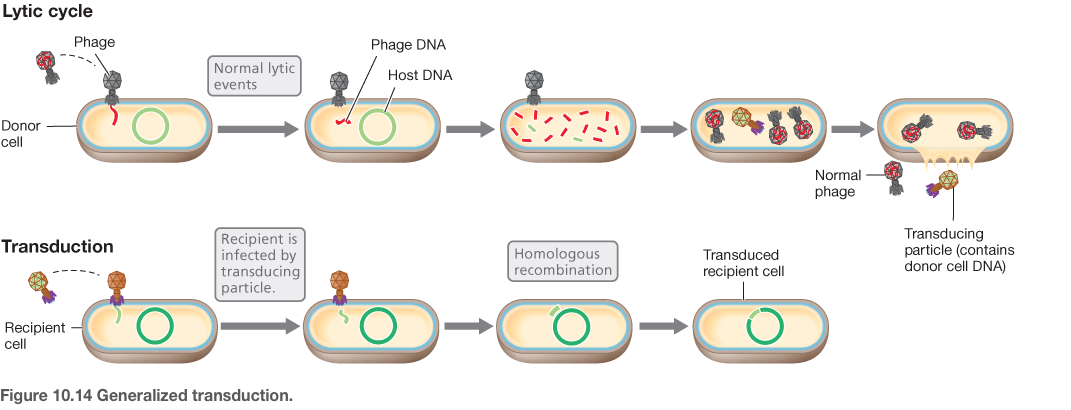
1) Temperate phages
2) Can transduce parts of the bacterial chromosome adjacent to the site where the phage has integrated (prophage) into the chromosome.
- At excision of the prophage, an excision error occurs that cuts out some of the host cell DNA, next to where the prophage has inserted, along with the prophage DNA
- Only those host (bacterial) genes close to where the prophage genome inserts in to the host DNA are transduced; this is why it is called “specialized transduction”.
What is conjugation? How does it occur? What is an F plasmid?
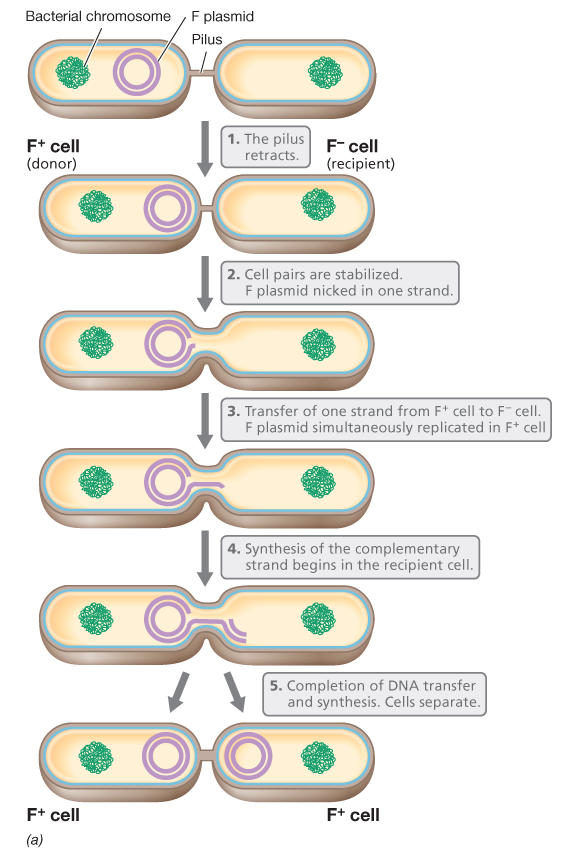
- Direct cell to cell transfer of DNA through formation of a connective pilus between cells and transfer of a copy of a special F plasmid (F for fertility, indicating the ability to transfer DNA).
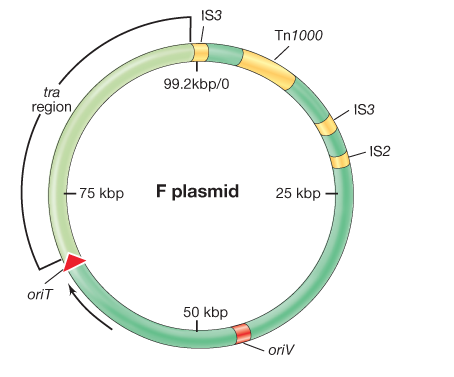
- F plasmids carry genes for enzymes involved in plasmid replication, transfer of the plasmid, and synthesis of the pilus, called F pilus.
- The F pilus serves to connect a donor to a recipient cell.
- Current thinking is that the two cells are pulled together by the contraction of the pilus, and then a cytoplasmic connection is made, allowing a copy of the F plasmid to be transferred from the donor to the recipient.
1) What three forms can an F plasmid exist in (bacterial cell)?
2) Explain what they are.
- An F- cell can recieve a copy of the F plasmid from an F plus cell, making the F- cell now F+.
1) F+ donor cell
2) F’ donor cell, like F+, but with a few genes from the bacterial chromosome. - In F+ and F’ donors, the F plasmid replicates autonomously (1-3 copies per cell) from the chromosome.
- These donor cells can transfer a copy of their F plasmid independently of the chromosome.
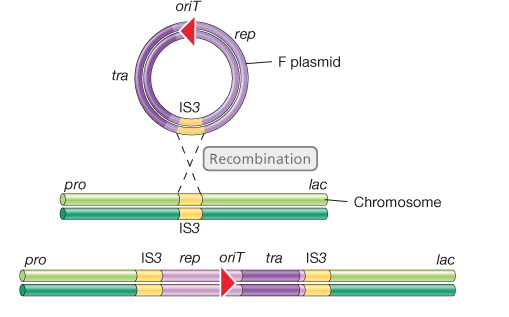
3) Integrated into the bacterial chromosome. called Hfr cell (high frequency of recombination).
How does a cell become an Hfr cell?
- In Hfr cells, the F plasmid is integrated at specific sites on the bacterial chromosome; there are different integration sites around the chromosome, so an F plasmid can integrate at different locations.
- F’ donor cells arise from Hfr cell in which excision of the integrated F plasmid DNA, in rare cases, is imprecise and a few bacterial genes get included in the F plasmid. The excised DNA circularizes, as a plasmid, to form the F’ plasmid.
1) What happens during conjugative transfer?
2) What can this transfer be followed by?
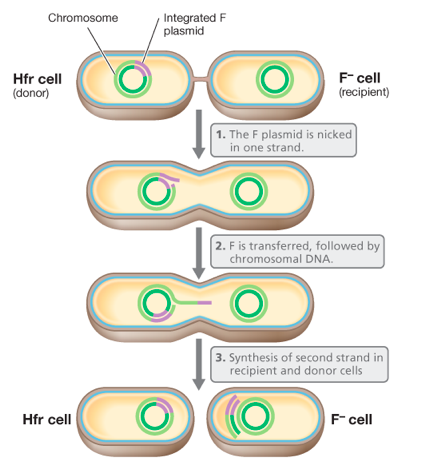
1) In conjugative transfer of the F plasmid from Hfr cells (donor) to F- cells (recipient), some of the bacterial chromosome can be transferred.
2) This transfer can be followed by homologous recombination, such that portions of the recipient cell chromosome are replaced by the donor chromosomal DNA.
1) Is it rare for very large portions of chromosome to be transferred?
2) What can we do to determine relative positions of genes in a bacterial chromosome?
1) Yes it is rare, because cells do not stay in conjugative contact long enough.
2) By using different Hfr strains, “time and order of entry” with interrupted mating experiments was used to determine relative positions of genes on the bacterial chromosome, i.e., to map E. coli chromosome.
- This is how gene order and genomic organization were worked out before whole-genome, shot-gun sequencing methods were developed.
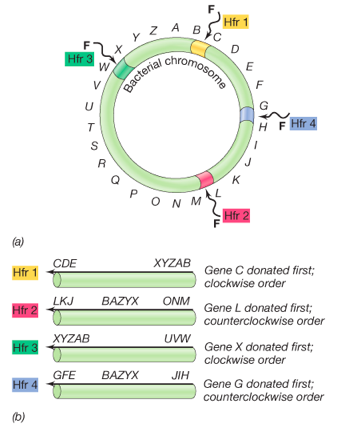
What is the process of conjugation is Hfr cells?
- In Hfr cells, the F plasmid is integrated into the chromosome.
- From there, it can initiate a transfer of the plasmid just as if the F plasmid were not integrated, but when it does so, it can carry along into the recipient cell some of the bacterial chromosomal genes.
- These genes can undergo non-reciprocal homologous recombination.
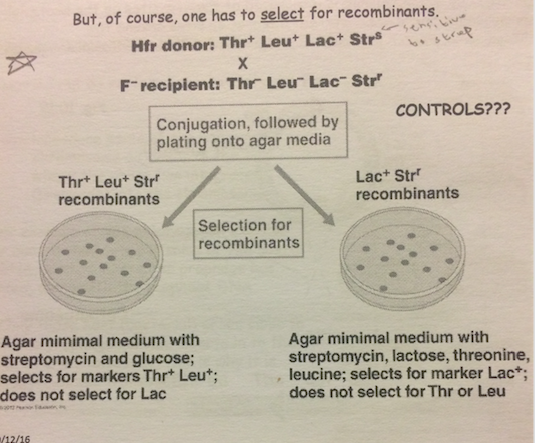
How can we select for recombinants?
-
Lecture 1014
-
Lecture 1116
-
Lecture 1221
-
Lecture 1314
-
Lecture 1415
-
Lecture 1511
-
Lecture 1623
-
Lecture 1720
-
Lecture 1812
-
Lecture 1913
-
Lecture 2013
-
Lecture 2117
-
Lecture 2212
-
Lecture 2316
-
Lecture 2415
-
Lecture 2512
-
Lecture 2613
-
Lecture 2718
-
Lecture 2821
-
Lecture 2918
-
Lecture 3014
-
Lecture 3116
-
Lecture 3215
-
Lecture 3316
-
Lecture 3417
-
Lecture 356



