What percent of your total energy does your visual system require?
15%
What happens when your eyes function in unnatural spectrums of light?
It stresses your mitochondria, slows down your energy production, increases free radical production, and can damage mitochondria.
What is Photobiomodulation?
Photobiomodulation is the utilization of non-ionizing photonic energy to trigger photochemical changes within cellular structures that are receptive to photons, particularly in mitochondria. At the cellular level, visible red and near-infrared light energies are absorbed by mitochondria, which perform the function of producing cellular energy (ATP) via cytochrome C oxidase. Photobiomodulation has been used in many kinds of situations and health problems to promote healing of the target tissue(s).
What is Photodynamic therapy?
The use of specific wavelength light to stimulate an exogenously supplied photosensitizer elicits the formation of toxic levels of reactive oxygen intermediates. Resulting in the death of the pathogen.
What is the Direct Light Method?
Light directly interacts with endogenous photosensitizers of the target microbe. Resulting in the death of the pathogen.
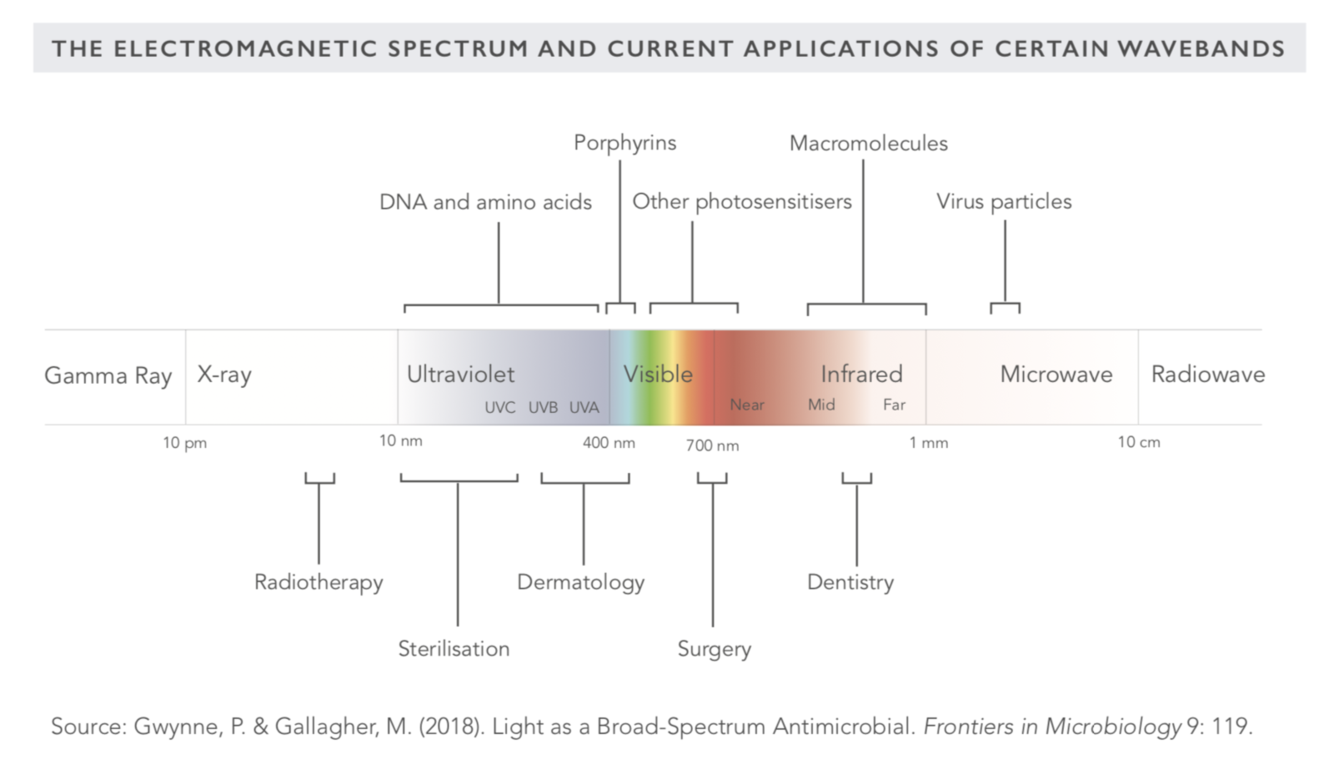
Therapeutic potential of blue light (400–450 nm):
- The bactericidal effect of blue light has been shown in many pathogenic species.
- Animal models have demonstrated blue light killing of infected cells a few hours after inoculation.
- Little research has been translated into human clinical trials to date
Therapeutic potential of Red Light (630–670 nm) and Near-Infrared Light (780–940 nm):
- The safest and most effective and the easiest available.
- Red light has been shown to reduce cell numbers in some pathogens. This is possibly due to porphyrins, which absorb most strongly in the blue light region but also absorb other visible wavelengths.
- Irradiation with red and infrared light at doses ranging from 1 to 120 J/cm2 has a significant effect on destroying Gram-positive (S. aureus) and Gram-negative (P. aeruginosa and E. coli) bacteria
- Photobiomodulation (PBM) has been shown to help modulate chronic stress; this means that with the use of light therapy, the whole system can achieve balance and homeostasis faster
- Intranasal low-intensity laser therapy (ILILT) has a systemic effect on the body (red & infrared light). ILILT can enhance NAD+/NADH and SIRT1 activity until the system reaches function-specific homeostasis.
- ILIT may be used in the treatment and prevention of upper respiratory tract infections
- In general, red light and infrared light therapy can be used to reduce inflammation in the body and in the lungs
Ultraviolet light-emitting diodes (UV-LEDs) for disinfection:
- Ultraviolet (UV) disinfection is an effective technology for the inactivation of pathogens in water.
- This technique is also used in hand dryers to provide simultaneous disinfection.
- UV-LEDs improve microbial inactivation effectiveness by applying LED special features such as multiple wavelengths and pulsed illumination.
Elecrtomagnetic Spectrum
Best source of Vitamin D?
The biologically best source of vitamin D is the sun.
When is the best time for sunlight?
The best time for sunlight is in the morning, which helps to balance circadian rhythms and also has a beneficial effect on the immune system.



