why do we need micronutrients? / role of micronutrients?
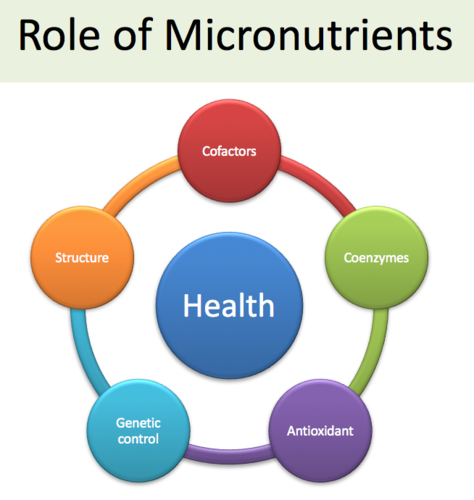
micronutrients act as:
- *1. co-factors:** compound required for a proteins biologal activity
- *2.** co-enzymes: help enzymes catalyse a reaction
- *3. antioxidants:** inhibits the oxidation of other molecules. counteracts free radicals
- *4. control of gene expression**
- *5. structure:** e.g phosopholipids causes complexes with Mg & Ca
what are the different types of sources that free radicals can be derived from? (2)
what can they have an adverse reaction on?
endogenous sources: mito, peroxisomes, ER
exogenous sources: pollution, alcohol, tobacco, paracetemol
adverse reactions on: nucleic acids, lipids & proteins :(
how does an antioxidant work?
e.g.?s (5)
antioxidant:
- free radicals cause chain reaction of oxidation causing damage
- antioxidants: neutralise free radicals by ‘lending; an electron to stabilise damaged atoms
examples:
vitamin A, C, E & copper, zinc & selenium
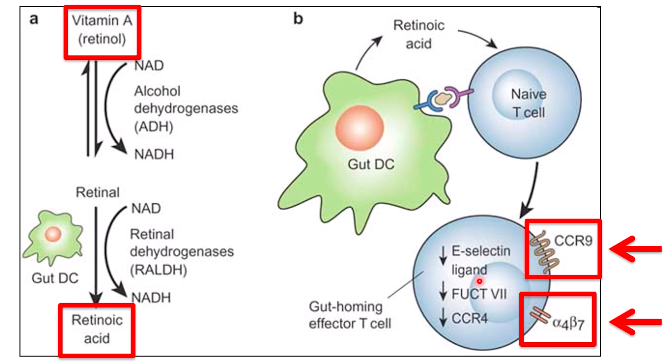
which micronutrient is important in imprinting home to the gut mucosa from peyers patches?
how does it occur (2)
vitmain A: precursor for retinoic acid !
- gut dendritic cells use retinoic acid to inform the niave T cells
- causes niave T cells to change transcription to express CCR9 & a4B& to do gut honing
which population are micronutrients most important in?
WHY? (3)
most important in paediatric population: (body growth & development; energy supply; healthy infants have 3x energy per kg body weights than adults)
which micronutrient helps to improve childrens learning ability and cognitive development? WHY? (1)
iron helps to improve childrens learning ability and cognitive development: Fe helps Hb to carry oxygen to neurons in brain
if someone is malnourished, what is going to be impaired? (7)
- impaired wound healing
- reduced fertlitliy
- impaired immune response - predisposes to infection
- reduced muscle strength
- depression
- increased risk to post-op complications
- inactivity - pressure sorees
what are vegans likely to be deficient in? (2)
- *vitamin D: (**oily fish, dairy products)
- *vitamin B12 (**meat and dairy food)
what are fat-soluble vitamins (4?)
which are water-soluble vitamins? (2)
which can be stored / which normally excreted? what does this mean as a consequence?
fat soluble: A D E K -> can be stored in liver (but can be toxic in XS)
- absorbed with fats (readily absorb in micelles & chylomicrons)
water soluble: B & C -> normally excreted
why is commensal bacteria gut overgrowth clinically significant regarding vitamins?
commensal bacteria: providers AND consumers of B vitamins** & **vitamin K.
overgrowth: likely to have B12 deficiency & high B9
vitamin deficiency in deveoloped countries is likely from two overarching categories. what are they?
**decreased intake
decreased absorption**
what are main causes of vitamin deficieny in developed countries are
- *decreased intake:**
- alcohol:
- vegans:
- elderly w. poor diet:
- anorexia:
- *decreased absorption:**
- malabsorbative state e.g. coeliac disease:
- ileal diease:
- liver & biliary tract disease:
- intestinal bacterial overgrowth:
- oral antibiotics:
what are they likely to be deficient in?
- *decreased intake:**
- alcohol: B vitamins
- vegans: Vit D & Vit B12
- elderly w. poor diet: Vit D & folate
- anorexia: folate
- *decreased absorption:**
- malabsorbative state e.g. coeliac disease: folate (B9)
- ileal diease: only B12
- liver & biliary tract disease: fat soluble vitamins (bc bile helps absorb fat !)
- intestinal bacterial overgrowth: b12
- oral antibiotics: vit K
what are the clinical features of deficiences in
vitamin A
vitamin D
vitamin E
vitamin K
(fat soluble vitamins)
vitamin A: eyes -> xeropthalmia (Xerophthalmia refers to the spectrum of ocular disease caused by severe Vitamin A deficiency (VAD))
vitamin D: rickets (in adults = osteomalacia)
vitamin E: peripheral neuropathy
vitamin K: coagulopathy
what are the clinical features of deficiences in
- vit c
- B1
- B2
- B3
- B4
- B6
- B12
- folate?
- vit c: scurvy
- B1: beri beri
- B2: angular stomatitis
- B3: pellagra
- B4: anemia
- B6: anemia
- B12: anemia (but also lots of neurological disorders)
- folate: anemia
trace element deficiencies?
calcium?
phosphorous?
iron?
selenium
zinc
copper
calcium: bone problems ! osteoporosis, muscle spasms
phosphorous: bone pain, pseudofractures
iron: anemia, muscle problems
selenium: cardiomyopathy
zinc: growth retardation, congenital deformation
copper: growth retardation
iron metabolism:
- absorbed where in GI?
- function in the body? (2)
- stored where (2) and as what (1)?
iron metabolism:
- absorbed where in GI: duodenum (and proximal jejunum)
- function in the body: oxygen transport with Hb (1) myoglobin function in skeletal muscle
- stored: liver (1) & macrophages (1) as ferratin (1)
deficiency in iron can cause? (4)
excess in iron can cause? (5)
- *Fe deficiency:**
- microcytic anaemia (smaller than normal size)
- lethargy & fatigue
- cognitive impairment in children
- exacerbation of inflam diseases
- *Fe XS: haemochromatosis**
- lethargy & fatigue
- ab and joint pain
- reduced libido
- diabetes
- cirrhosis
- cardiomyopathy
what is vitamin D deficiency in a) adults called? b) children
how can we actually manufacture vit. D?
- * what is biological activty of Vit D? * (3)
- vitamin D deficiency in a) adults: osteomalacia b) children: rickets
- vitamind D can be made by SUNLIGHT
- biological activity:
i) increases gut Ca2+ absorption
ii) increases bone calcification
iii) increases reabsorbtion of calcium
(what is the difference between exposure time needed to generate vit D during summer bewteen caucasian & non-causcaisian?)
caucasians: 20/30 mins of sunlight x 2/3 week in summer
non-cau: requires 2-10 X this
(also: october -> march insufficient UVB to make Vit D AND sunscreens block dermal Vit D synthesis)
what are rickets and osteomalacia characterised by?
children- rickets:
- occurs prior to epiphyseal fusion (It is the part of a long bone where new bone growth takes place)
- growth retardation
- *- expansion of growth plate**
adults: osteomalacia:
- **reduced bone strength
- increased fracture
- bending of bones
- bone pain
- waddling gate
- looser zones of bones**
which lifestyle factors can also contribute to vit D deficiency? (6)
what are disease factors that can contribute to vit D (3)
- *lifestyle factors:**
- obesity
- smoking
- alcohol
- exercise (too much)
- exclusive breast feeding
- lack of sun
- *disease factors:**
- reduced skin synthesis
- drug-related interference
- reduced bioavailbility (from obesity)
B1 (aka thiamine)
- absorbed where?
* - function? (3) * - deficency leads to which diseases? (3)
B1
absorbed: jejuneum
function:
- glycolysis & krebs cycle - if not present **causes build up of lactate !
- BCAA (** branch chain a.a. met)
- pentose phosphate cycle
deficiency leads to:
- *- Beri-Beri
- Wernicke’s Enceophalopathy
- Korsakoffs Physchosis**
what are the 3 clinical presentations of beri beri?
**Beri-beri - shutting down krebs and ox-phosph.
i) wet:**
cardiac: enlarged heart, tachycardia, high output, peripheral oedema (wet !); neurological: peripheral neuritis
ii) dry: peripheral neuropathy (motor & sensory)
iii) shoshin: cardiac failure & lactic acidosis
what are consequences of Wernicke’s & korsakoffs syndrome by?
caused by a lack of WHAT?
**B1 deficiency !
Wernickes’ encephalopathy:**
- rapid & repititive eye movement (horizontal nystagmus)
- opthalmoplegia (paralysis of eye)
- cerebellar ataxia (inflamede cerebellum)
- *Korsakoff syndrome = chornic neurological sequel of wernicke’s enceph.**
- mentail impairment
- irreversible !!

-
Anatomy of Anterior Abdomen Wall31
-
Digestion and Absorbtion24
-
Glycogen Synthesis and Mobilisation23
-
Gut Health24
-
Histology of Gut27
-
Imaging the gut14
-
MET: Anatomy Practical 145
-
GI motility22
-
Gut as an Immune Organ21
-
Learn this pls - Antibodies10
-
Anatomy of the Mouth and Oesophagus25
-
Gluconeogenesis26
-
:)56
-
Big boy14
-
Body Fluid Compartments and Water Balance: MET24
-
Gastric Secretions29
-
The Krebs Cycle and Oxidative Metabolism26
-
Insulin: Mechanisms & Action 119
-
Fat Metabolism INCOMPLETE NOTES16
-
Extremes of Metabolism23
-
Lipoprotein Handling22
-
The Peritoneum31
-
Anatomy Session 2: Oesophagus to Anys67
-
Micronutrients32
-
Glycolysis3
-
:))54
-
Blood Supply to Gut26
-
Nitrogen Metabolism18
-
Introduction to Endocrinology23
-
Metabolic Insights into Genetic Diseases14
-
Big Boys18
-
:P55
-
:M49
-
MESS Anatomy: MET46
-
:L53



