Lesson 2.1 - Newton’s First Law of Motion
What is force? Types?
Force: Any kind of push or pull on something
- Contact Forces: force is exerted when one object comes into contact with another
- Force of gravity: objects falls
- Force is required when accelerating from zero
- Force is required when changing direction
Lesson 2.1 - Newton’s First Law of Motion
How does one measure the magnitude (or strength) of a force?
Spiral Scale.
- Normally used to find the weight of an object
Weight: for force of gravity acting on an object
Lesson 2.1 - Newton’s First Law of Motion
How does the direction of the force affect it?
Force is a vector
- Represented by an arrow
- Arrow is the direction of the push or pull
Lesson 2.1 - Newton’s First Law of Motion
What is Newton’s First Law of Motion?
Every object continues in its state of rest, or of uniform velocity in a straight line, as long as no net force acts on it
- consistent with Galileo’s observations
- The tendency of an object to maintain its state of rest or uniformity = INERTIA (called law of Inertia)
Lesson 2.1 - Newton’s First Law of Motion
What are the Inertial Reference Frames?
- New’s First Law does not hold in every reference frame
- Does not hold in an accelerating frame of reference
- Physics is easier in frames where the Law does hold
For most purposes, we usually make the approximation that a reference frame fixed on the Earth is an inertial frame
- Any reference frame that moves with constant velocity relative to an inertial frame is called an inertial reference frame
- Reference frame not hold = noninertial reference frame
Lesson 2.2 - Newton’s Second Law
What is mass? (According to Newton)
Mass = “quantity of matter”
- Measure of inertia in an object
- More mass = greater the force needed to give it a particular acceleration
- SI = kilogram (kg)
Lesson 2.2 - Newton’s Second Law
What is the difference between mass and weight?
- Mass: property of an object itself (Quantity of matter)
- Weight: a force (gravity pulling on an object)
Lesson 2.2 - Newton’s Second Law
What happens when a net force is exerted on an object?
- Net force exerted on an object increased its velocity (or reduce it if its in the opposite direction as the motion)
- If the net force acts sideways on a moving object, the direction of velocity changes
Generally speaking, the net force causes acceleration
Lesson 2.2 - Newton’s Second Law
What is the proportionality between net force and acceleration? How is this influenced by mass?
- Acceleration of an object is directly proportional to the next applied force
- Acceleration also dependent on mass: the greater the mass, the less acceleration for the same net force
The acceleration of an object is directly proportional to the net force acting on it, and is inversely proportional to the mass of the object.
The direction of the acceleration is the direction of the next force acting on the object
Lesson 2.2 - Newton’s Second Law
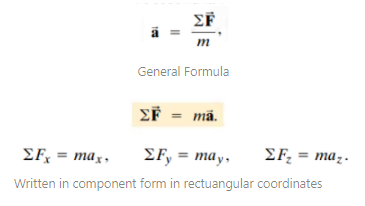
What is Newton’s Second Law of Motion?
- a: acceleration
- m: mass
- ΣF: vector sum of all forces on the object (net force)
- SI Units: newton (N)
- Only valid in inertial reference frames
Lesson 2.2 - Newton’s Second Law
What units are used in Newton’s Second Law
- SI units: newton (N)
- cgs units: mass in grams (g) and force is dyne
Dyne: net force needed to impart an acceleration of 1 cm/s2 to a mass of one gram
Thus,
(1) 1 dyne = 1 g*cm/s2
(2) 1 dyne = 10-5 N
Lesson 2.3 - Newton’s Thrid Law
What is Newton’s Third Law of Motion?
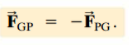
Whenever one object exerts a force on a second object, the second object exerts an equal force in the opposite direction on the first
“To every action there is an equal and opposite reaction”
- All materials, no matter how hard, are elastic to some degree
- A force influences the motion of an object only when its applied on that object
- A force exerted by an object does not influence that same object - only influences the object on which it is exerted
Ex: force exerted on the Person by the Ground
Lesson 2.3 - Newton’s Thrid Law
What is gravitational force? (g) How does it affect Newton’s first law?
- Objects dropped near the earth with the same acceleration (if air resistance is negligible)
- If gravitation force = acceleration, then:
FG = mg
- Force down to the center of the earth
- Weight: the magnitude of the force of gravity on an object
- SI units:
g = 9.80 m/s2 = 9.80 N/kg
Lesson 2.3 - Newton’s Thrid Law
What is contact force and normal force?
Contact Force:
- When two objects are in contact
Normal Force:
- Contact force acts perpendicular to the common surface(FN)
Lesson 2.4 – Newton’s Laws and Vectors
What is the net force of an object?
Newton’s second law states that the acceleration is proportional to the net force of an object
- NET FORCE: vector sum of all the forces acting on the object
Lesson 2.4 – Newton’s Laws and Vectors
What are free-body (force) diagrams?
* Choose one object and draw an arrow to represent the force acting on it
- Include every force acting on the object
- Not include forces acting on other objects
Add different diagrams for different objects
Forces like gravity and contact forces (one object pushing or pulling another, normal force, friction)
Lesson 2.4 – Newton’s Laws and Vectors
What are the steps to create a Free-Body Diagram for problems requiring the use of Newton’s Laws?
- Draw a sketch of the situation
- Consider only one object (at a time) and draw its corresponding free-body diagram
* (a) All the forces acting on it
(b) Include unknown forces
(c) Not include forces acting on other objects***- Draw the arrow for each force vector with reasonably accurate direction and magnitude
- Lable each force
- Only forces acting on a given object can be included in ΣF = ma for object
- Newton’s second law involves vectors, so it’s usually important to resolve vectors into components. Choose x and y axis
- For each object, apply Newton’s second law to the x and y component separately
- Solve the equation(s) for the unknown(s)
Lesson 2.4 – Newton’s Laws and Vectors
What is tension in a flexible cord?
- Flexible cord pulls on an object, the cord is said to be under tension
Force exerts on the object is the tension FT - Has negligible mass = force exerted at one end is transmitted undiminished to each adjacent piece of cord along the entire
- ΣF = ma = 0
- If the cord’s mass is zero (or negligible) no matter what a is
- Force pulling on the cord at two ends must add up to zero:
FT and -FT
Lesson 2.5 – Newton’s Laws with Friction, Inclines
What is friction?
- Exists between two solid surfaces (even the smoothest looking surfaces is rough on a microscopic scale)
- Microscopic bums impede the motion
- Rolling Fiction: when an object rolls over the surface
- Kinetic Friction: sliding friction
Lesson 2.5 – Newton’s Laws with Friction, Inclines
How does (sliding) kinetic friction work?
- Object slides across a surface, forces of kinetic friction acts opposite to the direction of the objects’ velocity
- The magnitude of friction: depends on the two surfaces
The friction force is approximately proportional to the normal force between two surfaces (which is the force that either object exerts on the other and is perpendicular to their common surface and contact)
Proportionality between the magnitudes of the friction force [Ffr] and the normal force [FN] as an equation by inserting a constant of proportionality µk:
Ffr = µkFN
- Not a fundamental law, its experimental relationship between the magnitude and force of friction
- Ffr: acts parallel to the two surfaces
- FN: acts perpendicular to the surfaces
- Not a vector equation
- µk: coefficient of kinetic friction (roughly independent of sliding speed as well as the area in contact)
Lesson 2.5 – Newton’s Laws with Friction, Inclines
What is static friction?
Force parallel to the two surfaces that can arise even when there is no sliding.
- Ex: The desk is resting on the floor and there is no horizontal force exerted on the dest, so it doesn’t move. You exert a horizontal force, bt the dest isn’t movies, so there is another force keeping it in place (net force is zero at rest).
If you push with greater force without moving it, then the static friction increased
Push hard enough, kinetic friction takes over = exceeded the maximum force of static friction
Maximum force of static friction:
(Ffr)max = µsFN
- µs: coefficient of static friction
- Since the static friction can vary from zero to this maximum value:
Ffr ≥ µsFN
Lesson 2.5 – Newton’s Laws with Friction, Inclines
How can friction be a hindrance and how can it be reduced?
- Slows down moving objects and causes heating and binding of moving parts in machinery
- More effective in reducing friction: oil or other gas between them
Lesson 2.5 – Newton’s Laws with Friction, Inclines
How can friction be useful?
Walking depends on the friction between the soles of our shoes and the ground (static friction)
Lesson 2.5 – Newton’s Laws with Friction, Inclines
What is an incline and how does it affect physics?
The object slides down an incline, such as a hill or ramp
- Gravity is an accelerating force - yet the acceleration is not vertical
- Change the axis, so the x-axis points along the incline and the y-axis is perpendicular



