Lesson 7.1 Angular Quantities, Constant Angular Acceleration, and Rolling
What is translational motion?
Translational Motion: object’s center of mass plus rotational motion about the center
Lesson 7.1 Angular Quantities, Constant Angular Acceleration, and Rolling
What is purely rotational motion?
Purely Rotational Motion:
All the points in the object move in a circle
- The Center of the circles all lie on one line called the axis of rotation
- The Axis of rotation is perpendicular to the center
All the points in an object rotate about a fixed axis moves in a circle
Straight-line drawn from the axis to any point in the object sweeps out the same angle in the same time interval.
Lesson 7.1 Angular Quantities, Constant Angular Acceleration, and Rolling
What is the angular position?
Angular Position: How far it rotates.
Specify the Θ of some particular line in the object (with respect to a reference line such as the x-axis)
A point in the object (P) moves through an angle Θ when it travels the distance (l) measured along the circumference of its circular path.
Use radians: Θ = l/r, where r = radius and l = arc length subtended by the angle
- if l = r then Θ = 1 radians
- Dimensionless, since it is a ratio of two lengths
Lesson 7.1 Angular Quantities, Constant Angular Acceleration, and Rolling
How do radians and degrees relate to each other?
- 1 revolution = 360° = 2π
- Radians to Degrees:
x° = rad/π * 180°
- Degrees to Radians:
rad = π/180° * x°
Lesson 7.1 Angular Quantities, Constant Angular Acceleration, and Rolling
What is angular displacement?
ΔΘ = Θ2 - Θ1
Lesson 7.1 Angular Quantities, Constant Angular Acceleration, and Rolling
What is the angular velocity (ω)?
Average Angular Velocity:
ω = ΔΘ/Δt
Instantaneous Angular Velocity:
ω = lim(Δt - 0) ΔΘ/Δt
- Radians per second (rad/s)
- Not all points in a rigid object rotate with the same angular velocity
- Angular velocity is always perpendicular to the plane of rotation
Lesson 7.1 Angular Quantities, Constant Angular Acceleration, and Rolling
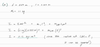
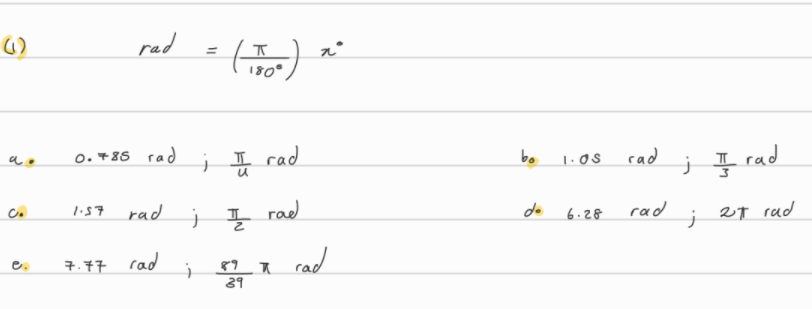
1. (I) Express the following angles in radians: (a) 45.0°, (b) 60.0°, (c) 90.0°, (d) 360.0°, and (e) 445°. Give as numerical values and as fractions of π.
Lesson 7.1 Angular Quantities, Constant Angular Acceleration, and Rolling
What is the angular acceleration (α)?
Average Angular Acceleration:
α = Δω/Δt
Instantaneous Angular Acceleration:
α = lim(Δt - 0) Δω/Δt
- Acceleration same for all points
- Radians per second squared (rad/s2)
Lesson 7.1 Angular Quantities, Constant Angular Acceleration, and Rolling
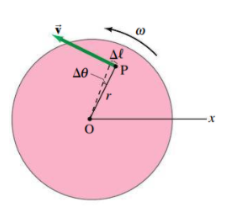
What is linear velocity?
Each point has a linear velocity and acceleration
Can relate the linear quantities to angular quantities for a rigid object rotating about a fixed axis
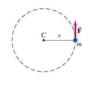
- If an object rotates with angular velocity, any point will have a linear velocity
- Direction of linear velocity is tangent to the circular path
- Magnitude of linear velocity:
v = Δl/Δt = r ΔΘ/Δt = rω
- If the angular velocity of a rotating object changes, the object as a whole has an angular acceleration
Lesson 7.1 Angular Quantities, Constant Angular Acceleration, and Rolling
What is linear acceleration?
If the angular velocity of a rotating object changes, the object as a whole has an angular acceleration
Linear acceleration is tangent to the point’s circular path
Lesson 7.1 Angular Quantities, Constant Angular Acceleration, and Rolling
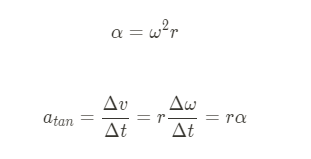
What is total linear acceleration?
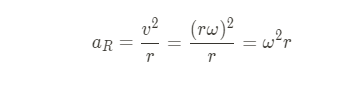
Total Linear Acceleration of a point is the vector sum of two components:a = atan + aR
- aR is the radial component - the “centripetal” acceleration and direction is towards the center of the circular path
Lesson 7.1 Angular Quantities, Constant Angular Acceleration, and Rolling
What is the frequency of rotation?
- Number of complete revolutions (rev) per second
- One revolution = 2π radians
- 1 Hz = 1 rev / s
f = ω / 2π
Lesson 7.1 Angular Quantities, Constant Angular Acceleration, and Rolling
What is rolling without slipping?
Rolling without slipping depends on static friction between object and ground
- Friction is static because the object’s point of constant is at rest at each moment
- Depends on both translational and rotational movement
v = rω
(Only is there is no slipping)
Lesson 7.1 Angular Quantities, Constant Angular Acceleration, and Rolling
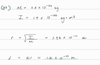
3. (I) A laser beam is directed at the Moon, 380,000 km from Earth. The beam diverges at an angle (Fig. 8–40) of 1.4 × 10⁻⁵ rad. What diameter spot will it make on the Moon?

Lesson 7.1 Angular Quantities, Constant Angular Acceleration, and Rolling
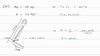
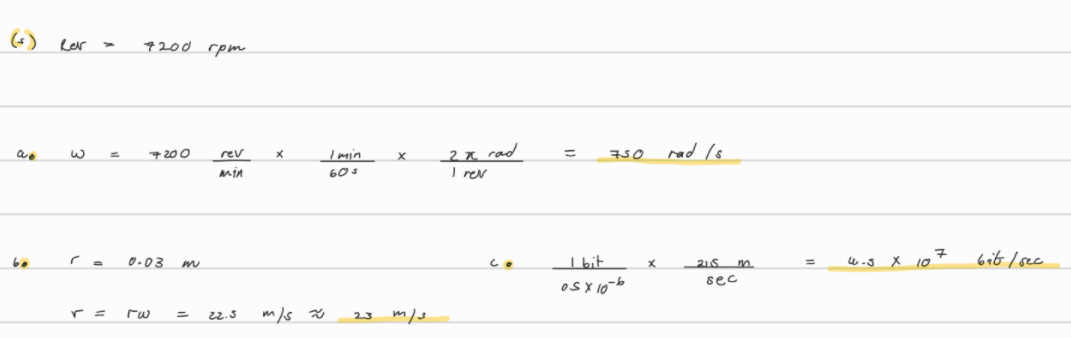
5. (II) The platter of the hard drive of a computer rotates at 7200 rpm (rpm = revolutions per minute = rev/min). (a) What is the angular velocity (rad/s) of the platter? (b) If the reading head of the drive is located 3.00 cm from the rotation axis, what is the linear speed of the point on the platter just below it? (c) If a single bit requires 0.50 m of length along the direction of motion, how many bits per second can the writing head write when it is 3.00 cm from the axis?
Lesson 7.1 Angular Quantities, Constant Angular Acceleration, and Rolling
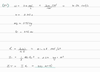
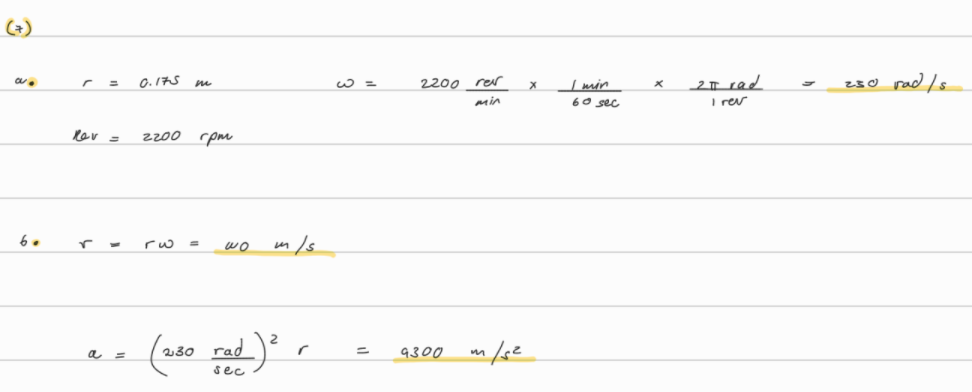
7. (II) (a) A grinding wheel 0.35 m in diameter rotates at 2200 rpm. Calculate its angular velocity in rad/s. (b) What are the linear speed and acceleration of a point on the edge of the grinding wheel?
Lesson 7.1 Angular Quantities, Constant Angular Acceleration, and Rolling
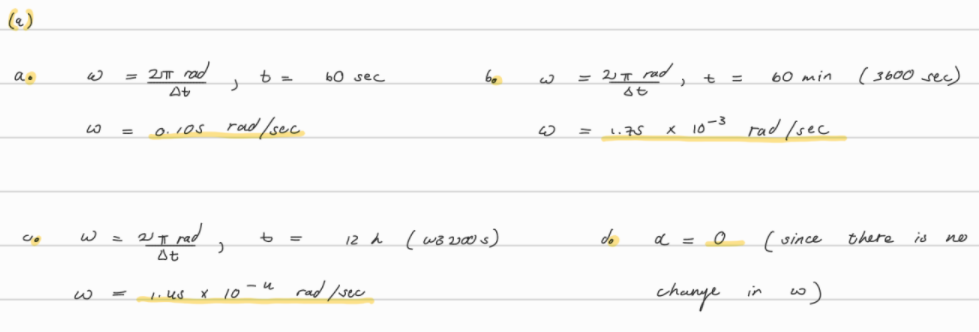
9. (II) Calculate the angular velocity (a) of a clock’s second hand, (b) its minute hand, and (c) its hour hand. State in rad/s. (d) What is the angular acceleration in each case?
Lesson 7.1 Angular Quantities, Constant Angular Acceleration, and Rolling
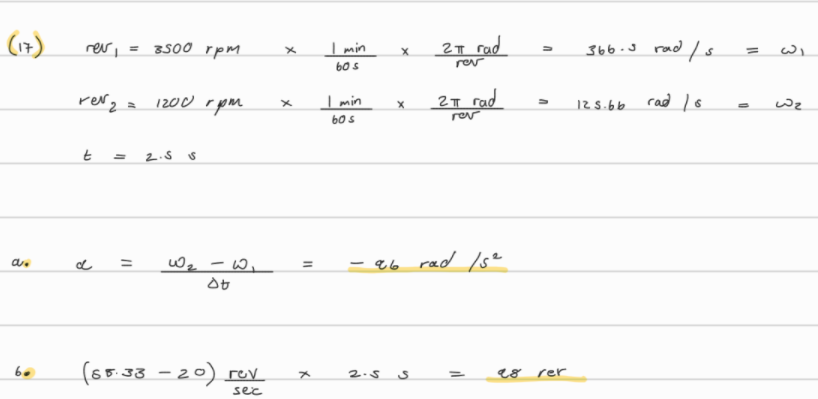
17. (I) An automobile engine slows down from 3500 rpm to 1200 rpm in 2.5 s. Calculate (a) its angular acceleration, assumed constant, and (b) the total number of revolutions the engine makes in this time.
Lesson 7.1 Angular Quantities, Constant Angular Acceleration, and Rolling
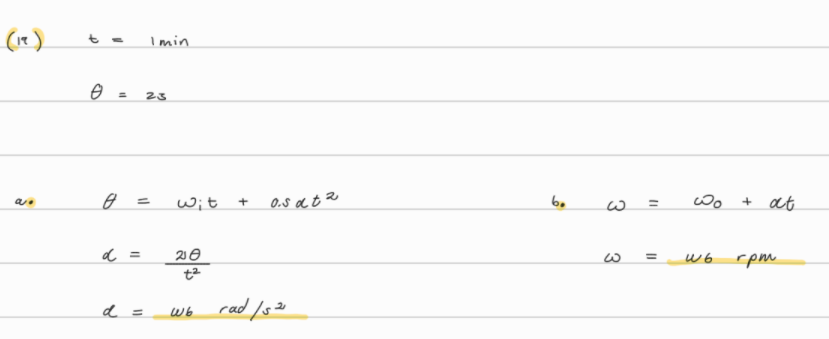
19. (I) Pilots can be tested for the stresses of flying high-speed jets in a whirling “human centrifuge,” which takes 1.0 min to turn through 23 complete revolutions before reaching its final speed. (a) What was its angular acceleration (assumed constant), and (b) what was its final angular speed in rpm?
Lesson 7.1 Angular Quantities, Constant Angular Acceleration, and Rolling
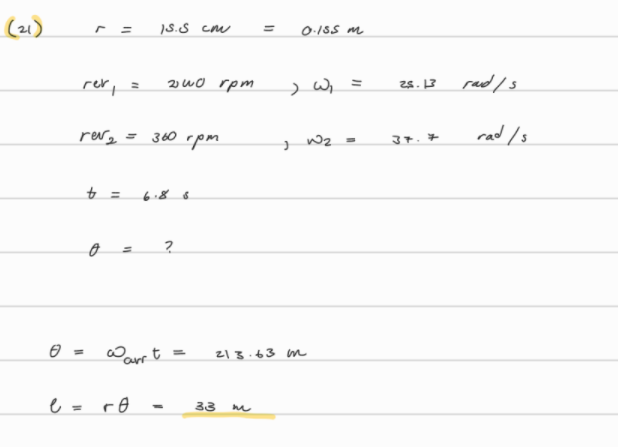
21. (II) A wheel 31 cm in diameter accelerates uniformly from 240 rpm to 360 rpm in 6.8 s. How far will a point on the edge of the wheel have traveled in this time?
Lesson 7.1 Angular Quantities, Constant Angular Acceleration, and Rolling
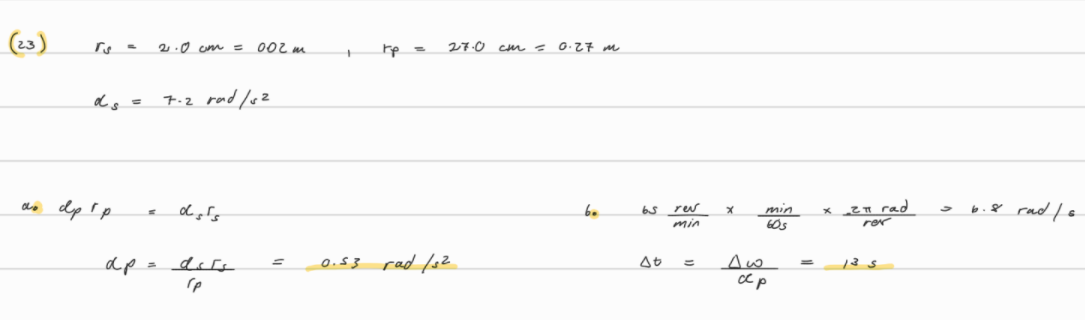
23. (II) A small rubber wheel is used to drive a large pottery wheel. The two wheels are mounted so that their circular edges touch. The small wheel has a radius of 2.0 cm and accelerates at the rate of 7.2 rad/s2, and it is in contact with the pottery wheel (radius 27.0 cm) without slipping. Calculate (a) the angular acceleration of the pottery wheel, and (b) the time it takes the pottery wheel to reach its required speed of 65 rpm.
Lesson 7.2 Toque
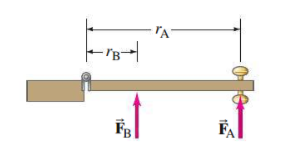
How does force relate to making an object roll?
- Making an object start rolling requires a force
- Direction important
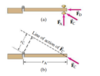
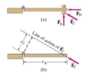
FA: perpendicular to the door
- greater the magnitude, the faster it will open
FB:
- not open as quickly
- $r_A$ is the lever arm
Lesson 7.2 Toque
What is angular acceleration?
The angular acceleration is proportional to the (1) magnitude of the force and (2) directly proportional to the perpendicular distance from the axis of rotation to the line along which the force acts
- “Distance” is the lever arm or moment arm (r)
- Angular Acceleration is proportional to the product of the force times the lever arm
- Product is the moment of the force and called the TORQUE (𝜏)
Hence, the angular acceleration is directly proportional to the net applied torque:
α ∝ 𝜏
- Analogue with Newton’s Second Law
Lesson 7.2 Toque
What is torque in relation to angular acceleration?
Product is the moment of the force and is called the TORQUE (𝜏)
Hence, the angular acceleration is directly proportional to the net applied torque:
α ∝ 𝜏