What is BPH?
Enlargement of the prostate gland, specifically within the prostatic transition zone, commonly occurring as men age. Symptomatic patients may benefit from medical or surgical treatment.
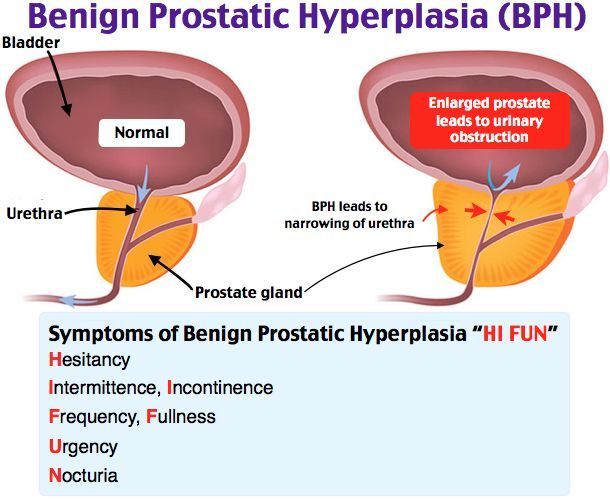
What are the clinical manifestations associated with BPH?
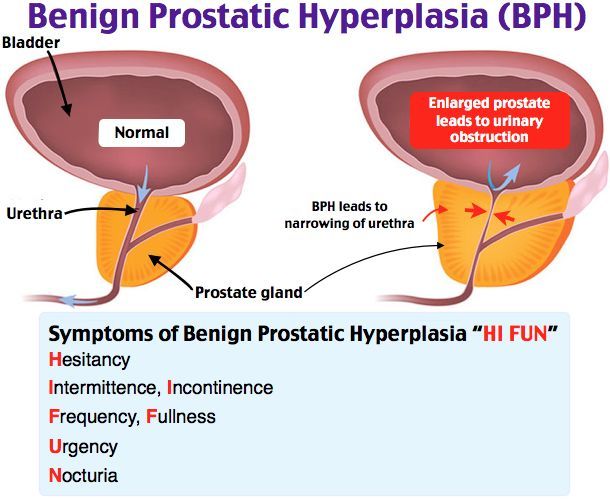
Obstructionand increased smooth muscle tone and resistance within the enlarged gland lead to symptoms such as:
- Hesitancy, straining, starting and stopping, dribbling, retention, decreased force and caliber of stream, sensation of incomplete bladder emptying, and double voiding (urinating again within 2 hours)
Irritative symptoms associated with bladder dysfunction:
- symptoms such as frequency, dysuria, urgency, nocturia, and incontinence
What are some physical examination findings associated with BPH?
- Digital Rectal Examination (DRE) - enlarged prostate, smooth and rubbery; size does NOT correlate to degree of symptoms or with degree of obstruction;
- If focal nodules or extreme hardness present on DRE, may represent malignancy, refer to Urologist for radiologic imaging and biopsy
- Palpable bladder consistent with urinary retention
What are some laboratory/diagnostic findings associated with BPH?
A. Urinalysis: pyuria suggests infection; hematuria may be sign of malignancy
B. Urine C&S – to rule out infection
C. BUN/Creatinine – to assess for renal insufficiency
D. Prostatic Specific Antigen (PSA) – optional
- Normal 2-4 ng/ml (this does not guarantee a patient does not have cancer)
- Elevated > 4 ng/ml ( can be from BPH or malignancy or prostatitis/UTI)
E. Transrectal ultrasound – obtained with a palpable nodule or elevated PSA
How do you manage a patient with mild BPH symptoms?
The decision to treat BPH balances the severity of the patient’s quality of life symptoms with potential side effects of therapy.
- Watchful waiting
- Avoid medications that can worsen symptoms: examples include a decongestant, diuretics, sympathomimetic, anticholinergics, bowel antispasmodics, tricyclic antidepressants, opiates and antipsychotics (decrease bladder muscle contraction increasing urinary retention).
How do you manage a patient with mild to moderate BPH symptoms?
- Alpha blockers- the preferred agents for BPH; relax muscle fibers in prostate gland, capsule and internal urethral sphincter
- Examples of Alpha blockers: Terazosin, Prazosin, Doxazosin
- Adverse events: Hypotension and dizziness
- Alpha 1a blockers: (less hypotensive side effects) examples: tamsulosin (Flomax), alfuzosin, silodosin (Of Note: Tamsulosin exhibits selectivity for alpha 1 receptors in the human prostate which is why it causes less hypotensive side effects)
How is finasteride used in BPH?
- Blocks conversion of testosterone to dihydrotestosterone
- Works on epithelial component of prostate, resulting in decrease in size of gland and improvement of symptoms
- 6 months of therapy is required for most beneficial effect
How do you manage a patient with severe BPH symptoms?
- Surgery may be warranted – dependent upon severity of symptoms
- Indications: recurrent urinary tract infections, bladder stones , persistent obstructive urinary symptoms
Types of surgery:
- Transurethral resection of the prostate (TURP)
- Low Mortality (1%); Moderate Morbidity (18%)
- Retrograde ejaculation common post TURP
- Complications: bladder neck contracture, urethral stricture, incontinence
- Open simple prostatectomy
- Transurethral incision of the prostate (TUIP)
Describe the physiologic changes to the prostate related to aging
Physiologic Changes Related to Age
- Decreased renal mass, blood flow and GFR (lose 10% per decade after age 30)
- Renal elimination of most medications
- Reduction in bladder elasticity, tone and capacity
- Increased post void residual and nocturnal urine production
- Male reproductive changes:
- Prostate enlargement
- Decreased testosterone levels leads to increased estrogen : androgen ratio
- Increase in gynecomastia
- Decrease in sperm motility
Sexual function
- Slowed arousal time to achieve erection
- Erection less firm, shorter lasting
- Delayed ejaculation and decreased forcefulness of ejaculate
- Longer interval to achieving subsequent erection
Prostate
- By 40 years of age, there is hypertrophy of glandular tissue. This is stimulated by dihydrotestosterone

-
Module 10.0 - HIV/AIDS and Opportunistic Infections Among Older Adults13
-
Module 10.1 - Autoimmune diseases10
-
Module 11.0 - Urinary Tract Infections18
-
Module 11.1 - Chronic Kidney Disease16
-
Module 11.2 - Benign Prostatic Hyperplasia9
-
Module 11.3 - Renal Artery Stenosis6
-
Module 12.0 - Dementia14
-
Module 12.1 - Multiple Sclerosis9
-
Module 12.2 - Parkinson’s Disease6
-
Module 13.0 - Sexually Transmitted Diseases47
-
Module 13.1 - Drug Eruptions11
-
Module 13.2 - Herpes Zoster6
-
Module 13.3 - Cellulitis7
-
Module 13.4 - Wound Management20



