What is multiple sclerosis?
An immune-mediated inflammatory demyelinating disease of the central nervous system (CNS) which is characterized pathologically by multifocal areas of demyelination
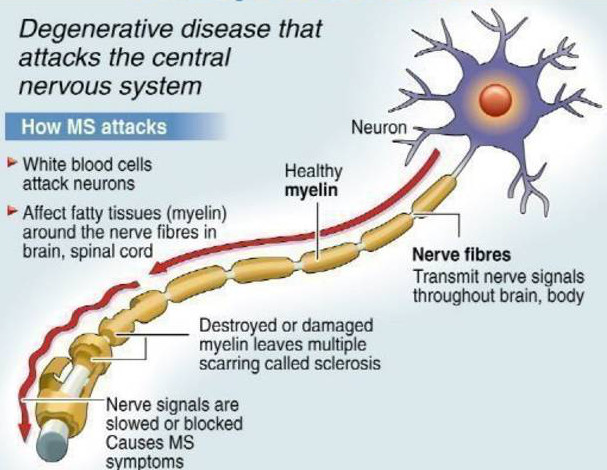
Describe the etiology of multiple sclerosis
- Highly variable progression and many atypical forms
- Diagnosed primarily clinically
- Women have a 2 – 3 times higher incidence than men.
- Onset of disease is earlier in women than men.
- Caucasians have higher incidence than African Americans.
- Onset occurs in 20s-40s for up to 80% of patients
- No clear etiology, but thought to be multifactorial in cause
- Viral infection as precursor
- No clear genetic association
What are the 5 types of multiple sclerosis?
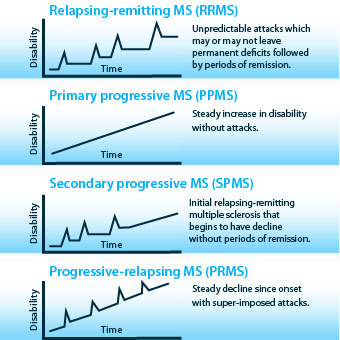
A. Relapsing-Remitting (RRMS) – 85-90% of cases at onset; characterized by clearly defined relapses with full recovery, or with residual deficit upon recovery. Minimal disease progression during periods between relapses; most individuals will eventually enter a secondary progressive phase
B. Secondary Progressive (SPMS) – occurs 10-20 years after disease onset; characterized by initial RRMS course followed by gradual worsening with or without occasional relapses
C. Primary Progressive (PPMS) – represents about 10% of cases at disease onset; characterized by progressive accumulation of disability from disease onset with occasional plateaus, and relapses
D. Malignant MS – occurs in approx. 6% of patients; usually older at diagnosis; aggressive, rapid progressive course leading to significant disability in a relatively short amount of time after disease onset
E. Benign MS – occurs in about 15% of patients; a retrospective diagnosis made when the individual remains fully functional 10-15 years after disease onset; a single demyelinating event followed by no relapse
What are some subjective findings associated with multiple sclerosis?
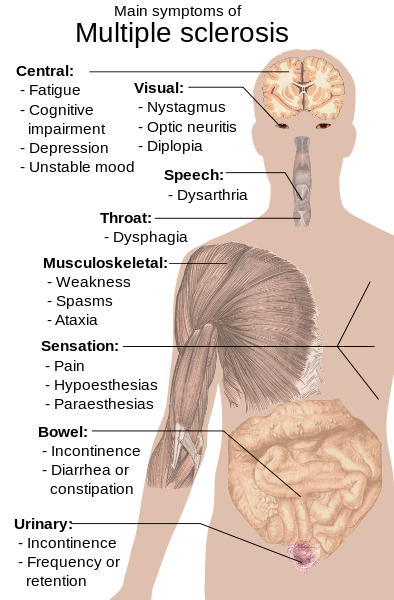
- Motor weakness, spasticity or stiffness
- Sensory alterations – numbness, burning, tingling in 1 or more limbs, facial numbness
- Brain stem symptoms- double vision, dysphasia, vertigo
- Visual deficits- decreased acuity, impaired color perception, field deficits, double vision/blurred vision
- Cerebellar symptoms- gait ataxia, tremor, uncoordinated movements
- Cognitive dysfunction – short term memory, slowed processing, difficulty in higher level problem solving
- Fatigue – 90% Of patients
- Sleep Disorders
- Bladder, bowel and sexual dysfunction
- Seizure
- Tonic spasms
What are some physical exam findings associated with multiple sclerosis?
- Sensory disturbances 20-50% Of patients
- Decreased vibratory sense, position sense, pinprick perception and temperature sensation
- Reflexes- abnormal DTRs, positive Babinski and Hoffman, spastic limb weakness
- Brain Stem disorders – nystagmus, hearing loss, tinnitus
- Cerebellar disorders – ataxia, tremor, lack of coordination
- Visual disorders- 25% of patients initially present with optic neuritis; visual field defect, trigeminal neuralgia
- Frontal Lobe – cognitive dysfunction, emotional lability
What lab/diagnostic tests are used to diagnose multiple sclerosis?
A. Complete neurological exam with noted deficits
B. MRI Findings: white matter lesions in brain, lesions in spinal cord, T2 weighted lesions in periventricular white matter of brain and spinal cord, cerebral atrophy
C. CSF Findings: elevated IgG with oligoclonal bands in CSF but not serum; 70% of patients with bands in CSF (not conclusive)
D. Evoked Potentials: slowed conduction or prolonged evoked response, not conclusive
E. McDonald Diagnostic Criteria: developed in 2001, latest revision 2010; core requirement of the diagnosis is the objective demonstration of dissemination of CNS lesions in both space and time, either clinically alone or a combination of clinical and MRI findings.
- Dissemination in space: MRI shows 1 or more T2 lesions in at least 2 of 4 MS typical regions of the CNS OR by the clinical development of attack of a different CNS site
- Dissemination in time: MRI shows the simultaneous presence of asymptomatic gadolinium enhancing and non-enhancing lesions at any time or a new T2 or gadolinium enhancing lesion on follow-up MRI irrespective of its timing with reference to baseline scan. OR the development of a second clinical attack.
F. Other
- No other explanation for MRI findings, CSF findings, or abnormal evoked potentials
How do you manage a patient with multiple sclerosis?
A. Neurology consult
B. Mild acute exacerbations- not always requiring treatment if no functional decline present
C. Acute intervention for relapse:
- Glucocorticoids, oral of IV: High dose (500-1000mg/day) ;usually Methylprednisolone; duration dependent on clinical response
What is the role of Disease modification medications in multiple sclerosis?
Reduces relapse rate, delays disability; initiate early in course of disease to slow progression of disease
- Fingolimod (Gilenya)- 0.5mg po daily; observe for bradycardia
- Interferon beta-1b: Betaseron or Extavia used in relapsing form of MS; SQ administration every other day; watch for depression/suicidality; injection site necrosis
- Interferon beta-1a : Avonex- used in relapsing MS; IM weekly dosage; watch for flu like symptoms, fatigue depression, myalgias
What are important symptoms to control in patients with multiple sclerosis?
Spasticity, fatigue, mood disorders, immobility, seizures, incontinence, cognitive effects, gait disturbances, sexual dysfunction

-
Module 10.0 - HIV/AIDS and Opportunistic Infections Among Older Adults13
-
Module 10.1 - Autoimmune diseases10
-
Module 11.0 - Urinary Tract Infections18
-
Module 11.1 - Chronic Kidney Disease16
-
Module 11.2 - Benign Prostatic Hyperplasia9
-
Module 11.3 - Renal Artery Stenosis6
-
Module 12.0 - Dementia14
-
Module 12.1 - Multiple Sclerosis9
-
Module 12.2 - Parkinson’s Disease6
-
Module 13.0 - Sexually Transmitted Diseases47
-
Module 13.1 - Drug Eruptions11
-
Module 13.2 - Herpes Zoster6
-
Module 13.3 - Cellulitis7
-
Module 13.4 - Wound Management20



