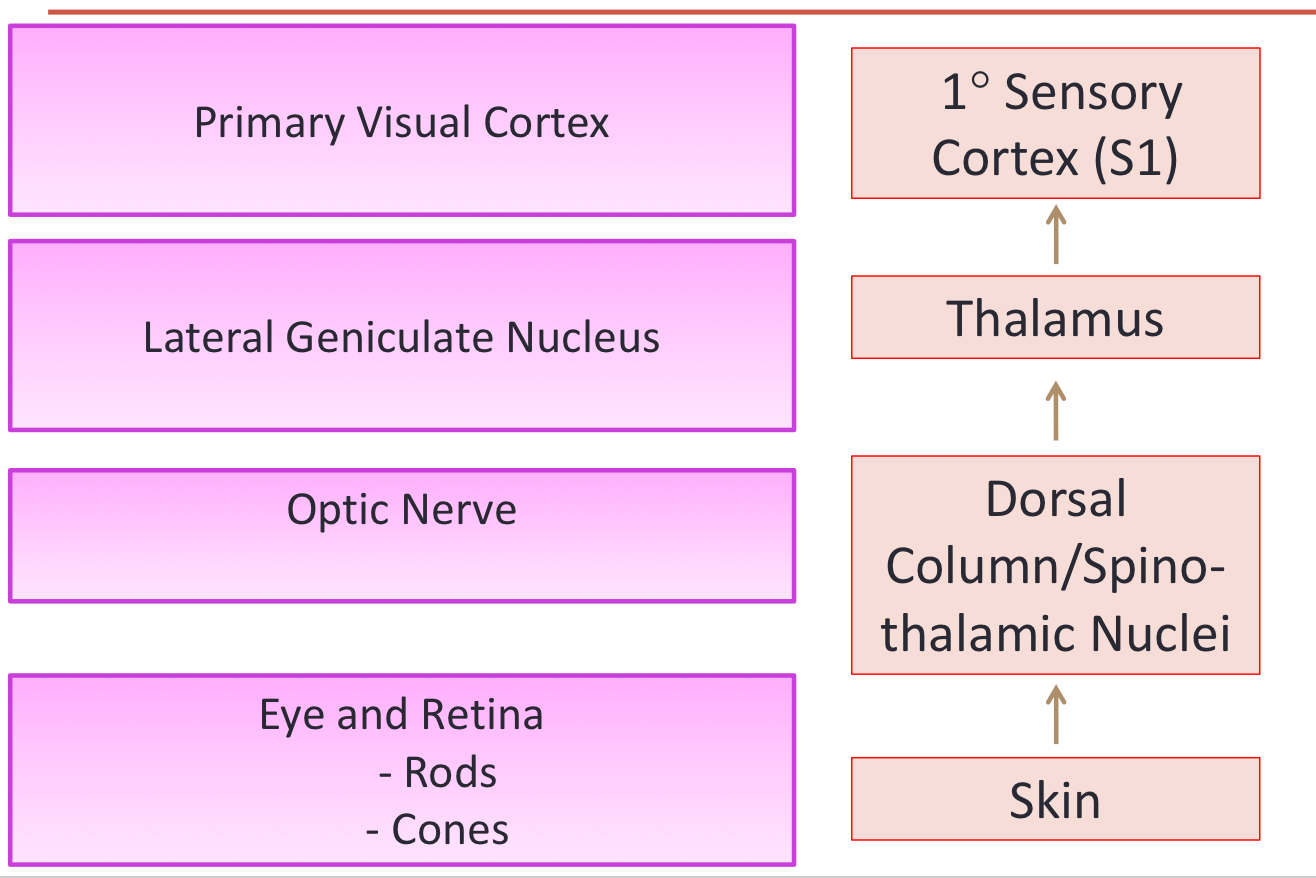
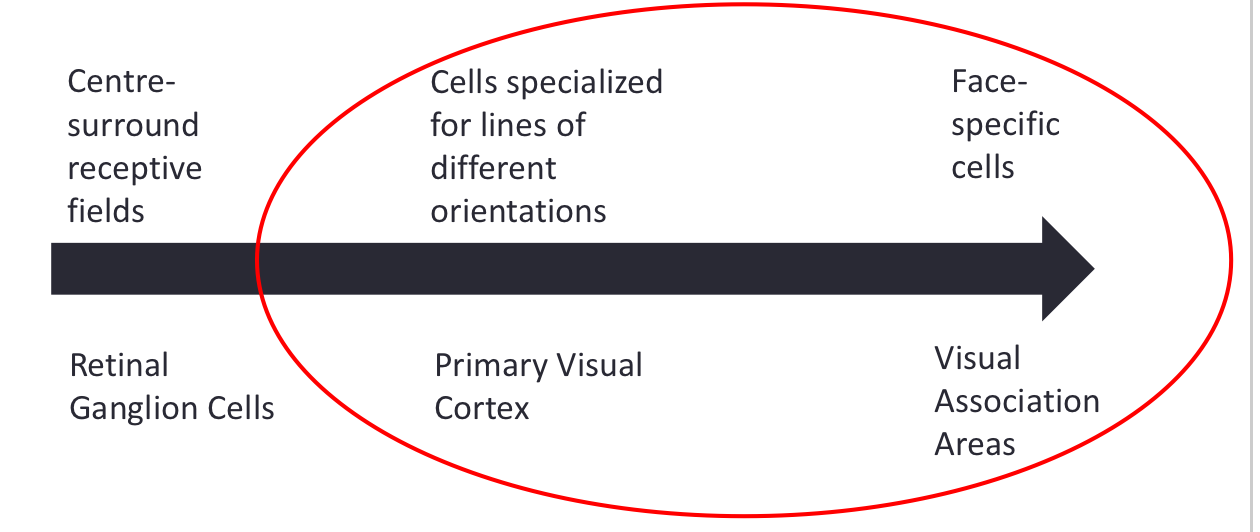
What is the sensory system hierarchy for the visual system?
Basic neurons in the eye and the retina such as the rods and cones → go through the optic nerve to a specialized area in thalamus called the lateral geniculate nucleus and ultimately lies in the primary visual cortex.
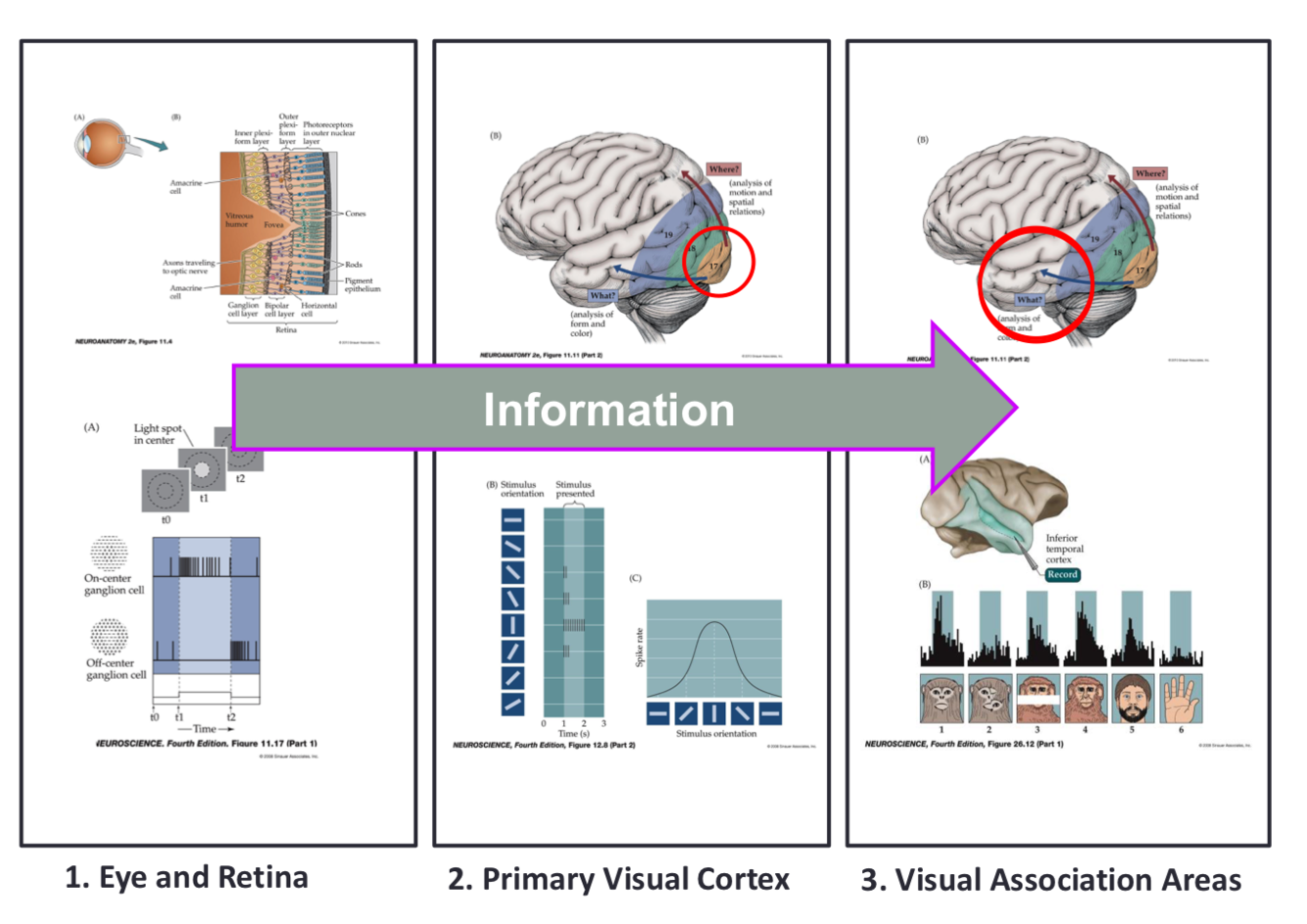
What are the 3 main steps for the information to reach higher processing areas in the visual system?
- Eye and retina
- Primary visual cortex
- Visual association areas
What is the Retina?
- Retina = receives light from the lens and converts it into neural signals that the brain can understand.
- It is a laminated neural component of the eye that contains photoreceptors = which are the specialized neurons that respond to light.
- It is the initial processing machinery for the visual pathway.
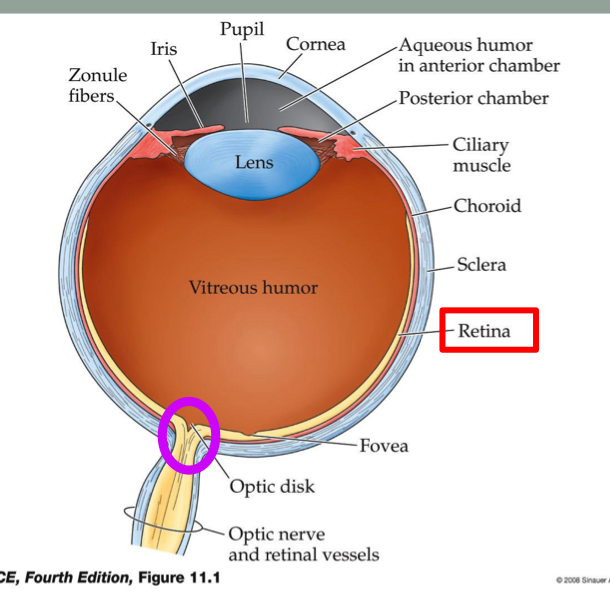
What is the optic disc?
- This is the region where the axons leaving the retina to gather to form the optic nerve.
- There are no photoreceptors here → blind spot
- The blindspots are not superimposed, they are slightly different for each eye, therefore you have no functional deficits when you are using both eyes at once.
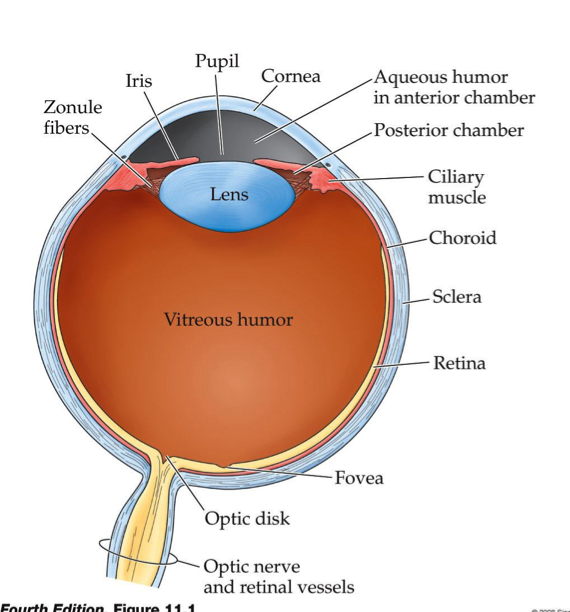
What is the Fovea?
- The fovea is the central fixation point for each eye.
- Region of the retina with the highest visual acuity.
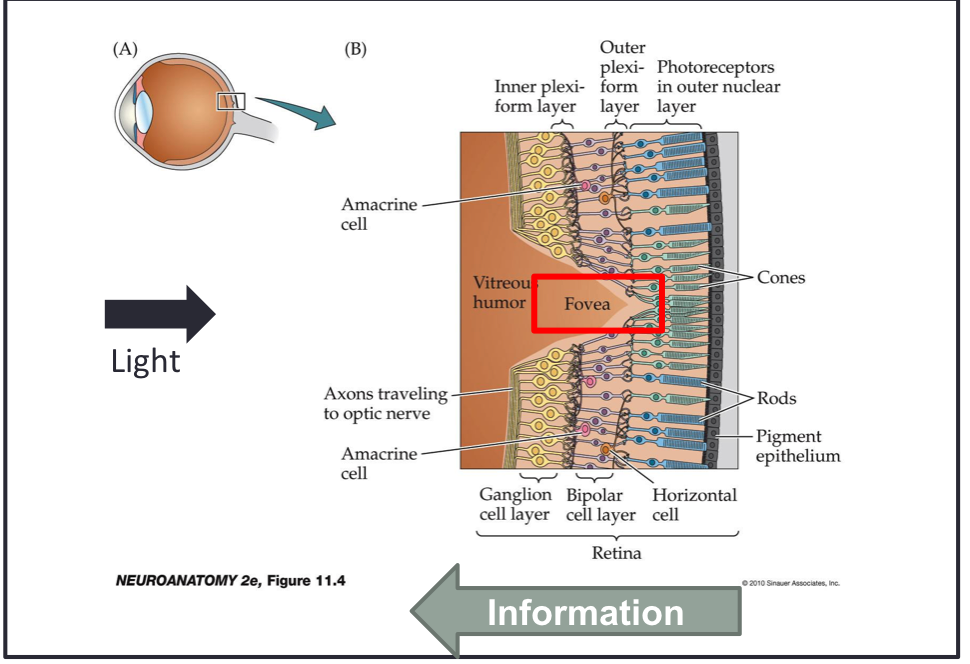
What is the Macula?
- Oval region surrounding the fovea.
- It also has high visual acuity.
- Occupies the central 5 degrees of visual space.
- Detailed vision
- Small in size, but provides input to about half of the optic nerve fibers and cells in the visual cortex.
- It corresponds to the central 1-2 degrees of visual space
What is the general pathway of the light to travel in the fovea and macula to be perceived as information?
- As you can see in the image the light is coming in a different direction than the information.
- Light will enter the area and hit the photoreceptors, and then the information will travel backward (back to where the light came from = as you can see in the image).
What are photoreceptors?
- They are cells in the retina that respond to light
- They are specialized neurons.
What are the two types of photoreceptors?
Rods and cones
What are a few of the characteristics of RODS photoreceptors?
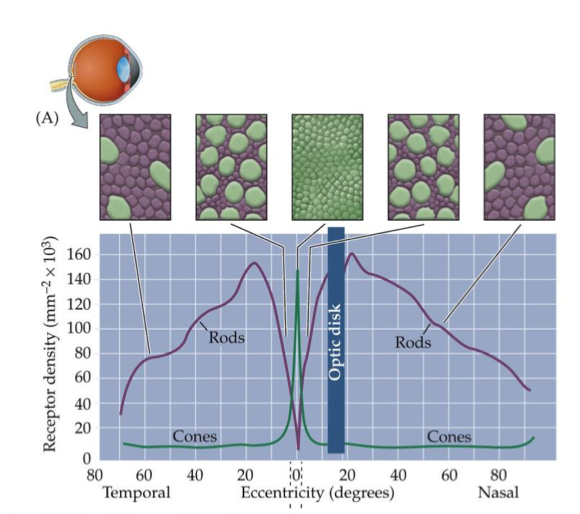
- Primarily found in the peripheral retina
- Achromatic → they do not see color
- High light sensitivity
- Nighttime vision, when light levels are low
- More rods than cones (20:1)!!!
What are a few of the characteristics of CONES photoreceptors?
- High-acuity and colour vision during day-time when light levels are higher
- Primarily found in the central retina (fovea)
- Cones are less numerous than rods overall but there are more of them located in the fovea. This makes sense because the fovea has the highest level of acuity, therefore we need cells that are specialized for high acuity and color.
Why do we have an acuity grading of the visual field?
- The two systems of photoreceptors both the Rods and the Cones allow the visual system to meet the conflicting demand for sensitivity and acuity.
- The way the photoreceptors are laid out allows for our visual field to meet the visual demands.
- The optic disk = the blind spot = where the axons are coming out
- Blurred peripheral vision = A high number of Rods for the peripheral vision and barely any for the fovea/central part
- Central detailed vision = A high number of Cones for the fovea/central vision and barely any at the peripheries.
What are the main players of the eyeball
Retina
Fovea
Optic disk
Photoreceptors
Rods/cones
What are the main players for phototransduction?
Retina
Fovea
Optic disk
Photoreceptors
- Rods/cones
How is light translated into a neural signal our brain can understand?
The photoreceptors will respond to light, and we know that photoreceptors provide information to ganglion cells.
What is the receptive field for photoreceptors?
- All photoreceptors (cones and rods) CANNOT respond to everything at the same time.
- Otherwise, everything would look the exact same all the time → it is similar to touch, if you hit your pinky finger with a hammer your whole hand isn’t going to feel it.
- But if you hit your finger in space where there isn’t a receptor field (which isn’t necessarily possible but for argument sake) you aren’t going to feel it.
- For the eye or the visual system, it is the same but instead of this mechanical system or the hammer, you need to think of the visual system responding to light
- But if you hit your finger in space where there isn’t a receptor field (which isn’t necessarily possible but for argument sake) you aren’t going to feel it.
- The receptive field of a neuron in the visual pathway is defined as the portion of the visual field where light causes excitation or inhibition of the cell.
- Each cone and rod has its own receptive field.
What is a graded potential?
A graded potential is a change in membrane potential that varies in size. It is NOT an all or none phenomenon.
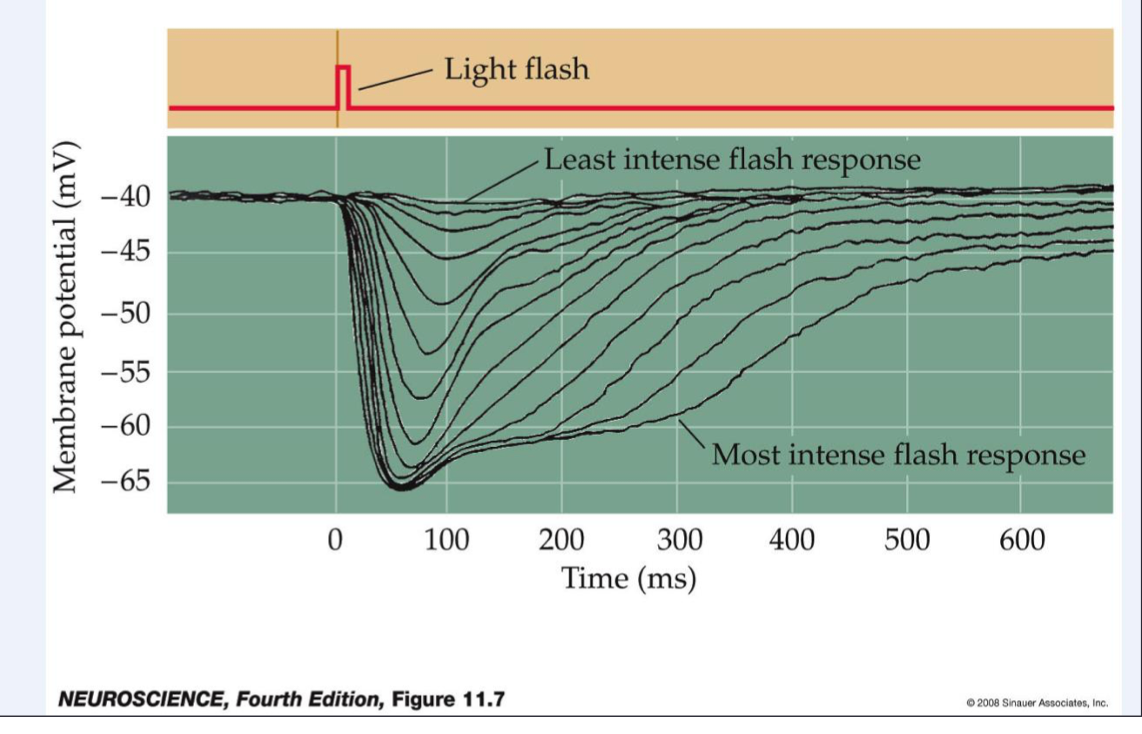
Recap: If the information that is felt on the skin, is sufficient in magnitude an AP will happen and the information will travel up to the brain. This is how the sensory system, or in terms of touch works. NOW: There are a few differences when we talk about phototransduction. Talk about these differences…
- Photoreceptors (rods and cones) use graded potentials, not action potentials, to control the release of neurotransmitters onto post-synaptic neurons.
- In the eye, membrane potential changes are done in a graded response with varying degrees of light.
- Photoreceptors respond to light by hyperpolarizing. NOT depolarizing.
- Light = hyperpolarized = low NT release onto post-synaptic neuron
- Dark = relatively depolarized = high NT release onto post-synaptic neuron
What are the two main differences between photoreceptors and other sensory afferents?
- Photoreceptors use GRADED POTENTIALS
- More light (more stimulus) causes HYPER-POLARIZATION (less NT release)
Where do interneurons fit in the light pathway in the eyeball?
- Once photoreceptors (cones and rods) have responded to the light, the information will then travel through the retina through the bipolar cell layer and ganglion cell layer before it goes out the axon to the optic neuron. As they go through the bipolar and ganglion cell layer there are these interneurons called horizontal cells and amacrine cells
- The interneurons are quite similar to the stellate and basket cells in the cerebellum –> they have a lot of lateral inhibitory or excitatory connections with nearby bipolar and ganglion cells
How are the interneurons in the eyeball similar to the stellate and basket cells in the cerebellum?
The interneurons are quite similar to the stellate and basket cells in the cerebellum –> they have a lot of lateral inhibitory or excitatory connections with nearby bipolar and ganglion cells
Where do the horizontal and amacrine cells reside?
In the bipolar cell layer.
What are the two types of cells within the ganglion cell layer?
Parasol (ganglion) cells
Midget (ganglion) cells
Describe the parasol (ganglion) cells.
- Gross stimulus features and movement
- Large cell bodies
- Large receptive fields
- Large axons



-
Module 2 - Lecture 1 - Action Potential & Propagation - Review Questions22
-
Module 3 - Lecture 2 - Synapses and Postsynaptic Cells - Review Questions14
-
Module 4 - Lecture 3 - Excitation-Contraction Coupling - Review Questions9
-
Module 5 - Introduction to the neuroanatomy of the CNS and PNS - Original slides45
-
Module 7 - Lecture 4 - Clinical Conditions Affecting the PNS34
-
Module 8 - Lecture 5 - Repair and Compensation in the PNS13
-
Module 9 - Lecture 6 - CNS Synapses, Transmitters, Integration12
-
Module 10 - Lecture 7 - Plasticity22
-
Module 12 - Lecture 8 - Movement25
-
Module 13 - Lecture 9 - Movement - Reflexes and Gait16
-
Module 14 - Lecture 10 - Motor, Premotor and Descending22
-
Module 14 - Lecture 10.5 - Clinical LMN vs UMN Lesions8
-
Module 15 - Lecture 11 - Vestibular system posture and balance26
-
Module 19 - Lecture 12 - Motor Control41
-
Module 17 - Lecture 13 - Basal Ganglia32
-
Module 18 - Lecture 14 - Cerebellum25
-
Module 20 - Lecture 15 - Motor Learning17
-
Module 23 - Neuroanatomy of Motors Systems44
-
Module 24 - Neuroanatomy of Sensory Systems74
-
Module 25 - Neurophysiology of TOUCH40
-
Module 26 - Neurophysiology of PAIN46
-
Module 28 - Spinal Cord and Brainstem Lesion40
-
Module 29 - Vision72
-
Module 30 - Eye movements & Reflexes63
-
Module 32/22 - Neuroanatomy of the development of the brain51
-
Module 33 - Cognition54
-
Concussions: Brain Bang Theory19
-
Module 34 - Cortical states62
-
Module 34 - Sleep55
-
Module 36 - Attention and Perception63
-
Module 37 - Memory86
-
Module 39 - Speech & Language62
-
Module 40 - Emotions67
-
Module 41 - Mental Health78



