What are the two different ways all emotions are expressed?
- All emotions are expressed in 2 ways:
- Visceral motor changes → the feeling you get into your gut when you are nervous, for example.
- Somatic motor responses (facial muscles)
True or false: All emotions are accompanied by subjective experiences.
True
How are all emotions accompanied by subjective experience but similar across all human cultures?
Generally being happy is a pleasant state whereas sad is an unpleasant state → and all humans have the same perception of how happy is good but sad is not.
What are some of the visceral (autonomic) motor system changes?
- Heart rate
- Cutaneous blood flow
- Piloerection
- Sweating
- Gastrointestinal motility
What controls/ brings on the various visceral motor system changes?
- Heart rate, Cutaneous blood flow, Piloerection, Sweating and Gastrointestinal motility → are all brought on by changes in the activation of sympathetic, parasympathetic, and enteric components of the visceral motor system.
- The sympathetic system = fight or flight
- Parasympathetic/enteric systems = rest and digest
What does this quote mean: “ the desire for food and drink… the pleasures of the table are nothing in the presence of anger or great anxiety. “
This visceral response to emotions can sometimes override other things. For example, if you are under a lot of stress, a neuroscience midterm and you’re anxious, but it was your friends birthday the night before and all your friends are going out and having a good time; sometimes it is really difficult to turn off the anxiety or negative emotions for the test that you have the next morning in order to enjoy the evening. → fight or flight system on overdrive.
What is the overall message to take away from this quote: “What kind of emotion of fear would be left if the feeling neither of quickened heart-beats nor of shallow breathing… neither of goose-flesh nor of visceral stirrings… I say that for us emotion dissociated from all bodily feeling is inconceivable.” - William James, 1983
- Emotion and sensorimotor behavior are inextricably linked
- Our emotions and our body is a two-way street
What is a somatic motor response?
- Somatic motor responses are the cortex, the premotor cortex, and the typical facial muscles.
- Example, smiling, tensing up your muscles
What are the two mechanisms of control of our somatic motor response?
Voluntary (classical motor pathways)
Involuntary/automatic (limbic system)
What is one of the main functions of the brainstem reticular formation?
This is part of the brainstem that keeps up awake and alert.
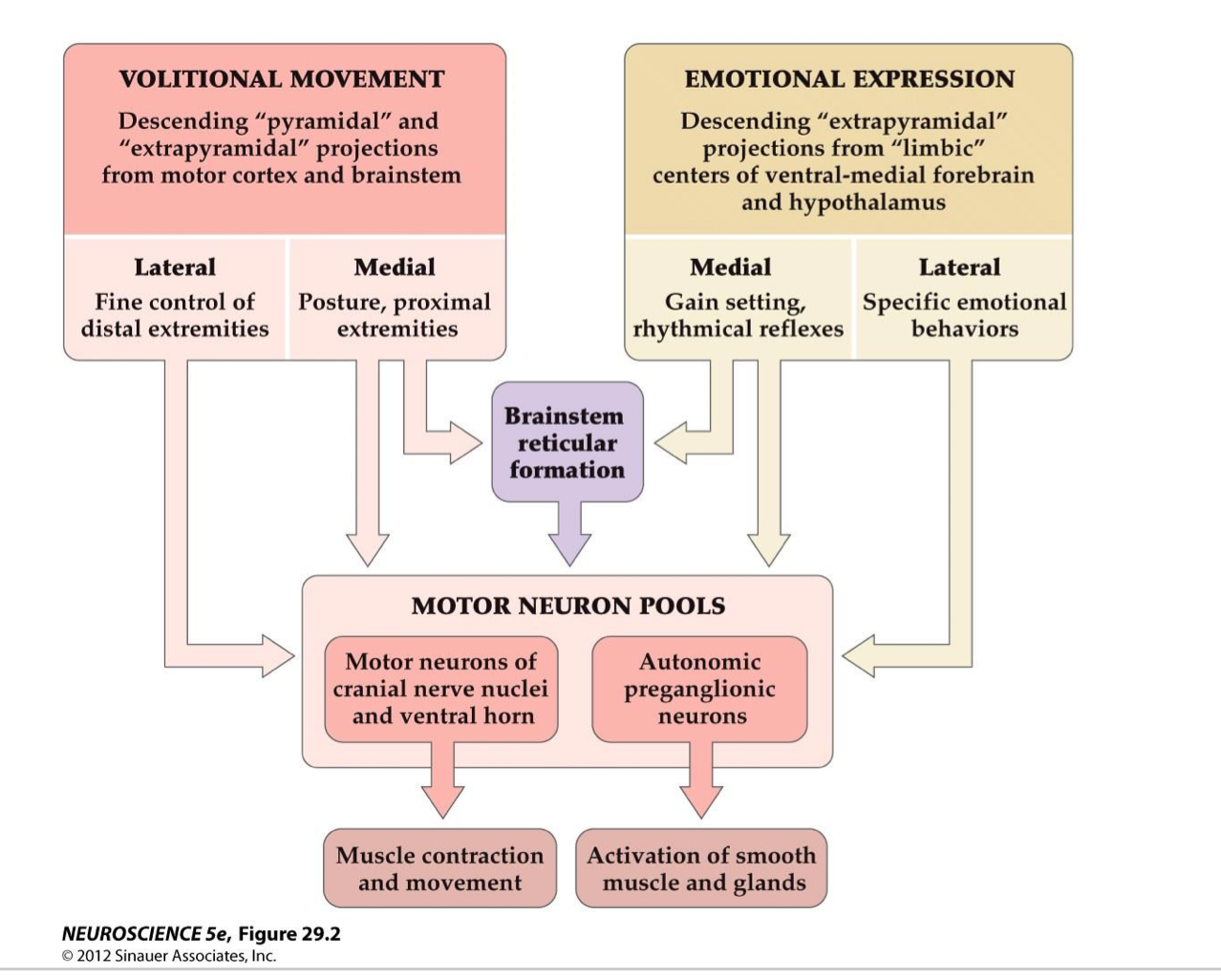
Explain the descending systems that control somatic and visceral motor effectors in the expression of emotion.
IMAGE
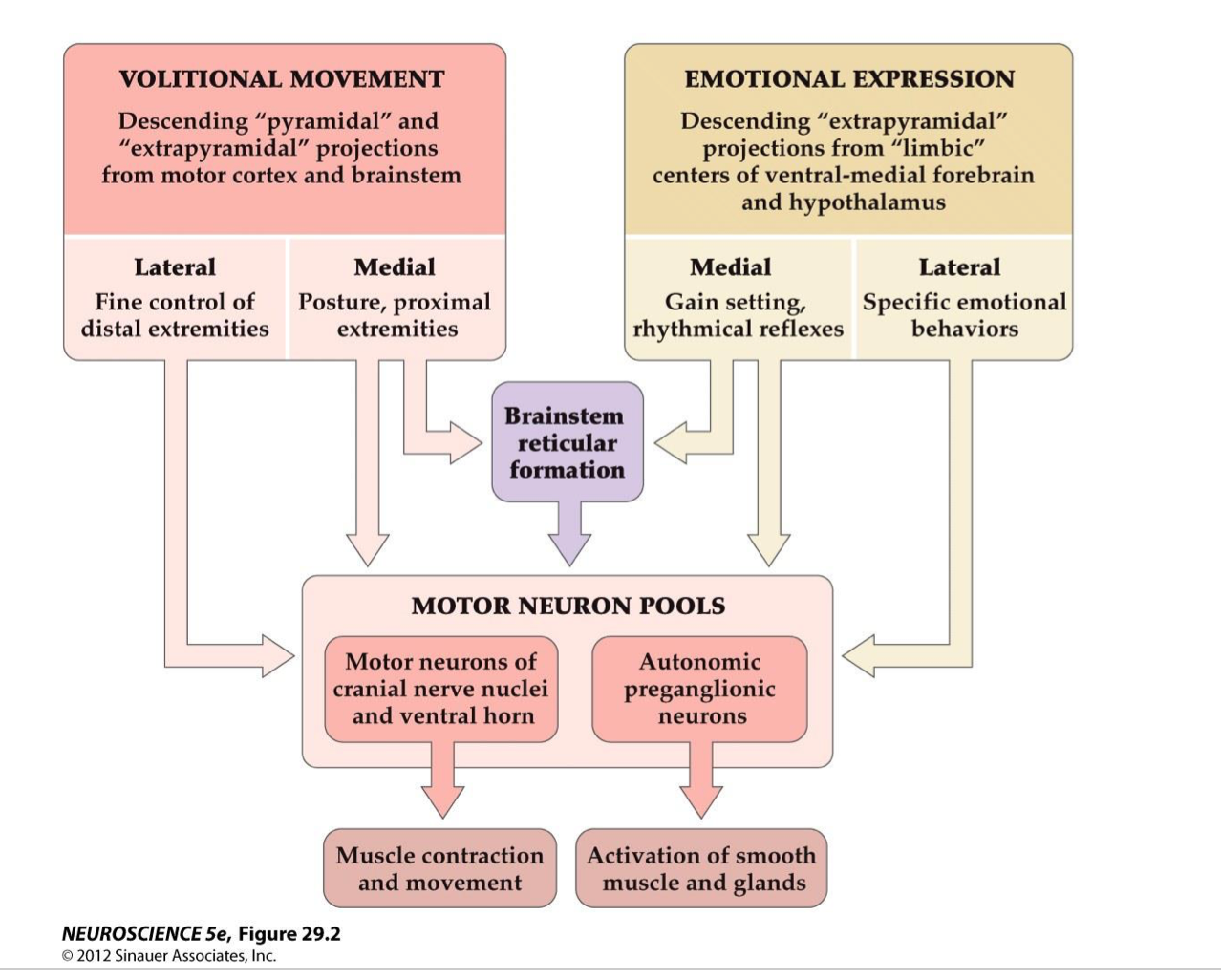
What descending structures are responsible for the emotional expression/ involuntary control of our somatic motor response?
Descending “extrapyramidal” projections from “limbic” centers of ventral-medial forebrain and hypothalamus
Explain each scenario in the following image
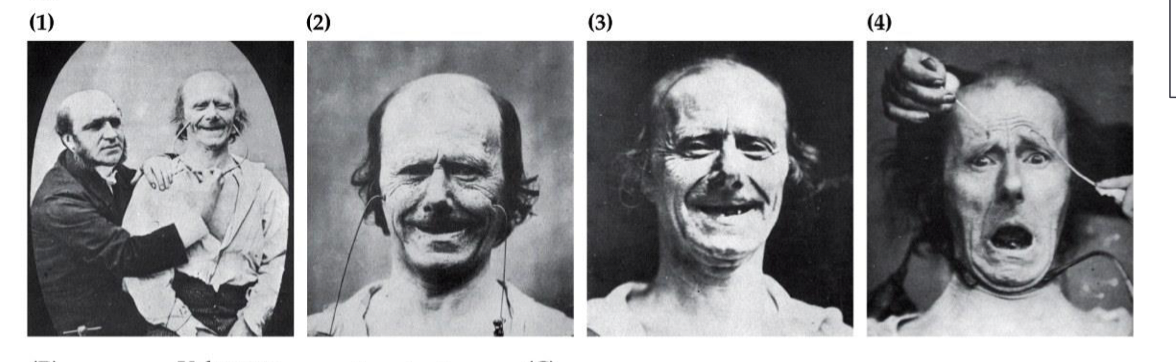
- (1) Duchenne and one of his subjects undergoing faradization of the facial muscles → which is with the use of transcutaneous electrical stimulation to activate single muscles and small groups of muscles in the face, dorsal surface of the head, and neck.
- (2) Bilateral electrical stimulation of the zygomaticus major mimicked a genuine expression of happiness…
- …(3) although closer examination shows insufficient contraction of the orbicular oculi (surrounding the eyes) compared with spontaneous laughter.
- (4) Stimulation of the brow and neck produced an expression of “terror mixed with pain, torture.. That of the damned.”; however the man reported no discomfort or emotional experience consistent with the evoked contractions.
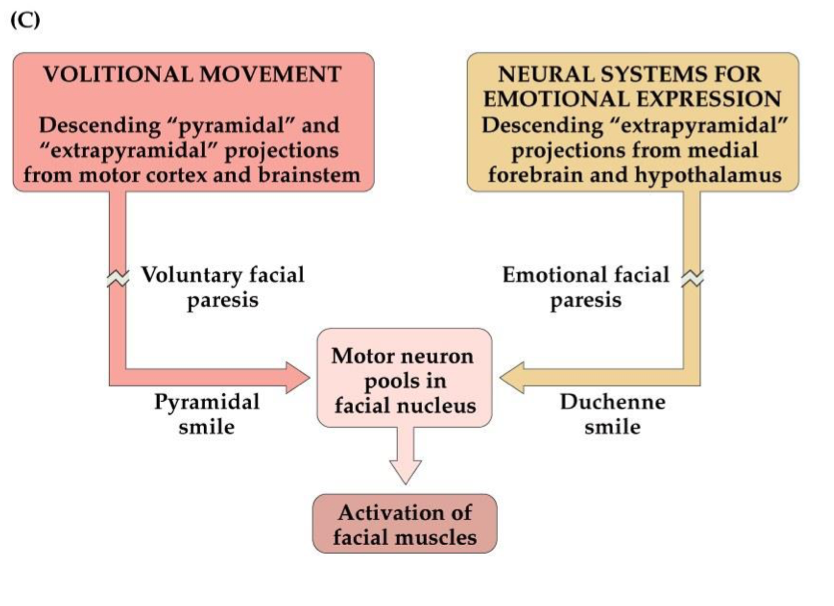
What are the two different types of facial paresis?
Voluntary facial paresis
Emotional facial paresis
What structures would be impaired with a voluntary facial paresis?
It is the structures that are responsible for volitional movement → the descending “pyramidal” and “extrapyramidal” projections from motor cortex and brainstem
What structures would be impaired with an emotional facial paresis?
Descending “extrapyramidal” projections from “limbic” centers of ventral-medial forebrain and hypothalamus
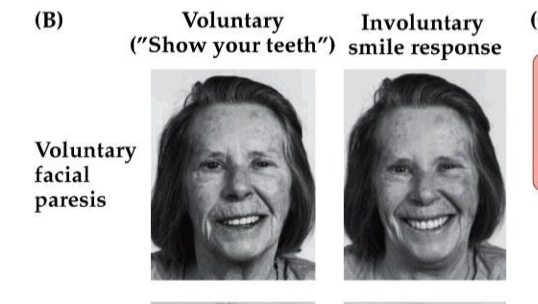
What would be a typical voluntary and involuntary smile response for a patient with voluntary facial paresis?
The mouth of a patient with a lesion that destroyed descending fibers from the right motor cortex displaying voluntary facial paresis. When asked to show her teeth, the patient was unable to contract the muscles on the left side of her mouth (upper left), yet her spontaneous smile in response to a humorous remark was nearly symmetrical (lower left).
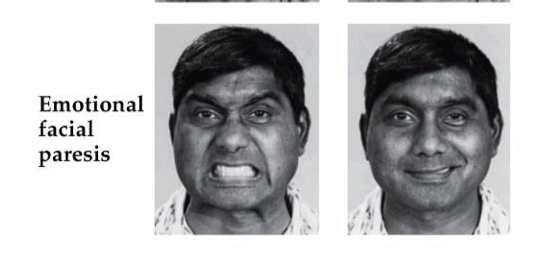
What would be a typical voluntary and involuntary smile response for a patient with emotional facial paresis?
The mouth of a patient with a lesion that destroyed descending fibers from the forebrain displaying emotional facial paresis. When asked to show her teeth, the patient was able to contract the muscles, yet his spontaneous smile in response to a humorous remark the right side of his face was unable to express emotion.
What are the two anatomical and functional distinct sets of descending projections that motivate the muscles of facial expression? Explain their connection.
IMAGE
When it comes to emotional expression, what controls the nature of descending motor control for facial musculature?
- There is a DUAL nature of descending motor control for facial musculature.
- There is a voluntary response → motor cortical areas
- There is also an involuntary response → limbic system
The descending inputs from the volitional and emotional/involuntary systems run parallel to each other. Why is this true?
- They both have connections to the reticular formation
- They both have a connection to the somatic motor pools, although they are different motor pools
- This connection between limbic system and body is a “two-way street”. The motor system influences the limbic system/emotional states and vice versa
- A good example of this = mediation
What are the different “sources” of emotion?
- Sensory drive from muscles and internal organs
- This input forms the sensory limb of reflex circuitry that allows rapid physiological changes in response to altered conditions.
- Forebrain
- Anticipated events, suspenseful TV shows, etc all lead to autonomic activation and strongly felt emotions.
How do emotions differ along 2 dimensions?
Intensity (arousal level)
Valence (pleasantness or aversive: approach or avoidance)
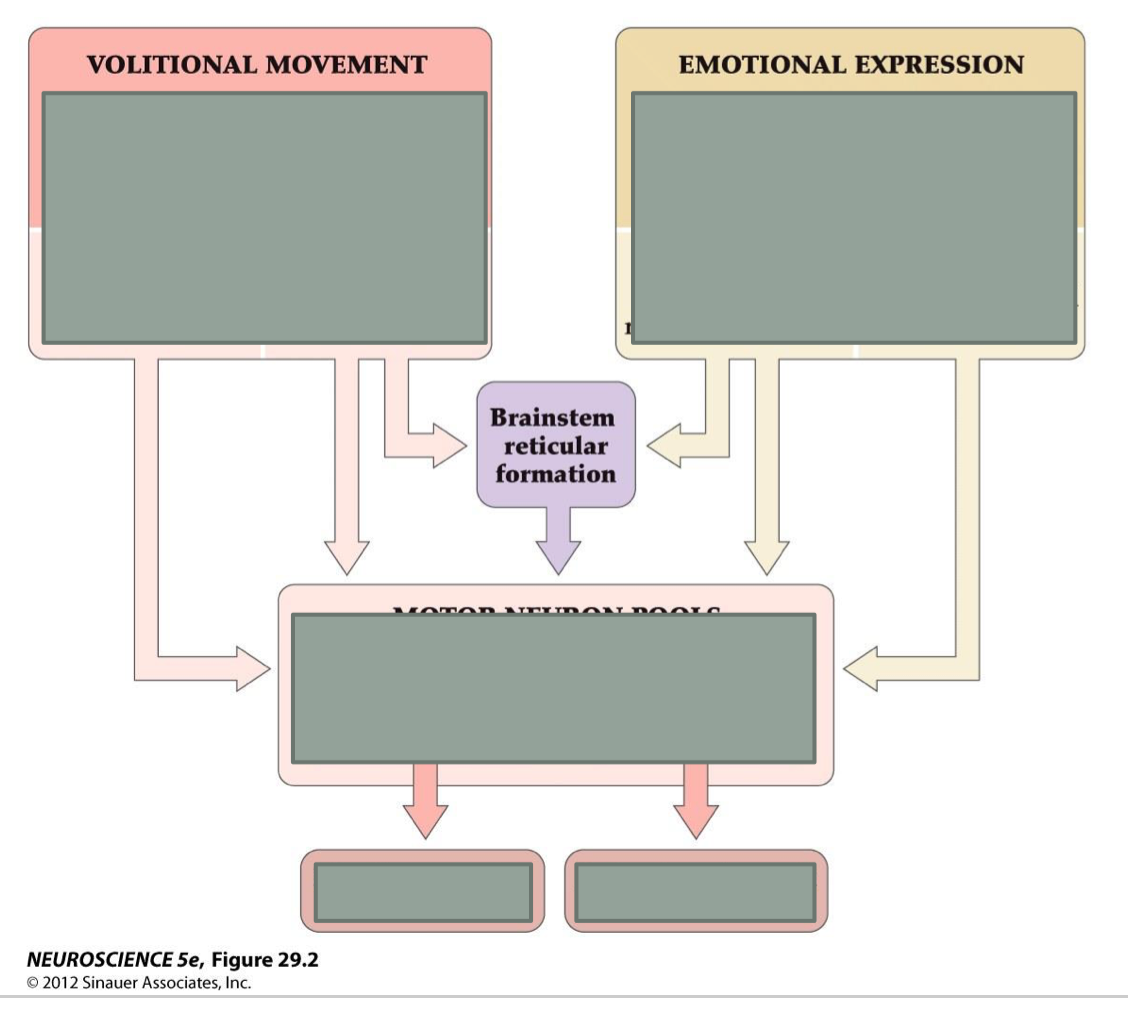
Fill out the image below.
IMAGE



-
Module 2 - Lecture 1 - Action Potential & Propagation - Review Questions22
-
Module 3 - Lecture 2 - Synapses and Postsynaptic Cells - Review Questions14
-
Module 4 - Lecture 3 - Excitation-Contraction Coupling - Review Questions9
-
Module 5 - Introduction to the neuroanatomy of the CNS and PNS - Original slides45
-
Module 7 - Lecture 4 - Clinical Conditions Affecting the PNS34
-
Module 8 - Lecture 5 - Repair and Compensation in the PNS13
-
Module 9 - Lecture 6 - CNS Synapses, Transmitters, Integration12
-
Module 10 - Lecture 7 - Plasticity22
-
Module 12 - Lecture 8 - Movement25
-
Module 13 - Lecture 9 - Movement - Reflexes and Gait16
-
Module 14 - Lecture 10 - Motor, Premotor and Descending22
-
Module 14 - Lecture 10.5 - Clinical LMN vs UMN Lesions8
-
Module 15 - Lecture 11 - Vestibular system posture and balance26
-
Module 19 - Lecture 12 - Motor Control41
-
Module 17 - Lecture 13 - Basal Ganglia32
-
Module 18 - Lecture 14 - Cerebellum25
-
Module 20 - Lecture 15 - Motor Learning17
-
Module 23 - Neuroanatomy of Motors Systems44
-
Module 24 - Neuroanatomy of Sensory Systems74
-
Module 25 - Neurophysiology of TOUCH40
-
Module 26 - Neurophysiology of PAIN46
-
Module 28 - Spinal Cord and Brainstem Lesion40
-
Module 29 - Vision72
-
Module 30 - Eye movements & Reflexes63
-
Module 32/22 - Neuroanatomy of the development of the brain51
-
Module 33 - Cognition54
-
Concussions: Brain Bang Theory19
-
Module 34 - Cortical states62
-
Module 34 - Sleep55
-
Module 36 - Attention and Perception63
-
Module 37 - Memory86
-
Module 39 - Speech & Language62
-
Module 40 - Emotions67
-
Module 41 - Mental Health78



