What are advantages and disadvantages of Superconductive magnets?
Advantages:
- High field strength and homogeneity
- Low power consumption
- High SNR
- Fast scanning
Disadvantages:
- High capital cost and cryogen cost
- Acoustic noise
- Motion artifacts
- Techical complexity
What is diamagnetic susceptibility and what are examples?
- Slightly negative susceptibility and opposes the applied magnetic feild
- Materials:
- calcium
- water
- most organic materials (C,O)
What is paramagnetic suscptibility and what are examples?
- Slightly positive susceptibility and enhances local magnetic field, but no measurable self-magnetism
- Examples:
- Molecular O2
- some blood degredation products
- Gadolinium
What is ferromagnetic susceptibility and what are examples?
- Supramagnetic augmenting the external magnetc field and can exhibit self-magnetism
- Examples:
- iron
- cobalt
- nickel
What is the gyromagnetic ratio for H?
H = 42.58 MHz/T
(1.5T = 63.87 MHz)
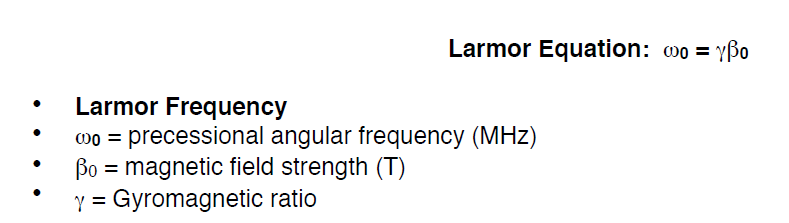
What is the Larmor equation?
At equilibrium, what do Mz and Mxy equal?
Mz = M0
Mxy = 0
What is the difference between T2* and T2 decay/relaxation?
- T2* depends on both intrinsic (spin-spin) and extrinsic (field inhomogeneities) relaxation factors
- T2 depends only on intrinsic spin-spin interactions
What is the T2 decay constant?
Time after the 90-degree RF pulse (time 0) over which the signal decays to 37% of the maximal transverse magnetization
What causes T2 shortening?
- Slow molecular tumbling rates
- Rigidly bound molecules (tumbling slower than the Larmor frequency)
- Large macromolecules
Arrange from long to short the T2 relaxation times of:
Grey matter, CSF, white matter
CSF (long) > grey matter > white matter (hypo)
How does magnetic field strength affect T2 relaxation?
Magnetic field strength has no effect on T2 relaxation (unlike T1)
What causes T1 shortening (hyperintensity)?
- intermediat molecular tumbling (close to Larmor), size and protein binding
- fat stores in adipose and marrow tightly bound and close to Larmor
- protein binding in fluids (mucin) close to Larmor)
Arrange tthe following from short to long T1 relaxation times:
CSF, fat, grey matter, white matter
fat (hyper) < white matter < grey matter < CSF (hypointense) Mmm
How does B0 impact T1 relaxation?
Larger B0 can cause increased T1 relaxation times - due to less overlap of lattice with precessional frequencies
What is the T1 relaxation constant?
Time needed to recover 63% of the longitudinal magnetization (Mz) (after the 90 degree RF pulse)
What are the typical TR and TE for T1?
TR = 400-600, TE = 2-20
What molecules can cause T1 shortening?
Gd-DTPA and methemoglobin
T2 shortening?
Gd-DTPA, deoxyhemoglobin and intracellular methemoglobin
What is the difference in resonance frequencies of the protons in water and fat?
224 Hz (3.5 ppm)
WHat are the TR and TE in PD weighting?
TR = 2000-4000, TE = < 40
What is the typical TI for STIR?
TI = 140-180 ms, TR = 2500
WHat is the typical TI and TR of FLAIR?
TI = 2400, TR = 7000
How can you make a GRE sequence more T1W? more T2W or PD?
- T1W GRE: Short TE, large FA (70-90)
- PD GRE: Short TE, medium FA (40-50)
- T2W GRE: Longer TE, small FA (5-30)



