XR signs of OM and timeline
1) Effusion/ST swelling (acute)
2) Lytic lesion 10 -14 days
3) Peiosteal reaction 10-21 days
Osteomyelitis: organisms & Abx
S. Aureus (most common)
GAS, Strep Pneumo
Kingella Kingae (6mo-4y)
- Salmonella - SCD*
- Pseudomonas - nail through sneaker*
Abx:
- Ancef, (Vanco if MRSA)
- Cefuroxeme (if not vacc agst H Flu)
Complication of septic arthritis
Vascular compromise –> ischemic injury
Hip: avascular necrosis of femoral head
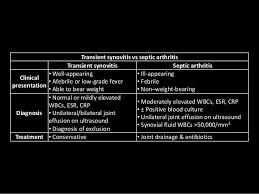
compare Transient/toxic synovitis vs Septic arthritits
Kocher Criteria and Risk of SA
- WBC > 12
- ESR > 40
- Fever
- NWB
Number of RFs:
- 3%
- 40%
- 93%
- 99%
Ways to detect an “open joint” ?
1) Direct visualization
2) Air in joint on XR
3) “Saline load test”: injecting saline into joint from another area, ans seing if leaks via injury area
Describe the following OVERUSE injuries
- Osgoode Schlatter
- Sinding-Larsen–Johansson Disease
- Little League elbow
- O-S: apophysisits of tibial tubercle , patellar insertion site
- runners/jumpers, 11-15 (pre pubertal, physis closure)
- focal tenderness @ tib tubercle, prone, heel to buttocks = pain, forced extension/jumping/squatting/direct pressure
- SLJ: traction apophysitis of inferior patella
- running and jumping , same as OS
- same maneuvers as S
- Little league elbow
- Medial epicondylitis or apophysitis
- result of repetitive valgus stress on underdeveloped joint
- avulsion fracture can result
- Pain with valgus or point tenderness
Osteocondritis Dissicans:
1) Types?
2) Who ?
3) Where ?
1) Juvenile vs Adult - prognosis differs, juvenile more likely to spontaneously
2) Juvenile: Male athletes 12-16 yo
3) Knee: medial femoral condyle, Ankle: posteromedial aspect of the talus, Elbow: capitellum
osteochondritis dissecans:
1) presentation
2) exam
3) XR finding
1) pain develops over months, worse w activities, pain/stiffness w hours rest, free body –> locking
2) often normal, can have effusion
3) XR: early: none, then a crescentic-shaped defect within the subchondral bone, +/- free bodr
osteochondritis dissecans:
management
depends on the age and skeletal maturity
- Skeletal immature or Early disease: conservative w activity restriction
- Surgical intervention
- Adults: surgery often needed
- Fail to improve with conservative after 6 mo
- Free body is unstable - also needs OR
- OR;
- via arthroscopy
- fragment is replaced by same or graft
tenosynovitis: signs
●Tenderness along the course of the flexor sheath
●Symmetric or fusiform enlargement of the affected digit
●Slightly flexed finger at rest
●Pain along the tendon with passive extension
Lis Franc Injury /#
Complications
- Foot compartment syndrome after a major trauma
- Nonanatomic reduction or alignment
- Posttraumatic midfoot arthritis (most common)
- Chronic pain
- Painful hardware, hardware failure, or breakage
- Flatfoot deformity with instability with weight bearing
- Vascular injuries dorsalis pedis artery
- Deep peroneal nerve injury
Name the pelvic avulsion fracture sites
ASIS- sartorius AIIS- rectus femoris ILIAC CREST - abdominal muscles PUBIS SYMPHISIS (sup corner)- rectus abdominis Ischial tuberosity- hamstrings Lesser trochanter - iliopsoas
Differentiate
Monteggia vs Galeazzi
G.M
Galeazzi: Radial # + RUJ dislocation
Monteggia: Ulnar # + Rad Head dislocation
Causes of Pathologic Fractures
Non-malignant (Benign) tumor – osteochondroma, giant cell tumor
Malignant tumor – chondrosarcoma, ewing sarcoma
Hereditary - gaucher disease, osteogenesis imperfecta
Endocrine/metabolic: hyperparathyroid, renal osteodystrophy
Infectious
what is gaucher disease
hereditary
Lysosomal storage disease
Osteoporosis –> pathologic fractures
C-spine lines on XR
4 cervical lines:
- Ant Vertebral line
- Post Vertebral line - ant margin of spinal canal
- Spinolaminar line - posterior margin of spinal canal
- Spinous process tips
PECARN C-spine clinical variables indicating risk of injury
- altered mental status
- Neurologic deficit
- neck pain
- Substantial torso injury
- high-risk motor vehicle collision
- diving
NEXUS C-SPINE RULES
- midline cervical tenderness
- intoxication
- alertness
- focal neurologic deficit
- distracting (painful) injury (i.e., long bone fracture, visceral injury, large laceration, degloving or crush injury, large burns, and injuries producing impairment in appreciation of other injuries).
CANADIAN C-SPINE RULES
(high risk)
1) Age >65
2) Dangerous Mechanism
2) Paresthesias in extremities




