What is a ‘Normal labour’?
The process in which the foetus, placenta and membranes are expelled via the birth canal. It is:
- Spontaneous in nature
- Occurs during 37-42 weeks gestation
- Foetus presenting by the vertex - head down
- Results in a spontanous vaginal birth (SVD)
It is not fully understood why labour commences, however, what are 3 key physiological changes that must occur to allow for expulsion of the foetus?
- Cervix softens, shortens and thins out
- Myometrial tone changes - allows for coordinated contractions
- Progesterone decreases whilst oxytocin and prostaglandins increase to allow for labour to initiate
How many stages of labour are there?
3
- First stage of labour - early/latent phase, active first stage and transition
- Second stage of labour - passive, active
- Third stage of labour - active or physiological
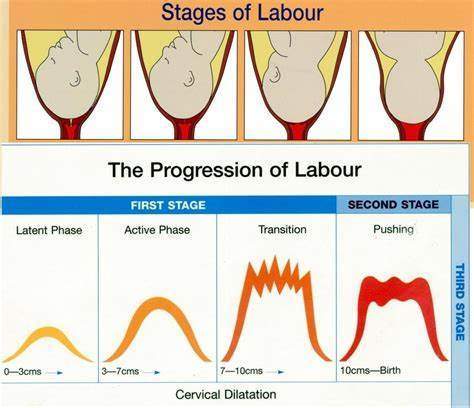
1st stage of labour
The first stage of labour can be split into the latent phase/ early and the active phase. There is then a transition phase before the 2nd stage of labour.
- Latent phase / early
- This can be the longest stage of labour as the body has to go through a lot of changes
- Irregular contractions start - short-lasting, mild in tone
- Cervical changes and dilatation up to 4cm
- Active phase
- Length of active labour can vary from 8-12hrs
- Regular, painful contractions
- Cervix is 4-10cm
- Transition
- Cervix is 8-10cm
- May experience physical changes such as shaking, vomiting or the need to empty her bowels
- May express that they can no longer cope
The 2nd stage of labour
The 2nd stage of labour can have a passive and active element to it. This stage lasts from being fully dilated to the birth of the baby. Length of second stage varies (depends if they are non-parous or multi-parous), usually varies between 2-3 hours.
Passive
- Woman is fully dilated - assess this with vaginal examination
- No involuntary expulsive contractions
Active
- See presenting part of baby visible
- Expulsive contractions
- Maternal effort
3rd stage of labour
The 3rd stage of labour is categorised from the birth of the baby to the expulsion of the placenta and membranes. Physiological and active component:
- Physiological management - up to 60 mins from birth
- No use of uterotonic drugs - used to induce contraction or greater tonicity of the uterus.
- No cord clamping
- Placenta is delivered by maternal effort
- Active management - 30 mins from birth
- Use uterotonic drugs i.e Syntocinon or Syntometrine
- Optimal cord clamping - wait for blood to drain from the placenta before clamping and cutting the cord and then deliver it by controlled cord traction
What is controlled cord traction?
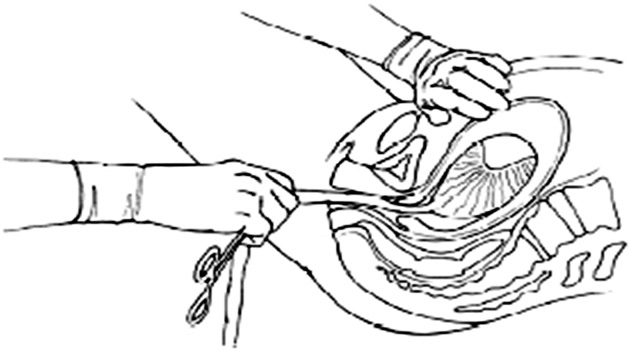
Traction applied to the umbilical cord once the woman’s uterus has contracted after the birth of her baby, and her placenta is felt to have separated from the uterine wall, whilst counter-pressure is applied to her uterus beneath her pubic bone until her placenta delivers.
Basically, you carefully pull it out.
What is meant by the mechanism of labour?
The mechanism of labour covers the passive movement the foetus undergoes in order to navigate through the maternal bony pelvis. Labour can be broken down into several key steps.
What are the stages/mechanisms of labour?
- Engagement and descent
- Flexion
- Internal rotation
- Crowning and extension of the head or presenting part
- Restitution
- Internal rotation
- Lateral flexion of shoulders
What mechanism does labour start with?
Engagemenet and descent
- This might happen before labour begins - especially in non-parous women
- In multi-parous women this may start after labour has already commenced
How does the pressure in the uterus change in order to aid descent of the foetus into the pelvis?
During the first stage of labour the contraction and retraction of the uterine muscles allow less room in the uterus. Fundal dominance of the uterine contractions pushes the foetus down.
This pressure aids descent.
Once the waters have broken and if there is any maternal effort, this process may speed up.
What is engagement?
This is when the largest diameter of the fetal head descends into the maternal pelvis.
Engagement is identified by abdominal palpation, where the fetal head is 3/5th palpable or less.
What is the effect of increasing flexion throughout labour?
- Fundal dominance of uterine contraction exerts pressure down the fetal spine towards the occiput, forcing the occiput to come into contact with the pelvic floor.
- As the foetal head comes into contact with the pelvic floor, cervical flexion occurs.
- In this position, the foetal skull has a smaller diameter which aids navigation through the pelvis.
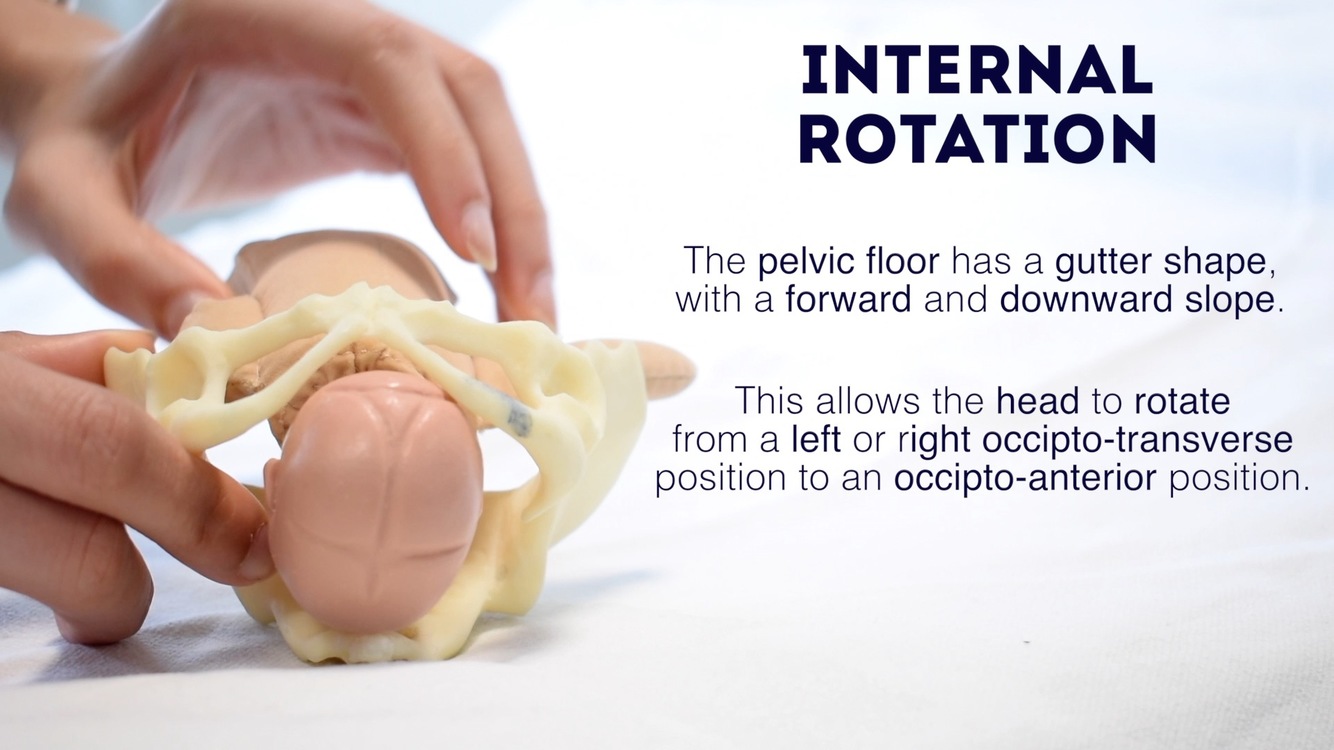
When does internal rotation occur?
- During the contractions the leading part is pushed down towards the pelvic floor.
- As the pelvis is hammock shaped when the baby’s head pushes against it it is pushed forward. The resistance from it brings about the rotation.
- Regular contractions eventually lead to the fetal head completing the 90-degree turn.
- Baby moves from a left or right occipito transverse position to an occipital-anterior position (occiput facing forward).
This rotation will occur during established labour and it is commonly completed by the start of the second stage.
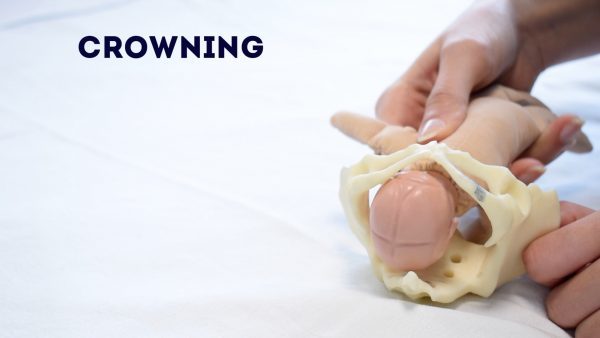
What is crowning?
When the widest diameter of the foetal head successfully navigates through the narrowest part of the bony pelvis.
This is clinically evident when the head, visible at the vulva, no longer retreats between contractions.
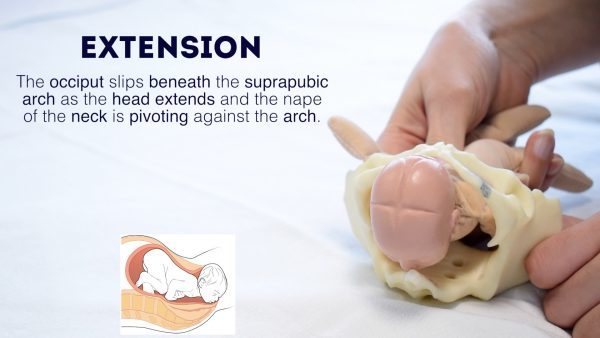
Extension of the presenting part
- The occiput slips beneath the suprapubic arch allowing the head to extend.
- The fetal head is now born and will be facing the maternal back with its occiput anterior.
- See the brow, the face and the chin be born over the pernieum
What is Restituition?
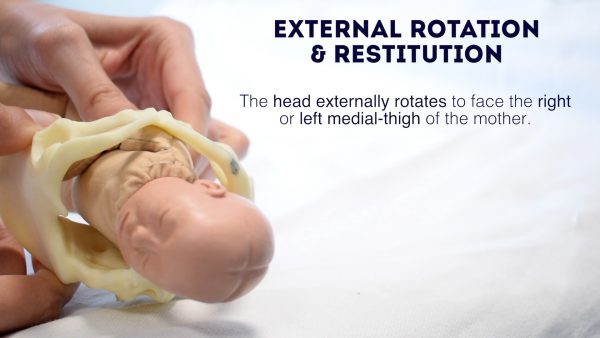
- The twist of the baby’s neck that results from the internal position now being corrected. Will try to face the same direction it was facing in utero.
- Because the shoulders at the point of the head being delivered are only just reaching the pelvic floor they are often still negotiating the pelvic outlet and the fetus may naturally align its head with the shoulders.
- You may see the head externally rotate to face the right or left medial thigh of the mother.
Lateral flexion of the shoulders is the last mechanism of labour. What happens during this stage?
- Aid the birth of the baby by giving gentle downward traction - assists delivery of the anterior shoulder below the suprapubic arch.
- This is followed by upward traction assisting the delivery of the posterior shoulder.
- The fetal body will be delivered by the contractions, the health professional’s role is only to assist safe negotiation of this last stage.
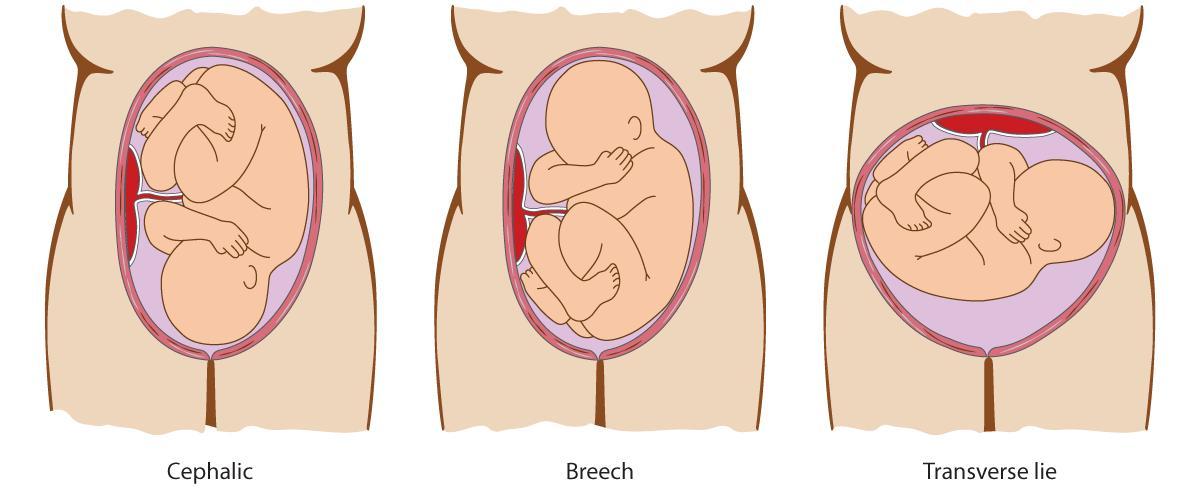
Foetal lie
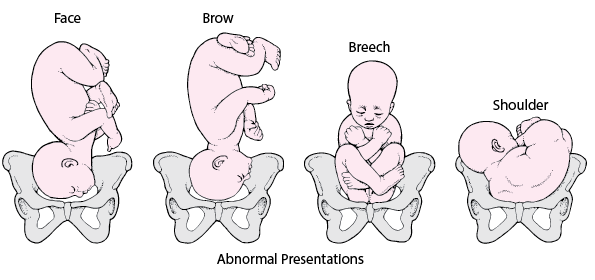
Abnormal foetal presentations
Look
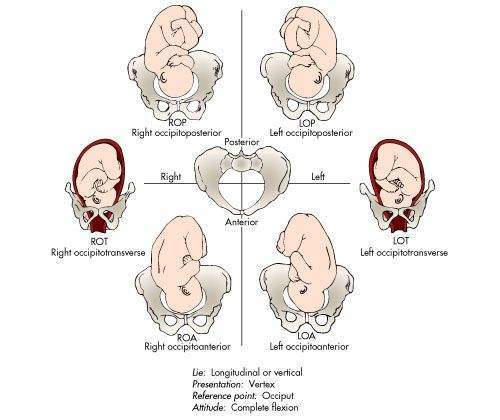
How do you assess foetal wellbeing during labour?
Foetal heart - may assess through intermittent auscultation or continuous monitoring
What devices are used to monitor foetal heart?
- Pinards stethoscope - intermittent auscultation
- Hand held doppler - intermittent auscultation
- Cardiotocograph (CTG) - continuous monitoring
What is considered a normal foetal heartrate?
Between 110-160 bpm
Good variability (>5bpm) and accelerations (15 bpm)


-
Antenatal screening33
-
Contraception24
-
Embryology27
-
Maternal and perinatal mortality18
-
Pharmacology in pregnancy58
-
Genital symptoms27
-
An intro to STIs23
-
History and examination24
-
Menstrual disorders32
-
Common pathologies in pregnancy33
-
Basic Male reproductive physiology22
-
Breast anatomy25
-
Basic Female reproductive physiology20
-
Prolapse22
-
Incontinence25
-
Infertility21
-
Cervical screening27
-
Cervical cancer21
-
Vulval cancer15
-
Menopause, HRT and Amenorrhoea20
-
Normal labour37
-
Abnormal labour21
-
Obstetric emergencies17
-
Postnatal care18
-
Infant feeding25
-
Complications in pregnancy 128
-
Complications in pregnancy 238
-
Breast cancer + cytology/histology40
-
Pathology of the breast12
-
STIs27
-
Endometrial Cancer15
-
Physiological changes during pregnancy15
-
HRP20
-
Anatomy31



