List the obsessive-compulsive Related Disorders (5)
- Obsessive-compulsive disorder
- Body dysmorphic disorder
- Hoarding Disorder
- Trichotillomania
- Excoriation Disorder
(there are also substance/medication-induced and those related to medical condition)
Obsessive compulsive disorder: male/female
- M=F (males have earlier onset)
(Lifetime prevalence: 3%; 12-month prevalence US 1%; internationally 1-2%)
Onset of obsessive-compulsive disorders
Late teens to early twenties
Obsessive compulsive disorder course of disease
- 85% chronic
- 10% Progressive or deteriorating
- 2% episodic (periods of remission)
Criteria for obsessive compulsive disorder (4)
- Either obsessions or compulsions are both
- They recognize that these are excessive or unreasonable (except in children)
- Time-consuming (>1 hour/day)
- Distress and impairment
Define obsessions
- Recurrent and persistent thoughts, urges or images that are experienced - intrusive and inappropriate
(The person attempts to ignore or suppress such thoughts, impulses or images, or to neutralize them with some other thought or action)
Define compulsions
- Repetitive behaviors or mental actions patient feels driven to do in response to an obsession, or according to rules that must be applied rigidly
(trying to prevent or reduce anxiety or distress; Young children are not able to articulate the aims of these behaviors or mental acts)
OCD specifiers (3): patient thinks that the OCD beliefs are ______
- With good or fair insight: are definitely or probably not true
- With poor insight: are probably true
- With absent insight/delusional beliefs: absolutely are true
OCD biological findings
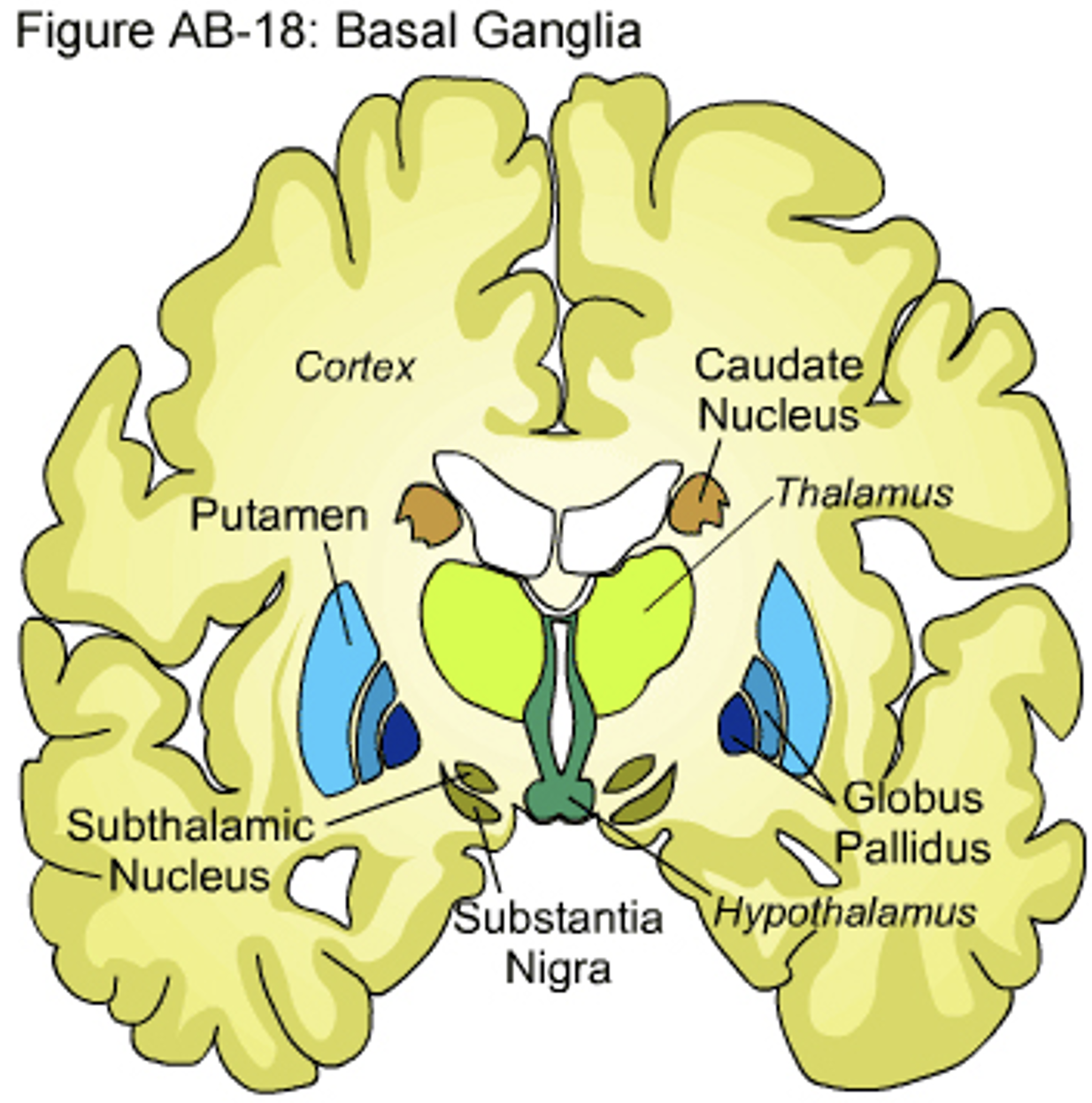
- Dysfunction of the Corticostriatal circuit:
- Orbitofrontal cortex
- Caudate nuclei
- Globus pallidus
- May occur in neurological disorders that involve the basal ganglia (Huntington’s disease)
OCD: genetic risk factors:
- First ° relative of adults with OCD
- Concordance rate between Twins
- 2X risk; If adult had childhood onset, risk 10X
- 0.57 for monozygotic twins& 0.22 for dizygotic twins
(don’t memorize numbers, just know that genetics plays a role)
OCD: pattern of anxiety (anxiety, cognitions and behaviors) (4)
- Panic attacks: related to obsessive fears
- Anticipatory anxiety: Triggers of O-C behavior
- Typical cognitions: Obsessive fears of contamination, causing harm to others, not doing something “just right”
- Typical behaviors: Washing/cleaning, checking, ordering, avoiding contaminants
OCD treatment: first line and second line
- First line: SSRI, clomipramine, CBT, family therapy
- Second line: atypical antipsychotic augmentation
Body dysmorphic disorder (BDD) is a preoccupation with a______.
- perceived flaw in physical appearance
(Repetitive behaviors or mental acts in response concerns → Significant distress/impairment)
Body dysmorphic disorder specifiers they may have good/fair insight, poor insight or _______ (2)
- Muscle dysmorphia: think their muscles are too small
- Absent insight/delusional belief: completely convinced the dysmorphic beliefs are true
Prevalence of OCD and subtypes (greatest to least):
- Hoarding: 6%
- OCD: 3% (1% in 1 yr period)
- BDD: 3% of population
- Trichotiloomania: 2%
- Excoriation: 1.5%
(Excoriation & BDD ~ 70% female)
Body dysmorphic disorder is most common with which features (3)
- Skin
- Hair
- Nose
(Dermatology, cosmetic, orthodontia, and oral/maxillofaical surgery visits)
Body dysmorphic disorder: course of disease (onset, acute v. chronic, remission)
- Onset: adolescence - early adulthood
- Chronic
- Full remission rare
(Have genetic predisposition to obsessional thinking)
BDD impairments
- No work or school
- Housebound
- Psychiatrically hospitalized
- Suicidal ideation & attempts
(Completed suicide 22-36x general population)
Body dysmorphic disorder treatments (3)
- CBT: correcting cognitive distortions
- SSRIs
- Don’t refer to a plastic surgeon
(Be empathy, instill hope, educate about the condition, focus on suffering and impact on life)
Criteria for hoarding disorder
- Difficulty discarding possessions, regardless actual value→congest and clutter active living areas
(significant impairment, not caused by other disorder)
Hoarding disorder: course of disease
- Symptoms may begin 11-15 yo
- Severity increases w/ each decade of life
- Chronic course
- Twin studies: approximately 50% variablility genetic
Hoarding disorder treatment focuses on:
- Excessive acquisition
- Difficulty discarding or letting go of possessions
- Disorganization and clutter
CBT for Hoarding disorder focuses on
- Thoughts and feelings about not acquiring things/getting rid of them
- Avoidance of anxiety due to lack of object/being less than perfectly prepared
- Test what will happen if does not acquire/how it will feel to not be perfectly prepared
Criteria for trichotillomania
- Recurrent pulling out of one’s hair → noticeable hair loss
(Attempts to stop pulling hair, causes distress/impairment)


-
Intro46
-
Mental Status Exam26
-
Anti-depressants55
-
Anti-depressants 255
-
Depression 147
-
Depression 239
-
Depression 382
-
Bipolar 124
-
Bipolar 244
-
Bipolar 3: Tx47
-
Psychotherapy 115
-
Psychotherapy 2 Types of Therapy67
-
Antipsychotics87
-
Schizophrenia 146
-
Schizophrenia 2: Subtypes49
-
Schizophrenia 3: Meds & Side Effects77
-
Anxiety41
-
Anxiety 221
-
Anxiety 356
-
Anti-anxiety Meds56
-
Drugs of Abuse 138
-
Drugs of Abuse 247
-
Suicide65
-
Substance Use Disorders 147
-
Substance Use Disorder 270
-
Substance Use Disorder 357
-
Personality Disorders 141
-
Personality Disorders 229
-
OCD39
-
Adjustment Disorder43
-
Trauma39
-
Violence36
-
Dissociative Disorders33
-
Somatoform39
-
Legal - Forensic Psychiatry49



