Trauma may result from witnessed events resulting in emotional or psychological impact, such as _____.
witnessing abuse
Psychological trauma may result from experiencing physical trauma, such as ______ (2).
- Traumatic brain injury
- Vehicle accidents
Psychological trauma may result from a single episode or be continuous and complex, for example _____ (2).
- Refugees
- Lengthy hospitalization
Examples of global traumatic events (6)
- War
- Economic upheaval
- Mass murder
- Natural disaster
- Epidemics
- Assassination
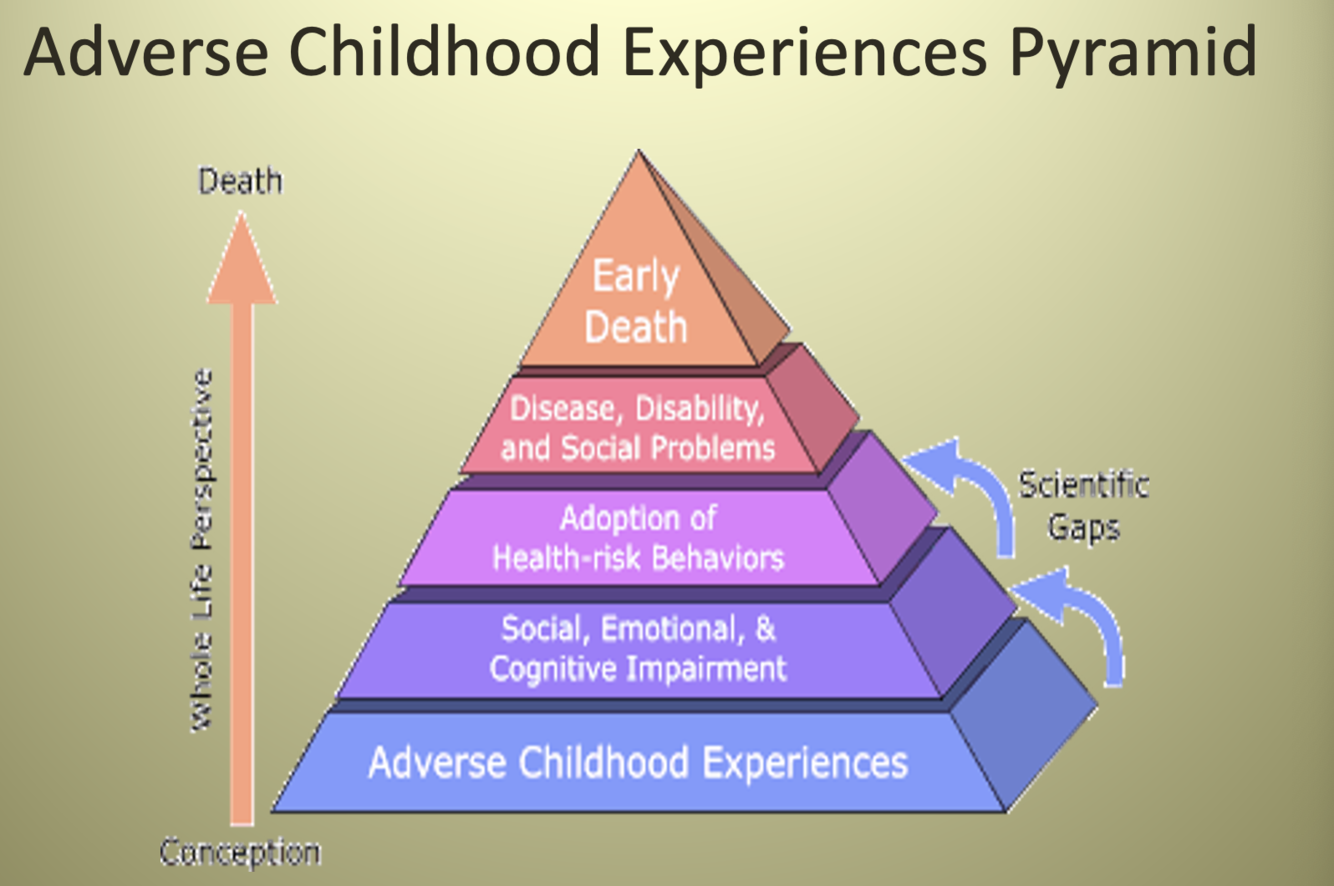
Health effects of adverse childhood experiences (4)
- Obesity
- Early onset smoking→COPD
- IV drug use
- Suicide attempts
List the trauma and stressor Related Disorders (5)
- Acute Stress
- Adjustment
- Disinhibited Social Engagement
- Posttraumatic Stress
- Reactive Attachment
Reactive attachment disorder: diagnostic criteria symptom clusters (3)
(“Sullen Girl”)
- Consistent pattern of inhibited, emotionally withdrawn Behavior toward adult caregivers (x2)
- Social and emotional disturbance (x2)
- Extremes of insufficient care (x1)
Criteria for reactive attachment disorder: requires both of these _____.
Child rarely or minimally seeks or responds to comfort when distressed
Children with reactive attachment disorder must have two of these persistant social and emotional disturbances (3)
- Minimal social and emotional responsiveness others
- Limited positive affect
- Episodes of unexplained irritability, sadness or fearfulness in non-threatening interactions with adult caregivers
Children with reactive attachment disorder will experience at least one of the following patterns of extremes of insufficient care (3):
- Lack of having basic emotional needs for comfort, simulation and affection met by adult caregivers
- Repeated changes of primary caregivers (foster kids or lots of Nannies)
- Rearing in unusual settings that severely limit opportunities to form selective attachments
Reactive attachment disorder signs are evident between the age of _____ & _____.
- 9 months
- 5 years old
(10% of severely neglected children)
Reactive attachment disorder treatment (4)
- Medical & psychiatric Care
- Parent education/adequate caretaking
- Parents psychiatric treatment
- Legal intervention
What is a major difference between Disinhibited Social Engagement Disorder and Reactive Attachment disorder?
- Disinhibited Social Engagement Disorder: Child approaches and interacts with unfamiliar adults
- Reactive Attachment Disorder: Child is unable to seek or respond to comfort of caregivers
(Both must be at least 9 months (developmentally) and have an extreme of insufficient care)
Disinhibited Social Engagement Disorder: pattern of behavior in which the child actively approaches and interacts with unfamiliar adults will exhibit two of the following 3 behaviors:
- approaches unfamiliar adults without reserve
- overly familiar verbal or physical behavior with unfamiliar adult
- willingness to go with unfamiliar adults or wander off w/out checking back
Disinhibited social engagement disorder is not limited to ______ and reactive attachment disorder must be differentiated from _______.
- impulsivity
- autism
How is the treatment of Disinhibited Social Engagement Disorder different from Reactive Attachment Disorder?
- same as RAD, except w/o legal or medical care
- Psychiatric Care: child & parent
- Parent education
- Adequate caretaking
PTSD: men is usually ______-related; women is usually ______-related.
- combat
- rape or assault
PTSD co-morbid disorders:
- Anxiety
- MDD
- SUD
PTSD crieria: for more than 1 month, the following cluster of symptoms are exhibited (associated w/traumatic event):
- Intrusion sx (x1)
- Avoidance of stimuli (x1)
- Negative alterations in cognition & mood (x2)
- Altered arousal or reactivity (x2)
PTSD may result from exposure to actual or threatened death, serious injury or sexual violence in one or more of the following ways: (4)
- Direct experience
- Repeated exposure to events
- Witnessing event in person
- Learning of event that happened to loved one
List the 5 intrusion sx that may be experienced in PTSD
(dx criteria x1)
- recurrent, involuntary, intrusive memories
- recurrent dreams
- Dissociative flashbacks
- Intense psychological stress when cued
- Physiological reactivity when cued
(cues are external or internal stimuli that resemble an aspect of the traumatic event)
List the 2 examples of persistent avoidance of stimuli associated w/the traumatic event in PTSD.
(dx criteria x1)
- avoid memories, thoughts, feelings associated
- avoid external reminders (people, places, conversations, acvities, objects)
List the 6 alterations in arousal & reactivity sx that may be experienced in PTSD
(dx criteria x2)
- Irritable behavior & angry outbursts (little to no provocation)
- reckless, self-destructive behavior
- hypervigilance
- exaggerated startle response
- difficulty concentrating
- sleep disturbance
List the 7 negative alterations in cognitions & mood sx that may be experienced in PTSD
(dx criteria x2)
- Inability to remember an aspect of the event
- cognitive distortions → self-blame
- exaggerated negative belief or expectation about the world, oneself or others
- negative emotional state
- inabilty to experience positive emotions
- feel detached or estranged from others
- decreased interest or participation in significant activities

-
Intro46
-
Mental Status Exam26
-
Anti-depressants55
-
Anti-depressants 255
-
Depression 147
-
Depression 239
-
Depression 382
-
Bipolar 124
-
Bipolar 244
-
Bipolar 3: Tx47
-
Psychotherapy 115
-
Psychotherapy 2 Types of Therapy67
-
Antipsychotics87
-
Schizophrenia 146
-
Schizophrenia 2: Subtypes49
-
Schizophrenia 3: Meds & Side Effects77
-
Anxiety41
-
Anxiety 221
-
Anxiety 356
-
Anti-anxiety Meds56
-
Drugs of Abuse 138
-
Drugs of Abuse 247
-
Suicide65
-
Substance Use Disorders 147
-
Substance Use Disorder 270
-
Substance Use Disorder 357
-
Personality Disorders 141
-
Personality Disorders 229
-
OCD39
-
Adjustment Disorder43
-
Trauma39
-
Violence36
-
Dissociative Disorders33
-
Somatoform39
-
Legal - Forensic Psychiatry49



