what are free radicals? and how do they cause damage ?
- an atom, molecules or ion that contains 1 or more unpaired electrons and is capable of independent existence
- by taking electrons from other molecules .. this reaction can generate a second radical and thereby propogating the damage
whats oxidative stress?
whats special about oxygen?
what are sources of biologic adn give examples?
- the inbalance between antioxidants and free radicals in the body
- oxygen has 2 unpaired electrons but they are in different energy levels and so is pretty stable
- endogenous ( electron transport chain / nitric oxide synthases / NADPH oxidases) + exogenous ( drugs [primaquine-antimalarial drug ; aspirin ; antibiotics ;] pollutants, toxins [paraquat herbicide], UV radiation, cosmic rays and x-rays)
what do ROS RNS damage?
what are the bodies defences against it?
- proteins ;
by causing change to the backbone= fragmentation = protein degradation or by causing an effect on the side chain = change in protein structyr leading to either gain of funciton or loss of it.
-lipids ;
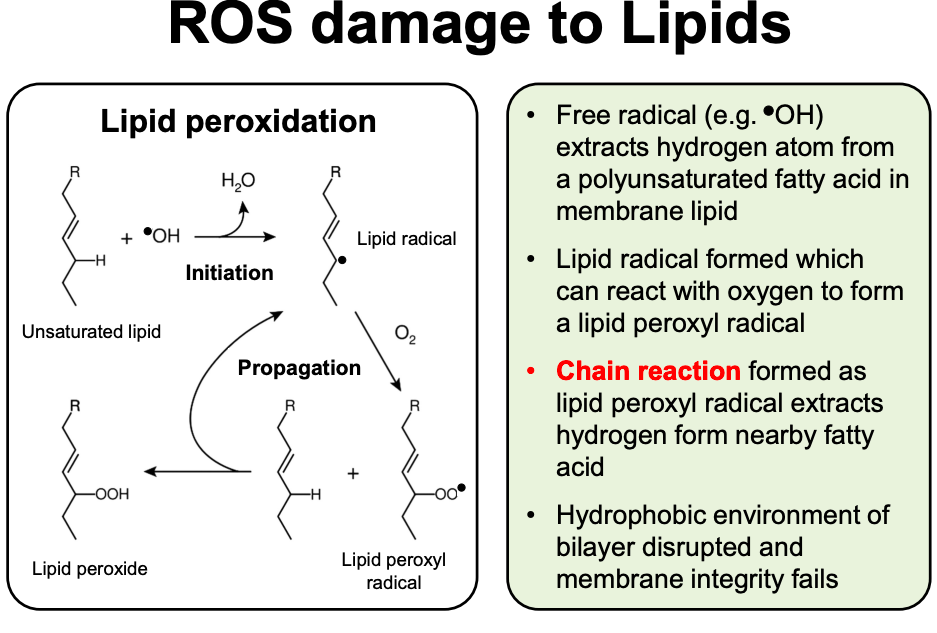
free radical (OH-R) extracts hydrogen atom from polyunsaturated fatty acid in the membrane lipid, this lipid radical then reacts with oxygen to form lipid peroxyl radical.. then a chain raction is set up where lipid peroxyl extracts hydrogen from nearby fattu acid, this resuts in the disturbation of the hydrophobic environment of bilayer and the membrane integrity fails resulting in cell damage… this is known as lipid peroxidation
- DNA ;
ROS can react with the bases modifiying the base resulting in mispairing and mutation, or it can react with the sugar (ribose or deoxyribose ) cauing the strand to break and mutation on repair , these mutations result in cancer
disulfide bridges and their role
how do inappropiate dilsulfide bonds form?
- bond between -thiol groups of cysteine residues , important function in maintaining stability and folding of some proteins ( whcih are usaully secreted )
- if ROS rakes electrons from cyestine causing misfolding crosslinks and distruption of function
describe and draw the ROS of oxygen
draw the NOS pathway
image
describe NOS and the enxymes involved
- enxymes; iNOS = inducible NOS, prodced high NO conc. in phagocytes for toxic effect / eNOS; endothelial NOS (signaliing in vasodilation) / nNOS= neuronal NOS (signalling for neurotransmitters)
- NOS have a role in signalling (neuronal and endothelial) + S-nitrosylation ( covalent attachment of -NO to cyestines’ thiol group which has a regulatory role in baceria, yeast and plant and mammalian cells
- image
describe respiratory burst?
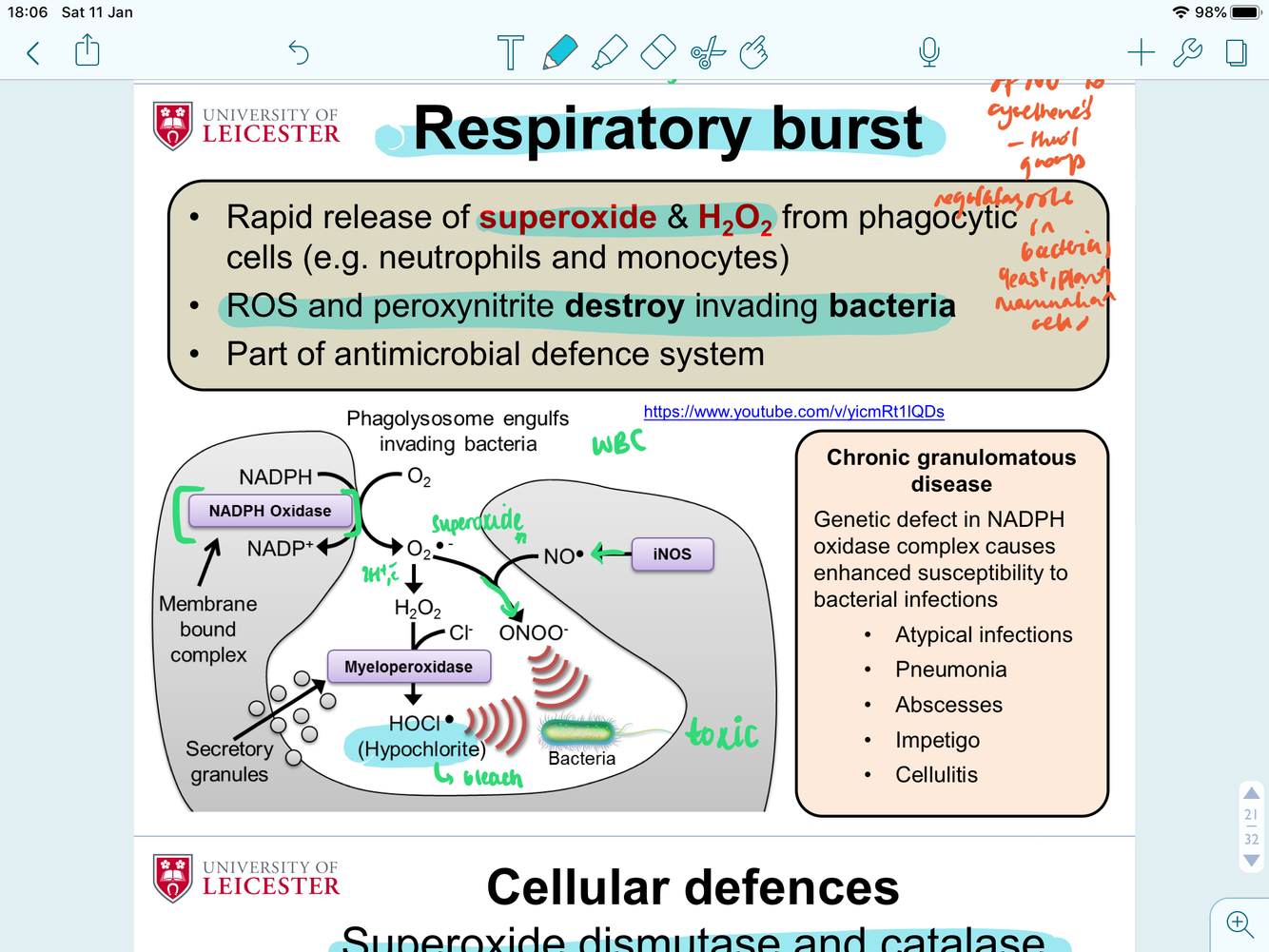
- rapid release if superoxide and H202 from phagocytic cells , the h202 react with cl- to form (HYPOCHLORITE) and the o2- reacts with NO-(from iNOS) to form ONOO-
- the aim is prodcue alot of toxins and destroy the bacteria by exposing it to alot of toxins
what are cellular defence enzymes
- superoxide dismutase (SOD) ; converts superoxide into h202 and o2. this is because primary defence because superoxxide is strong intiator of chain reactions ( 3 isoforms of the enzymes = CU+-ZN2+ CYTOSOLIC / CU+-ZN2+ EXTRACELLULAR / MN2_ MITOCHONDRIA
- catalase ; converts h202 to water and oxygen, common enzyme important in immunity and protection against oxidative burst, also declining levels of this enzyme are thought to contribute to grey hair
- Glutanthione ;
explain glutathione and how it works
- tripeptide made of glyceine-cysteine-glutamate
- image
- NADPH is made by Glucose 6 dehydrogenase in th pentose pathway , this NADPH is used by glutathione reductase to convert reduced GSH into oxidised GSSG, oxidised GSSG then gives it electron (H+) to h202 allowing it to be converted into h20 instead of being a free radical and reacting with other compounds in the body.
what are the enzymes involved in the glutanthione cycle adn what do they do?
- glutathione reductase which converts reduced into oxidised
- glutantione peroxide which requires selenium and helps remove the e from GSH and give it to h202
whats the purpose of the pentose pathway and why and what is the rate limiting enxyme?
- produce NADPH because its needed for ; reducing power for biosynthesis / maintainenxe of GSH levels / detoxification reactions
- glucose-6-phosphate dehydrogenase
what are other free radical scavengers (antioxidants) and how do they work
- vitamin E (alpha-tocopherol) which works in a similar way to GSH ; its is a lipid soluble antioxidant and is important for protection against lipid peroxidation
- vit C (ascorbic acid) is a water soluble antioxidant and works by regenerateing the reduced form of VIT E so it can be used to give e to free radical
- carotenoids / uric acid / flavonoids / melatonin
- they work by donating electrons (H+) to free radicals in nonenzymatic reactions
draw pathway for galactosaemia and explain its relation to oxidative stress
give symptoms
- defiency of galactokinase = galactose undergoes the reaction catalysed by aldolase which uses NADPH so NADPH cant be used to maintain GSH levels and so free radicals like h202 can remain in the system and cause damage
- cataracts and increased osmotic pressure
how does G6PDH deficency cause haemolysis ?
blister cells?
- NADPH isnt produced and so free radicals cause damage and so lipid peroxidation is undergone an dprotein damage, proteins aggregate and form heinz bodies (percipitated Hb) making the RBC more likley to undergo haemolysis since increased mechanical stress when they squeeze through capillaries
- spleen removes the heinz bodies and pinches it off allowign the RBC to continue
describe the metabolism of paracetamol?
Paracetamol can be metabolised into GLUCURONIDE and SULPHATE but once it reaches above threshold value it is converted into NAPQI which can cause oxidative damage to liver cells (lipid peroixdation/ damage to proteins/damage to DNA)
- with Glutathione depletion dueto affects of NAPDH you cant remove the oxidative stress
- treatment is Acetylcysteine treatment which works to increase the levels of GSH in the body helping fight the oxidative stress that is caused as a result of NAPQI
chronic granulomatous disease
- genetic defect in NADPH oxidase complex causes enhanced susceptibility to bacterial infections ;
- atypical infetions (infection of the respiratory tract) / pneumonia (inflammatory infection of lungs) / abscesses (collection of bacterial pus)/ impetigo(contagious skin infection) / celulitis (infection of the inner layer of skin)
how is the electron carrier chain a source of ROS
- NADH and FADH2 supply electrons from metabolic substrates , these elctrons pass through ETC and reduce oxygen to form h20 at complex IV, occasionally electrons can accidentally escape from the chain adn react with o2 to form superoxide
what the difference in enzymatic and non enzymatic reactions that generate free radicals?
- enzymatic = inolved in ETC + cytchrome P450 system
- reactions of oxygen with organic compounds
chronic granulomatous disease
genetic defect in NADPH oxdiase wc is involved in releaving NADPH of the H so it forms NADP+ in doing so giving the free pair of electrons to an oxygen to form a superoxide
in this condition patients present with constant recurrent atypical bacteria and fungal infections like pneumonia (listeria types), and candida species infections, and abscesses , impetigo, celluilitis,
testing is done using a flow cytometry or immunoblotting to look for decreased NADPH oxidase proteins, or genetic test
patients are diagnosed quite young
the reason they get these infections is due to the defect in normal respiratory burst sinc they are nable to generate as much superoxides using NADPH oxidase adn so find it hrder to fight off these infection
explain galactosemia pateint symptoms
galactose is converted into galacticol using aldolase reductase which uses NADPH and converted it into NADP+, so it cant use NADPH to oxidase GSSG, this results in the disulfide bridges froming inappaortaite interactions between cyestines resulting in coiling, this can be seen in cataracts of the patients eyes and inceaes osmotc pressure in the kidneys

-
Alcohol Metabolism5
-
Oxidative Stress20
-
Haemopoesis27
-
Blood34
-
Glycogen and Lipid17
-
Cholesterol4
-
Vitamin b12 and folate deficiency16
-
Amino Acid Metabolism24
-
Iron metabolism and microcytic anaemia24
-
Haemoglobinpathies ad Haemolytic Anemia22
-
Haemopoiesi24
-
Endocrine Pancreas21
-
Haematology in systemic disease26
-
Endocrine41
-
Diabetes31
-
HPA Axis24
-
Pituitary Disorders22
-
Parathyroid glad and calcium regulation46
-
Endocrine42
-
Metabolic and Endocrine control14
-
Adrenal Disorders52
-
Haematology87
-
intro to anaemia1
-
x1



