Adaptive Responses
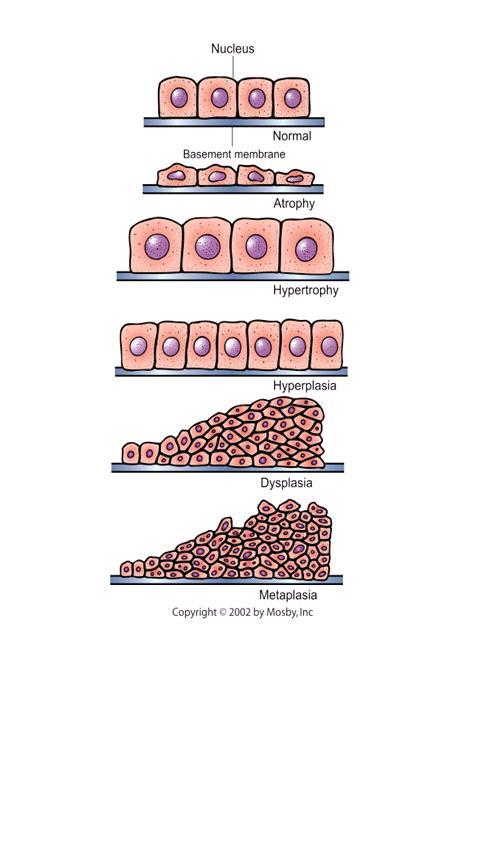
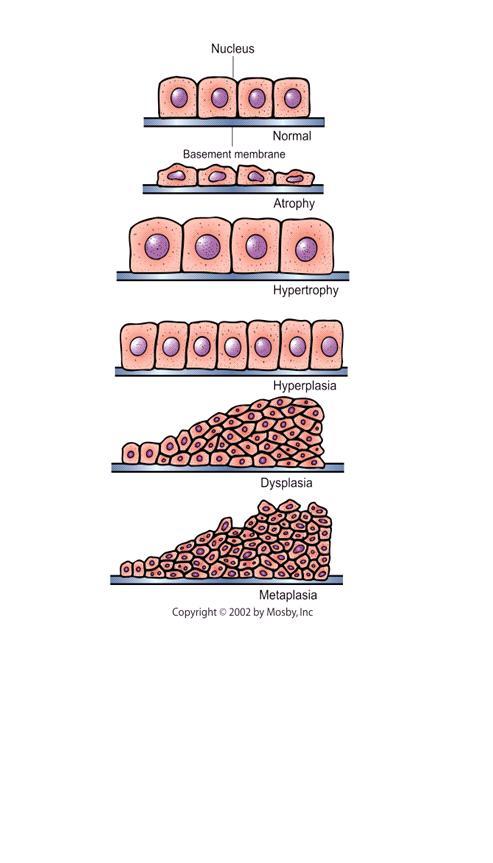
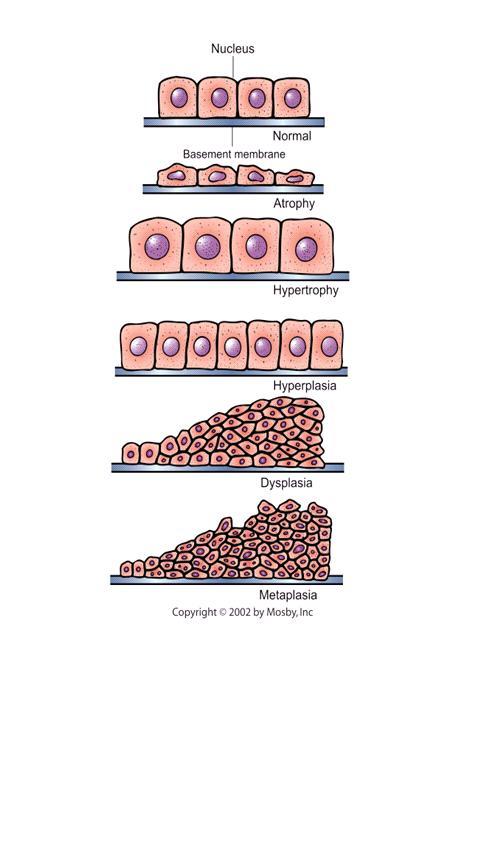
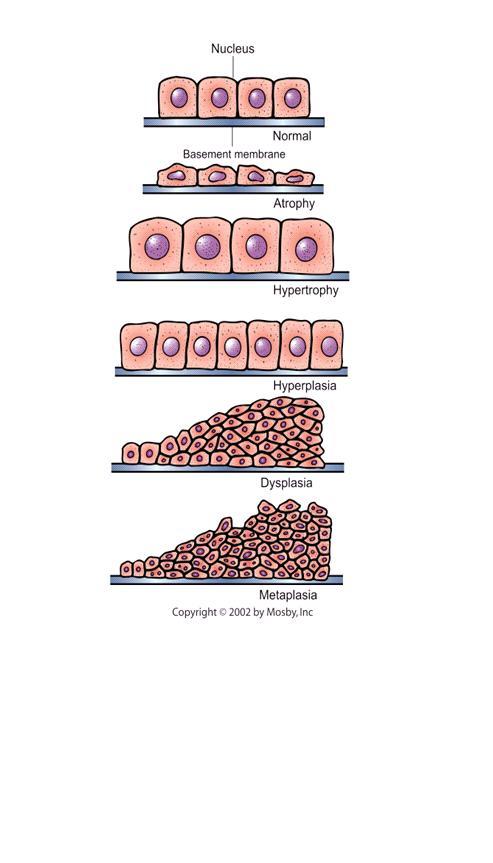
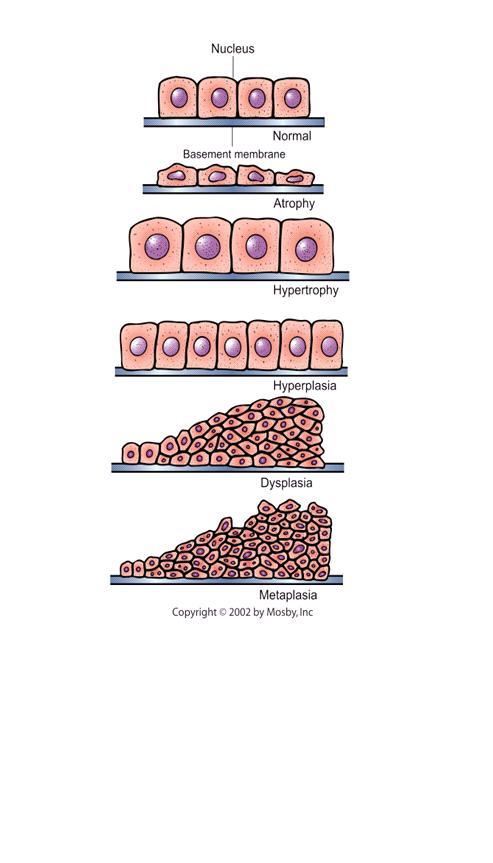
_______ is an increase in cell size (and functional components) that allows it to increase work demands.
a. ) metaplasia
b. ) hyperplasia
c. ) dysplasia
d. ) atrophy
e. ) hypertrophy
e.) hypertrophy
an increase in cell size (and functional components) that allows it to increase work demands
-trophy ⇒ change in cell size
Endocytosis is when the cell engulfs material, forms vesicles, and takes material into the cell.
_____ involves microorganisms, damaged cells, and other particles that are then killed/degraded.
Phagocytosis → involves microorganisms, damaged cells, and other particles that are then killed/degraded
Adaptive Responses
_______ is an increase in the number of cells (only in tissues with cells capable of division). Usually as the result of a chemical stimulus (i.e. uterus of pregnant women).
a. ) metaplasia
b. ) hyperplasia
c. ) dysplasia
d. ) atrophy
e. ) hypertrophy
b.) hyperplasia
an increase in the number of cells (only in tissues with cells capable of division). Usually as the result of a chemical stimulus (i.e. uterus of pregnant
There are two pathways for energy production. Where does aerobic respiration occur?
Aerobic = mitochondria
Anaerobic = cytoplasm
What happens if the nucleus is damaged?
- ) Accumulation of wastes
- ) Lack of O2 (no ATP)
- ) Nerve and muscle cells will not work
- ) Cannot synthesize/make certain proteins
- ) Transportation problems inside the cell
- ) Transportation problems into extracellular fluid
- ) Reactions may not occur
- ) Damage to cells caused by free radicals
- ) Proteins will be made in defective forms
Damage to Nucleus
4.) Cannot synthesize/make certain proteins
9.) Proteins will be made in defective forms
Endocytosis is when the cell engulfs material, forms vesicles, and takes material into the cell.
_____ involves fluid and dissolved particles.
Pinocytosis → involves fluid and dissolved particles
What happens if lysosomes are damaged?
- ) Accumulation of wastes
- ) Lack of O2 (no ATP)
- ) Nerve and muscle cells will not work
- ) Cannot synthesize/make certain proteins
- ) Transportation problems inside the cell
- ) Transportation problems into extracellular fluid
- ) Reactions may not occur
- ) Damage to cells caused by free radicals
- ) Proteins will be made in defective forms
Damage to Lysosomes
1.) Accumulation of wastes
Adaptive Responses
_______ is deranged cell growth that results in cells that vary in size, shape, and appearance; usually related to chronic irritation or inflammation.
a. ) metaplasia
b. ) hyperplasia
c. ) dysplasia
d. ) atrophy
e. ) hypertrophy
c.) dysplasia
deranged cell growth that results in cells that vary in size, shape, and appearance; usually related to chronic irritation or inflammation.
- increases risk for cancer*
- common places ⇒ airways of smokers, uterine of women*
What happens if the golgi complex is damaged?
- ) Accumulation of wastes
- ) Lack of O2 (no ATP)
- ) Nerve and muscle cells will not work
- ) Cannot synthesize/make certain proteins
- ) Transportation problems inside the cell
- ) Transportation problems into extracellular fluid
- ) Reactions may not occur
- ) Damage to cells caused by free radicals
- ) Proteins will be made in defective forms
Damage to Golgi Complex
6.) Transportation problems into extracellular fluid
Action potential causes the resting membrane to _______. Cell membrane becomes permeable to sodium → Na moves into cell r/t concentration gradient → depolarization occurs (inside of cell isn’t - anymore) → current-carrying ions pass through gap junctions to other cells → impulse conducted through muscle/nerve tissue.
Depolarize / Depolarization
Action potential causes the resting membrane to depolarize.
Cell membrane becomes permeable to sodium → Na moves into cell r/t concentration gradient → depolarization occurs (inside of cell isn’t - anymore) → current-carrying ions pass through gap junctions to other cells → impulse conducted through muscle/nerve tissue.
What happens if the cell membrane is damaged?
- ) Accumulation of wastes
- ) Lack of O2 (no ATP)
- ) Nerve and muscle cells will not work
- ) Cannot synthesize/make certain proteins
- ) Transportation problems inside the cell
- ) Transportation problems into extracellular fluid
- ) Reactions may not occur
- ) Damage to cells caused by free radicals
- ) Proteins will be made in defective forms
Damage to Cell Membrane
3.) Nerve and muscle cells will not work
All body cells are polarized; at rest, inside is more negative than outside. At this state, the membrane is permeable to K, so it goes out of cell and the inside becomes negative.
Resting Membrane Potential
All body cells are polarized;
At rest, inside is more negative than outside.
At this state, the membrane is permeable to K, so it goes out of cell and the inside becomes negative.
What happens if mitochondria are damaged?
- ) Accumulation of wastes
- ) Lack of O2 (no ATP)
- ) Nerve and muscle cells will not work
- ) Cannot synthesize/make certain proteins
- ) Transportation problems inside the cell
- ) Transportation problems into extracellular fluid
- ) Reactions may not occur
- ) Damage to cells caused by free radicals
- ) Proteins will be made in defective forms
Damage to Mitochondria
2.) Lack of O2 (no ATP)
In the resting state of a cell, is the inside of the cell regularly more negatively or more positively charged?
negatively charged
What happens if the ER is damaged?
- ) Accumulation of wastes
- ) Lack of O2 (no ATP)
- ) Nerve and muscle cells will not work
- ) Cannot synthesize/make certain proteins
- ) Transportation problems inside the cell
- ) Transportation problems into extracellular fluid
- ) Reactions may not occur
- ) Damage to cells caused by free radicals
- ) Proteins will be made in defective forms
Damage to ER
5.) Transportation problems inside the cell
There are two pathways for energy production. Where does anaerobic respiration occur?
Aerobic = mitochondria
Anaerobic = cytoplasm
Adaptive Responses
_______ is a change from one cell type to another that is better able to survive adverse circumstances. Usually triggered by chronic irritation/inflammation.
a. ) metaplasia
b. ) hyperplasia
c. ) dysplasia
d. ) atrophy
e. ) hypertrophy
a.) metaplasia
a change from one cell type to another that is better able to survive adverse circumstances. Usually triggered by chronic irritation/inflammation.
(i.e. smoking)
What happens if ribosomes are damaged?
- ) Accumulation of wastes
- ) Lack of O2 (no ATP)
- ) Nerve and muscle cells will not work
- ) Cannot synthesize/make certain proteins
- ) Transportation problems inside the cell
- ) Transportation problems into extracellular fluid
- ) Reactions may not occur
- ) Damage to cells caused by free radicals
- ) Proteins will be made in defective forms
Damage to Ribosomes
4.) Cannot synthesize/make certain proteins
9.) Proteins will be made in defective forms
Adaptive Responses
_______ is when the cell reverts to a smaller size and lower level of functioning. This causes a decrease in oxygen and energy needs, making the cell more compatible with survival.
a. ) metaplasia
b. ) hyperplasia
c. ) dysplasia
d. ) atrophy
e. ) hypertrophy
d.) atrophy
when the cell reverts to a smaller size and lower level of functioning. This causes a decrease in oxygen and energy needs, making the cell more compatible with survival
-trophy ⇒ change in cell size
Inside of cell returns to more negatively charged because of the pump.
Repolarization
Inside of cell returns to more negatively charged because of the pump.
What happens if peroxisomes damaged?
- ) Accumulation of wastes
- ) Lack of O2 (no ATP)
- ) Nerve and muscle cells will not work
- ) Cannot synthesize/make certain proteins
- ) Transportation problems inside the cell
- ) Transportation problems into extracellular fluid
- ) Reactions may not occur
- ) Damage to cells caused by free radicals
- ) Proteins will be made in defective forms
Damage to Peroxisomes
8.) Damage to cells caused by free radicals

-
Packet 121
-
Packet 225
-
Packet 2 (genetics)10
-
Packet 3 - Blood25
-
Packet 3 - Blood (part 2)24
-
Packet 4 - immunity & inflammation29
-
Packet 4 - immunity & inflammation (2)9
-
Patho Study Book27
-
Packet 5 - Immune System22
-
Packet 6 - Circulatory Function20
-
Packet 6 - Circulatory Function (2)15
-
Packet 6 - Circulatory Function (3)10
-
Packet 6 - Circulatory Function (4)8
-
Packet 7 - Circulatory System10
-
Packet 7 - Circulatory System (2)21
-
Packet 8 - Circulatory Function Part 212
-
Packet 8 - Circulatory Function Part 2 (2)5
-
Packet 8 - Circulatory Function Part 2 (3)15
-
Packet 8 - Circulatory Function Part 2 (4)20
-
Patho Study Book 219
-
Patho Study Book 313
-
Packet 9 - Respiratory System12
-
Packet 9 - Respiratory System (2)16
-
Packet 10 - Fluid Balance13
-
Packet 10 - Fluid Balance (2)17
-
Packet 10 - Fluid Balance (3)23
-
Packet 10 - Fluid Balance (4)2
-
Packet 11 - Renal Function13
-
Packet 11 - Renal Function (2)1
-
Packet 11 - Renal Function (3)10
-
Patho Study Guide21
-
Patho Review Questions21
-
Packet 12 - GI System2
-
Packet 12 - GI System (2)9
-
Packet 12 - GI System (3)0
-
Packet 13 - Hepatobiliary System7
-
Packet 13 - Hepatobiliary System (2)23
-
Packet 13 - Hepatobiliary System (3)10
-
Packet 14 - Endocrine Function17
-
Packet 14 - Endocrine Function (2)11
-
Packet 14 - Endocrine Function (3)8
-
Packet 14 - Endocrine Function (4)7
-
Quizlet Final P.Q.'s20
-
Quizlet Final P.Q.'s (2)17
-
Packet 15 - Endocrine System8
-
Packet 15 - Endocrine System (2)16
-
Packet 15 - Endocrine System (3)11
-
Packet 16 - Alterations in Neural Function Part 110
-
Packet 16 - Alterations in Neural Function Part 1 (2)8
-
Packet 16 - Alterations in Neural Function Part 1 (4)13
-
Packet 17 - Nervous System5
-
Packet 17 - Nervous System (2)11
-
Packet 17 - Nervous System (3)13
-
Patho Study Book Random5



