Lecture 01
Define “Proof:”
A proof is a sequence of statements that are connected by inferences
Lecture 01
Define “Theorem:”
A theorem is a statement that is the last line of the proof
Lecture 01
Define “lemma:”
A lemma is a theorem that is usually used within another proof
Lecture 01
What are conditional proofs?
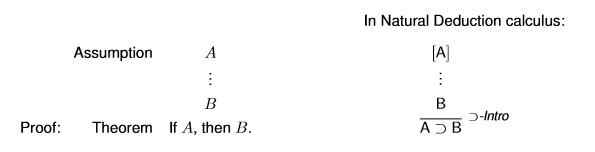
The starting points of proof are not definitions, axioms, or theorems but assumptions or hypotheses of which we don’t know whether they are true or false.
To prove a conditional statement:
Claim: if A then B
Assume A and show B
Lecture 01
What are biconditionals?
Claim: A if and only if B
- Assume A and show B
- Assume B and show A
Abbreviate “if and only if” by ‘iff”
Lecture 01
What are proof by cases?
Proof by cases the original problem is divided into two or more different problems that are smaller and thus easier to deal with, that can be attacked separately.
Must be finite cases (exhaustive)
Ex:
Claim: Every day of the weed has a “d” at the end
Proof: list the days of the week
The general structure of the Proof:
- Claim: Either A1 or A2 or … or An holds
- Case (1): Uner the assumption A1, we conclude C
- Case (2) Under the assumption A2, we conclude C
…
- Case (n): Under the assumption An, we conclude C
- Conclusion: C
Lecture 01
What is the Simplest case distinction?
Either A or not -A
- Formally: A v ¬A
- Tertium non datur,
Based on the principle of bivalence: every proportion is either true or false
Note: not all accept this! - Sometimes not able to determine which one of the cases actually holds, not necessary for the proof to work
- Bring a certain non-constructive element into proof technique
- Non-classical forms of reasoning
Lecture 01
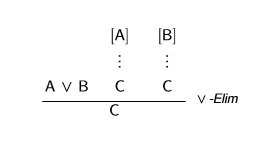
What is the formal system of Natural Deduction?
Inference rule that corresponds to this type of proof:
Lecture 01
Proof by contradiction/reductio ad absurdum:
Structure:
- Claim: A
- Assumption (for the sake of contradiction): Negation of A
- Argument (reductio)
- Contradiction (absurdum) Symbolically: ⊥
- Conclusion: A

-
Formal Systems25
-
Proofs10
-
Inductive vs. Deductive Logic17
-
Sets, Relations, Functions, and Cardinality25
-
Infinite Cardinalities20
-
Formal Systems12
-
Interpretation of Formal Systems8
-
Recursively Enumerable vs. Recursive Sets14
-
Meanings, Equivalence, & Independence16
-
Formula Trees and Propositional Logic23
-
Propositional Logic as a Calculus67
-
First-Order Predicate Logic14
-
First-Order Arithmetic31
-
First-Order Predicate Calculus13
-
Formal Theories21
-
Meta-Reasoning17
-
Turing Machines17
-
The Halting Problems9
-
Primitive Recursive Functions17
-
Recursive (Total) and Partial Recursive Functions8
-
Representability and Formal Theories of Arithmetic7
-
Godel's First Incompleteness Theorem15
-
Godel's Second Incompleteness Theorem0



