A 20-year-old female presents with several months’ history of worsening rash, mainly on her limbs. It started on her elbows and knees. It is itchy. She is otherwise well but has been suffering with stress for some time.
What is the most likely diagnosis?
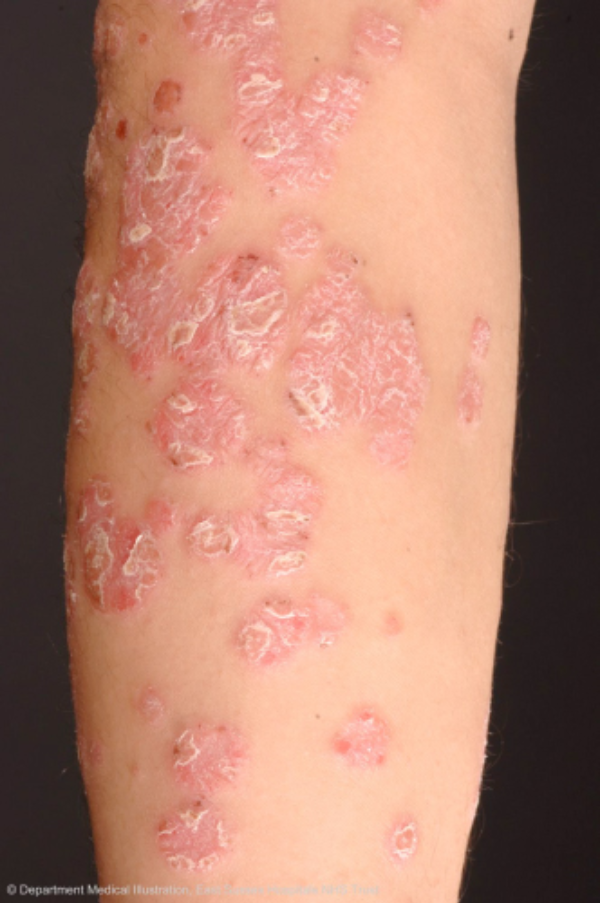
Psoriasis (plaque)
What are the different types of psoriasis? Describe each briefly.

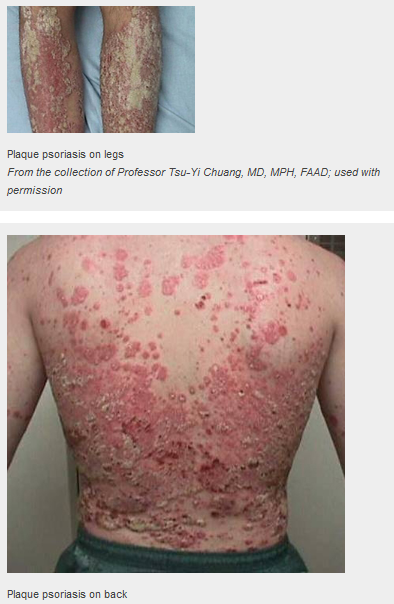
Plaque psoriasis = most common form, affecting 75 to 90% - patches of various sizes of red skin with white scales and can be very thick, particularly in scalp area.
Pustular psoriasis = small fluid filled pustules. It can be localised, or generalised. Generalised is a medical emergency as it can be fatal. The patient often is systemically unwell. They should be immediately referred and managed in secondary care.
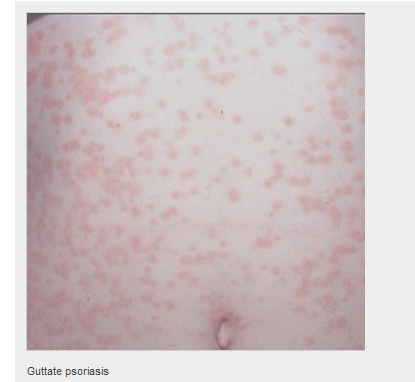
In guttate psoriasis = most of the body is usually covered with multiple tiny teardrop-like psoriatic patches. It often follows a bacterial throat infection.
Flexural psoriasis = red and shiny, due to the moist nature of the skin in the flexural areas. It affects areas such as the groin, axillae, inframammary folds etc.
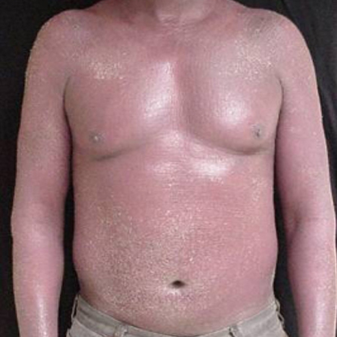
Erythrodermic psoriasis = widespread painful red skin – severe psoriasis with >90% of body affected. It is potentially life threatening – It requires immediate referral and treatment in secondary care.
Scalp psoriasis = commonest first presenting site
Which factors are known to exacerbate psoriasis?
- Stress
- Infections - Bacterial (streptococcal) and fungal infection may precipitate psoriasis
- Medications - Lithium, beta-blockers, anti-malarials, ACE inhibitors and withdrawal of steroids may also cause a flare-up.
- Smoking and alcohol
- Skin injury - Psoriasis may appear in the site of a recent skin injury.
- UV light- Ultraviolet light is usually beneficial except in cases of photosensitive psoriasis.
- Hormonal changes - female patients may find it is worse during puberty and menopause, and improves during pregnancy.
What treatments of psoriasis are commonly used in primary care?
- Emollients
- Vitamin D based creams
- Topical steroids
- Salicylic acid
Info:
Moisturisers soften the plaques.
Salicylic acid helps to lift off the scales and is often used in combination with other preparations such as coal tar and topical steroids.
Vitamin D based creams such as calcipotriol work well on plaque psoriasis – they are easy to use and are often the treatment of choice.
Topical steroids have to be used with caution and for a short period of time. When stopped, they may cause a rebound flare-up. They are useful in combination with other preparations (calcipotriol).
Dermatology only:
PUVA-oral** psoralen and **ultraviolet light** is used by dermatologists for severe psoriasis. Drugs which affect immune response are used for severe cases. They include **methotrexate** and **anti-TNF drugs such as Etanercept. The risk of serious side effects must be balanced with benefits under specialist supervision.
Define psoriasis.
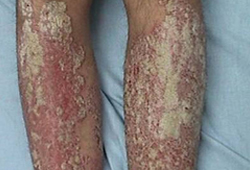
Psoriasis is a chronic inflammatory skin disease characterised by erythematous, circumscribed scaly papules, and plaques. It can cause itching, irritation, burning, and stinging.
It has cardiovascular and psychological comorbidities.
What sites are commonly affected by psoriasis?
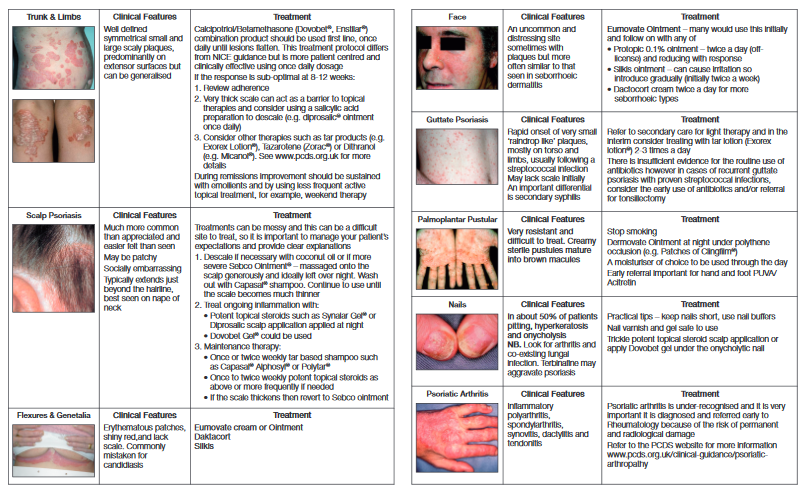
Often affecting elbows, knees, extensor limbs, and scalp, and, less commonly, nails, ear, and umbilical region.
What questions might you ask to distinguish eczema from psoriasis?
- Location - psoriasis is on extensor surfaces while eczema is on flexor surfaces
- Other involvement - psoriasis affects:
- Nails - pitting, ridging, onycholysis in psoriasis
- Scalp - often involved in psoriasis
- Joint involvement - might get pain in psoriasis
- Age of onset - usually later for psoriasis than eczema
FH will probably not help as there is often FH of eczema and psoriasis.
Is this psoriasis?
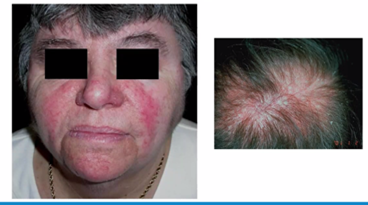
No - this is seborreic dermatitis/eczema - usually occurs in middle aged men and has a T zone, back and chest distribution (oily areas).
It ill ILL DEFINED but may show some scaling.
What is the aetiology of psoriasis?
Patients with psoriasis make new skin cells more quickly than normal, and this leads to inflammation of the skin.
The exact aetiology is unknown, but it is thought to be a combination of:
- autoimmune,
- genetic
- environmental factors e.g. infection like URTI → guttate
Patients with psoriasis are also more prone to develop obesity, joint problems, psychological problems and are more likely to have risk factors for CVD. Therefore, in primary care, it is also important to screen for associated problems as well when managing psoriasis.
Describe the pathophysiology of psoriasis. What is the silver scale made up of?
- Hyperproliferation + complex cascade of inflammatory mediators
- Mitosis of basal and suprabasal cells is increased → cells migrate to stratum corneum in a few days → silver scale of dead cells on the surface of lesions
- Condition primarily driven by Th1 cells → IL-17 and IL-23 cytokine production. Inhibition of these shows efficacy in treatment of psoriasis.
What are the 6 different types of psoriasis?
- Chronic plaque psoriasis
- Guttate psoriasis
- Flexural
- Palmoplantar
- General pustular
- Erythrodermic
Other manifestations:
- Psoriatic arthritis
- Nail psoriasis
- Keratoderma blennorrhagicum (reactive arthritis)
What does guttate psoriasis look like? When does it commonly occur?
Widespread, erythematous, fine, scaly papules (water drop appearance) on trunk, arms, and legs.
The lesions often erupt after an upper respiratory infection.
Describe plaque psoriasis.
- Raised inflammed plaque lesions
- Superficial silvery-white scaly eruption
- Scale can be scraped away –> inflammed friable skin
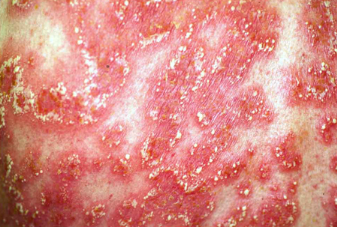
Describe the main features of pustular psoriasis.
- Rare and SEVERE
- Involves widespread inflammation of skin and small white/yellow pul-filled blisters/pustules
- Pus is made of WBC and is not infectious
Can be palmoplantar pustulosis - chronic involvement of hands and feet
Describe erythrodermic psoriasis.
- Uncommon, aggressive inflammatory psoriasis
- Can cause a peeling rash across the entire surface of the body
What investigations would you do for psoriasis?
Clinical diagnosis - usually no tests necessary
Annual CVD risk assessment - BP, lipids, BMI, glucose
PASI (see below)- psoriasis area and severity index score, used for treatment allocation by NICE
Others:
Skin biopsy (not done)- would show intra-epidermal spongiform pustules and Munro neutrophilic microabscess in the stratum corneum; focal parakeratosis and epidermal acanthosis with dilated capillaries and dermal papillae.

How do you manage psoriasis?
Primary care treatments:
Emollients = softens scale
Salicylic acid = to make plaques soft so the top scales off and then
Vitamin D analogue (topical calcipotriol 0.05%) = help the inflammation underneath
Topical corticosteroids (e.g. hydrocortisone 2.5%) = helps the inflammation underneath
For more severe cases:
- Topical tacrolimus/pimecrolimus
- Phototherapy - narrow band UVB or PUVA; 2-3 times weekly
Systemic therapy:
- Methotrexate
- Ciclosporin
- Acitretin
Advanced therapies:
- Dimethyl fumarate
- Apremilast - Oral phosphodiesterase-4 (PDE-4) inhibitor
- Biologics e.g. anti-TNFa, anti-IL-17, anti-IL23
What types of psoriasis are these? Which are dangerous?
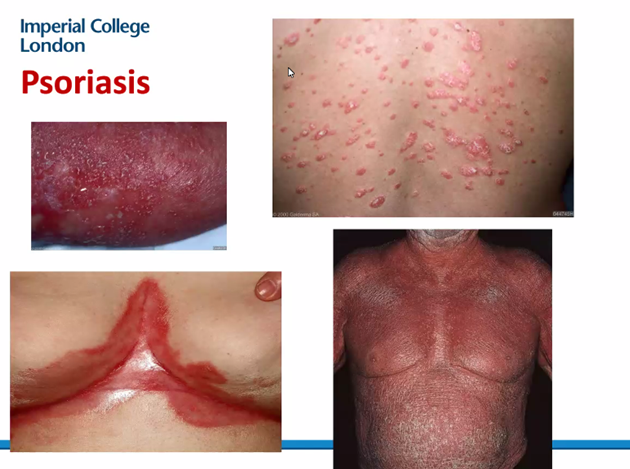
TL/?BR - erythroderma - if there is 90% skin involvement then this is an emergency (“red man syndrome”) because fluid and electrolyte balance will likely be disrupted and wet wraps are required, as well as fluid balance monitoring. Pustules can be seen (white)
TR - guttate/small plaque psoriasis - after strep throat infection; tear drop plaques; self-limiting
BL - flexural psoriasis, may also affect genitals; weepy if secondary infection
What is the difference bwteen a pustule and vesicle?
- Pustule – filled with pus
- Vesicle – clear filled fluid
Why should you see psoriasis patients anually?
CVD assessment in PSORIASIS – chronic inflammation puts you at risk of CVD so need an annual assessment.
Is UV treatment always helpful in psoriasis?
UV light treatment in psoriasis – useful in many patients but in some it can make it worse (a minority of photosensitive types)
When is sunlight not helpful in psoriasis?
In photosensitive psoriasis
What iatrogenic intervention can cause pustular psoriasis?
Pustular psoriasis may occur if you use steroids on psoriasis or orally
The pustules are sterile

What % TBSA psoriasis can be managed by primary care?
<10%
If more, then refer to dermatology



-
Cellulitis and Erysipelas17
-
CMV18
-
HSV16
-
HIV31
-
Infectious mononucleosis16
-
Malaria16
-
Neutropenic sepsis12
-
Erythema multiforme15
-
Necrotising fasciitis13
-
Psoriasis31
-
Chlamydia12
-
Gonorrhoea11
-
COVID-1912
-
General dermatology28
-
Toxic shock syndrome9
-
Typhoid fever12
-
Varicella Zoster16
-
[6] Urinary Tract Infections42
-
[8] Glomerulonephritis100



