Arthropathy
Pathology of the joints
Inflammatory arthritis
Includes a whole range of disease caused by inflammation. The immune system is at fault here. RA is one of the examples of this
Difference between primary and secondary arthritis
Secondary is when it is caused b trauma that may have happened several years ago or caused by genetics
Places where primary arthritis affects
Knee, hands, wrist etc More specifically they are PIP, DIP and carpometacarpal.
One way to diagnose secondary arthritis
The pain doesn’t happen in places observed with primary arthritis
Fundamental differences between RA and OA
OA is usually not bilateral, it is in an isolated joint such as a specific knee or shoulder. For RA these features are observed:
a. Systemic polyarticular involvement: usually 5, more joints than osteo, can be bilateral.
b. Upper and lower extremities are involved
c. PIPs are strongly involved, DIPs are not involved that helps with separating form osteo and rheumatoid
d. Osteo involves backpain, rheumatoid does not. People can have both osteo and rheumatoid so they can present with both of the disease symptoms
e. Predominant morning stiffness, usually last for more than hour, can be for several hours, in untreated patients it can take several hours, goes down with treatment
f. Joints effected are MCPs, PIPs, MTPs and wrists
Which one is systemic and which one is local in terms of RA and OA
RA is systemic, OA is local
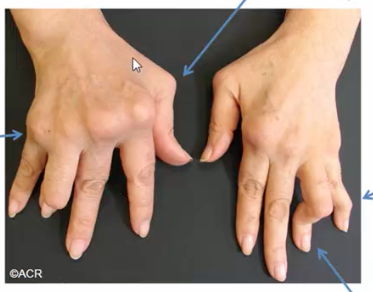
Know where the following features are: Z deformity on the thumb, Swann neck on the left pinky finger, Boutonniere deformity on the ring finger, these are all the signs of untreated rheumatoid arthritis
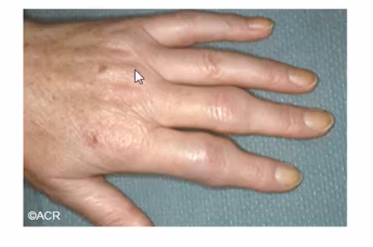
We can see here that the PIPs are swollen, DIPs are not swollen, we can feel the fluid on PIPs on examination and feel the bone on DIPs. Fingernails tell us that the person was a smoker, which is a risk factor of rheumatoid arthritis
Pulmonary manifestations of RA
- Since it is a systemic disease it also affects the lungs, she showed us a CT scan of a person who had very less normal lung tissue because there were honeycomb structures observed which were scarring due to the immune system attacking the lungs. a. There can be pleural disease where the pleural cavity is filled with fluid b. The above describes is interstitial lung disease c. There can also be pulmonary nodules
Cardiac manifestations
- Cardiac manifestation: a. Pericarditis: inflammation of the lining of the heart b. Myocarditis: inflammation of the muscle tissue of the heart c. Pericardial effusion: fluids in the lining of the heart d. Nodules on the valves of the heart e. Early or accelerated cardiac disease or heart diseases – driven by inflammation
Skin manifestations
- Skin manifestations: a. Nodules on the fingers – rheumatoid nodules b. Rheumatoid vasculitis – inflammation of blood vessel at the tip of fingers causing blockade and hypoxia leading to gangerene
Eye involvement
- Eye involvement: a. Dryness in the eye called the secondary Sjogren’s syndrome b. Episcleritis and scleritis which can progress to corneal melt
Other manifestations
- Other manifestations include: a. Felty’s syndrome: splenomegaly, leukopenia and RA b. Leukocytosis, thrombocytosis and anemia
First clinical manifestation and the more concerning clinical symptom
- The very first clnical manifestation of rheumatoid arthirits is the carpal tunnel syndrome due to inflammation in the wrist – an example of entrapment neuropathy. 2. The more concerning symptoms is the inflammation in C1-C2 region of the spine that is gonna press against the brain stem and may lead to paralysis
Prevalence and genetic linkage
General population has 1%, monozygotic twins have 20% and dizygotic twins have 5%.
Gene
Strongly linked to RA is HLA-DRB1 locus.
Environmental factors
a. Silica – miners are more prone b. Smoking c. Periodontal disease which is due to porphyromonas ginigvalis d. Gut microbiome – certain microbes in the gut makes you more prone to have RA
Environmental factors
a. Silica – miners are more prone b. Smoking c. Periodontal disease which is due to porphyromonas ginigvalis d. Gut microbiome – certain microbes in the gut makes you more prone to have RA
Immune system components involved
a. Th17 cells are at the heart of this b. Antigen presenting B cells are important – because rituximab is effective in treating RA c. Autoantibodies are made which are important to treat to control the symptoms of this disease
Mechanism of bone erosion:
Mechanism of bone erosion: a. Synovitis (inflammation in the synovial fluid) has TNF, IL-1 and IL-6. b. These act on the RANK-L c. This activates osteoclast, leading to bone destruction
Role of macrophages
They make all the cytokines and recruit neutrophils and mast cells
When treating RA why are we only concerned with joint pain and monitoring the progress of joint pain
Joint pain is indicative of other clinical manifestation and it can accuratly predict the progress of RA
What are some of the labs that we can order for diagnosis, progress and treatment
For diagnosis: RF and CCP (Anti cyclic citrullinated peptide)
Progress: ESR and CRP
Treatment: CBC with differential and look for creatinine levels, AST and ALT to keep an eye on liver toxicity.
ANA can be done to check for lupus. Sometimes it is positive.



-
Introduction21
-
Innate Immunity43
-
Acute Inflammation and Wound Healing32
-
Inflammation, DIC and Shock29
-
Arthritis and Systemic Inflammation8
-
Antigen Capture37
-
Antigen Recognition in Adaptive Immunity58
-
T Cell Immunity24
-
T Cell Effector25
-
Humoral Immunity34
-
Anti Inflammatory Medications26
-
Immunodeficiencies25
-
Hypersensitivity33
-
Immune Mediated Tissue Damage25
-
Tolerance and Autoimmunity36
-
Humoral Effector37
-
Diseases of B cells Deficiency5
-
Histopathology28
-
Opportunistic Infections7
-
Antibody Disorders16
-
Tumor and Transplant39
-
Immune Mediated Anemia12
-
Serum Sickness7
-
RA48
-
Liver Transplantation4
-
HSCT and GVHD4
-
eLearnings13
-
CNA and Autoimmunity19



