For results to be consistent in spirometry, FVC and FEV1 have to be within what percentage?
5%
What is a normal FEV1?
>80%
What is a normal FEV1/FVC ratio?
100%
What is FEF25-75%?
Mean expiratory flow over the mid 50% of expiration
Describe a normal flow volume loop.
Top loop is expiration
bottom loop inspiration
PEF = airflow in large airways
FEF25-75% = small airways, effort independent
FEV1 = middle airways
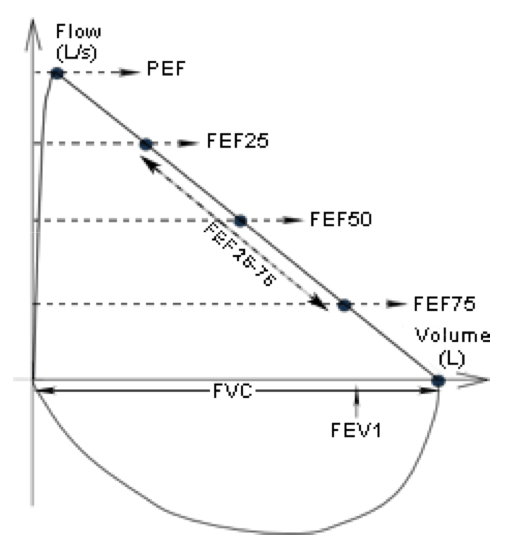
What does this flow volume loop indicate?
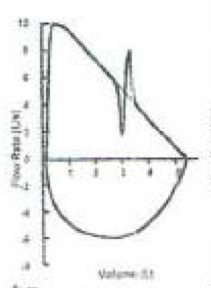
Coughing
What does this flow volume loop indicate?
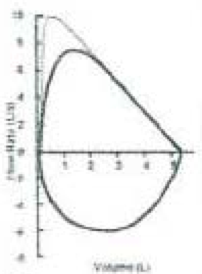
Slow start
What does this flow volume loop indicate?
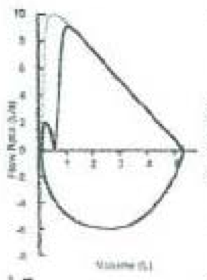
False start
What does this flow volume loop indicate?
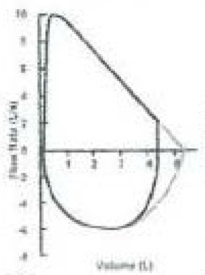
Early termination
What does this flow volume loop indicate?
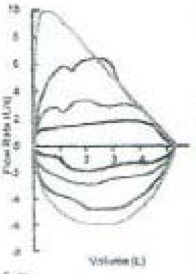
Variable effort
What does this flow volume loop indicate?
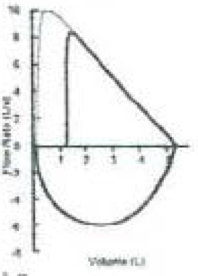
Not at TLC prior to start
What does a reduction in FVC indicate?
- Reduced lung size
- Restrictive lung disease or
- severe air flow limitation.
What does a reduction in FEV1 indicate?
Airflow limitation or severe restrictive process. [earliest change associated with airflow limitation seen in small airways (FEF: 75 then 25-50)]
What do changes in FEV1/FVC ratio indicate?
Proportion of Vital Capacity expired in 1 second.
Normal is 80%
FEV1/FVC ratio is decreased in obstructive lung disease.
If <70%, COPD can be diagnosed.
In restrictive lung disease, both FEV1 and FVC are reduced, therefore FEV1/FVC ratio should be approximately normal or increased.
10 yr old girl with persistant wheeze and cough.
FVC 98%
FEV1 76%
FEV1/FVC 69
FEF 25-75 34%
FEF50 44%
PF 77%
FIF 50% 116
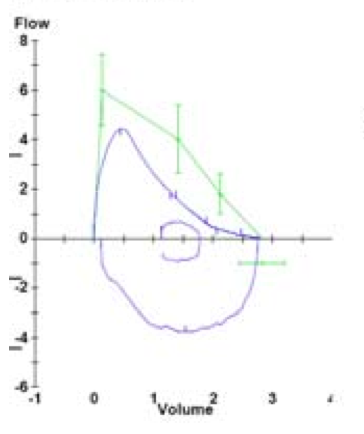
Inspiratory loop normal
Concave expiratory loop = obstructive.
FVC good
FEV1 reduced
FEV1/FVC reduced
FEF 25-75 reduced
Obstructive picture - asthma
What do you expect to see in an obstructive picture in spirometry?
- Low FEV1
- Low FEF 25-75
- Normal FVC
- FEV1/FVC
- Flow volume loop: Concave
- Normal large airways – can reach PEF
- Airways chockablock – air comes out slower like blowing through a straw
- Bronchodilator responsiveness: >12% increase FEV1
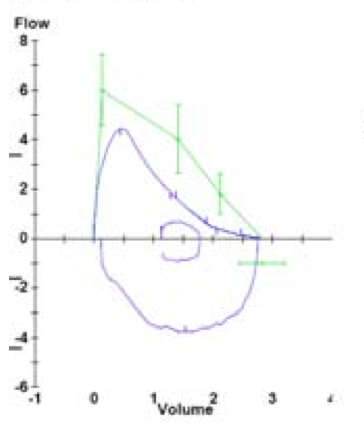
14 yo boy with severe extensive bronchiectasis
- FVC 85%
- FEV1 42%
- FEV1/FVC 42
- FEF 25-75 13%
- FEF50 15%
- PF 69%
- TLC 122%
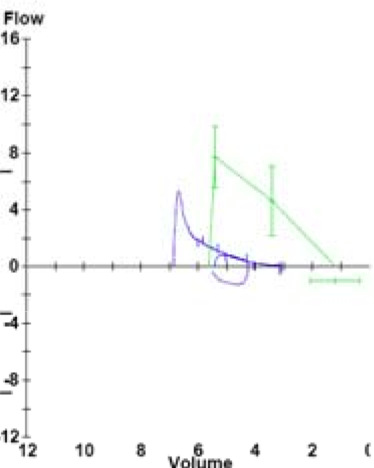
Mod to severe obstructive lung disease
- PEF reduced
- Concave expiratory loop
- FVC almost normal
- FEV1 reduced
- FEV1/FVC reduced
- FEF 25-75 reduced
- TLC high indicating air trapping
(FEV1/FVC ratio is decreased in obstructive lung disease)
What are the three main obstructive conditions?
Asthma
Cystic Fibrosis
Bronchiectasis
What is the main parameter to indicate obstructive lung disease in spirometry?
FEV1
- Normal >Lower limit of normal
- Mild >70%
- Moderate >50%
- Severe >35%
- Very severe <35%
- CF: FEV1 30% = 50% two year survival … transplant
In obstructive airways disease, what is the most useful long-term measure of disease progression?
FEV1
FEV1 is the most reproducible, most commonly obtained, and possibly most useful pulmonary function tests.
- objective measure of airflow in obstructive disease.
- FEV1 as a percentage of predicted norms is one of six criteria used to determine asthma severity. It provides an objective measure of airflow in obstructive disease.
- Lung hyperinflation can be adjusted for by FVC, which is why FEV1/FVC ratio of <80% for airflow limitation is used.
- Bronchodilator response with an improvement of >12% in FEV1 indicates obstruction.
- FEF25-75 considered by some to be more sensitive than the FEV1 for detecting early airway obstruction, but it has a wider range of normal values.
2008A Q36
A ten-year-old boy with severe bronchiolitis obliterans presents to the Emergency Department with increasing exercise intolerance over the previous week.
A capillary blood gas shows the following picture:
pH 7.29 [7.35 - 7.45]
pCO2 97 mmHg [36 – 44 mmHg]
Bicarbonate (HCO 3 -) 45 mmol/L [21 – 30 mmol/L]
Base excess +18 mmol/L [-3 – +3 mmol/L]
This result is most consistent with which of the following?
A. Acute on chronic respiratory acidosis.
B. Acute respiratory acidosis.
C. Chronic respiratory acidosis.
D. Mixed metabolic and respiratory acidosis.
E. Uncompensated metabolic acidosis.
A. Acute on chronic respiratory acidosis
pH is acidotic.
CO2 is elevated indicating respiratory acidosis.
HCO3- and base excess are elevated indicating compensation for respiratory acidosis, indicates more chronic picture.
pH being low despite chronic compensation shows an acute on chronic picture.
B is incorrect because compensation in place - chronic.
C is incorrect because if chronic with such strong compensation, pH should be better.
D and E are incorrect because HCO3- would be low for metabolic acidosis
2 most common systems in primary ciliary dyskinesia?
- respiratory
- otological
Methemoglobinemia
A disorder characterized by the presence of a higher than normal level of methemoglobin (metHb, i.e., ferric [Fe3+] rather than ferrous [Fe2+] haemoglobin) in the blood.
Methemoglobin is a form of hemoglobin that contains ferric [Fe3+] iron and has a decreased ability to bind oxygen. However, the ferric iron has an increased affinity for bound oxygen.[1] The binding of oxygen to methemoglobin results in an increased affinity of oxygen to the three other heme sites (that are still ferrous) within the same tetrameric hemoglobin unit.
This leads to an overall reduced ability of the red blood cell to release oxygen to tissues, with the associated oxygen–hemoglobin dissociation curve therefore shifted to the left.
In a 10-year-old child with neuromuscular weakness, which of the following lung function tests best evaluates the degree of respiratory muscle weakness?
A. Forced expiratory volume in 1 second (FEV1).
B. Forced vital capacity (FVC).
C. FEV1/FVC ratio.
D. Functional residual capacity.
E. Maximal mid-expiratory flow
Forced vital capacity (FVC)
- Monitoring of patients with Duchenne Muscular Dystrophy includes 6 monthly pulmonary function testing, including FVC.
- FVC predicts development of hypercapnia and survival and a combination of FVC and blood gas results can be used to monitor disease progression.



-
Genetics54
-
Haematology33
-
Oncology35
-
Neonates32
-
Nephrology36
-
Cardiology58
-
Respiratory43
-
Neurology51
-
Developmental65
-
Emergency42
-
Gastroenterology52
-
Endocrinology34
-
Pharmacology31
-
Microbiology16
-
Evidence Based Medicine6
-
Immunology15
-
Infectious Diseases30
-
General2
-
Dermatology37
-
Metabolic11
-
Mental Health2
-
Rheumatology2
-
Cardiology Exam Qs 2004-199972
-
Neurology Exam Questions83
-
Gastroenterology Exam Questions60
-
Cardiology Exam Q's 2008-200549
-
Statistics and Ethics Exam Questions20
-
2008 Paper A70
-
2008 Paper B100
-
2010 Remembered Paper8
-
2013 Remembered86
-
2012 A Remembered69
-
2012 B Remembered89
-
2007 Paper A70
-
2007 Paper B100
-
2011 A Remembered63
-
2009 Remembered4
-
2011 B Remembered89
-
2006 Paper A70
-
2006 Paper B100
-
2005 Paper A70
-
2005 Paper B35



