What five defence mechanisms are utilised in the airway?
- Aerodynamic filtration
- Mucociliary escalator
- Antibacterials
- IgA
- Protective reflexes
Describe the two mechanisms of aerodynamic filtration in the airways.
- Coiled turbinates cause particles >10nm to impact with airway mucosa
- Branched and tortuous bronchi filter out particles >3um (any less than this are deposited in bronchioles and alveoli.
What is the mucociliary escalator?
The epithelium of the respiratory tract contains ciliated epi cells and goblet cells. Mucous produced by goblet cells is swept in an oral direction by the cilia and is reswallowed by the animal.
What is the function of mucus in the respiratory tract?
- Mucociliary escalator (traps and transports particles to the pharynx)
- Physical barrier
- Prevents dehydration of mucosal epi
- Dilutes soluble gases
- Contains anti-bacterials
Name and describe the antimicrobial substances present in the mucous.
- Lactoferrin - Fe binding protein synthesized by neutrophils and epi cells - causes retardation of bact and fungal growth
- Lysozyme - Hydrolyses peptioglycan and key cell wall protein of g+ve bacteria
Which two factors affect the mucociliary carpet function?
What causes them?
- Changes in mucus viscosity - due to temperature, dehydration and inflammation.
- Epithelial injury - due to trauma, infection and chronic irritation (causes epi metaplasia)
What does this picture depict?
Describe.
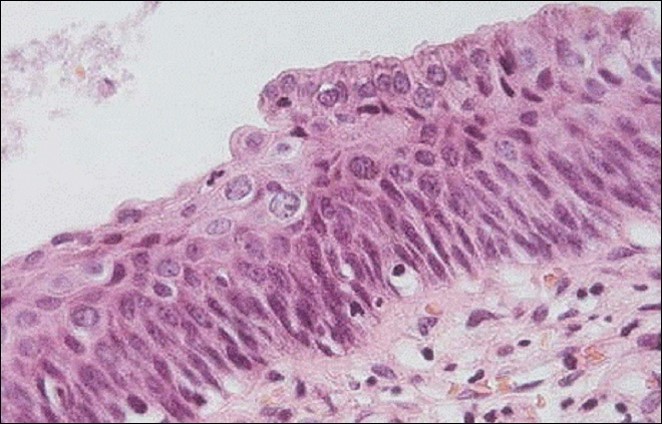
Epithelial metaplasia. An abnormal change in the nature of a tissue (ie cell type to a stratified squamous appearance) in response to a stimuli (here chronic irritation)
This is a reversible change, once the stimuli is removed and the cells turned over the native cells return.
Which Ig is the main type found in the airways?
IgA
What protective reflexes are airway motivated?
Why are they vital?
Cough and sneeze
These are the reserve clearance mechanisms and are particularly vital during situations such as those when the ciliated cells are lost (becomes only mechanism)
Describe the alveolar defences found in the LRT.
Macrophages: Three types
- Alveolar
- Interstitial
- Intravascular
These phagocytose particles and agents, recruit neutrophils, co-ordinate inflammation and ascend the mucociliary escalator
Describe the mechanisms of action of the of macrophages found in the alveoli.
- Alveolar - ingest pathogens and particles, then MO move to the bronchi and are removed by the mucrociliary escalator. Also secrete chemokines which attract neutrophils during inflammation.
- Interstitial - Reside within alveolar interstitial tissue and act to phagocytose particles that have traversed alveolar cells. They enter the bronchiolar/bronchial lymphatics and move to pulmonary or tracheobronchial lymph nodes.
- Intravascular - Only found in some species (ruminants, pig, cat) and attach to the lumenal surface of capillary endothelial cells & act like Kupffer cells in the liver to clear particulate matter from the blood (e.g. small emboli).
Describe this lesion.
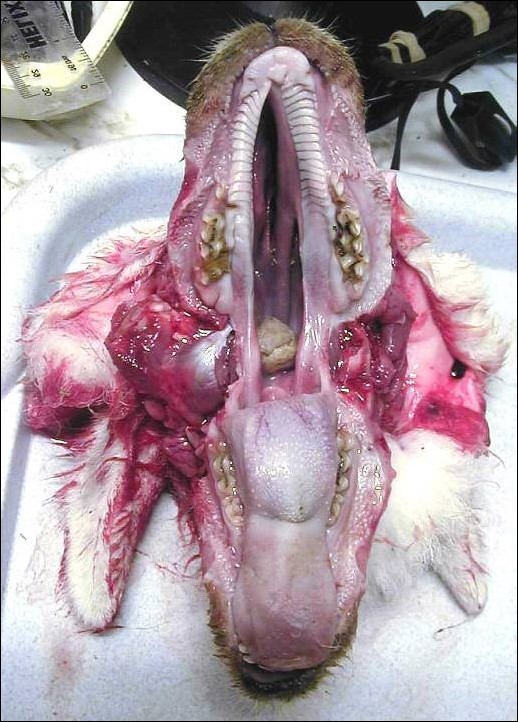
A cleft palate
Failure to close the palatine shelves (primary or secondary palate) causes aspiration of food at weaning and beyond
What is seen here? What problems can this pathology cause?
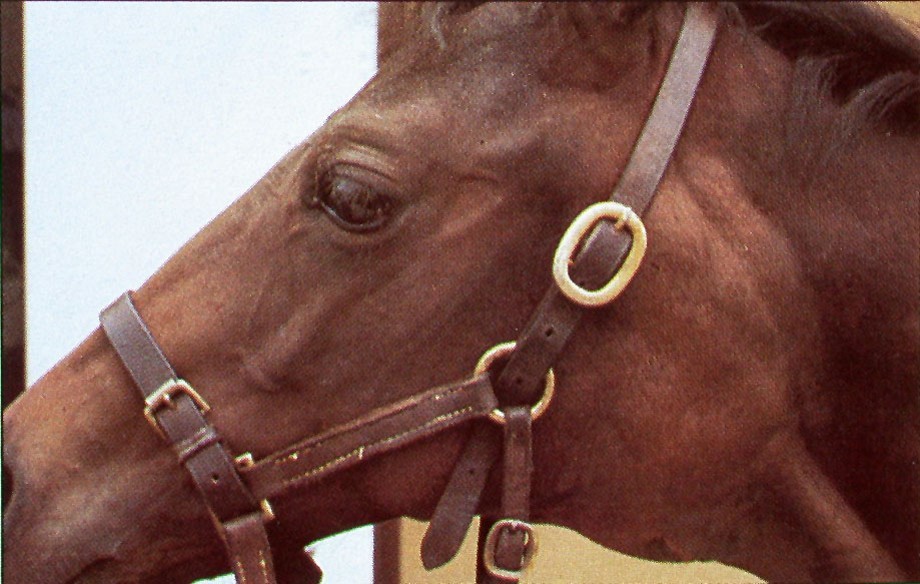
GP tympany (air build up)
A defect of the nasopharyngeal opening causes (unilateral) trapping of air and mucus in the GP.
Oesophageal pressure can lead to dysphagia and dyspnoea.
Can lead to aspiration of food and pneumonia and predisposes horses to GP bacterial infection
Describe the problems associated with Brachiocephalic airways.
- Stenotic nares
- Everted laryngeal saccules
- Elongated soft palate
Leads to airway obstruction, cyanosis and syncope
Epistaxis
Bleeding from the nose
What can cause bleeding from the URT?
- Inflm
- Infection
- Trauma
- Neoplasia
- Clotting defects
What is the difference between active and passive congestion of the URT?
- Active is caused by inflammation
- Passive is caused by reduced blood outflow
What are the cardinal signs of inflammation?
- Redness
- Swelling
- Loss of function
- Pain
- Heat
What stages of acute inflammation characterise types of nasal discharge?
Describe each stage
- Serous - clear, watery
- mucosal hyperaemia and oedema, increased fluid production
- Catarrhal - thick - mucoid/ creamy white
- Increased mucoserous secretions, some inflammatory cells
- +/- Fibrinous - tacky yellow red deposits
- Increased vascular permeability +/- necrosis
- Purulent - thick, white, green, brown
- Filled with degenerating neutrophils
What are the common pathological changes in the URT with chronic inflammation?
- Mucosal hyperplasia of epithelium and seromucous glands
- Epithelial metaplasia from ciliated columnar to stratified squamous
- Chronic inflammatory cells infiltrate - mo, l, plasma cells
- Fibroplasia
Polipoid thickening
Abnormal thickening/ growth of tissue projecting from a mucous membrane .
It is pedunculated if attached to the mucosa by an elongated stalk. If no stalk is present it is sessile.
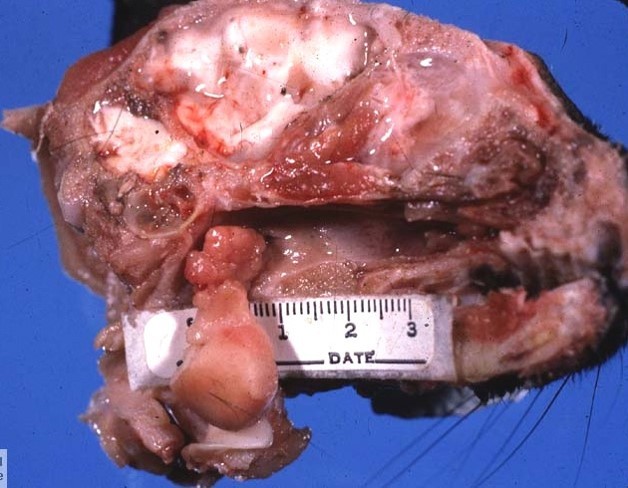
Polypoid thickening is characteristic of chronic nasal inflammation particularly in which species and where?
Horses - they arise in the ethmoid region
Cats - they arise from the auditory tubes or tympanic bulla (may extend into the pharynx or external auditory tubes
Causes of URT inflammation.
- Irritants/ allergens eg pollen
- FB/ trauma
- Parasites - oestrus ovis
- Dental disease
- Infectious agents - viral, bacterial and fungal
Name three examples of viral agents associated with URT infections
- Infectious bovine rhinotracheitis virus (IBR) - HV1
- Equine herpes virus 1 + 4
- Equine influenza virus
- Feline herpes virus 1 Flu
- Feline calicivirus Flu
- Canine distemper virus
- Canine adenovirus 2
- Canine parainfluenza virus



