CYSTIC FIBROSIS: Describe the clinical presentation of a patient with cystic fibrosis with respect to disease of the lung and pancreas and describe its inheritance
Mode of inheritance: Autosomal recessive
Clinical presentation:
- Lung: Productive cough, dyspnoea, recurrent respiratory infections, progressive lung damage, spontaneous pneumothorax
- ENT: Nasal polyps
- Pancreas: Loss of exocrine function (digestive enzymes), DM in later stages
- GI: Meconium ileus at birth, steatorrhoea secondary to malabsorption
- General: Faltering growth, rickets, osteomalacia
- Reproductive: Reduced/absent fertility
CYSTIC FIBROSIS: Describe the pathological changes in the lungs and the natural history of disease in a typical patient
Pathological changes:
A collection of unusually thick mucus in seen within the bronchi. The mucus acts as an ideal environment for the accumulation of bacteria, leading to respiratory infection.
The airways are dilated, with purulent secretions and chronic inflammation in the wall with granulomatous tissue (can lead to haemoptysis).
Fibrous scarring can occur, leading to respiratory failure.
Natural history:
- Normally detected via the heel prick test, in the neonatal period
- Faltering growth and recurrent chest infections seen throughout childhood
- Infertility in males and reduced fertility in females
- Complications in adult life include diabetes, rickets, osteomalacia
CYSTIC FIBROSIS: Outline the non-respiratory manifestations of cystic fibrosis
ENT: Nasal polyps, sinusitis
GI: Meconium ileus, malabsorption, intestinal obstruction, steattorrhoea
Pancreatic: Pancreatic insufficiency
Reproductive
Arthropathy
CYSTIC FIBROSIS: List the usual organisms causing lung infection
- Haemophilus
- Pseudomonas
- Klebsiella
- Strept. pneumoniae
CYSTIC FIBROSIS: Describe the main principles of treatment
Physiotherapy:
- Postural drainage
- Handheld devices to aid mucus drainage
- Positive expiratory pressure mask
Medications:
- IHD bronchodilator *to be given prior to physiotherapy*
- Pancreatic enzyme supplementation: Creon
- Fat soluble vitamin supplementation
- Bile acid supplement (ursodeoxycholic acid)
- Mucolytics
- Antibiotics
- Inhaled tobramycin for chronic Pseudomonas aeruginosa
- Inhaled anti-inflammatory agent (macrolide, ibuprofen, corticosteroid)
- CFTR modulator (e.g. ivacaftor)
Bilateral lung transplantation:
- Reserved for when all other therapies have been exhausted
PNEUMONIA: Describe the typical presentation of a patient with CAP and the features that identify severe pneumonia, including the role of the CURB-65 tool for risk prediction
Symptoms/signs:
- Productive cough
- Dyspnoea and tachypnoea
- Fever/chills/rigors
- Cyanosis: Central (lips)
- Confusion
- New focal chest signs on examination
- Pleuritic chest pain
THINK - could this be sepsis?
CURB-651 mortality risk prediction tool:
Confusion: AMT < 8
Urea (blood urea nitrogen) > 7 mmol/L
Respiratory rate > 30 breaths/minute
Blood pressure < 60/90 mmHg
> 65
Arrange urgent transfer to hospital if there is a score of 3 or >
Hospital assessment should be considered for scores of 1 or 2
1: CRB-65 severity score is used in the community setting
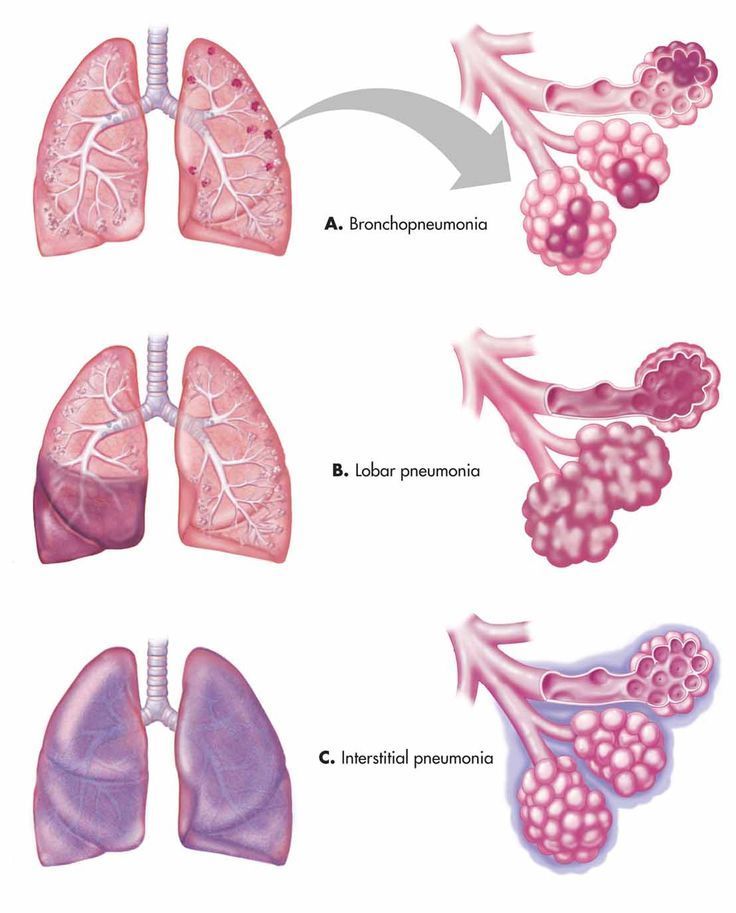
PNEUMONIA: Describe the pathology of acute lobar pneumonia and bronchopneumonia
Lobar pneumonia: Homogenous and fibrinosuppurative consolidation of one or more lobes
Bronchopneumonia: Suppurative peribronchiolar inflammation and subsequent patchy consolidation or one or more secondary lobules of a lung
PNEUMONIA: Describe the investigation of a patient presenting with CAP and interpret investigations
Investigations:
- Observations
- ABG
- Sputum: MC&S
- Bloods: FBC, U&Es, CRP, LFTs
- Blood cultures: For all pts with moderate to severe disease
- Sepsis screen: Blood cultures, lactate, urine output
- CXR: Consolidation
PNEUMONIA: Describe the complications of pneumonia
- Sepsis*
- Pleural effusion
- Pleural abscess*
- Empyema (a collection of pus within the pleural cavity)*
- ARDS (non-cardiogenic pulmonary oedema and severe lung inflammation)
- Antibiotic associated c. diff colitis
- Heart failure
* complications listed in the ACE study guide
PNEUMONIA: Create a treatment plan, including specification of observations, general supportive measures, appropriate antibiotic regimens, analgesia and physiotherapy
Observations:
- Temperature, oxygen saturation, pulse, RR, BP
General supportive measures:
- Oxygen
- Ensure adequate fluid and nutritional intake
- VTE prophylaxis
Antibiotic regimen:
- Empirical broad-spectrum antibiotics immediately after diagnosis:
- IV amoxicillin with clarithromycin or erythrocyclin
- 5/7 course
- Consider switch to PO according to treatment response
- Switch to pathogen-targeted antibiotic therapy once sensitivities have been confirmed
Analgesia:
- Paracetamol: 500 mg - 1000 mg every 4 hours, maximum 4g/day
Physiotherapy:
PNEUMONIA: Outline clinical management during recovery
* Radiological follow-up is required until the consolidation has cleared. Follow-up x-ray at 6 weeks should be organised to assess for resolution of consolidation and for persistent abnormalities of the lung parenchyma
TUBERCULOSIS: Describe the process of infection by the tubercle bacillus together with the route of spread and discuss the presentation of post-primary TB from reactivation of infection
Process of infection:
- Inhalation of respiratory droplets that are released when an infected individual coughs
- There is mild inflammatory response at the site of infection followed by spread to regional lymph nodes
- Characteristic caseating granulomas form. Most heal by fibrosis and calcify without treatment.
- A Ghon-focus forms
Route of spread:
- Respiratory
Presentation of post-primary TB:
- The primary complex may reactivate or there may be infection from an exogenous source
- The granulomatous response causes the formation of an Assmann focus, leading to cavitation
- The focus will normally heal and calcify but can progressively enlarge in patients who are immunocompromised
- Symptoms:
- Malaise, night sweats, anorexia, weight loss
- Productive mucoid cough
- Repeated small haemoptysis
- Pleural pain
TUBERCULOSIS: Outline the investigation of a patient with suspected TB
- Chest X-ray
- Suggestive findings: Cavitation, pleural effusion, mediastinal or hilar lymphadenopathy, parenchymal infiltrates mainly in the upper lobes
- 3 sputum samples with one morning sample
- Microscopy for acid-fast bacilli, mycobacterium culture and molecular testing/drug sensitivity
- Bronchoscopy with biopsy or bronchoalveolar lavage may be used if sputum samples are negative
Tests for latent TB
- Mantoux test
- Interferon-gamma release assay to be used in immunocompromised individuals
TUBERCULOSIS: List the common site of non-pulmonary TB infection and outline the pathological features
Miliary TB: A generalised haematogenous TB. Symptoms include fever, chills, weakness, malaise and progressive dyspnoea.
Lymphatic TB: Painless lymphadenopathy, typically of the posterior cervical and supraclavicular chains
Joint/spinal TB (Pott disease): Monoarthritis
Renal TB: Sterile pyuria
Cutanous TB: Erythema nodosum, lupus vulgaris
TB meningitis
TB pericarditis: Chest pain
TUBERCULOSIS: Outline common predisposing factors and outline the principles of treatment of confirmed cases and the principles of contact tracing
Predisposing factors:
- Living in endemic areas (India, China, Indonesia, Nigeria, South Africa, Bangladesh, Ethiopia, Pakistan, Philippines)
- Immunocompromised individuals
- Close contact with other who have had TB
- Alcohol/drug abuse
- Living in crowded environment
Testing
Looking for immune response to TB (previous, latent or active TB)
1st: Mantoux test - induration of 5mm or more is positive
Positive Mantoux with no signs of active disease → IGRAs
- Positive confirms latent TB
If there are signs of active infection:
- CXR
- Cultures - x3 sputum, blood cultures, lymph node biopsy/aspiration
- NAAT
Principles of treatment:
The main goal is to cure the pt and prevent further transmission.
Whilst infectious, patients should remain isolated (either at home or in a hospital room).
Consists of:
- An intensive phase: Lasts 8/52. Involves isoniazid, rifampicin, pyrazinamide and ethambutol.
- Rifampicin and isoniazid for 6 months
- Pyrazinamide and ethambutol for 2 months
- Isolation for 2 weeks until on established treatment
- A continuation phase: If sensitive to isoniazid and rifampicin, they are continued for 18/52.
- Steroids for extrapulmonary disease
Principles of contact tracing:
- Close contacts (prolonged, frequent or intense contact with the patient. Such as household contacts, partner etc.) should be assessed for symptoms of active TB or given testing for latent TB if asymptomatic
- Notify public health of suspected cases
- Social contacts (most workplace contacts) do not routinely require assessment. However, if the index case is particularly infectious or are known to be at high risk of developing TB then assessment is required
- People who have had significant exposure in the last 1-2 years should be evaluated for active TB disease and latent TB disease
Side effects of treatment
Rifampicin - Coloured urine, tears
Isoniazid - Peripheral neuropathy. B6 usually prescribing prophylactivally
Ethambutol - Colour blindness and reduced VA
RIP all associated with hepatotoxicity
PNEUMOTHORAX: Describe its typical clinical presentation and the recognised risk factors together with the underlying pathology and investigations.
Clinical presentation:
- Dyspnoea
- Chest pain
Risk factors:
- Smoking
- FHx of pneumothorax
- Chronic lung condition e.g. asthma, COPD, TB, CF
- Trauma
- Young, tall, thin males
- Structural abnormalities e.g. Marfan syndrome, Ehlers-Danlos syndrome
Investigations:
- Physical examination: Hyperresonance, reduced air entry, unequal chest expansion
- CXR
- Bloods: FBC, clotting
- ABG - if PaO<span>2</span> is < 92% on room air
Underlying pathology:
PNEUMOTHORAX: Distinguish between simple and tension pneumothorax including features that aid in recognition of critically ill patients presenting with a tension pneumothorax
Tension pneumothorax: A one way valve develops that allows the entry of air into the pleural space but not out.
Clinical presentation:
- Cardiopulmonary deterioration
- Hypotension !EMERGENCY - suggests imminent cardiac arrest
- Respiratory distress
- Tachycardia
- Shock
- Low oxygen saturations
- Mediastinal shift
- Hydrosis
PNEUMOTHORAX: Describe treatment options
Percutaneous aspiration (needle thoracocentesis)
- Indicated for:
- Pneumothorax > 2cm (between the lung margin and chest wall) +/- breathlessness
- Symptomatic pneumothorax < 2 cm
- Tension pneumothorax
- Insert local anaesthetic
- Insert a cannula into the 2nd ICS, midclavicular line. Attach a 3 way tap and then a syringe to the 3 way tap. Aspirate air via the 3 way tap.
- Aspirate until resistance, usually < 2.5 L
Intercostal underwater chest drain:
*MUST perform FBC and clotting to check for coagulopathy first*
- Insert local anaesthetic
- Insertion site may be identified using USS or by using the ‘safe triangle’
- 4th ICS, mid-axillary line
- Insert the needle, use a series of dilators to allow for eventual insertion of the chest drain, attach the chest drain to draining apparatus, secure the chest drain
- Re-examine the patient and order a supine CXR to check the position of the drain
PNEUMOTHORAX: Outline the indications for surgical pleurectomy and pleurodesis
Indications for surgical pleurectomy1:
- Those with persistent air leak at 48 hours should be considered for surgery
- Open thoractomy2 and pleurectomy should be considered
Indications for medical pleurodesis3:
- May be considered for patients refusing or not fit enough for surgery
1: Pleurectomy involves removal of a small portion of the pleura, allowing for the lungs to adhere to the chest wall in the hope that this will prevent further accumulation of air between the lungs and the pleura
2: Thoracotomy describes surgery to open the chest wall
3: Involves the introduction of irritant drugs between the pleura and the lung to encourgae them to adhere to each other, preventing further accumulation of air
PNEUMOTHORAX: Describe the emergency treatment of tension pneumothorax
- Put out an immediate cardiac arrest call
- Immediate decompression: thoracocentesis or open thoracostomy (if secondary to trauma)
- High flow oxygen
- Chest drain insertion and hospital
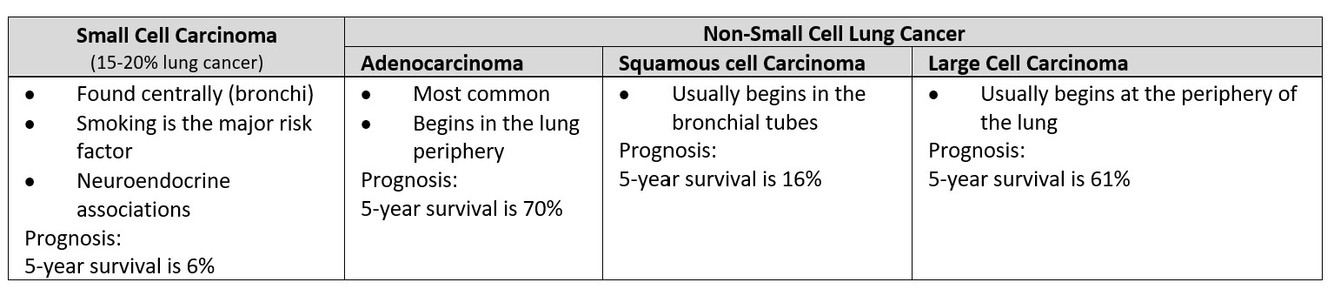
LUNG CANCER: Outline the major pathological classification of lung cancers and their prognosis
LUNG CANCER: Describe the common clinical presentation and risk factors
Common clinical presentation:
- RED FLAG symptoms: Weight loss, night sweats, malaise
- Cough
- Haemoptysis
- Dyspnoea
- Chest pain
Risk factors:
- Smoking
- Increasing age
- Occupational exposure
- COPD
- FHx
LUNG CANCER: List relevant investigations for lung cancer and interpret results
Investigations:
- CXR
- CT CAP/MRI
Investigations to consider:
- Sputum cytology
- Bronchoscopy
- Biopsy
- Bloods: FBC, Ca2+, LFTs
LUNG CANCER: Outline local metastatic manifestations of lung cancer and describe the systemic non-metastatic manifestations including paraneoplastic syndromes
Local metastatic manifestations:
- Hoarseness secondary to recurrent laryngeal nerve palsy
- Atelectasis
- Pleural effusion
- Bronchial obstruction
Systemic non-metastatic manifestations:
(liver, brain, bone, adrenal gland)
- Bone mets → Fractures and bone pain
- Brain mets → confusion, personality changes, seizures, focal neurological deficit, nausea and vomiting
- Paraneoplastic syndrome in SCLC:
- A group of symptoms that may develop when substances released by some cancer cells disrupt the normal function of surrounding cells and tissues
- Common paraneoplastic effects include: Hypercalcaemia, SIADH, Cushing syndrome, hypercoaguability, finger clubbing, symptoms similar to Myasthenia Gravis






