What is the respiratory system?
Series of organs responsible for taking in oxygen and expelling carbon dioxide.
Describe the pathway of air
- Nasal cavity and mouth
- Trachea
- Left or right bronchi
- Bronchioles
- Alveoli
- Gaseous exchange
Describe the function and/or characteristics of the trachea
Function - Tube carrying air to the lungs.
Characteristics - Made up of rings of cartilage to prevent it from collapsing. C-shaped rings to allow for expansion and contraction during inhalation and exhalation.
Describe the function and/or characteristics of the bronchi
Characteristics - First branch from trachea. One bronchus leads to each lung.
Describe the function and/or characteristics of the bronchioles
Characteristic - Bronchi branch off into bronchioles which lead into the alveolus.
Describe the function and/or characteristics of the alveoli
Function - Where gaseous exchange occurs.
Characteristics - Air sacs. Millions of alveoli in each lung, presenting a large, moist surface area for gaseous exchange. Surrounded by blood capillaries.
Describe the function and/or characteristics of the diaphragm
Function - Contracts and relaxes to allow for inhalation and exhalation.
Characteristics - Sheet of muscle at the base of the chest cavity dividing it from the abdomen.
Describe the function and/or characteristics of the intercostal muscles
Function - Raise and lower the ribs upon contraction and relaxation.
Characteristics - Muscles between the ribs, they are a skeletal muscle.
Describe the pathway of oxygen into the capillaries
- O2 enters respiratory system through the nasal cavity and mouth.
- Travels down the trachea, dividing into the left and right bronchi.
- The airways narrow and branch off into bronchioles.
- O2 reaches the alveoli where gaseous exchange occurs with the capillaries.
Define GASEOUS EXCHANGE
The process in the lungs whereby O2 is delivered to the bloodstream, while CO2 is removed from it. Takes place in the alveoli.
How can gaseous exchange be maximised? (4 marks)
- Millions of alveoli in lungs, providing a large, moist surface area for gaseous exchange to take place.
- Each individual alveolus is surrounded by bloody capillaries which ensures a good blood supply.
- The walls of the capillaries are only 1 cell thick, which gaseous exchange more efficient.
- Alveoli are well ventilated - air can reach them easily.
Describe how gaseous exchange occurs at the alveoli
- O2 arrives at alveoli after inhalation.
- Deoxygenated blood arrives at the alveoli via capillaries, CO2 diffuses from the capillaries into the alveoli.
- O2 diffuses from the alveoli into the capillaries to oxygenate the blood.
- CO2 is exhaled.
Describe the mechanics of inspiration. (Diaphragm and intercostal muscles)
- Diaphragm contracts and flattens.
- Intercostal muscles contract and expand the chest cavity up and out, increasing the volume.
- The expansion lowers the pressure in the chest below the pressure of the outside air.
- Air flows into the lungs as it moved from a high pressure (outside air) to a low pressure (lungs).
Describe the mechanics of expiration. (Diaphragm and intercostal muscles)
- Diaphragm relaxes and domes.
- Intercostal muscles relax and the chest cavity volume decreases.
- The decrease in chest cavity volume results in an increased pressure in the chest cavity - higher than the outside air pressure.
- Air moves from the lungs as air moves from a high pressure (lungs) to a low pressure (outside air).
Define TIDAL VOLUME
Volume of air inhaled in one breath during normal breathing.
Define RESPIRATORY/BREATHING RATE
Number of breaths taken in one minute.
Define MINUTE VENTILATION/VOLUME
The volume of air, in litres, breathed in in one minute.
(Tidal Volume x Respiratory Rate = Minute Ventilation)
Define VITAL CAPACITY
The maximum volume of air you can breathe out after a maximal inhalation.
Define RESIDUAL VOLUME
The volume of air left in your lungs after breathing out. This remaining air prevents our lungs from collapsing.
Define TOTAL LUNG CAPACITY.
The maximum volume of air that can be held in the lungs.
Define VO2 MAX
The maximum volume of O2 that can be taken in and used in one minute.
State the short term effects of exercise on the respiratory system
- Increased breathing rate
- Increased tidal volume
State the long term effects of exercise on the respiratory system
- Increased vital capacity
- Increased number of alveoli
- Increased lung capacity and volume
- Increased tidal volume
- Increased minute ventilation
- Improved oxygen debt tolerance
- Delay build up of lactic acid
Label the compentents of the respiratory system
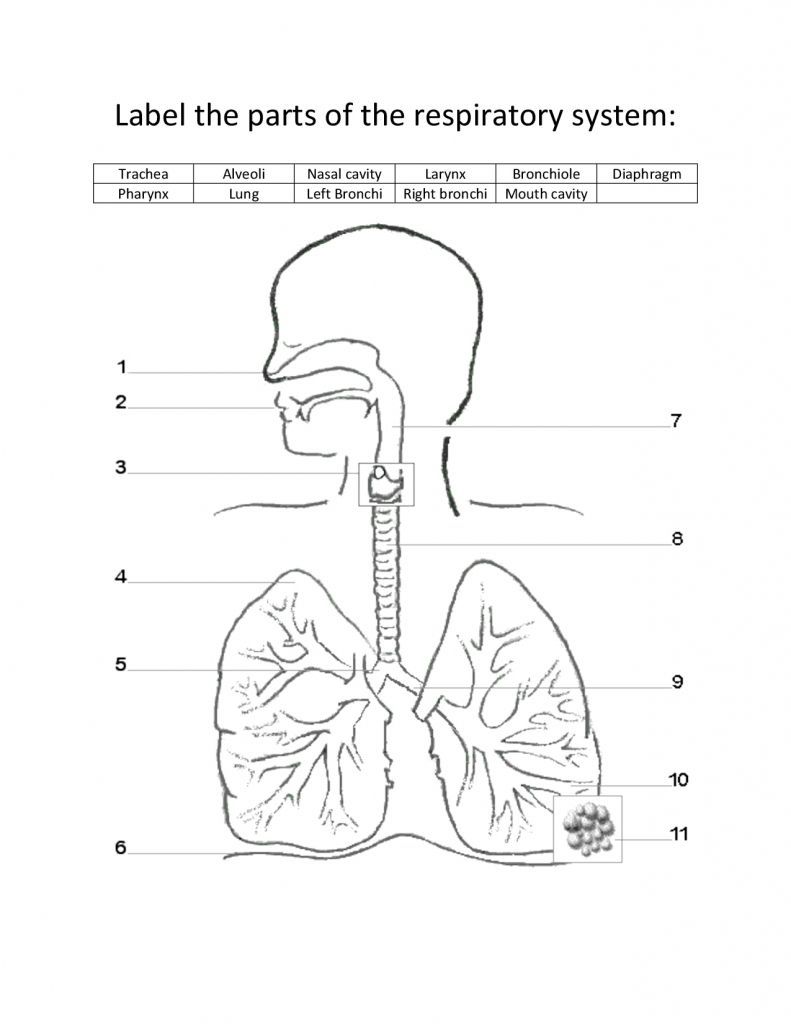
- Nose/ Nasal cavity
- Mouth/ Oral cavity
- Larynx
- Lung
- Right bronchi
- Diaphragm
- Pharynx
- Trachea
- Left bronchi
- Bronchiole
- Alveoli



