Label the skeletal system
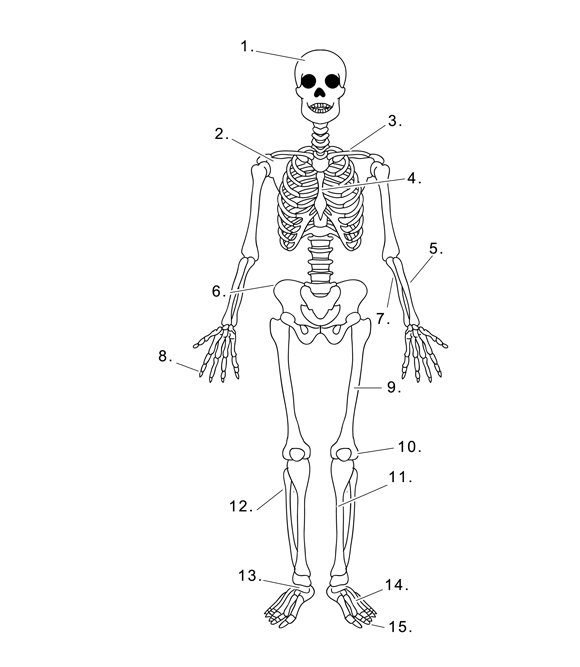
- Cranium
- Scapula
- Clavicle
- Ribs
- Radius
- Pelvis
- Ulna
- Phalanges - Metacarpals - Carpals
- Femur
- Patella
- Tibia
- Fibula
- Talus/ Tarsals
- Metatarsals
- Phalanges
State the 4 functions of the skeletal system
- Shape and support
- Movement
- Protection of vital organs
- Red blood cell production
Explain and give an example of how the skeletal system provides shape and support
How? - Skeleton provides shape and support for the body. It forms a frame for which our muscles can attach and in which our organs can sit.
Example - The vertebrae enables us to stay upright.
Explain and give an example of how the skeletal system allows for movement
How? - Muscles are attached to skeleton via tendons. Movement occurs when muscles contract and pull on bones which makes them move about a joint.
Example - The bicep connects the shoulder and elbow and helps with flexion.
Explain and give an example of how the skeletal system provides protection for vital organs
How? - Internal organs are soft, delicate and easily damaged. These vital organs are protected by the skeleton.
Example - The cranium protects the brain. The ribs protect the heart and the lungs.
Explain and give an example of how the skeletal system produces red blood cells
How? - The centre of some large bones contains bone marrow, which creates red blood cells.
Example - The pelvis and femur are both important in blood production.
State the 4 types of bones
- Long
- Short
- Flat
- Irregular
State the function and give an example of long bones
Function - Act as levers to produce a large range of movement.
Examples - Femur, tibia, fibula, humerus, ulna, radius, phalanges, clavicle
State the function and give an example of short bones
Function - Short bones are approximately as wide as they are long. Their function is to provide stability and support, with little movement.
Example - Carpals, tarsals
State the function and give an example of flat bones
Function - Provide a large surface area for muscles to attach to. They provide protection for organs.
Example - Pelvis, cranium, scapula
State the function and give an example of irregular bones
Function - These bones provide protection and support. They are shaped to suit the specific job they have to do.
Example - Vertebrae
Describe and give an example of a fixed/ immovable joint
Description - These bones cannot move at all and are found in the cranium. Also known as fibrous joints as the joints are connected via fibrous connective tissue.
Example - Cranium
Describe and give an example of a slightly moveable joint (cartilaginous joint)
Description - These joints can move a small amount as they are linked together by ligaments and cartilage.
Example - Vertebral column and ribs
Describe and give an example of a freely moveable joint (synovial joint)
Description - These joints have a large amount of movement and include a large number of parts.
Example - Elbow, knee, hip, shoulder
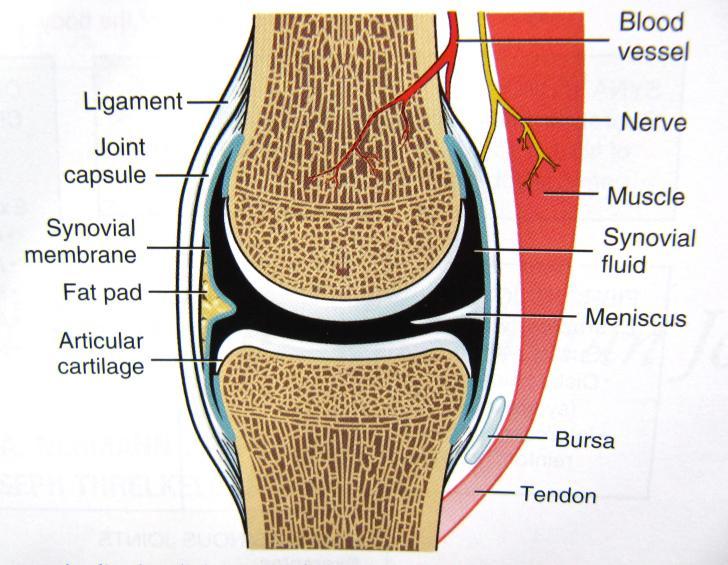
State an describe the parts that make up a synovial joint (6 parts)
- Synovial membrane - surrounds the joint capsule with synovial fluid.
- Synovial fluid - Acts as a lubricant that reduces friction in the joint; allows for smoother movement and reduces wear and tear.
- Joint capsule - Structure that surrounds and protects the joint, holding the bones together. Made up of an outer fibrous membrane and an inner synovial membrane.
- Ligament - Strong, elastic fibres that hold bones together and keep them in place.
- Cartilage - Strong but flexible material found at the end of the bones that acts as a cushion to stop bones knocking each other.
- Tendon - A tough band of fibrous tissue that connects muscle to bone and enables joints to withstand tension.
State, describe and name the location of two types of synovial joints
Ball and socket joint - Provide a large range of movement in every direction. One ball has a bone that fits into the socket of the other bone. Eg. Shoulder and hips.
Hinge joints - Act like hinges on a door, only allow movement in one direction. Eg. Elbow and knee.
Which synovial joint (ball and socket or hinge) is generally more susceptible to injury, why?
Ball and socket - More motion about the joint = less stability = more wear and tear = more susceptible to injury.
State the 8 types of movement at a joint
- Flexion
- Extension
- Adduction
- Abduction
- Rotation
- Circumduction
- Dorsiflexion
- Plantar flexion
Describe both flexion and extension and give an example of a joint where they occur
Flexion - Bending a part of the body, the angle of the joint decreases.
Extension - Straightening a part of the body, the angle of the joint increases.
Example joints - hip, elbow, knee, shoulder
Describe both abduction and adduction and give an example of a joint where they occur
Abduction - Sideways movement away from the centre of the body
Adduction - Sideways movement towards the centre of the body
Example joints - shoulder and hip
Describe both rotation and circumduction and give an example of a joint where they occur
Rotation - Turning point around an imaginary line.
Example - Turning head from left to right or turning your leg to point your feet and toes to the side.
Circumduction - The end of a bone moves in a circle.
Example - Swinging arms in a circle at your shoulder.
Describe both plantar flexion and dorsiflexion and give an example of a joint where they occur
Plantar flexion - Movement in the ankle joint that points the foot away from the leg.
Example - Planting your foot on the ground while running.
Dorsiflexion - Movement in the anke where toes are brought closer to the shin.
Example - Lifting your foot off the ground while running.
Describe the components of a synovial joint
- Synovial cavity
- Joint capsule
- Synovial fluid
- Cartilage
- Tendon
- Ligament