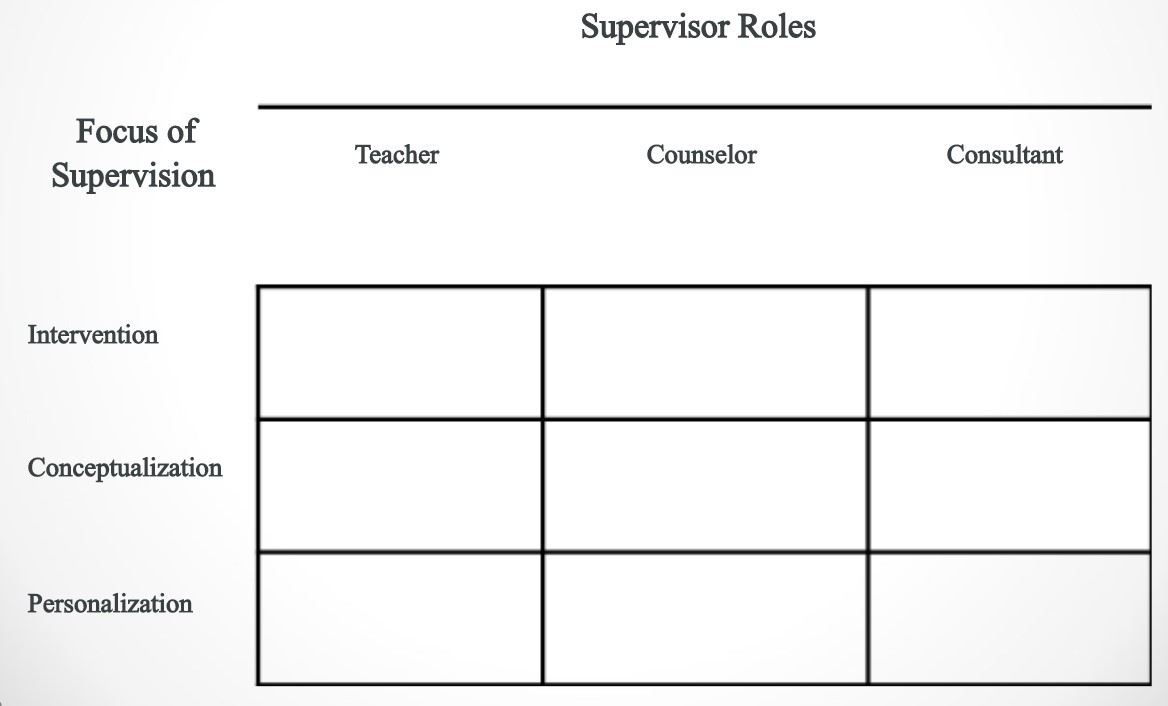
Bernard’s Discrimination Model - cite and define
Bernard (1979, 1997)
General Principles of Relational Approach
Safran and Muran (2007)
- Experiential Focus - ie encourage trainees to relate to videotapes of other trainees
- Self-exploration - helping therapists to find their own unique solutions to problems
- Relational Context - Supervisory impasses are explored the same way as therapeutic ruptures
- Supervisors as models -supervisors should present their own counseling videotapes
- Diversity - diversity issues need to be focused on the context of the therapist-client dyad
MRP’s “self” oriented work
- “Self” Knowledge (developing a sense of awareness that one has and remains committed to exploring with regards to multiple selves)
- “Self” Interrogation (the process of actively questioning one’s developing sense of self-awareness, i.e. unpacking and critiquing unexamined internalized messages).
- Location or Use of Selves (the facility with which one can draw from the knowledge one has of one’s self that can be accessed as a potential interpersonal resource to promote connections)
Relational Approach to Supervision
Safran and Muran (2007)
10 Foundational Principles of Supervision in MRP
CITE
- Promote relational thinking
- Embrace Both/And Thinking
- Advocate thinking culturally
- Encourage the development of a multidimensional view of the self
- Encourage an intense focus on the “Self”
- Focus on SJ by promoting awareness of and sensitivity to the dynamics of power and powerlessness, privilege and subjugation.
- Promote awareness of and sensitivity to the anatomy of socio-cultural oppression.
- Highlight, deconstruct and make visible the invisible trauma wounds of sociocultural oppression.
- Enhance cultural awareness and sensitivity and promote the distinctions between the two.
- Promote the recognition of the co-existence of multiple realities.
MRP - Minimal Objectives for Supervision
Hardy and Laszloffy (2002)
- Assist supervisees in seeing the ways in which human suffering and the appendages of culture are virtually inextricable.
- Highlight the ways in which the supervisor-supervisee relationship is powerfully shaped by the intricacies of the culture.
“Self” – MRP definition
“Self” is comprised of many selves in MRP (i.e. gendered self, an ethnic self, a sexual orientation self, etc.) Since many of our selves are socially constructed, they are imbued with varying degrees of power and they are reified in the larger culture. Many of us are equipped with both privileged and subjugated selves.
Personalization Issues
Bernard (1979, 1997)
focus on how therapists use their own experiences, thoughts, and feelings in therapy. This is to help practitioners to be non defensively present in the therapy, aware of their feelings, of their impact on the client and able to use this information as the session unfolds. Personalization skills include the contributions of the supervisee as an individual. This incorporates aspects of the person such as their personality, cultural background, sensitivity towards others, and sense of humor
Multicultural Critique of DM (need to add more to this one)
Hardy & Laszloffy (2002)
The Discrimination Model assumes a singular identity of either having or being without power; Ken Hardy’s reading speaks to “Embracing Both/And Thinking” making space for complex identies that hold privileged and subjugated identities in each person. (p.5 @ the bottom)
Rationale for MRP
Hardy (2016)
- One siz fits all is no longer viable approach.
- Devoting acute attention to preparing culturally sensitive clinicians is an ethical imperative.
- MRP holds greater promis than one or two isolated classes
- Development of MRP forges a paradigm shift that highlights the significance of oppression and diversity
Three Roles in DM
Bernard (1979, 1997)
- Teacher
- Counselor
- Consultant
Process Issues
Bernard (1979, 1997)
examine how technical aspects of the therapeutic process are handled. For example, is the supervisee reflecting the client’s emotion accurately, or offering appropriate interpretations at the right time. Process skills: refer to the observable activity of the supervisee.
MRP - cite and define
Hardy and Laszloffy (2002)
is a metaframework that can be used to facilitate a shift in how supervisors and supervisees begin to think about clinical work and how it seamlessly interfaces “culture” in both the broadest and narrowest sense of the word.
Conceptualization Issues
Bernard (1979, 1997)
Include how well supervisees formulate cases from theory and how well they convey this.They also focus on thinking about how to proceed with a clear understanding of the theoretical background. BLANK skills include the supervisee’s ability to make some sense of the information that the client is presenting, to identify themes that occur in counseling, and to discriminate what is essential information from what is nonessential.
Three Foci in DM
Bernard (1979, 1997)
- Process Issues
- Conceptualization Issues
- Personalization Issues
MRP Zinger
Hardy (2016)
The MRP is not only a way of looking at the world but also an invitation for each of us to be mindful of where we place ourselves in it, because where we stand often dictates what we see.




