What are the different mental models of sustainability?
- Efficiency
- Inter shift shut down focus: no production no energy use
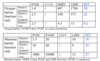
- Cement can be 20% more efficient with same costs
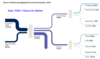
- 10,000 litres vs 60 for a pair of jeans
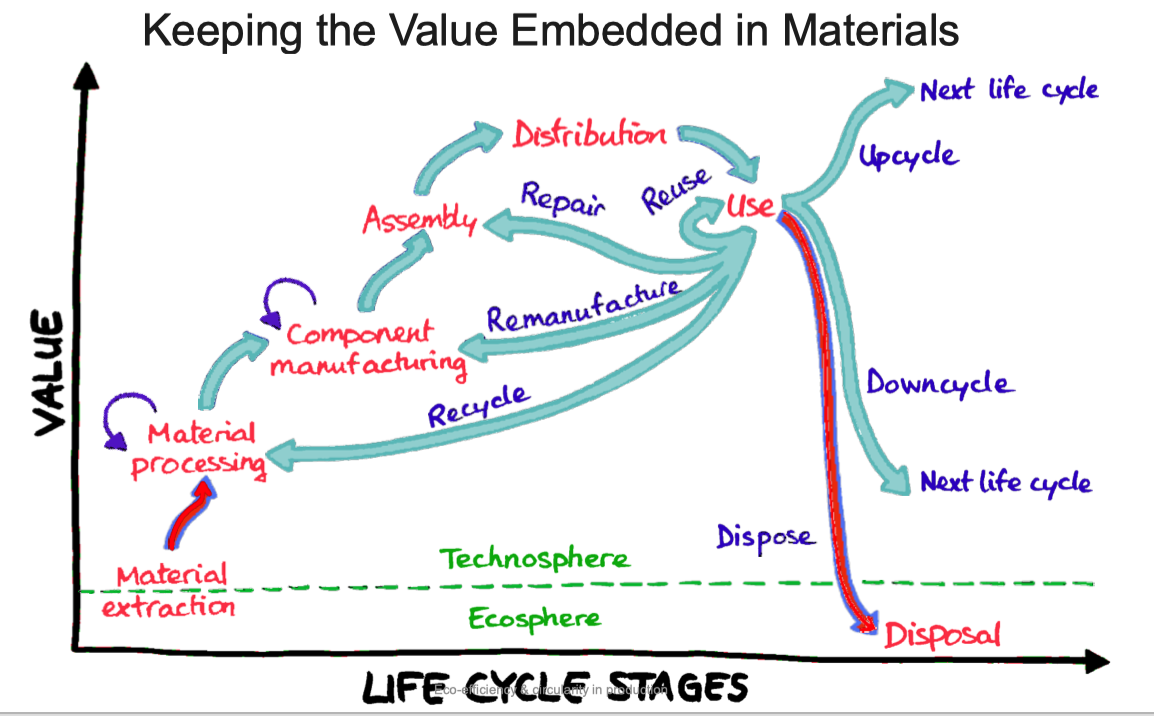
- Value
- Fast fashion: use a small interchangeable wardrobe
- Fire hose handbag
- Technology
- System
- AB sugar
- Mallorca
What is eco efficiency?
Simply do more with less
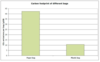
Factories making the same product can show large variation in operational efficiencies.
Outline the factors which may influence variations in resource efficiency.
Suggest ways in which resource efficiencies may be improved. Use specific examples, from module presentations or from your own experience, to illustrate your answer.
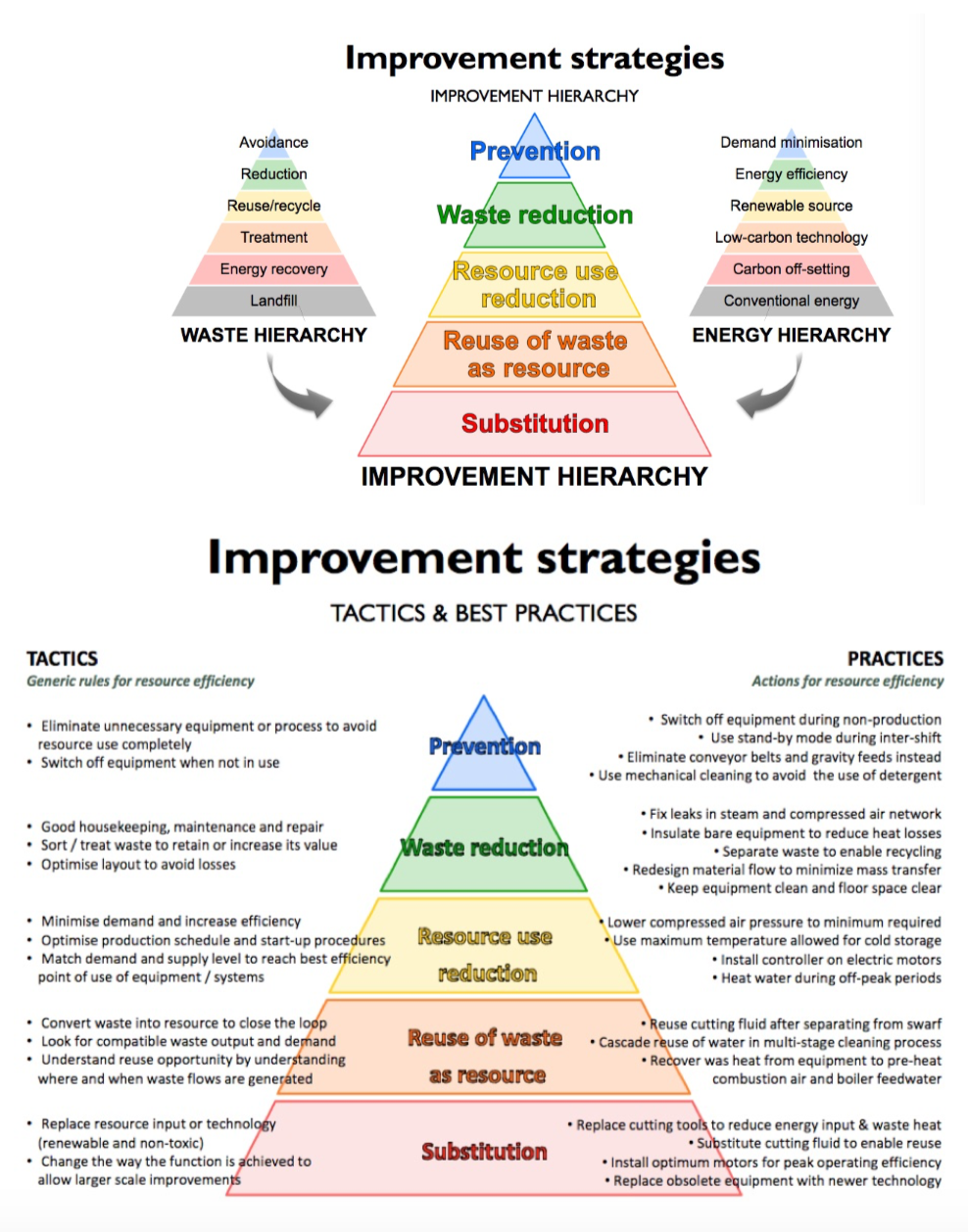
Improvement hierarchy:
- Prevention
- eliminate unnecessary equipment/processes
- switch off equipment when not in use
- e.g. use gravity feeds, standby mode
- Waste reduction
- good maintenance and repair
- sort/treat waste to optimise its value
- optimise layout
- e.g. fix leaks, insulate, separate waste, keep equipment clean
- Resource use reduction
- optimise production schedule and start up
- match supply and demand
- e.g. lower compressed air pressure, use highest temp for cold storage
- Reuse of waste as a resource
- look for compatible waste demand
- understand reuse opportunities
- e.g. reuse cutting fluid, recover waste heat and water
- Substitution
- replace resource (renewable and non toxic)
- change way function is achieved
- e.g. replace cutting tools, install optimum motors, replace obsolete tech
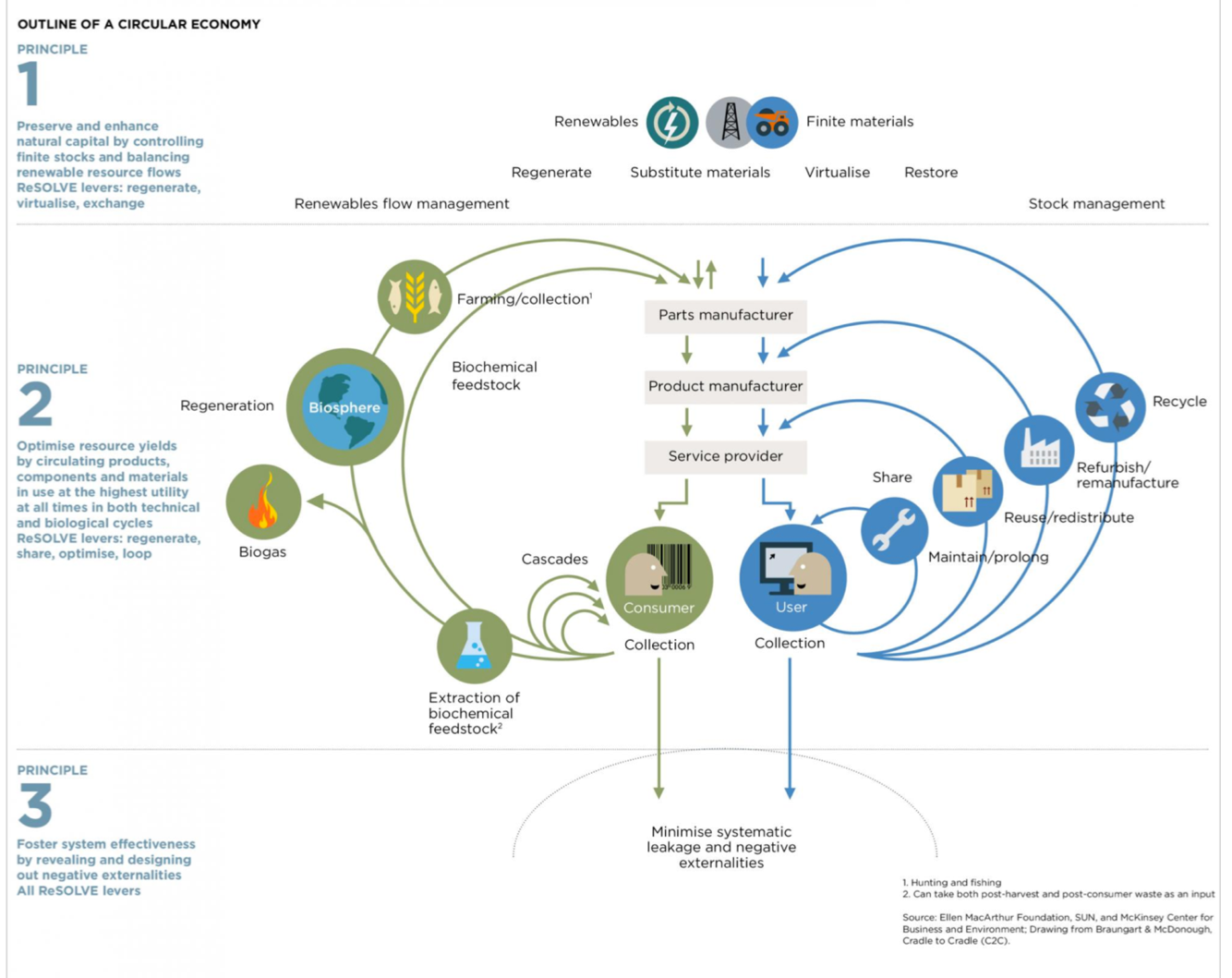
What is the circular economy?
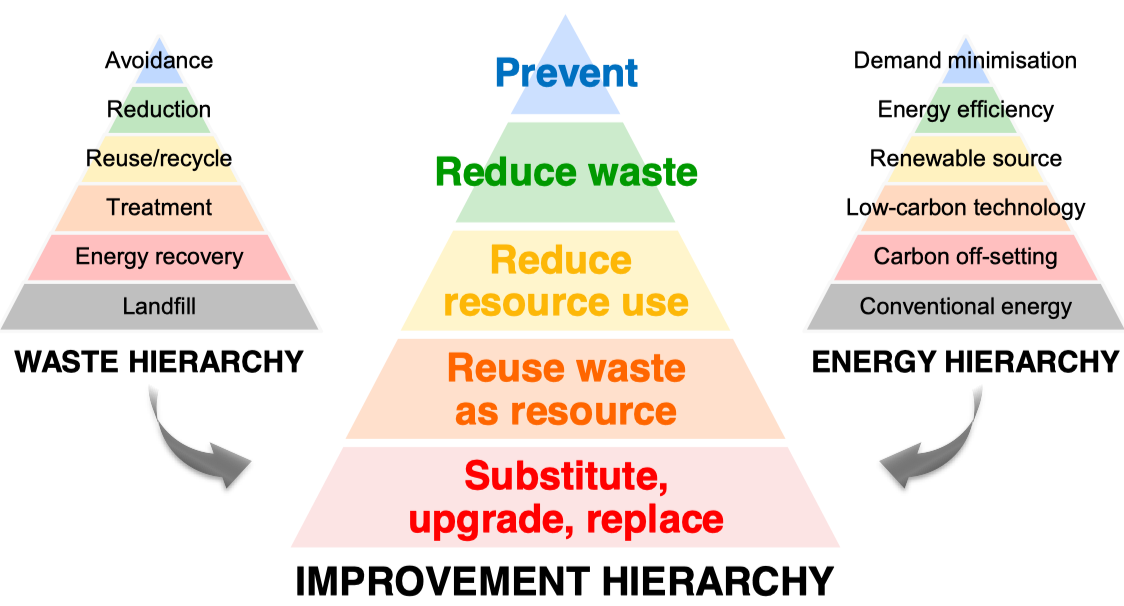
Describe the waste and energy hierarchy and how these feed into the improvement hierarchy
Waste hierarchy:
- Avoid
- Reduce
- Reuse/recycle
- Treatment
- Energy recover
- Landfill
Energy hierarchy:
- Minimise demand
- Energy efficiency
- Renewable source
- Low carbon technology
- Carbon offsetting
- Conventional energy
Improvement:
- Prevent
- Reduce waste
- Reduce resource use
- Reuse waste as a resource
- Substitute, upgrade, replace
Briefly outline how LCA and Eco-Audit should be carried out. What information is required?
LCA:
- Define goal and scope of study.
- Define
- the functions of the product system,
- functional unit,
- boundaries and
- product system.
- Define methodology, assumptions and limitations.
- Perform inventory analysis.
- Assign environmental impacts of product system.
- Interpret results.
Eco-audit:
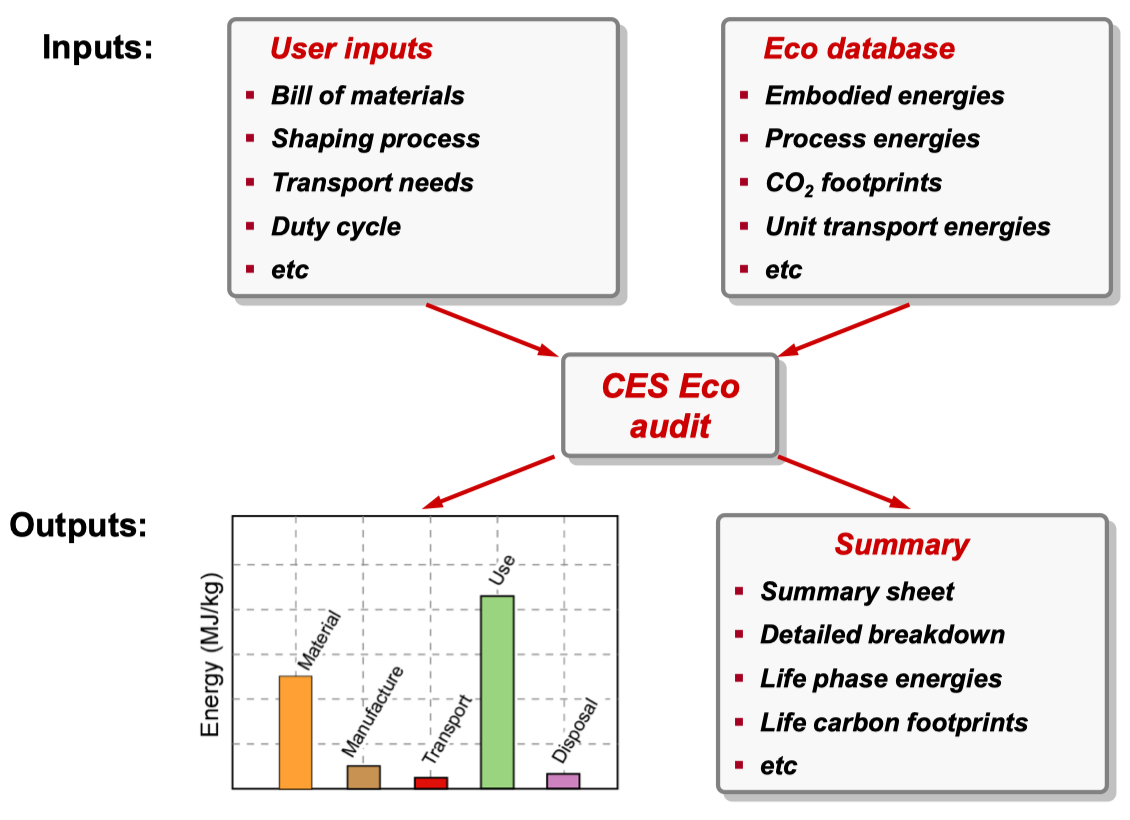
User inputs include
- Bill of materials,
- shaping processes,
- transport needs,
- duty cycle.
The Eco database is used to generate embodied energies, process energies, CO2 footprints, unit transport energies etc.
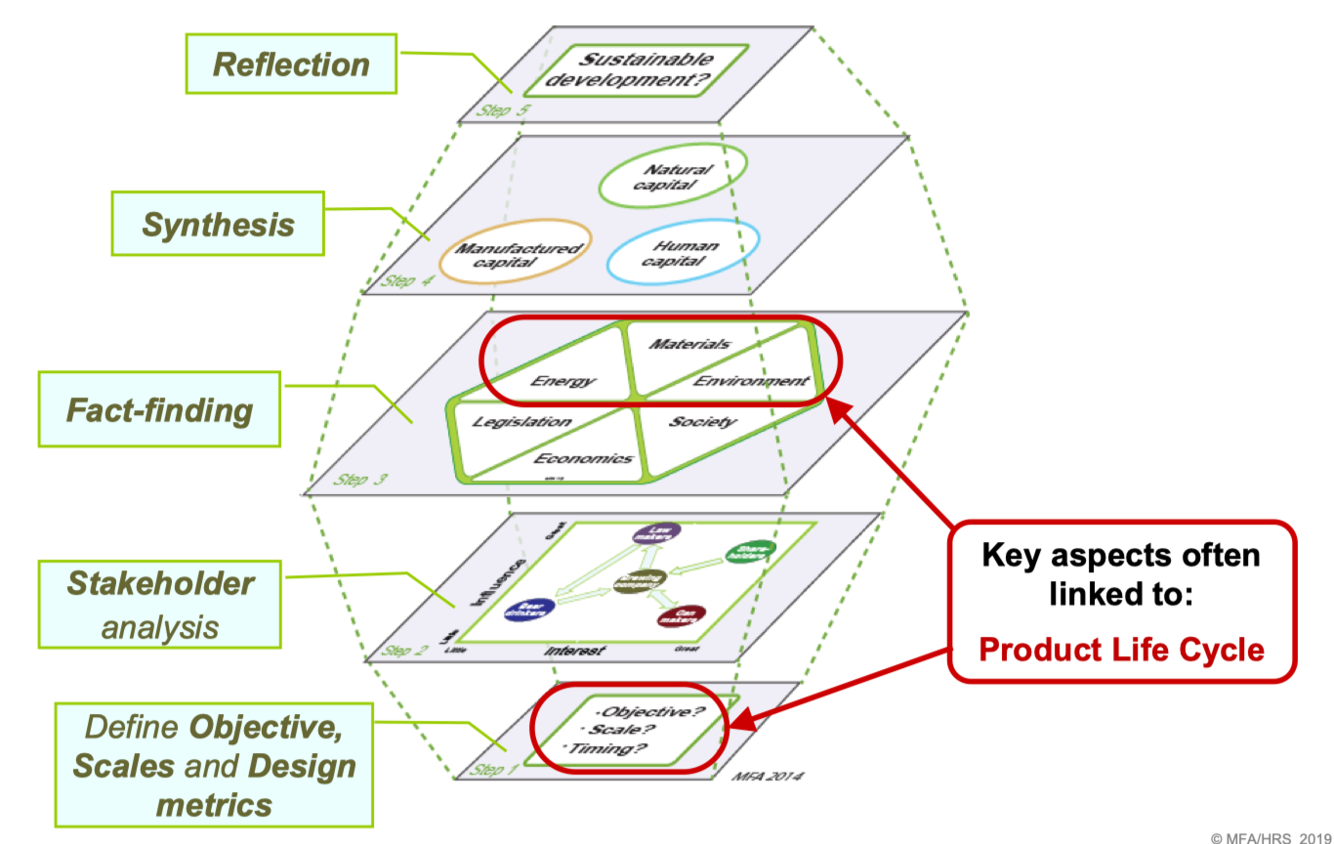
What is sustainable development? Define the methodology.
Development that meets the needs of the present without compromising the ability of future generations to meet their needs.
1a. Define objectives, size, time and geographical scale
1b. Identify key design issues and appropriate metrics
* Metrics: e.g. energy generation per unit mass
2. Identify stakeholders and their concerns/power
3. Fact finding: material efficient design, resource efficient design
4. Synthesis: assess data and analyse against three Ps (planet, profit, people)
5. Reflection: is this sustainable
What is a system boundary? Discuss what factors should be considered when defining a system boundary for environmental analysis of plastic film packaging for cheese produced and consumed in the UK.
- A system boundary is used to define what should be included for a particular environmental analysis. For this case, the following factors should be considered:
Packaging:
- Material production, manufacturing process, transport between different stages. End-of-life disposal.
Supply chain issues:
- The weight and volume of the packaging and how it affects the density with which the product can be packed for transport.
The analysis is of the packaging, so the production of the product being packaged (cheese) is outside the boundary. Nevertheless, the effectiveness of the packaging has implications for the shelf-life (lifetime) of the product.
With reference to the use of LCA for the production of biodiesel, outline the meaning and significance of the terms system boundary and allocation.
The system boundary defines what is included in the LCA. Although the protocol is documented, it is subject to interpretation. For biodiesel, there will be variation in the extent to which growing of the crops is included, and how the agricultural systems are treated.
Allocation: Any process involves many systems, which are not independent. Allocation is the appropriate distribution of responsibility for resource consumption, emissions and wastes from processes.
Define what an LCA might aim to achieve.
LCA is aimed at providing a measure of the total environmental impact of the kettle, from material production, manufacture, use and disposal. It is particularly useful for comparing the impacts of products, as much like-for-like as possible. For a kettle, one might compare different materials or production technologies.
Compare
LCA with Eco Audit for a kettle
LCA (life cycle analysis) provides outputs under headings of
- resource consumption (including materials, energy, water),
- emissions (including various gases, particulates),
- and impact assessment (including ozone depletion, global warming, acidification, human toxicity).
These different factors cannot readily be combined, so are usually left as separate datapoints.
There is currently no single method for conducting an LCA, but ISO14040 is an international standard which sets out a framework.
- It is a systematic way of analysing the impact of an activity or producing a product.
- It considers all phases of the lifecycle.
- It is useful for comparing the impacts of comparable activities (e.g. two ways of making a product).
LCA is expensive, time-consuming, does have subjective elements, and is retrospective (normally too late to influence design).
For the kettle, the outputs will include all those noted above (maybe in subcategories as well). It may be noted that most of the impact comes from the use phase.
Eco-audit provides a single measure of impact, which may be energy or CO2.
This is generated under the headings of
- Material, Manufacture, Transport, Use and Disposal and usually presented as a bar chart.
In addition a summary is generated showing detailed breakdown, life phase energies, life carbon footprints.
- Eco-audit provides a quick and approximate measure of one aspect of environmental impact.
- Does not take full account of other eco factors which are included in full LCA.
The following factors may be noted:
- gaseous emissions (e.g. SOX, NOX), particulates, ozone depletion potential, acidification potential, human toxicity potential.
- Water use is another big factor which may increasingly become a show-stopper.
It identifies the dominant life phase so allowing a targeted approach to reducing environmental impact. It is done early enough in the design process to influence design.
For the kettle, the use phase dominates, so the biggest improvement may be made by improving thermal insulation of the kettle.
Explain how you would use an Eco-Audit to make recommendations on how to reduce the environmental impact of a refrigerator. Give a prioritised list of proposals to achieve this, justifying your answer. What assumptions are made in performing the analysis?
- The eco-audit will generate a bar chart in which the dominant phase is the duty cycle, followed by the material.
- Increasing the operating efficiency of the fridge to reduce energy consumption will be the main recommendation.
- This will be achieved primarily by improving thermal insulation, though note that this will also increase the impact of the Materials phase.
- There may be scope within the design of the fridge for reducing the heat transfer when the fridge door is open – e.g. compartments in the fridge to retain the cold.
- Optimising the efficiency of the cooling mechanism is something else to be done – but there may not be much improvement possible there.
- There may be scope for encouraging good behaviour by incorporating alarms that sound if the fridge door is left open.
Define what an LCA might aim to achieve.
LCA is aimed at providing a measure of the total environmental impact of the kettle, from material production, manufacture, use and disposal. It is particularly useful for comparing the impacts of products, as much like-for-like as possible. For a kettle, one might compare different materials or production technologies.
Briefly describe how an eco-audit of a plastic film packaging for cheese would be carried out.
What are the outputs of such an analysis?
What assumptions might you expect to make in carrying out the assessment?
How would you use the analysis to propose reduction in the environmental impact of the packaging?
Identify any additional factors relevant to environmental impact assessment which should be considered that are not included in this analysis.
User inputs include
- Bill of materials,
- shaping processes,
- transport needs,
- duty cycle.
The Eco database is used to generate
- embodied energies,
- process energies,
- CO2 footprints,
- unit transport energies etc.
The eco-audit can be facilitated using CES. Assumptions may typically include details of the materials used.
Outputs include a bar-chart showing impact of the four lifecycle phases: material, manufacture, transport and use, plus end-of-life.
The analysis should be used to identify the phase with the greatest impact, and to focus on this for action.
Additional factors:
- In assessing the wider environmental consequences of food packaging, the domination of the food production aspect should be remembered.
- Not specifically mentioned are the factors associated with the function of food packaging in reducing food wastage, including the barrier function described under (a) (ii).
What is an LCA. What are the issues associated?
LCA: life cycle analysis
Issues
- It is time consuming, expensive and subjective.
- Too late in the design process. Detail only in retrospect.
- Need a simple approach. Choose a single metric e.g. carbon dioxide generated or energy.
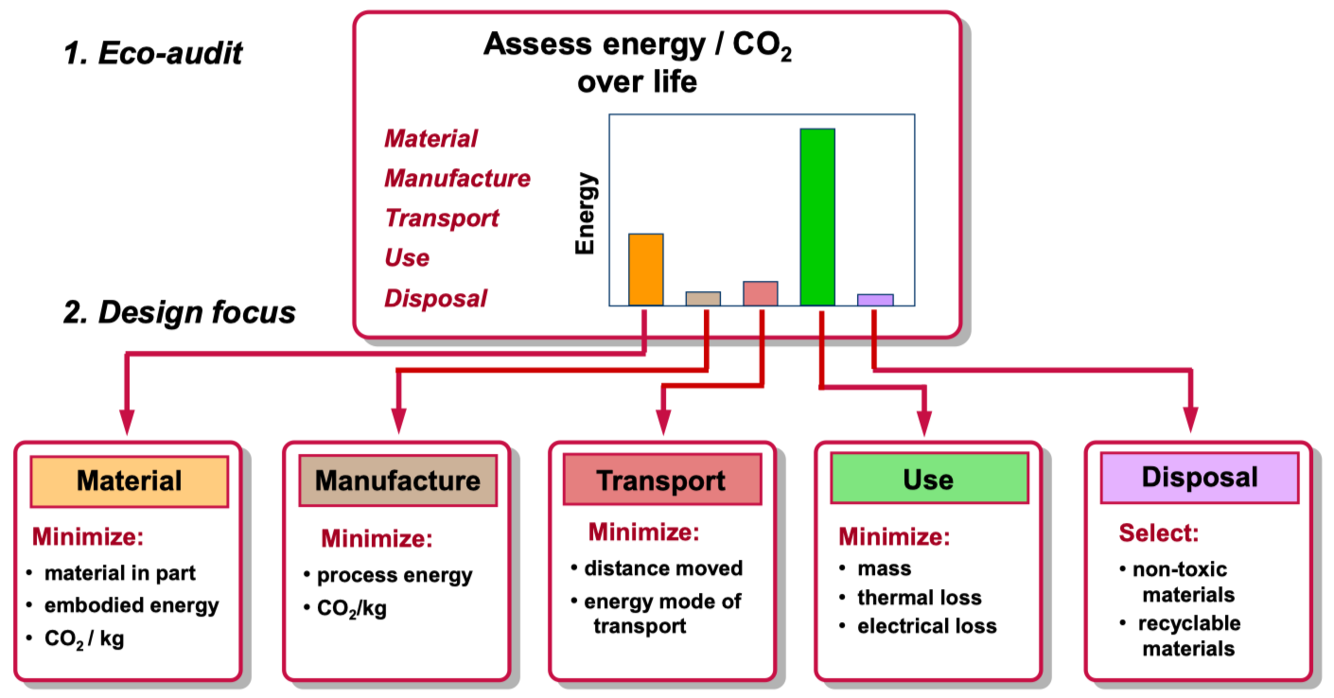
How is a CES eco audit carried out?
Choose the life phase which dominates:
- materials, manufacture, transport, use or disposal
Outline the outputs that will be generated from such an analysis. What are the difficulties with using these outputs?
Outputs can be generated under nine environmental themes (students were not expected to remember details for these, but they are stated here for completeness):
- Abiotic depletion potential;
- Energy depletion potential;
- Global warming potential;
- Ozone depletion potential;
- aquatic/terrestrial ecotoxicity;
- acidification potential;
- human toxicity;
- photochemical oxidant creation;
- nitrification potential.
All have different metrics, so combining them is not straightforward. Most studies choose only some of the headings, and tend to keep the figures separate under them. Assessment of impact therefore requires some judgment, such as which metrics are most important.
The choice of system boundaries is crucially important in any LCA. There is some flexibility about how this is done, so it is important that similar system boundary choices have been made when making comparisons between different LCAs. Similar care should be taken over allocation and choice of functional unit.
What are the main elements in a business model?
Value proposiiton
Value creation
Value capture
Explain the concept of value uncaptured?
Value captured: the benefits delivered to stakeholders either or not related to monetary profit, e.g. improved energy efficiency
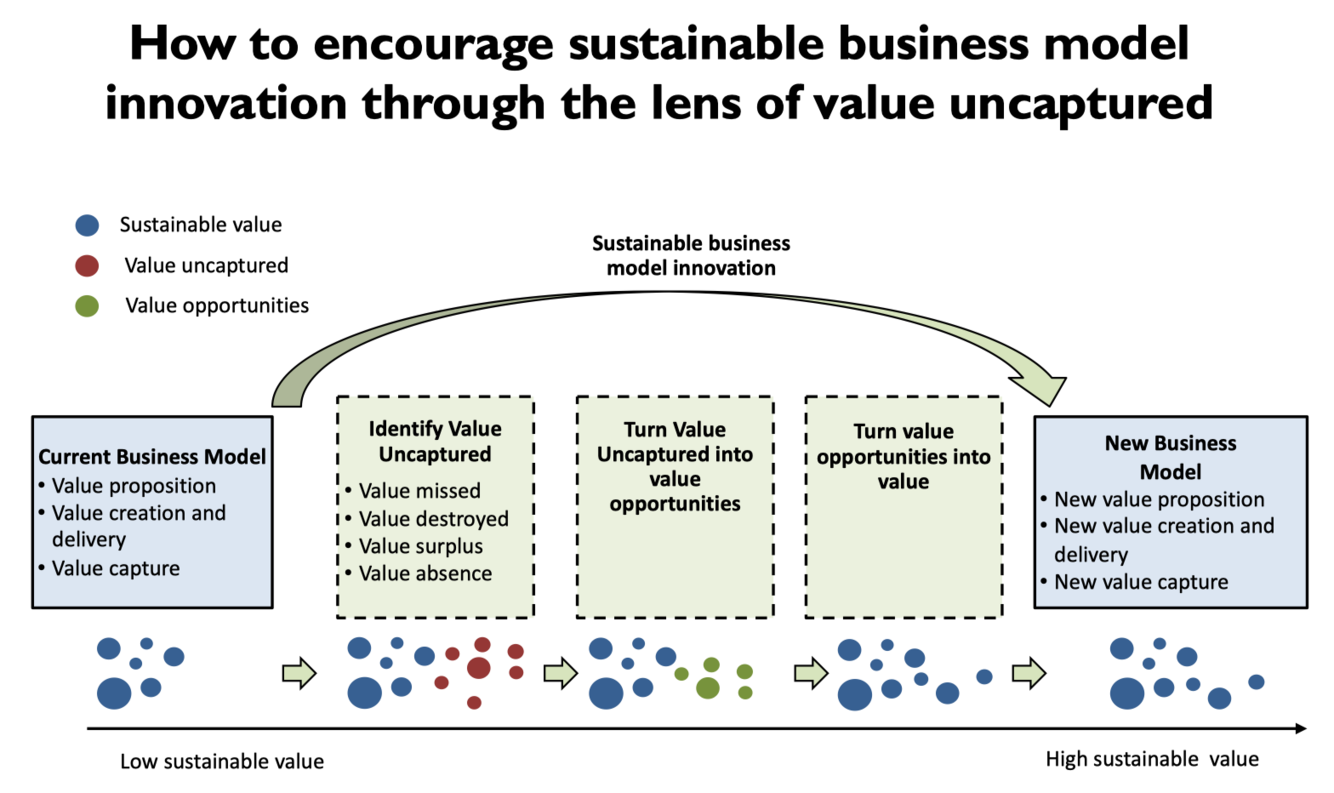
Value uncaptured:
- Value missed: value inadequately captured or lost,
- e.g. not using specialist knowledge, inefficient use of data
- Value destroyed: negative outcomes of business,
- e.g. pollution, bad working conditions
- Value surplus: redundant value that is larger than requirements
- e.g. over capacity of labour, excess functionality
- Value absent: value which is required but has not been created
- e.g. lack of skills, lack of warehouse space, unmet customer needs
Value opportunity: the new opportunities of additional value creation through new activities and relationships, e.g. the opportunity to utilise identified waste
Stakeholders must be considered:
- Investors, environment, society, employees, suppliers, customers
The concept of value uncaptured is used to understand failed value exchanges among multiple stakeholders across a business network to uncover new value opportunities.
Give examples of sustainable business models
Formula E
Dutjahn Sandalwood Oils
Elvis & Kresse
Explain the steps of the value mapping process
Steps 1, 2 and 3 – Setting the scene
- Decide the unit of analysis (product/service, business unit, company or an industry)
- Add or modify any missing stakeholders
- Identify the purpose of the unit of analysis
Steps 4, 5 and 6 –
- Map the value (follow the spiral, clockwise) current value captured for each stakeholder
- Value uncaptured, i.e. value missed / destroyed / surplus / absence for each stakeholder
- Stakeholder tensions may arise
Step 7 – Generate value opportunities for sustainability
- Eliminate value destroyed and absence - reducing the value uncaptured, turning it into positive value
- Utilise value missed and surplus – reusing the value uncaptured, increasing value in the business network
- Look for value opportunities – extending the value captured, shifting to higher value added
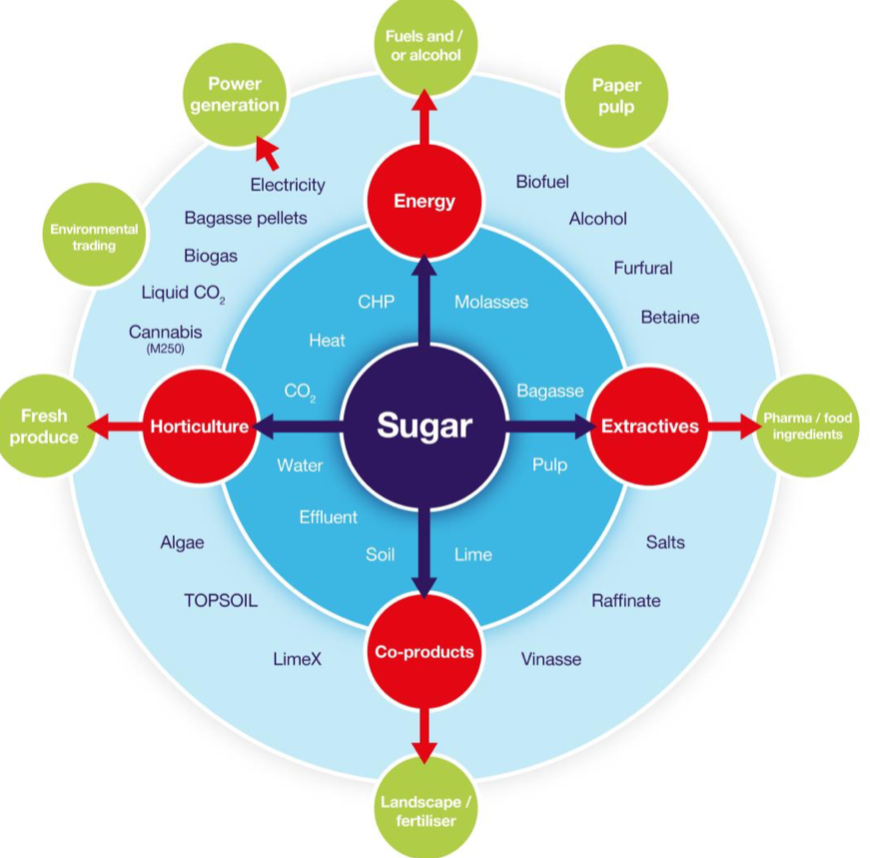
Explain the different waste streams that are utilised and sold in AB sugar
- Molasses and Bagasse made into:
- Alcohol
- Biofuel
- Furfural: fungicide/weed killer
- Betaine: used for young salmons
- Pulp and lime made into:
- Salts
- Raffinate and Vinasse: animal feed
- Water, effluent and soil made into:
- Algae and topsoil
- CHP, heat and CO2 made into:
- Power generation
- Tomatoes/marijuana
- Biogas
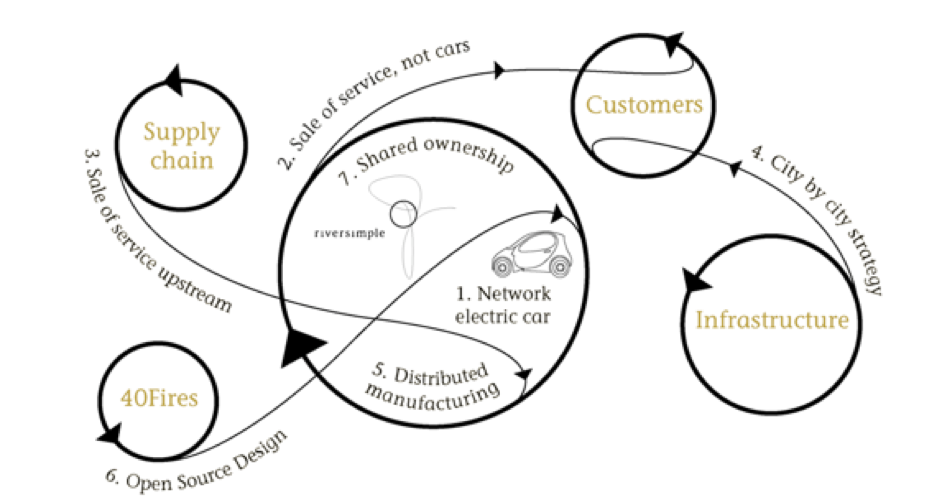
Explain riversimple’s 7 point strategy
- Network electric car
- Sale of service not cars
- Sale of service upstream
- City by city strategy
- Distributed manufacturing
- Open source designs
- Shared ownership
Define microplastics and their issues for marine life
Defined as any piece of plastic less than 5mm in length, but often less than 0.5mm (small enough to evade standard filtration systems)
Origins include:
synthetic fibres (from washing clothing); microbeads from cosmetics and personal care products; partially broken-down waste plastics
Issues:
Larger bits:
- Suffocation, entanglement.
- Sharp edges particularly when ingested
Smaller fragments (sub-millimeter):
- Mistaken for food so can cause starvation
- Unexpected effect: mimic oestrogen, disrupts reproductive ability in fish and causes infertility
Additives from processing and product requirements are released from polymer waste (and during a product’s useful life…)
Additives leach out and contaminate fluids: can mimic oestrogen and disrupt reproductive ability in animals and fish so impacting food supplies. But can also cause hormone-related problems in consumers (including humans)