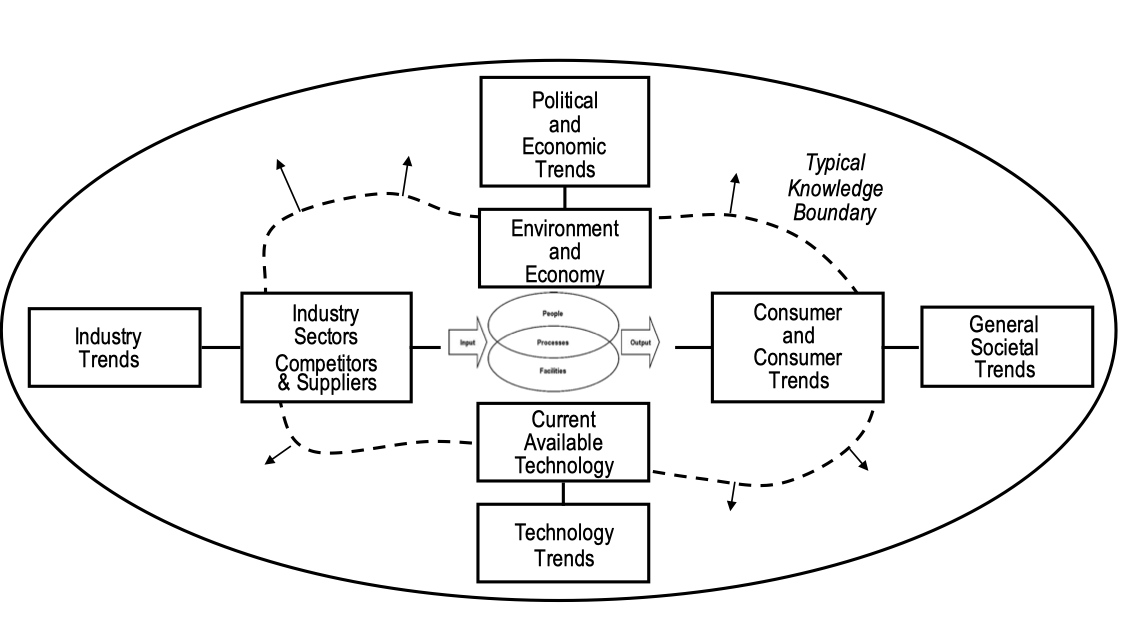
Explain the different factors that influence the firm
Industry
Political and economic
General societal (consumer)
Technology trends
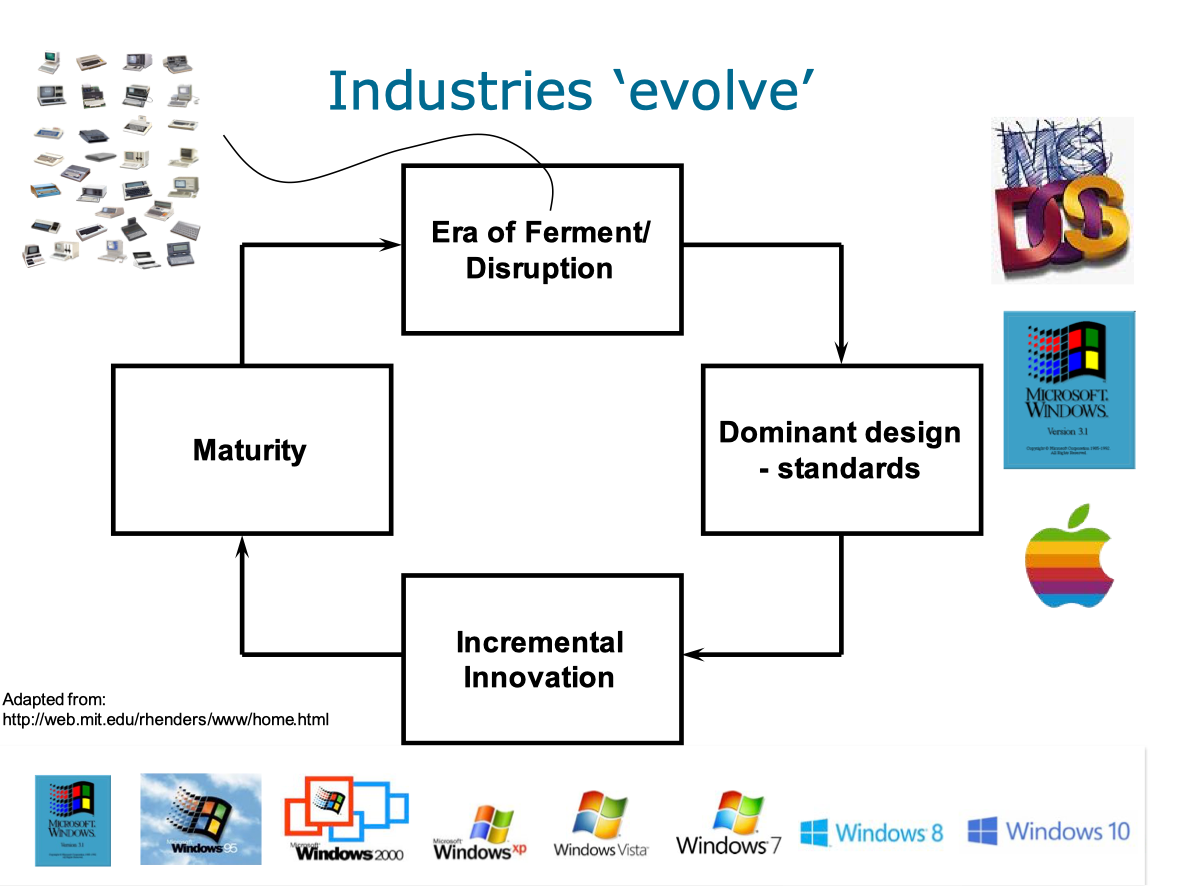
Describe how industries evolve
- Era of ferment/Disruption
- Dominant design emerges
- Incremental innovation
- modularisation: specialist parts, innovation at part level, efficiency gain
- complementary assets dominate: brand image, market info, distribution, manufacturing
- Maturity
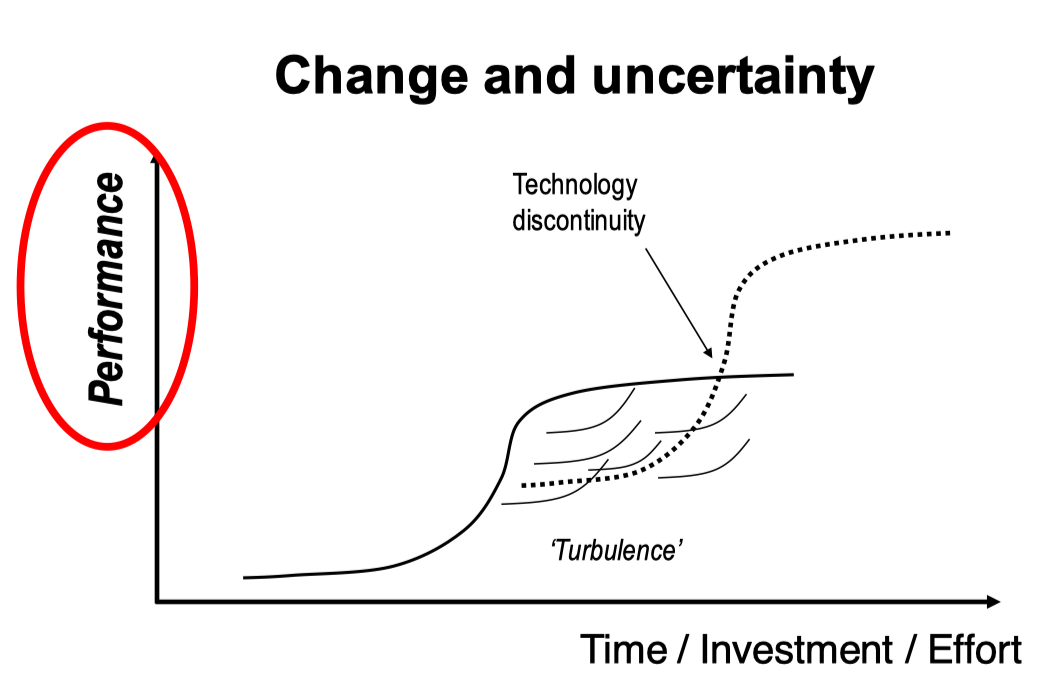
What is meant by a technology ‘S-curve’?
The S curve is a curve with technology performance over time with four phases:
- Emerging: early research, emerging in other industries, competitive impact unclear but positive
- Pacing: potential gamechanger, not yet in product, competitive impact likely to be high
- Key: in use in product, basis of competitive differentiation, high competitive impact
- Base: essential to business, widespread, little competitive impact
The S curve usually includes and depicts a technology generation shift depicted by a second s curve, sometimes illustrated as a discontinuity.
Examples of S curves:
- photographic technologies, film vs pixel. Performance factor is image quality.
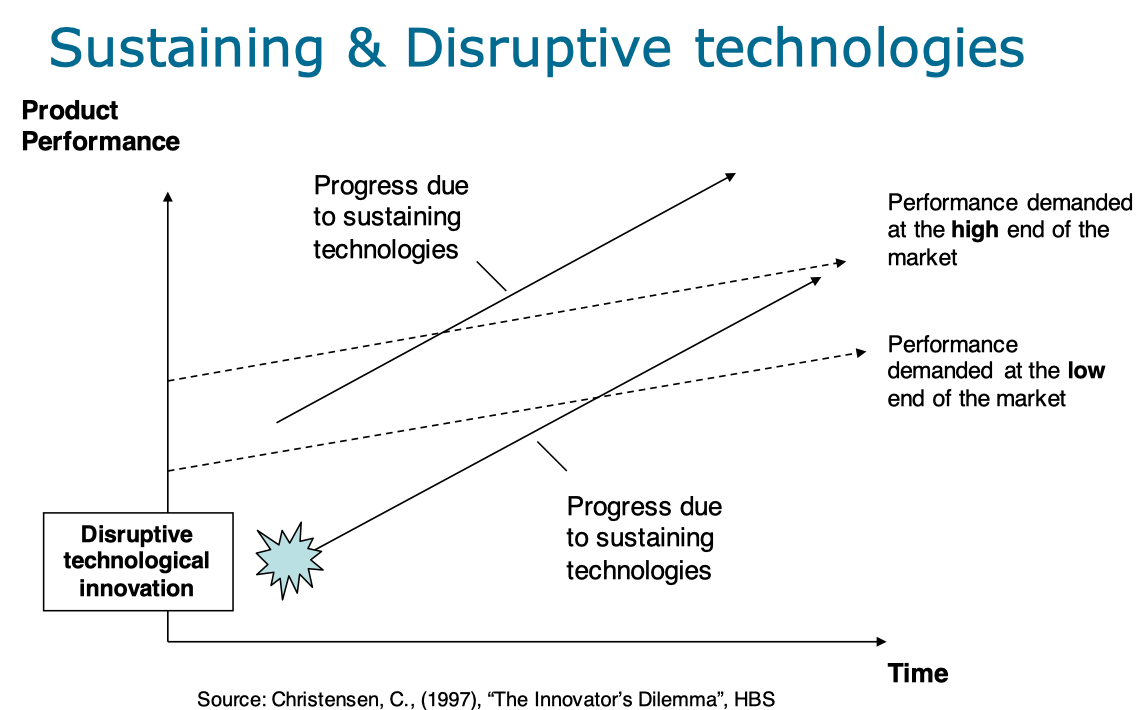
What is the difference between sustaining and disruptive technologies?
Sustaining:
- Improving performance of existing products with reference to current customers’ performance measures
Disruptive:
- Product performance may be initially worse but presents new value proposition
What are the attributes that enable product’s to be easily analysed?
- Relative advantage: over existing offerings
- Observability
- Trialability: experiment without switching costs
- Compatibility: with current conditions
- Complexity
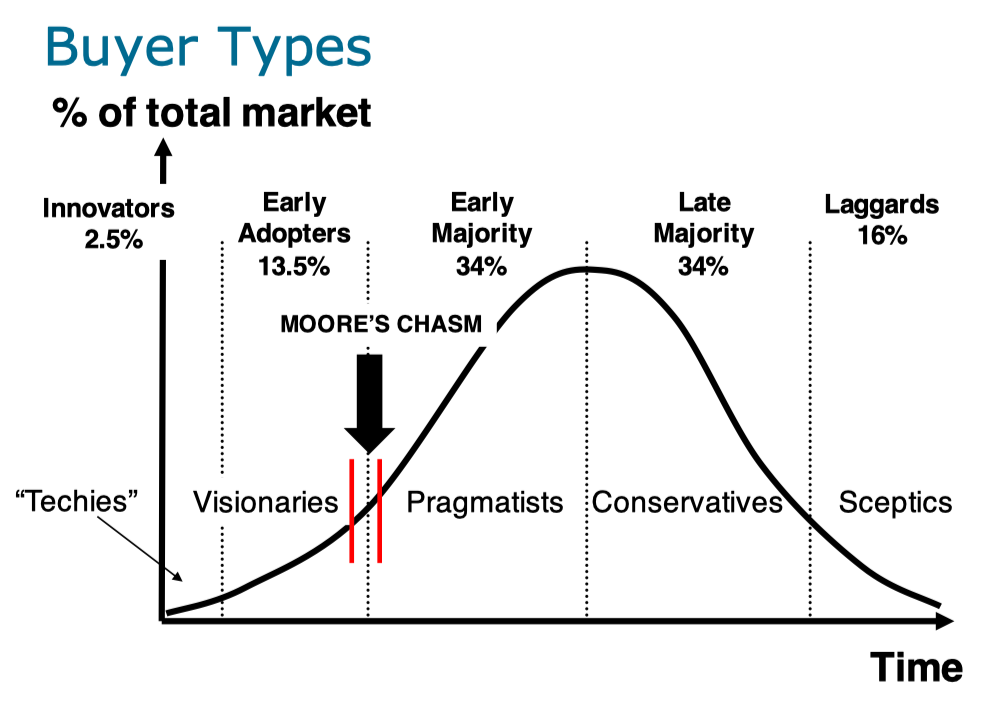
Describe what is meant by a consumer adoption curve.
A curve with either the rate of adoption out of 100% or the market share over time with five adopter types:
- innovators/techies
- early adopters/visionaries
- early majority/pragmatists
- late majority/conservatives
- laggards/sceptics
Evolution of adoption curve and markets is unpredictable as supply and demand do not move in synch.
- Supply:
- improvement of competing technology is unpredictable
- new business models reach users in unexpected ways
- technology standard wars can be engaged in unpreditable ways
- supply needs investment which may not come in times of uncertainty
- Demand:
- Feedback loops between users influencing each other`s choices are unpredictable
- Demand for interactive products are especially unpredictable because of network effects
- Users may face switching and learning costs
- Demographics lead to surprises
What is the ISAEP framework? Give examples
It is a technology management process framework:
- Identification
- Read journals, Internal research, Work with universities, Patent searching, Lead users
- GE open innovation
- Selection
- Stage gates, PESTEL, Ansoff matrix , Cost benefit analysis, TRL analysis, Pareto and Porters
- Technology roadmaps (BAESystems, BP), Innovation ‘outposts’ (Amazon), ‘Open’ campus approach (Unilever)
- Acquisition
- M&A, Reverse engineering, R&D, Recruitment, Joint ventures
- Be helpful (comet and boeing), Get the person, Run a competition
- Exploitation
- Licensing, Servitisation, Pricing strategy, Branding, Platform efforts, Sell IP
- Domino, Facebook
- Protection
- IP, Barriers to entry, Secret, NDAs, First mover advantage, Predatory pricing
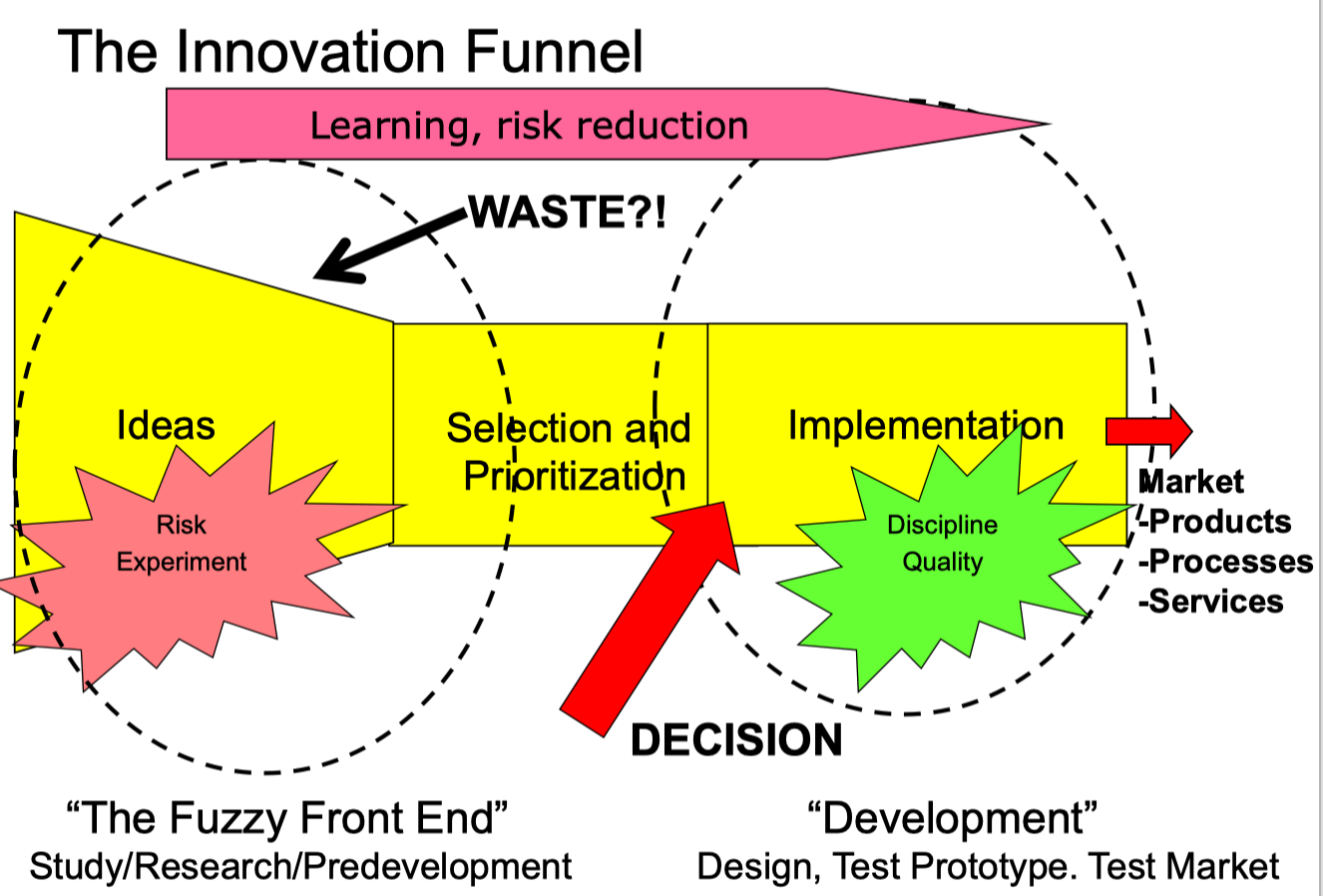
Explain the innovation funnel
- Ideas (risks and experiments)
- Selection and prioritisation
- Implementation (discipline and quality)
Explain the different project management models
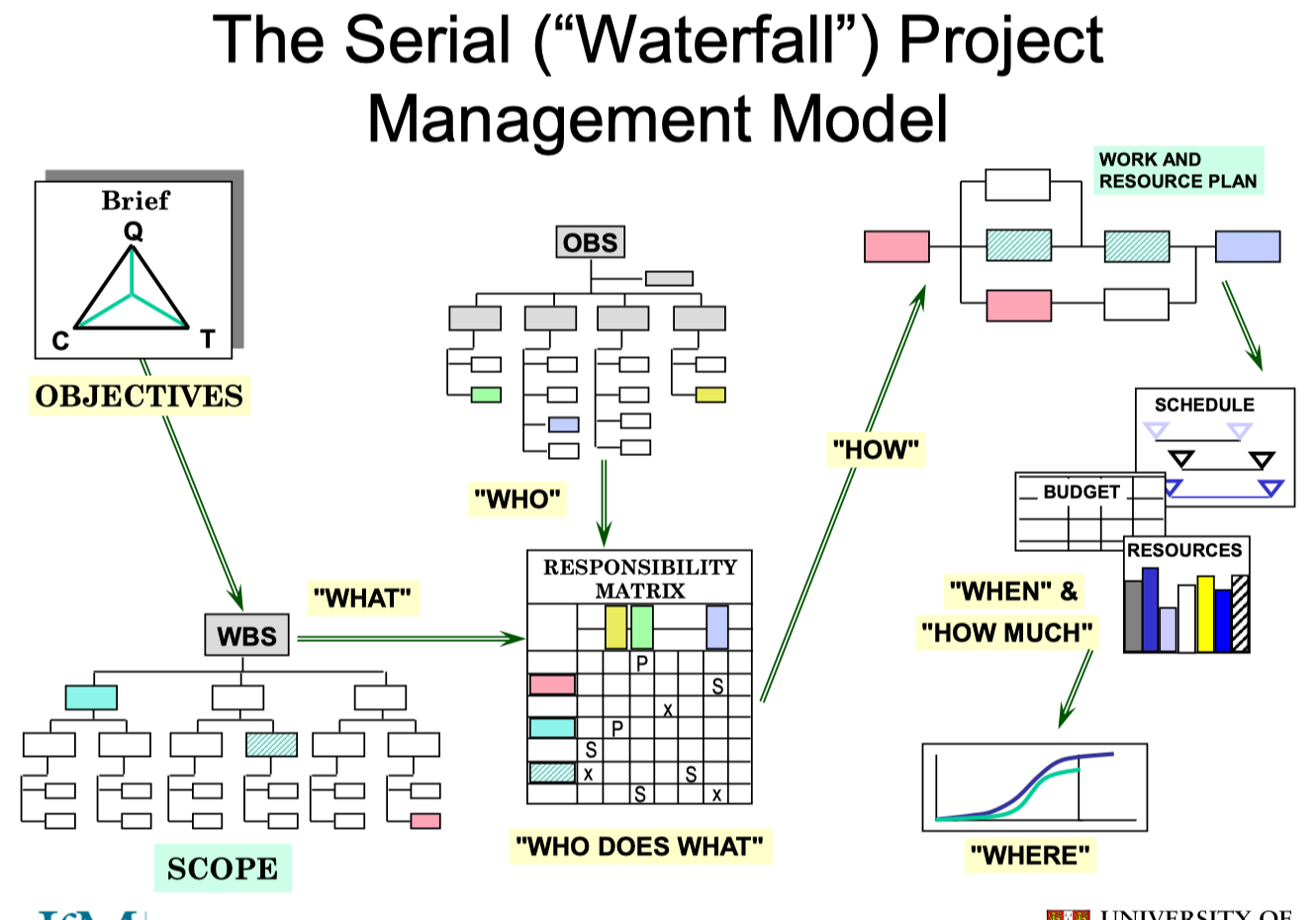
Serial waterfall
- Objectives
- Scope (what)
- Responsibility matrix (who does what)
- Work and resource plan (how)
- Schedule, budget, resources (when, how much, where)
Agile project management:
- Determine objectives, alternatives and constraints
- Identify and resolve risks
- Evaluate alternatives
- Develop deliverables
- Plan next iteration
Scrum:
- No work plan/critical path
- Meet everyday
- Share tasks
- ideal for software upgrades and investigations
Explain the product creation process
- Define/refine the project
- clear aims (elevator pitch into full specification)
- understand tradeoffs (quality, cost, time)
- Define risks and experiments
- create risk register
- main risks may not be the product
- Manage the performance engine
- New products require changes throughout the company
- Cross functional teams not partnerships
- Manage the process
- stage gates
- quality control
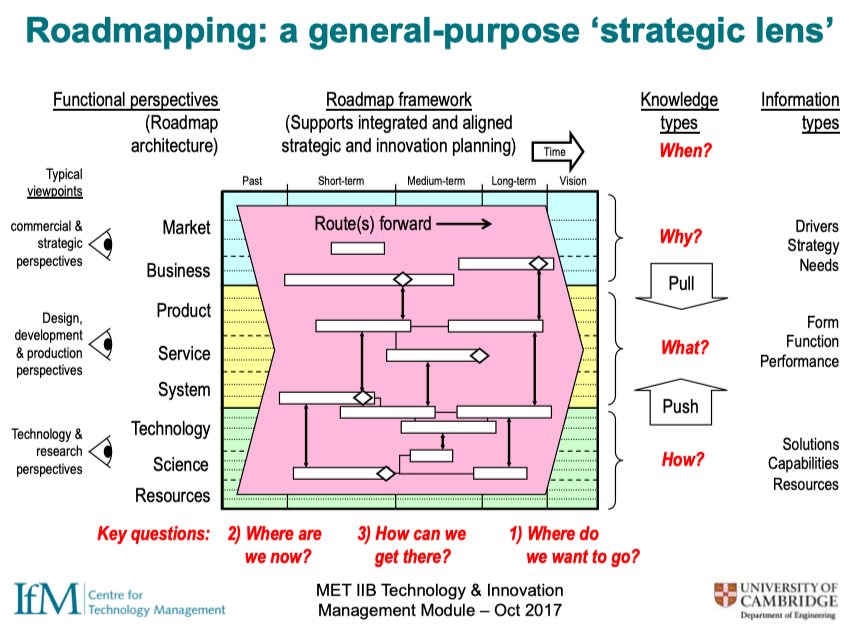
How to construct a roadmap?
Strategic technology management tool
Roadmap:
On the horizontal axis:
- where are we now
- how are we going to get there
- where do we want to be
On the vertical axis
Along the vertical axis:
- Why? (commercial perspective)
- Market and Business
- The drivers, the strategy, and the needs
- What? (design and production perspective)
- Product, Service and System
- The form, the function and performance
- How? (technology and research perspective)
- Technology, Science and Resources
- The solutions, capabilities and resources
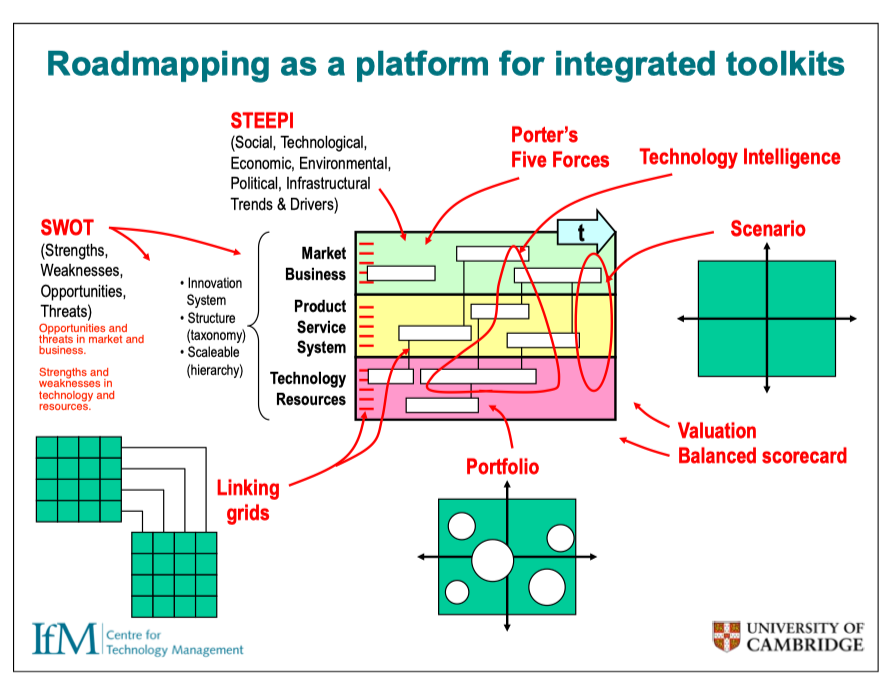
Explain how roadmaps can be used as platform for integrated toolkits
SWOT
PESTLE
PORTER
TECHNOLOGY INTELLIGENCE
What are the benefits of a roadmap?
- Roadmaps provide a consistent framework throughout the strategic planning/innovation process
- Alignment of business areas from different strategic perspectives.
- Facilitate development and integration of new technology
- Supports strategy and planning process
- Identify new opportunities for exploiting tech and deciding on a tech direction
- Support communication and coordination
- Identify gaps in market and technical knowledge
- Supports resource allocation, risk mgmt and exploitation decisions
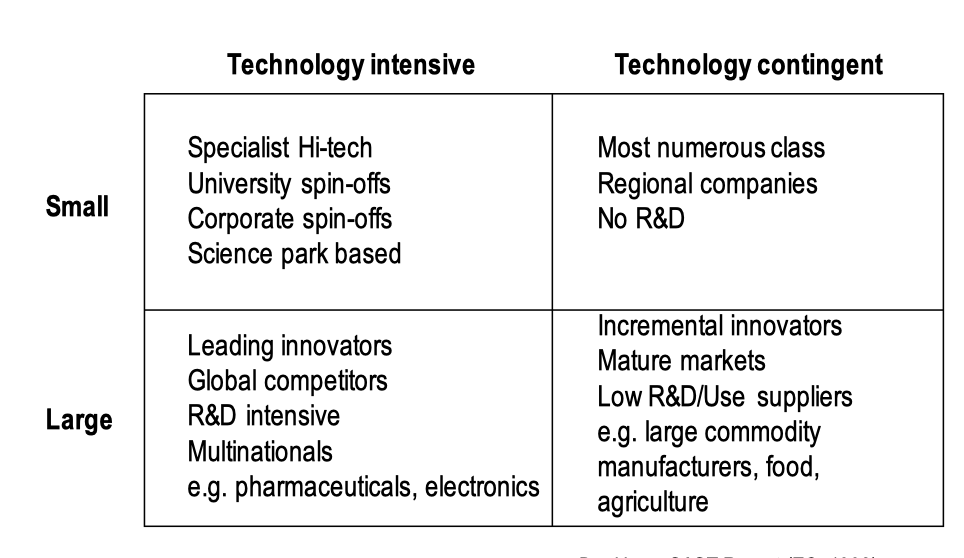
What are the different types of technology based firms and what are their issues?
Technology intensive and small:
Examples: uni spin offs, specialist high tech, science based park
Issues: finance availability, staff quality, coordination, needs new technology
Technology intensive and large:
Examples: leading innovators, global competitors, R&D intensive
Issues: think in terms of R&D, technology competent organisation redesign
Tech contingent and small:
Examples: most numerous class, regional companies
Issues: limited capacity, lack of mgmt time, lack of marketing
Tech contingent and large:
Examples: incremental innovators, mature markets, low R&D
Issues: large mature company use available tech of others, organising supplier helps them to innovate
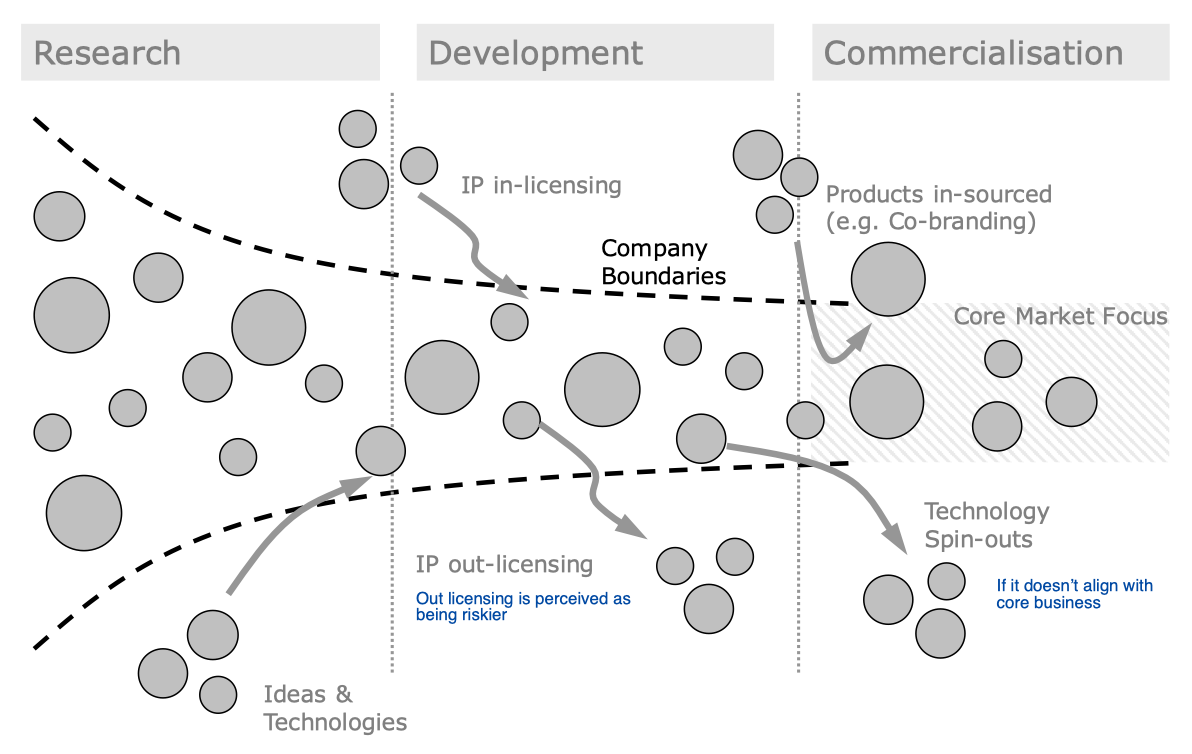
What is open innovation?
Collaborations with other comapnies throughout the development of a new technology including:
- Ideas and technology
- IP inlicensing and outlicensing
- Products insourced (co branding)
- Tech spin outs
Open innovation principles:
- Access knowledge and expertise of bright people outside the company
- Don’t have to originate the research to profit from it
- Build a better business model rather than get to market first
- Make best use of internal and external ideas to win
What are the five management challenges with open innovation?
Can be done in house or ad-hoc external.
Challenges:
- Organisational culture
- Implementation team should try to create OI culture in the firm.
- Skills
- introspective: know your own business
- extrospective: know your partner’s business
- technical: financial, portfolio mgmt.
- interactive: communication, negotiation
- Metrics
- activity vs value
- IP
- how to deal with IP and its costs
- how to agree valuation and royalty rates
- ‘Assymetric partnerships
- Reputational risk
Come to me strategies or go to them!
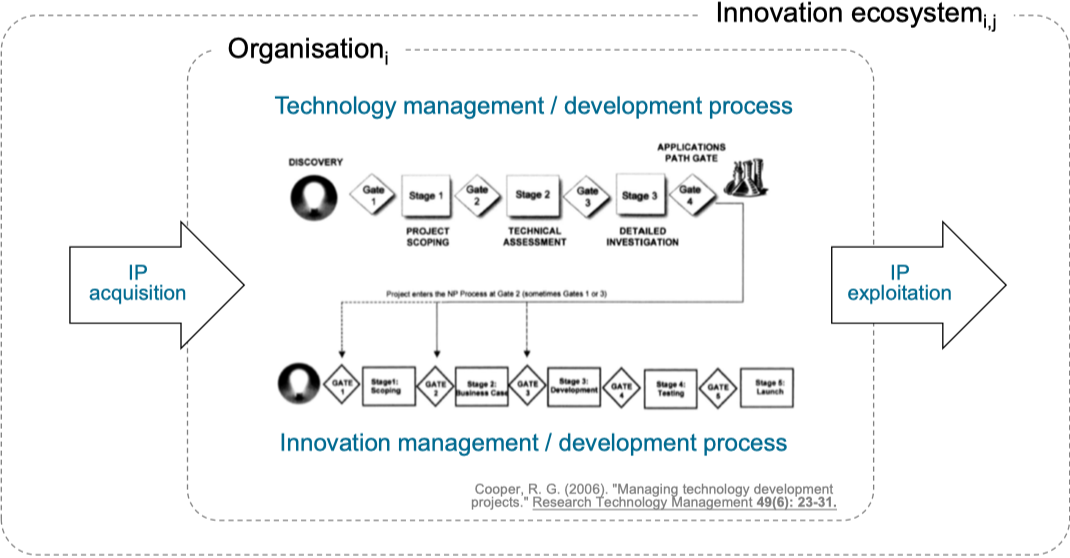
Define IP management
IP management is about ownership and control. Control mechanisms include
- legal enforcement actions, contacts, royalties, licensing, confidentiality agreements, publishing
IPM is concerned with the strategic and operational decision making, organisational routines and processes regarding the development, maintenance and exploitation of an organisation’s IP asset portfolio, in alignment with its business objectives.
How is infringement determined?
Claims define the features of the development that are protected. Everything that is covered by the claims is protected.
Infringing occurs when infringing product posses features of the claimed invention. Generally speaking production and sale of patents are acts of infringement.
What is the IP risk management approach?
- Identify the risks the company faces
- Assess the severity of those risks
- Manage the steps that should be taken to manage those risks
Generic considerations
- Origin of the risk
- Form of IP involved
- Location, timeframe, likelihood
Sources of risk include:
- internal (e.g. R&D)
- micro IP ecosystem (e.g. suppliers)
- macro IP ecosystem (e.g. competitors, new entrants)
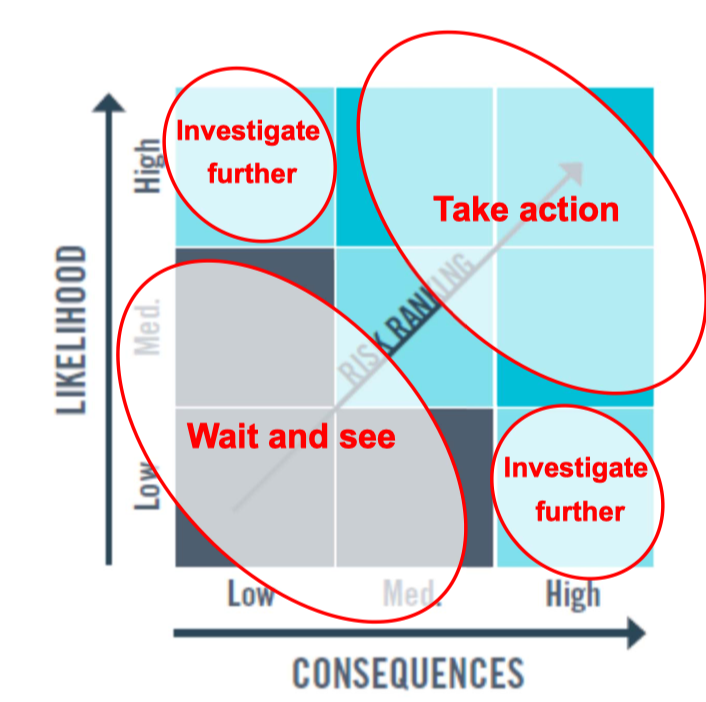
What are the different consequences of IP risks?
- Strategic: big ticket items that can affect the mission, business objectives, strategy and growth of a company.
- e.g. wrong valuation of patent portfolio
- Operational: hazards that arise during day to day runnings
- e.g. trade secrets leaked to employees
- Compliance: relating to the law
- e.g. not complying with open source licensing terms
- Financial: negative impact of money
- e.g. litigation and damage payments
- Reputational: events that undermine public trust
- large scale leak of customer data
What are the approaches for mitigating risk?
- Change risk likelihood
- Change consequences
- Accept risk and pursue opportunity
- Life cycle management
- Complementing patents with other IP (trademarks)
- IP insurance for complementors
- Contactual clauses in licensing
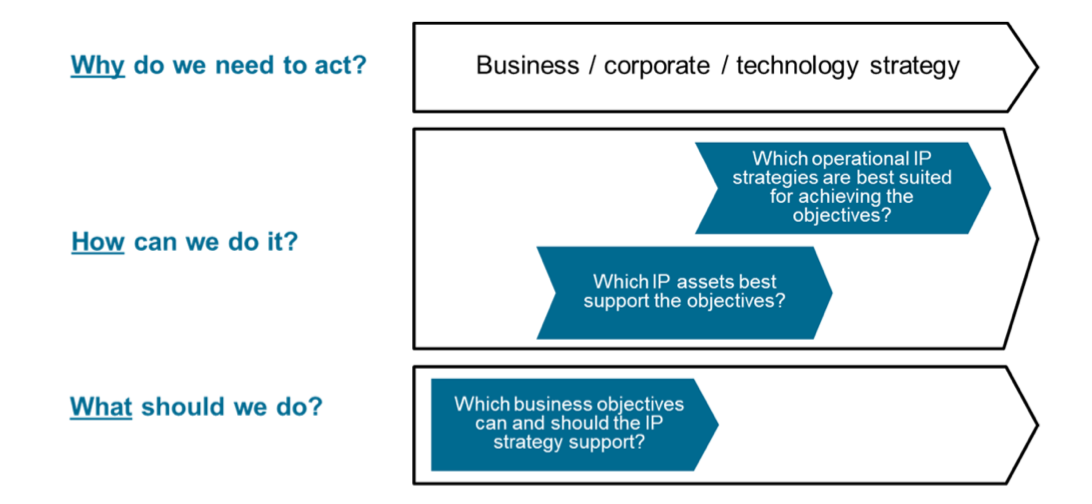
Define IP strategy and the different dimensions
Decision making relating to the ownership and control of IP to maximise value creation and capture from an organisations technology base in alignment with its goals.
Dimensions:
- Agressiveness: defensive vs offensive
- Openness: closed vs open
- Complexity : single vs multiple IPR
- Comprehensiveness: selective vs comprehensive
- Coverage: national vs global
Explain the IP strategy development process.
What should we do?
- which businesses can and should IP strategy support?
- strategic positioning
- revenue generating
- cost reduction
- conflict avoidance
How can we do it?
- which IP assets best support the objectives?
- patents, trademarks, know how, relationships
- which operational IP strategies are best suited for achieving the objectives?
- patenting
- enforcing
- publishing
- secrecy
- inventing around
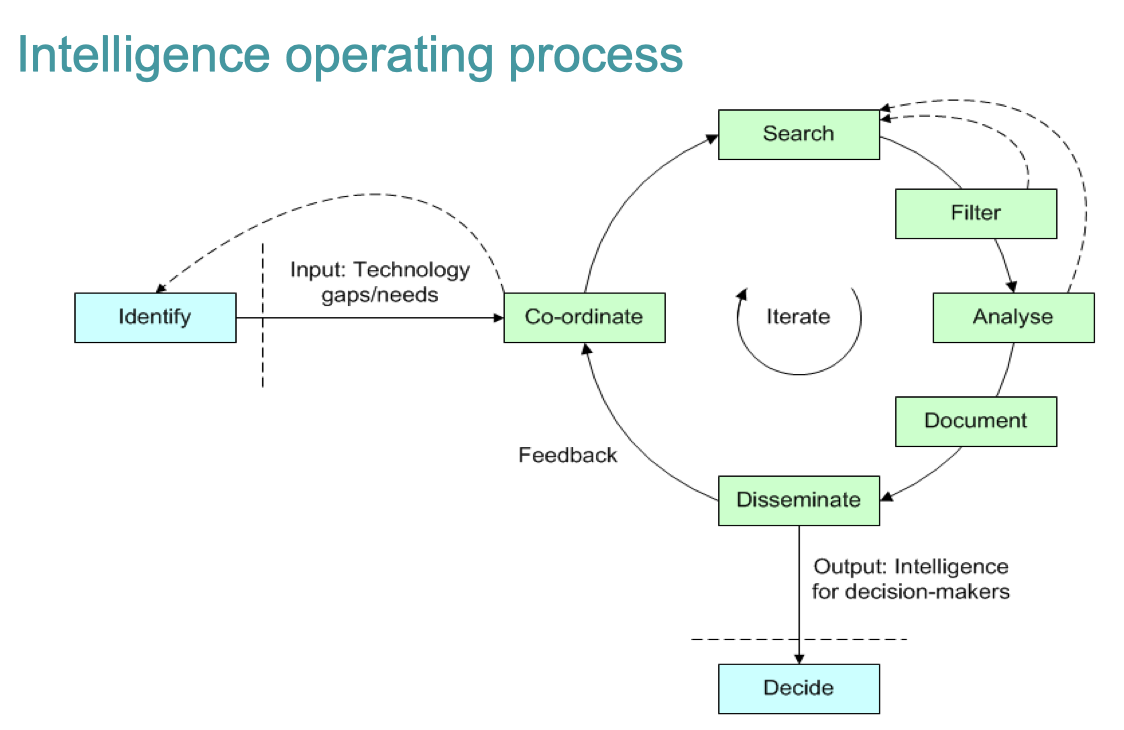
What is technoloy intelligence?
It is the capture and delivery of information about technology to help the organisation develop an awareness of threats and opportunties.
Involves a tech intelligence team who:
- capture info, develop an insight and deliver that to the decision makers.
Intelligence operating process involves:
- identify
- coordinate
- search
- filter
- analyse
- document
- disseminate
- decide