General info about thyroid hormoens
- hydrophobic signaling molecules that influence gene transcritpion
–> regulators of basal metabolic rate
–> important in development
- Iodine deficiency is the leading cause of preventable brain damage
Organization of the thyroid gland
- folicles are the functional unit of the thyroid gland
–> formed from follicular cells arranged around a central cavity (lumen)–> lumen contains colloid, protein rich fluid
–> parafollicular cells surround the follicles
- produce calcitonin and other molecules
structure and synthesis of thyroid hormones
- iodinated tyrosine residues are contained with thyroglobulin
–> large homodimeric glycoprotein
–> made in follicular cells and dsecreted through the apical membrane
–> forms major component of colloid
- Source of iodine is the diet and concentrated by thyroid follicular cells
- Very high thyroglobulin content of colloid means that the thyroid gland has significant storage capacity (2-3 months supply)
Goiter
- low dietary iodine intake leads to devleopment of goiter
–> enlargement of thyroid gland
–> attempt to better scavenge low levels of iodine causes persistently elevated TSH drives growth
Describe the organification of iodine
- incorporation of iodine into thyroglobulin is referred to as the organification of iodine
- catalyzed by THYROID PEROXIDASE, an integral protein of the apical membrane of follicular cells
–> uses iodide ions to reduce H2O2 to water
–> I- is oxidized to I (atomic iodine) or I+ (iodinium)
–> react with tyrosine in thyroglobulin to form monoiodothyronine (MIT)
–> MIT can react with another I or I+ forming diiodothyronine (DIT)
- THYROID PEROXIDASE couples DIT with MIT or DIT with DIT forming protein bound T3 or T4 respectively (more T4 is formed than T3)
describe the release of T3 and T4 from thyroglobulin
- release of T3 and T4 requires PROTEOLYSIS OF THYROGLOBULIN
–> thyroglobulin taken back up into the follicular cells by endocytic processes
–> endocytic vesciles traffic to the lysosome where proteolysis releaes T3, T4 traffic out of the cell
describe why thryoglobulin in serum is important
- small amounts of iodinated thyrobolin enters the serum via transcytosis
–> easy to measure in clincial laboratory
–> levels increase greatly with graves disease, thyroiditis
describe the control of thyroid hormone release
- Paravicellular neurons release thyrotorpin releasing hormones (TRH)
- TRH delivered to anterior pituitary by the portal hypophysal system
- TRH binds G-protein coupled receptor
- phospholipase C is avitivated
- subsequent release of Ca tiggers exocytosis of vesciels containing thyrotropin (better known as thyroid stimulating hormone; TSH)
**TSH MASTER REGULATOR OF THYROID REGULATION**
Tyrotropin (TSH)
- its is a glycoprotein hormone (alpha subunit common to FSH and LH; unique beta subunit)
- TSH receptor is G-protein coupled receptor
–> triggers signaling cascades (both adenylate cyclase and phospholipase C pathways
–> stimulates ALL ASPECTS of thyroid hormone syntheiss and secretion
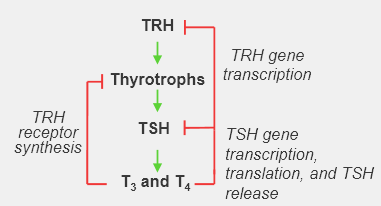
describe feedback control of thyroid hromone production
- TRH gene expression is negatively regulated by thyroid hormone (T3) (TRH receptor synthesis is also down-regulated)
- T3 levels within thyrotrophs regulates transcription of mRNA for TSH
–> tarnslation of TSH mRNA and release of TSH from thyrotrophs is also regulation
- SOMATOSTATIN AND DOPAMINE BOTH INHIBIT TSH SECRETION
**AS T3, T4 GO UP, THE ABILITY TO PRODUCE THEM GOES DOWN**
describe transport of thyroid hormones to peripheral tissue
- Majority of T3 and T4 is bound to CARRIOER PROTEINS
–> thryoid-binding globin
–> transthyretin
–> albumin
- increase HALF-LIFE of hormone because T3 and T4 are cleared by kidney
–> T4 binds protein more tightly than T3 (given T4 a longer half-life)
- Biologically active form of T3 and T4 is the FREE FORM!!!!!!!!!!
describe metaboism in peripheral tissues
- Deiodination reactions can activate or inactive thyroid hormones
–> T3 is more biologically active than T4
- T3 binds serum protein LESS tightly than T4 (more free form)
- T3 binds thryoid hormone receptors MORE TIGHTLY than T4 (pretty much JUST T3!!!)
–> Deiodination converts T4 to T3 –> ACTIVATION
describe modification of thyrid hromone activity
- Deiodination reactions are major means of modifying thyroid hormone activity
- deiodination of T3 produces T2
- Deidoination of T4 can produce reverse T3 (rT3)
–> neight T2 nor rT3 interact with classical nuclear thyroid hormone receptors
–> EFFECTS OUTSIDE OF THE NUCLEUS
Type I deiodination
- Major source of circulatin T3
- production of T2 in peripheral tissue
Type II deiodination
- Important in the control of thyroid hormone release
- converts T4 to T3
- important in tissue that generate T3 locally from T4, rather than acquring T3 from circualtion
(pituitary/hypothalmic cells)
Type II deiodinases
- considered to be MAJOR physiological terminator of thyroid hormone action in peripheral tissue
- Converts T4 to rT3 and T3 to T2
- DOES NOT CONVERT T4 TO T3
- INACTIVATION OF T4 and T3
describe the role of glucuronidation
- occurs in liver
- glucuronic acid added to phenolic hydroxyl group to thryoid hromones
- INCREASES WATER SOLUBILITY OF THYROID HROMONES
- FACILITATES ELIMIANTION IN BILE!
why are thyroid hormones important in development
- regulators of transcription
–> lack of thyroid hormone during devleopment leads to mental retardation, growth, and developmental delay
–> Broad nose, puffy eyes, large, protruding tongue; sparse hair and dry skin
–> growth failures, feeding problems, constipation, delayed development
–> child could not sit unsupported and failed to crawl
describe the physiologic effect of thyroid hormones
- REceptors present in virtually all tissues
- Increase basal metabolic rate
–> increase transcription of Na+/K+-ATPase
–> stimualted transcription of mitochondrial uncoupling protein
- INcrease cardiac output = increase HR, decrease peripheral vascular resistance
- Regulate carbohydrate and lipid metabolism
–> enhance carbohydrate absorption and oxidation
–> stimulate glycogen breadkwon and gluconeogenesis
–> stimulate lipolysis and cholesterol synthesis/degradation
- bone turnover = increase bone resorption and formation
- hematopoeitc effects = increase erythropoietin production
- increase gut motility
HYPERthyroid symptoms
- Excessive heat production
- nervousenss
- insomnia
- increase heart rate
- weight loss, increased appetitie
**GRAVES DISEASE = autoimmune disease; antibodies bind TSH receptor**
Describe hypothyroid symptoms
- increased sensitivity to cold
- decreased basal metaboic rate
- lethargy
- weight gain without increase caloric intake
Hashimoto thyroiditis
- autoimmune disease
- antibodies to thyroid peroxidase, thyroglobulin, TSH receptor-blocking antibodies, other components
–> DECREASE HORMONE PRODUCTION/SECRETION
Mechanism of thyroid hromone
- often bind DNA as heterodimers
- binding of thyroid hormoen triggers conformation change in thyroid hormone receptor
- HDAC is released and a histone acetylase (HAT) binds in its place
- leads to relaxation of chromatin and enhancement of transcritpion
extranuclear effects (new stuff)
- some effects of thyroid hormone occur within a few minutes
- mechanism of action appears independent of transcription and translation (effects are insenstive to inhibitors
- Extranuclear effects include
–> regulation of ion channels
- Ca-translocating ATPase
- Na/K-ATPase
–> mitochondrial bioenergetics (T2)
–> alterations in actin cytoskeleton (T4, rT3, but NOT T3)




