Define:
- Non-renewable.
- Renewable.
- Sustainable.
- A finite resource, which means once humans use it up no more will be available.
- There is a continuous, infinite flow of these resources.
- These resources can be used but then replaced, if humans manage them carefully.
State one reason why non-renewable resources cannot be produced in all countries (1).
Answers may include:
- Not having the money and technology to develop oil wells.
- Political decisions to protect areas from oil drilling.
Explain why oil consumption is likely to increase in the future (4).
- The Chinese, Russians, Indians and Brazilians hope to enjoy the same income and lifestyles as Europeans and Americans.
- Demand for petroleum products is rising.
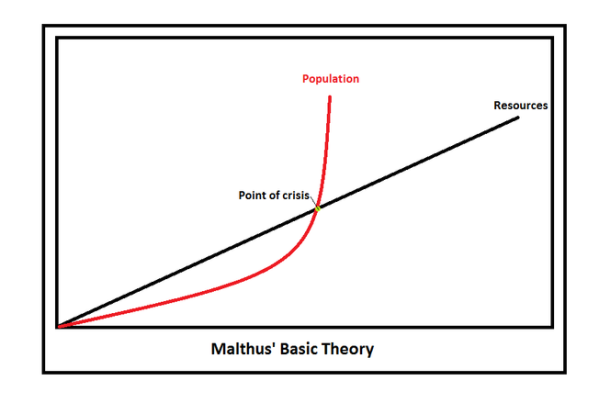
What was Malthus’ theory?
He suggested the population growth was doubling, whilst food production would only increase singly and eventually there won’t be enough resources to support the population.
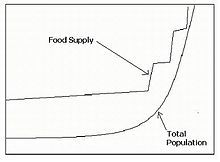
What was Boserup’s theory?
Boserup’s theory suggest we’ll never run out of resources because as we get to the point when resources are getting short we are pressured to invent ways of avoiding crisis. “Necessity is the mother of invention”.
How can we reduce resource demand as individuals?
Reducing resource consumption per person, so non-renewable resources last longer (e.g: taking public transport and reducing water to a minimum).
Using more environmentally friendly resources (e.g: using low energy light bulbs).
How can changing production methods reduce resource demand?
- Obtain all energy from renewable sources by 2020.
- Installing renewable energy systems.
- Measure, reduce and compensate for carbon emissions.
- Sell ‘carbon neutral’ products.
- Motivate workers with waste reduction programmes.
How can the fossil fuel resource shortage be tackled?
Give the advantage(s) and disadvantage(s) to two solutions.
Hydrogen can be used as a fuel to replace petrol and diesel:
A- When it’s burnt, only water vapour is released.
A- Concentrated resource.
D- Hydrogen fuel cell technology is very expensive.
D- Hydrogen is a very explosive gas so it has to be safely stored.
Maize and other crops can be made into biodiesel:
A- Renewable alternatives to petrol and diesel.
D- Biofuels use land for growing crops, so using the biofuels can reduce food supply and/or increase food prices.
How can food supply shortages be tackled?
Give the advantages and disadvantages to one solution.
GM crops that are drought or flood tolerant could be developed:
A- They could also have higher yields, be resistant to disease and contain extra nutrients.
A- Reduced need for pesticides.
D- The public are uncomfortable with GM because it’s considered to be ‘meddling with nature’.
D- Could trigger allergic reactions in some people.
D- Less biodiversity.
Define the four different types of natural resource.
Mineral- Ores like iron ores, bauxite, gold, silver and rock salt.
Physical- Water, the sun’s energy, wind and land.
Biological- Anything living, such as forests, fish and animals.
Energy- Fossil fuels.
Define:
- Food security.
- Food insecurity.
- The ability to obtain sufficient food on a day-to-day basis.
- When it is difficult to obtain sufficient food.
Give an example of past tensions between countries over energy.
In 2012, Sudan and South Sudan were in dispute over payments for oil transportation.
In 2012, Japan and China were in dispute over the ownership of a group of islands in the East China Sea- an area rich in oil and gas reserves.
Give 4 advantages and 4 disadvantages to fracking in the UK.
A- Provides jobs directly and indirectly.
A- Less imported fuel= cheaper energy costs.
A-10% of UK shale reserves= power for 50 years.
A- Burning natural gas is considered less harmful to the environment than coal and oil.
D- Concerns about potential gas leaks.
D- Risk of contamination of underground water reserves.
D- Risk of small earthquakes.
D- Uses a lot of water which could impact tourism and food production.
Apart from luck, what factors affect how much oil a country produces?
- Having the money and technology to develop oil wells.
- Political decisions to protect areas from oil drilling.
How is oil production of countries likely to change by 2030?
- Saudi Arabia= 50% of world oil➡️Most remaining reserves.
- Asia, Europe and Russia less important➡️Reserves running out.
- North America increasing➡️Development of oil-shales, tar sands etc.
How might changing international relations put pressures on supply and consumption of oil?
-Increasing political tensions as consumer countries try to negotiate deals with producing countries➡️China has alliances with Sudan.
Why can not all countries develop HEP?
- You need valleys, usually in mountains.
- You need high rainfall and large reliable rivers.
- Money and technology to build and install the dam, turbines and electricity pylons.
How can resource consumption be managed by national government?
- Education➡️UK national curriculum includes sustainability, recycling and environmental issues as past of science and geography.
- Education➡️Recycle Now is the UK’s national campaign to educate people about the need to recycle and provides advice on how to do it.
- Conservation➡️Introduced variable car tax and phasing out incandescent light bulbs.
- Conservation➡️Set target for 15% electricity generation renewable by 2020.
- Recycling➡️Sets targets for recycling.
How can resource consumption be managed by local government?
- Conservation➡️Provides and manages green spaces➡️Parks, greenbelts and local nature reserves.
- Recycling➡️Manages household waste by providing recycling bins➡️Recycles plastics, food waste, paper, glass and other materials.

-
U1- Climate Change23
-
U1- Restless Earth28
-
U1- Battle for the Biosphere40
-
U1- Water World30
-
U2- Population Dynamics25
-
U2- Consuming Resources19
-
U2- Globalisation26
-
U2- Development Dilemmas20
-
U1- Extreme Environments58
-
U1- Coastal Change and Conflict34
-
U2- Challenges of a Rural World52
-
U2- Changing Economy of the UK45



