Define social development.
Rising life expectancy, better healthcare and access to education; improved equality for women and minorities➡️ improved quality of life.
Define political development.
Improving political freedom and the right to vote; a free press and freedom of speech➡️ greater control over who governs.
Define GDP.
Gross Domestic Product is the value of all goods and services produced within a country in a year.
What is the HDI?
Human Development Index is a widely used indicator of development. It combines:
Life expectancy (health), number of years in school (education) and income per person (wealth).
What is the development gap?
The gap between the most developed countries and the least developed countries in the world = development gap.
Describe the 5 stages of Rostow’s development model.
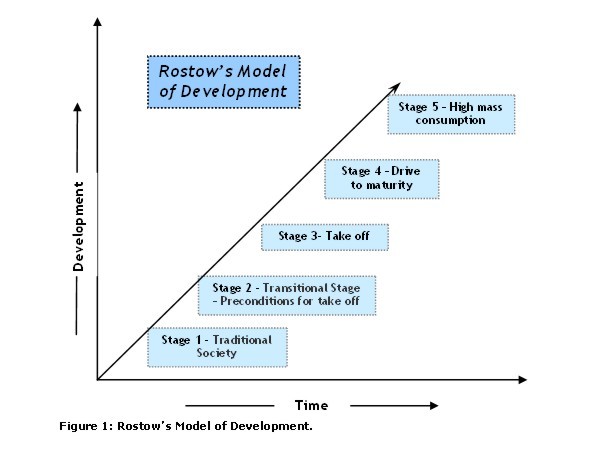
1) Traditional- most people are farmers.
2) Pre take off- small industry and trade, infrastructure built.
3) Take off- industrialisation, people move to cities, exports begin and income grows.
4) Drive to maturity- developed industrialised economy, growth of tertiary jobs.
5) Mass consumption- developed country, most people in services.
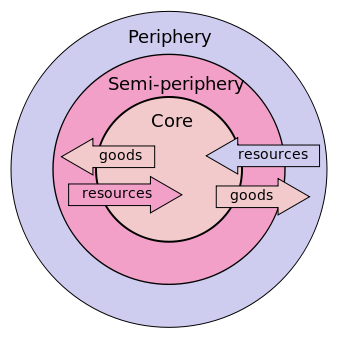
What does Frank’s theory about development suggest?
Frank’s theory argues that developed countries exploit developing countries and this keeps them in state of ‘underdevelopment’.
Using an example, compare differences in development level within a country (6 marks).

Maharashtra is a centre for banking, insurance and call centres, Bollywood and administration and government jobs which are often well paid.
Bihar is part of India’s rural periphery. Education is poor and birth rate is high, many people work as landless farm labourers with small farms and more corrupt government.
Describe top-down development.
- Aims.
- Scale.
- Control.
- Funding.
- Technology.
- Examples.
Aims: Economic development, to improve income.
Scale: Large, such as a whole region or city.
Control: National, controlled by government in capital city.
Funding: Cost millions or billions.
Technology: Highly technical,imported machinery,foreign tech support.
Example: HEP, major roads, bridges and railways, ports or airports.
Describe bottom-up development.
- Aims.
- Scale.
- Control.
- Funding.
- Technology.
- Examples.
Aims: Social development,small project to improve at local level.
Scale: Small, village, rural areas or urban slums.
Control: Local, controlled by local community.
Funding: Low cost, often funded by NGOs like Oxfam.
Technology: Intermediate tech which is simple, renewable, less tech support.
Example: Wells and water pumps, schools, health clinics, biogas.
Give advantages and disadvantages of the Three Gorges Dam in China.
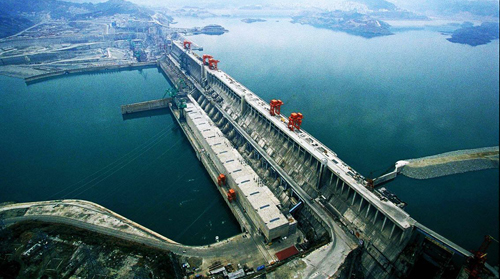
A- HEP to power China’s industries and cities.
A- 100 million people downstream no longer at risk of flooding.
A- Provides employment for building and maintenance.
A- $30.5 million made in tourism.
D- 1.3 million people has to relocate from flooded area which cost approximately $100 million.
D- 1300 archaeological sites and 181 factories flooded.
D- Reservoir may become polluted with farm and industrial waste.
D- Dam is built on fault lines in earthquake zones.
D- Yangtze River Dolphin became extinct.
Define economic development.
An increase in the number of people working in the secondary or tertiary employment sectors ➡️rising income.
What factors limit Uganda’s future development?
- Youth➡️55% under 18➡️Huge potential workforce but social problems if they can’t get work.
- Corruption➡️Foreign aid goes ‘missing’ and TNC investors must pay bribes to get business done.
- Conflict➡️East Africa plagued with conflict which could spill over Uganda’s borders.
- AIDS/HIV➡️6.5% of adults have HIV, this figure could rise if it isn’t managed.
- Landlocked➡️Relies on other countries for import and export routes.
- Coffee prices➡️Economy too dependent on a few crop exports, if coffee prices fall so does GDP.
Using examples from one country in sub-Saharan Africa, describe the barriers that prevents its progress (6 marks).
Malawi is land-locked so it has no port to export and import goods. Nearly all of the exports (sugar, tea & tobacco) have to be transferred across Mozambique by train which is slow and expensive.
20% of the adults in Malawi have HIV/Aids, many of them at a working age. Due to the disease, people become ill, weak and unable to work which leads to less income. The death of a wage earner pushs families further into poverty.
Finally, trade is made difficult by the WTO placing tarrifs of 7.5% on export products in the EU and USA, making it more expensive to buy.
Describe the multiplyer effect.
Investment➡️Growth of Industry➡️Needs workforce➡️People move there➡️Need houses, water and services➡️Workers need to build and provide these➡️Workers need food➡️Shops open, more services needed➡️Demand for more workers➡️Growth continues- population and economy expand.
Using a named example, describe how levels of development may vary within a country (6 marks).
In India, there are regional differences in development, for example for Maharashtra is the rich core region due to the entertainment industry (Bollywood) which is the largest film industry in the world. Maharashtra also has administration and government jobs which are paid well. There are manufacturing industries from steel to textiles as well as many services such as banking and call centres due to the universities in Mumbai.
On the other end of the spectrum, Bihar is India’s poorest state with most people working in subsistence farming with little or no income. Bihar has one of the most corrupt governments in India which makes it difficult to progress and develop. Finally, Bihar is a caste-based society with poor literacy at 47% due to poor school attendance.
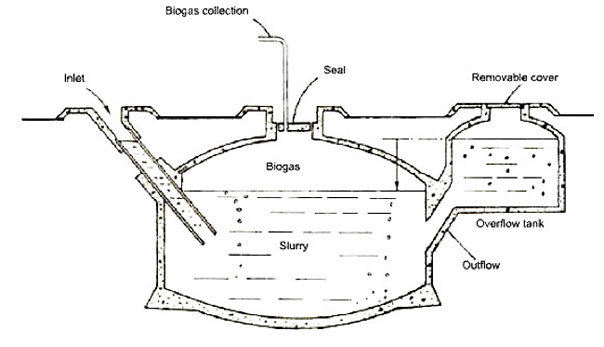
How do cow dung biogas generators work?
The dung is placed in an underground pit where it ferments to produce methane. This methane can then be used to run lights, cooking stoves or to produce electricity in a generator.
Give the short, medium and long-term benifits of biogas.
- Short➡️Women and children gain 2 hours for other activites; children use the time to go to school. 80% of families use time to earn extra income. Cow dung is no long stored at home.
- Medium➡️No smoke or ash in kitchen= reduced lung and eye problems within 6 months of being installed, also sanitation and health has improved.
- Long➡️4 million biogas plants have been built across India, 200,000 permanent jobs have been created and 244 women are earning income.
How and why has the HDI development gap improved?
- Average 0.48 to 0.68 over past 40 years.
- Aid given to developing countries to improve health, education and water supplies.
- Deadly diseases like polio have been controlled in developing world➡️Life expectancy rises.
- Countries in Aisa have industrialised which has increased incomes➡️Better diets and can afford healthcare.
How has Uganda experienced recent social, economic and political development?
- Social➡️HDI rose to 0.46 in 2012 but life expectancy only rose from 50-55 yrs.
- Social➡️90% primary children attend school but only 20% 11+ do so.
- Economic➡️Economy grown due to IMF helping Uganda pay back debt and use money saved to invest in education and health.
- Political➡️Has become more democratic with political parties and elections but human rights still an issue.

-
U1- Climate Change23
-
U1- Restless Earth28
-
U1- Battle for the Biosphere40
-
U1- Water World30
-
U2- Population Dynamics25
-
U2- Consuming Resources19
-
U2- Globalisation26
-
U2- Development Dilemmas20
-
U1- Extreme Environments58
-
U1- Coastal Change and Conflict34
-
U2- Challenges of a Rural World52
-
U2- Changing Economy of the UK45



