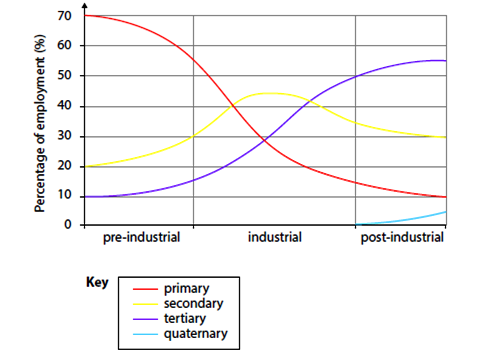
What are the three stages of the Clark-Fisher model and what is the dominant economic sector of each?
- Pre-industrial➡️Primary: farming, fishing, mining to grow or extract raw materials.
- Industrial➡️Secondary: manufacturing goods in factories and workshops.
- Post-industrial➡️Tertiary: services such as education and retail.
- Post-industrial➡️Emergence of quarternary: scientific research and high tech manufacturing.
What is the WTO’s role in globalisation?
The World Trade Organisation promotes free trade by persuading countries to reduce/remove trade barriers like taxes, tariffs and quotas.
What’s the IMF’s role in globalisation?
The International Monetary Fund gives loans to developing countries for infrastructure and encourages countries to allow foreign investment to create new jobs.
What’s the TNCs role in globalisation?
Transnational Corporations aim to reduce costs and increase profits by moving factories to cheaper locations. This creates new jobs in developing countries.
How has globalisation resulted in some key changes to employment sectors in the last 30 years?
- In the developed world, secondary jobs have been lost.
- In industrialising countries secondary jobs have been gained.
- In industrialising countries the no. of people working in primary jobs has fallen.
- Some tertiary jobs such as call centres have moved from developed countries to developing countries.
How has globalisation had an impact on different groups of people in the last 30 years?
- Most countries have become richer, especially in the developed world.
- 300 million people in China have been lifted out of poverty.
What is FDI?
TNCs investing in new factories and transport infrastructure for LEDCs so they are able to manufacture goods cheaply.
Why is FDI easier to implement than in the past?
- Communication is cheap and instant.
- Jet aircraft has reduced the cost of travel.
- Container ships make it cheap and efficient to move products.
What is a TNC?
A TNC operates in at least two countries.
What does globalisation mean?
- Jobs and wealth in one country increasingly dependent on trade and investment from other countries.
- Countries specialise in certain types of economic activity (e.g: finance in UK and manufacturing in China).
- Jobs move from high cost countries to low cost countries.
- Amount of trade in goods, services and money is increasing.
- World increasingly connected by air travel, shipping and Internet.
How do each of these things aid globalisation?
- Shipping container.
- Internet.
- TV.
- Planes.
- Importing and exporting goods.
- Provides ease of communication and access to information about other cultures and countries.
- Provides better insight into different cultures.
- Provides a quick/easy way to travel round the world.
Describe how a country may change moving through the Clark Fisher Model.
- Pre-industrial➡️Most people spend their time subsistence faming.
- Industrial➡️Growth of big cities and people leave the countryside to work in factories, many people work long hours in poor conditions.
- Post-industrial➡️Increase in cheap foreign imports, the population becomes wealthier and demands more services.
What have people in developed countries lost and gained due to globalisation?
✅The well qualified gained benifitted from the growth in services.
❌Decline in manufacturing reduced jobs available for skilled people.
❌Older men and women with unwanted skills struggle to find new, well paid jobs.
❌Fewer apprenticeships available for young people➡️Only low paid jobs available.
What have people in developing countries (e.g: Bangladesh) lost and gained due to globalisation?
✅There are more oppurtunities for men, with increasing numbers of jobs in transport, distributing and retailing.
✅2006 labour laws mean any child can work in a factory above 14 years of age.
✅About 70% of employees are unskilled women.
✅Working conditions have improved.
❌Low wages.
❌Long hours.
❌Labour laws are difficult to enforce.
❌Many sweat shops employ younger women and discriminate against older women returning after raising children.
Using examples, explain how the growth of TNCs has led to greater global trade between countries (4 marks).
TNCs manufacture in developing countries so their products are cheaper which has led to huge increase in global trade of goods. As TNCs grow, they make a wider range of products and now operate in almost every country in the world e.g: Apples good made in countries such as China and sold all over the world.
Using examples, explain how organisations like the IMF and WTO can help the process of globalisation (4 marks).
Organisations such as WTO promote free tade between countries, which helps remove the barriers between countries.
The IMF promotes trade and employment to try to reduce world poverty. As LEDCs such as Africa get out of poverty, world trade will increase because they have more money to spend. IMF also helps countries such as Greece with financial debt so unemployment isn’t so high.
Explain how globalisation has led to greater trade between countries (4 marks).
- Greater economic inter-dependence (national borders becoming less important).
- An increasing volume and variety of trade in goods and services.
- Easier international money flows to invest in other countries.
- Increased spread of technology.
- Increased spread of culture due to global media companies.
What are the working conditions and pay likely to be like for a subsistence farmer in Ethiopia?
- Hard, labour intensive.
- Vulnerable to weather.
- Lives depend on producing enough food.
- Children in family often have to work.
- No pay➡️Maybe small amount from selling surplus.
What are the working conditions and pay likely to be like for a factory worker in China?
- Long hours, repetitive.
- Unions often banned➡️Employees cannot exercise their rights.
- Factories only want workers under 30 yrs.
- £1000-£3000 per year.
What are the working conditions and pay likely to be like for a nurse in the NHS?
- Good working conditions, health and safety regs, union representation.
- Paid holidays and pensions.
- Unsociable working hours, high stress environment.
- £20,000-£40,000 per year.
What are the working conditions likely to be like for a pharmaceutical researcher?
- Very good working conditions.
- High stress job with TNC demand to develop new products.
- £25,000-£100,000 per year.
How does money flow around the world?
- Through trade in goods.
- Through stock markets.
- FDI.
How have patterns of international trade (exports) changed?
- Africa, Middle East, South and Central America= Same % exports.
- Aisa= More % exports.
- Europe and North America= Less % exports.
How have patterns of FDI changed?
- Most FDI goes to developed countries.
- FDI to developed countries has increased.
- FDI to China has grown by nearly $114 billion in 30 years.

-
U1- Climate Change23
-
U1- Restless Earth28
-
U1- Battle for the Biosphere40
-
U1- Water World30
-
U2- Population Dynamics25
-
U2- Consuming Resources19
-
U2- Globalisation26
-
U2- Development Dilemmas20
-
U1- Extreme Environments58
-
U1- Coastal Change and Conflict34
-
U2- Challenges of a Rural World52
-
U2- Changing Economy of the UK45



