UTIs in children
UTIs in children: more common in those under the age of 2
Proteus mirabilis
Virulence factors
- Proteases
- Haemolysins
- Biofilm formation
- Urease production
Increase in alkalization will cause stones to form
Lactobacilli characteristics
- Gram + rods, non-spore forming
- Facultative or strict anaerobes, produce lactic acid
- Rarely cause UTIs do not grow in urine well
Psuedomonas biofilm development
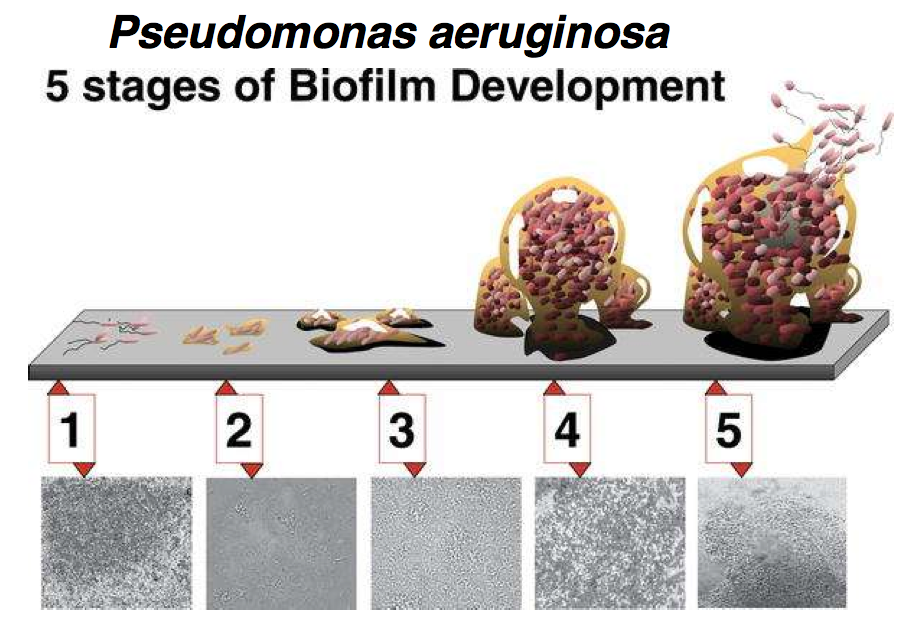
Diagnosis of UTIs
- Clean catch urine specimen (unspun, midstream)
- White and red blood cells, bacteria
- Culture and sensitivity tests
- ~20% of patients w/UTIs do not have pyuria
- No simple test to distinguish between upper from lower UTIs
Urine -> smells like ammonia, toxic to kidneys (alkaline -> urine struvite crystals)
Proteus mirabilis
Serotypes of E. coli in UTI
~85% of community- acquired, ~50% of hospital acquired UTIs
Uncomplicated vs Complicated UTIs
• Uncomplicated UTI
– no specific pre-disposing factors
– no structural abnormalities, etc.
• predisposing anatomic, functional, or metabolic abnormalities -> Complicated UTI
– requires more aggressive evaluation and follow- up
– definition is often imprecise
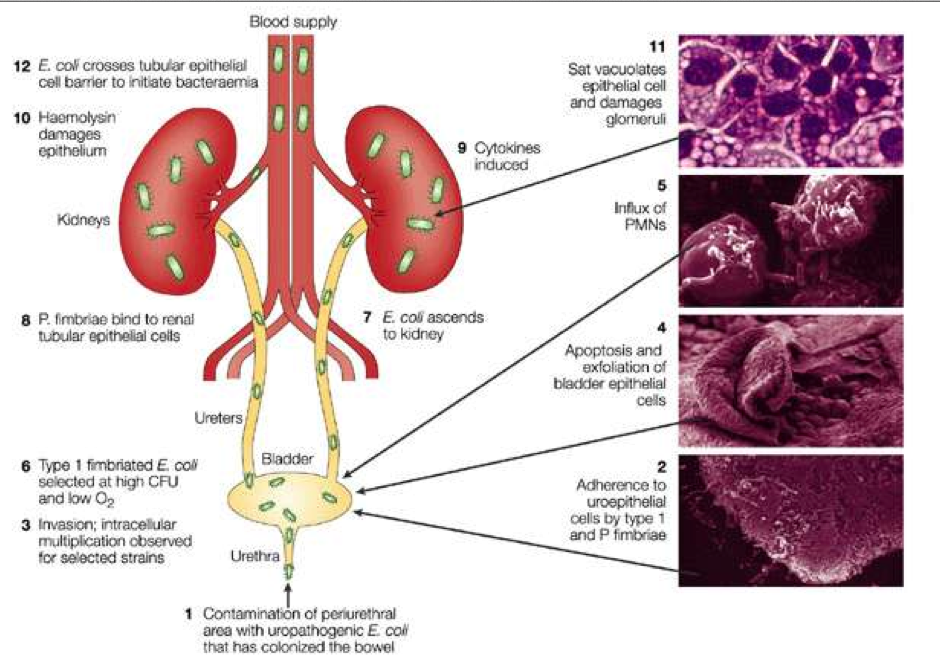
Pathogenesis of UTI pic
Clinical Outcomes of UTIs
• Prostatitis: spectrum of disorders, some infections (E. coli most common)
– acute bacterial prostatitis is most serious but least common (chronic more common)
– reflux of urine from urethra into prostate ducts
• Epididymitis: microorganisms can enter from prostate via ejaculatory duct
– pathogens vary in younger men vs older
– predisposing factors include prostatitis, indwelling urinary catheters, urologic surgery
Chronic UTI associated with which bacteria
E. coli
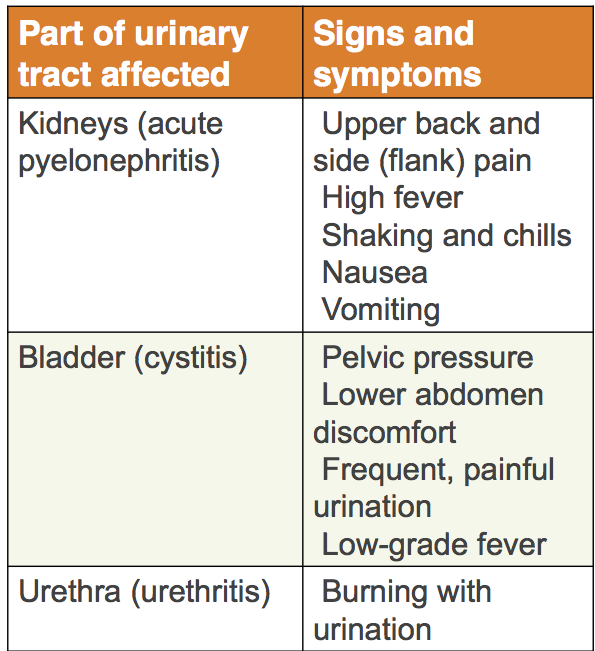
Sx and location of infection of UGT
Virulence factors contributing to UTIs
– Adhesins (pili, fimbriae, etc.)
– Ig proteases
– Hemolysins (get cytokine release, inflammation) – Ureases (i.e. P. mirabilis)
– Siderophore expression
– Factors promoting colonization and movement
Tamm-Horsfall Protein
Bladder host defense
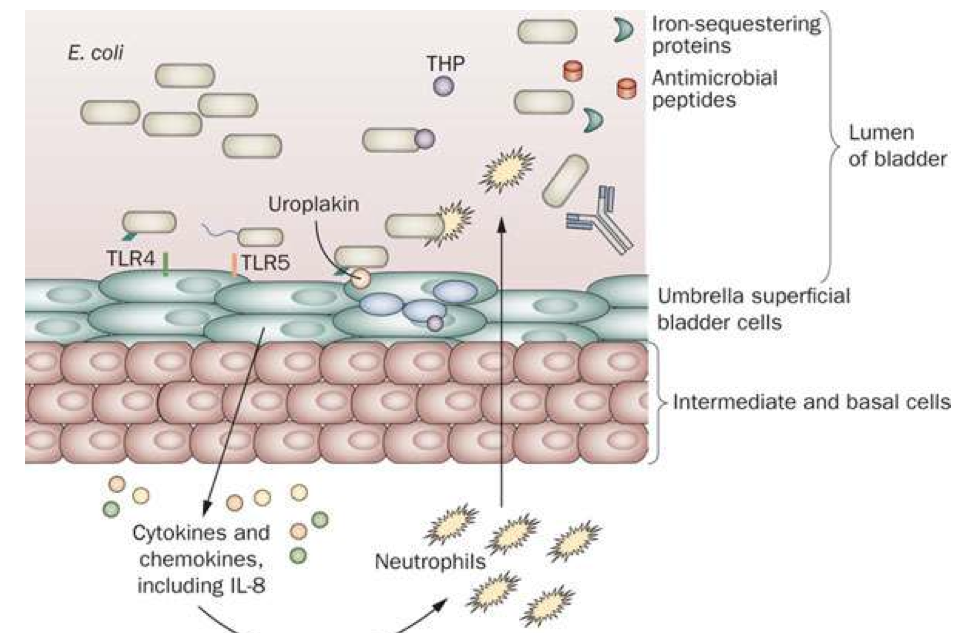
- binds specifically to type 1 fimbriated E. coli
- key urinary anti-adherence factor serving to prevent type 1 fimbriated E. coli from binding to the urothelial receptors
UTI Treatment
- Usually antibiotics
- Drug and length depends on patient’s history and infecting microbe
- Sensitivity tests useful in selecting most effective drug
Protective components of UGT
– Antimicrobial properties of urine (high urea conc., immunoglobulins, etc.) – Presence of normal microflora
most common site of healthcare-associated infection, accounting for more than 40% of the total # reported
UT infections due to catheterization
Asymptomatic Bacteriuria
Relatively common finding
- Present in ~5% of unselected medical outpatients, 10% pregnant patients at term, also in hypertensive and diabetic patients
- Anatomic obstruction increases incidence
- Nearly all patients with indwelling catheter w/open drainage for more than 48 hrs
Recurrent UTIs
- 3 or more UTIs within a 12-month period
- Relapse
- Re-infection
- New infection
- Predisposing factors
- 20 - 25% women w/acute uncomplicated cystitis have 2 or more infections/yr
UTI vs. STI
Juxtaposition of urinary and genital tracts in
vertebrates is a source of confusion
- UTI = Urinary tract infection. May or may not be transmitted by sexual activity – the more general term
- STI = Sexually transmitted infection –more narrowly specific
- Not all UTIs are sexually transmitted, and not all STIs manifest their symptoms and/or pathology
in the urogenital tract
Normal microflora of vagina
– More diverse, influenced by hormones
– Newborn girls colonized w/ Lactobacilli, vaginal flora becomes more diverse over time
– Lactobacilli become more prominent at puberty
Epidemiology of UTIs
2nd most common type of infection in the body*
Women: especially prone to UTIs (20-40% develops a UTI during her lifetime)
- Men: not as common as in women but can be very serious when they do occur
- US women that develop a UTI: 20% will have a recurrence
- Women who experience three or more UTIs are likely to continue experiencing them
Acute uncomplicated cystitis, Recurrent cystitis in young women, Acute cystitis in young men, Acute uncomplicated pyelonephritis, Asymptomatic bacteriuria in pregnancy
What bacteria
- Escherichia coli • Klebsiella pneumoniae
- S. saprophyticus • Proteus mirabilis
Complicated urinary tract infection bacteria
- E. coli
- Enterococcus species
- K. pneumoniae
- Pseudomonas aeruginosa
- P. mirabilis






