Q fever tx
Treat with doxycycline +/- surgery for endocarditis
Congo-Crimean Hemorrhagic Fever
sx
animals
location
– fever, hemorrhages
– tick, reservoir rodents
– Asia, Africa
Leptospirosis: Management
Doxycycline or penicillin for 1 week
• Prophylactic doxycycline 200mg weeklyi s effective in data from military clinical trials
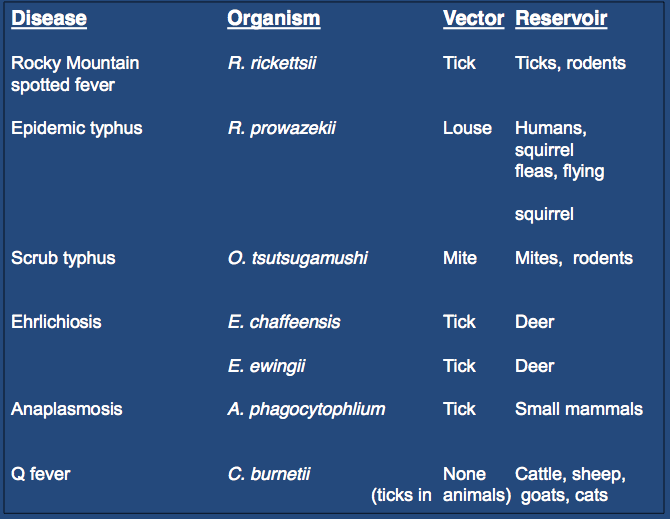
Rickettsial infections
Guillain-Barr’ is due to cross reaction between
capsular oligosccharides and glycosphingolipids on nerve surface (autoimmune disease)
Yersinia pestis
• Vector
Xenophylla cheopis, the Rat Flea, is the main
vector; related fleas of rodents are secondary vectors
Ixodes sp.: Life cycle
Eggs hatch to larvae (spring to summer)
Larvae require a vertebrate blood meal to develop into nymphs (early fall)
- Nymphs become dormant in winter; require another blood meal before they can become adults (spring to summer: most infectious stage)
- Adults mate and then lay eggs (summer to fall)
- Eggs remain dormant over the winter
Lassa fever characteristics
Arenaviruses
most common febrile illness in Sierra Leone
– African bush rat ( Mastomys natalensis )
– Transmission from urine from rats and patient body fluids ( nosocomially)
Flaviviruses
• Pathogenesis
– infect macrophages
– cell damage by cell mediators – tissue destruction by T- cell
– shock syndrome;
- virus-antibody complex enters monocytes via Fc rec
- antibody enhances infection
- generally increased production of cytokines
- severe illness, shock, hemorrhages
Campylobater jejuni
• Diagnosis:
Presence of “S” shaped bacteria in stool
• Detection of Campylobacter antigens in stool is more sensitive and specific for diagnosis
Campylobater jejuni
• sources
Worldwide round the year infections
• Poultry is the common source, ingestion of contaminated food, water and unpasteurized milk may cause diarrhea
Anthrax in what animals
Native to hoofed domestic herbivorous animals: cattle, horses, etc.
Brucellosis : pathogenesis
- Once skin or mucous membranes are penetrated by organisms they are carried to lymphatics by PMNs
- Cells multiply within macrophages
- Humoral response is ineffective; T-cell response required.
- Failure of T-cell control results in granulomatous inflammation with bacterial multiplication within the RES
- Waves of bacteria are released into the circulation from these sites resulting in recurrent bacteremia.
Flaviviruses characteristics
- Genome:ss+ polarity, RNA
- Epidemiology:
– Arbovirus (except Hepatitis C )
– All flaviviruses serologically related- cross reacting antibodies
Tularemia found in
Rabbits, beavers, deer (can be found in cats and dogs)
dog tick (Dermacentor variabilis), wood tick (Dermacentor andersoni), lone star tick (Amblyomma americanum), deer flies (Chrysops spp.)
Anaplasmosis sx
>95%: fever, myalgia, headache; 75%: renal dysfunction;
• Rarely: pancarditis, myocarditis, abdominal pain, renal failure, ARDS….
Filoviruses type of fever
MHF (Marburg Hemorrhagic Fever)
Pasteurella multocida:Epidemiology
Normal respiratory biota of many lower animals,
including cats and dogs.
• Human is infected by bite ( dog commonly) or scratch
Faliciparum zoonotic source
Birds (Chickens, Ducks)
Yersinia pestis infection in flea vector
- Flea acquires Y. pestis when it takes a blood meal from an infected rodent host.
- Organism multiplies in proventriculus of the flea, eventually blocking the flea’s GI tract.
- Starving flea regurgitates infectious material when attempting to take another blood meal.
- Flea eventually dies of the infection
Tularemia - Diagnosis
history
Direct fluorescent antibody on appropriate clinical material is sufficient
Cat-scratch disease
_ Papule/pustule 3 - 10 days post cat-scratch, lick or bite.
– Fever and with regional lymphadenopathy (head, neck, axilla)
– Most cases recover completely & spontaneously
Q fever ( “Q” for “Query”) caused by
Caused by Coxiella burnetti
Rocky Mountain Spotted Fever carried by
– Dermacentor andersonii Wood Tick Western States
– Dermacentor variabilis Dog Tick Eastern States
– Ambylomma americanum Lone Star Tick Southwest






