Three major mechanisms for cell signaling
1) Receptor-tyrosine kinases
- Epidermal growth factor (EGF) prototype, other forms are pieces of EGF. EGF located in plasma membrane. Protease (isoforms of ADAM) cleave extracelluar matrix, releasing active molecule. Target: receptor tyrosine kinase.
2) G protein coupled receptors
- GPCRs use neurotransmitters or hormones as ligands. Ligand binding causes conformational changes. α and β subunits stimulate amplifiers to produce messengers.
3) Channels
- When ion channels detect incoming stimulus, they undergo conformational change leading to amplification by gating ions. Gating ions changes membrane potential, which has a messenger function by altering activity of other channels.
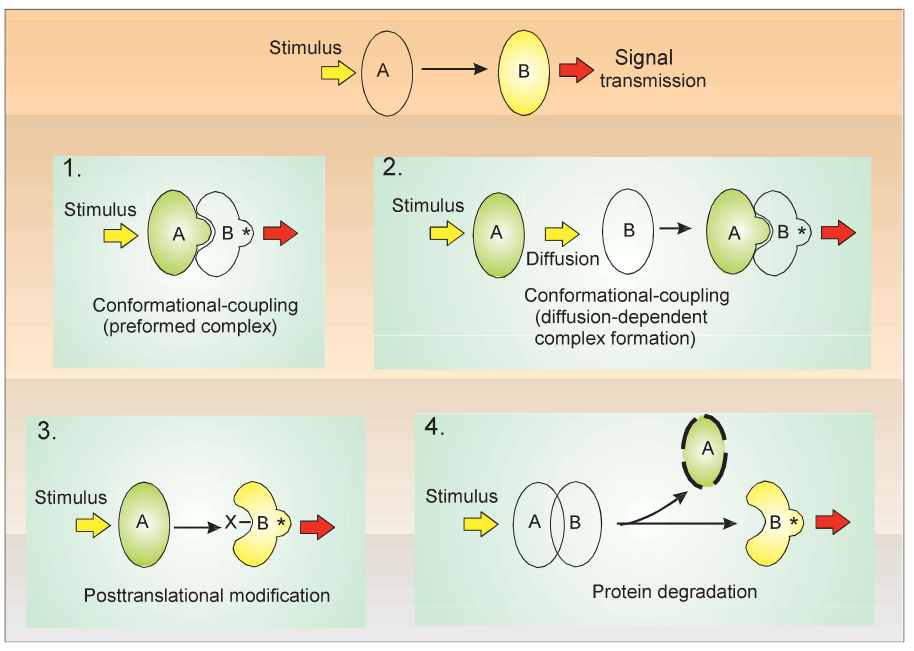
Modes of Signal Transduction
1) Preformed complexes
- Stimulus interaction causes conformational change to A, which directly interacts to cause conformational change to B, which causes signal transmission.
2) Diffusion-dependent complex formation
- Stimulus interaction causes conformational change to A, which diffuses to cause conformational change to B, which causes signal transmission.
3) Postranslational modification
- Stimulation of molecule A causes A to make posttranslational modifications to B (ex: phosphorylation), which causes signal transmission.
4) Protein degradation
- Stimulation of AB complex causes degradation to make smaller, active polypeptides, A and B, which cause signal transmission.
Stimuli formation and mode of action
Stimuli are released from cells through ectodomain shedding, via vesicles or endocytosis.
Juxtacrine
- Membrane-anchored stimuli activate receptors on neighboring cells
Autocrine
- Released stimuli activate receptors on same cell. Can be used as means to measure stimuli in extracellular envrionment. Responds as positive or negative feedback loop.
Paracrine
- Stimuli activate neighboring cells
Endocrine
- Stimuli enter blood stream to act on distant cells
Properties of Cell Signaling Pathways
Stimuli
- Small molecule or large peptide (ex: hormones, neurotransmitters, or GFs) that interact with cell-surface receptors to initiate signaling pathway. Stimuli do not have to cross the plasma membrane.
Transducers
- Use amplifers to generate internal messengers that act locally or diffuse through cell
Messengers
- Interact with sensors coupled to effectors that activate cellular responses
Post-translational modification (PTMs)
Phosphorylation
- Occurs at side chains of serine, threonine, and tyrosine (have hydroxyl groups that attack terminal phosphate group on ATP). Either activates or inactivates proteins & is reversible
Lipidation
- Targets proteins to membranes in organelles and the plasma membrane.
- Four types.
1) C-terminal GPI anchor: Two fatty acids added to anchor to membrane.
2) N-terminal myristoylation: Myristoyl group (C14) attached to N-terminal glycine. Not permanently anchored to membrane.
3) S-palmitoylation: Additon of C16 palmitoyl group. Can permanently anchor to membrane; however, can be broken off & act as on/off switch to regulate membrane localization.
4) S-prenylation: Addition of C15 or C20 fatty acids to relocate proteins from cytoplasm to membrane.
Ubiquitination
- Reversible ubiquitination causes conformation changes enabling proteins to carry out signaling functions. Also marks proteins for proteasome degradation.
Proteolysis
- Large polypeptide hormone precursor is cleaved into different active peptides depending on what proteases are available in a given cell type. Gives ability to produce many biologically active molecules from precursor.
Glycosylation, Nitrosylation, Acetylation, Methylation, Sumoylation
Describe how phosphorylation is a reversible post-translation modification that regulates protein function.
Protein kinases mediate phosphorylation whereas phosphatases reverse protein phosphorylation by hyrolyzing the phosphate group.
Phosphorylation can activate or inactivate protein function. It’s reversibility allows proteins to shuffle between active and inactive forms.
A) State a hypothesis for how protein kinase X phosphorylates a specific tyrosine (tyrosine295) within the cytosolic domain of protein substrate.
B) Design an experiment to identify how protein kinase X phosphorylates tyrosine295 within the cytosolic domain.
A) I hypothesize that protein kinase X phosphorylates tyrosine295 using the phosphoryl donor, ATP. The tyrosine’s -OH group attacks the terminal phosphate group.
B) I would introduce a point mutation to protein substrate where tyrosine295 was substituted with phenylalanine (no -OH) using RED recombination. As a control, in addition to primers containing my mutation, I would also design primers containing tyrosine at position 295, so that the resulting protein is unaltered. To check for phosphorylation, I would run a western blot using an antibody specific for phosphorylated protein substrate. I would expect to find my mutant is not phosphorylated, suggesting the -OH is necessary for the nucleophilic attack. I would additionally expect my control is phosphorylated, indicating protein kinase X is active.
Types of ligand signaling motifs
1) Ionotropic receptors
Binding site for ligand is ion channel protein. Binding causes opening (or closing) leading to ion flux and ultimately changes to membrane potential. Ca2+ common ion (as well as Na+ and Cl-) because extracellular concentration higher than intracelullar concentration. Ion opening leads to flow into cell following concentration gradient.
Activated by neurotransmitters like acetylcholine, GABA, and glutamate as well as mechanical, temperature, and noxious chemicals (Trp channels).
There are downstream effects caused by changes to membrane potential such as opening of voltage-operated channels.
2) GPCRs
Extracellular ligand binding to GPCR receptor activates different intracellular transducers that then bind different amplifiers to produce messengers that initiate signal cascades. Many different neurotransmitters and hormones activate many different GPCRs. Transducers have ability to bind different amplifiers to produce different messengers. Some produce one secondary messegner, some produce more.
3) Intracellular receptors
Require ligand that can cross cell membrane such as steroid hormones. Often times involve a carrier protein that ‘pulls’ steroid molecules out of the membrane into the intracellular space to bind a receptor, which often times regulates gene expression.
4) Tyrosine kinase & Serine/Threonine kinase
Growth and survival factors signal through pathways involving protein receptors that function as dimers. Ligand(s) pulls units together so they can cross-phosphorylate resulting in other proteins binding intracelullarly. This binding amplifies signal casccades.
Ligand types
1) Small molecular weight amines
Ex: acetylcholine, glutamate, norepinephrine, dopamine.
These ligands are sotred in vesicles and tend to be charged at physiological pH, making them extremely water soluble. There is very tight regulation of amount released & inactivation. Their release and concentration is the rate limiting step in activating signal cascades.
2) Peptides
Common in the nervous system. Peptides are larger and are not released using synaptic vesicles but through secretory pathways.
Chemokines are cysteine containg peptides important in the immune system. Cysteines can make cysteine containing bridges that confer unique 3D structure.
3) Lipids
Lipids are soluble in membranes and typically made ‘on demand’. Targets can be intracellular and in the membrane.
4) Gaseous molecules
Like lipids, freely diffuse through membranes but also water. Example: nitric oxide (NO), an important transmitter in the vasculature.



