ribs […] are true ribs, meaning that they […]
ribs […] are false ribs, meaning thaty they […]
ribs […] are floating ribs, meaning that they […]
- 1-7, connects directly to the sternum
- 8-10, connect indirectly to the sternum (via cc of rib 7)
- 11-12, do not connect to the sternum at all
which ribs are “typical” ribs”?
what does this mean?
3-10
contain one of each of the following landmarks: head, neck, tubercle, angle, shaft
which ribs are “atypical”?
what makes each rib atypical?
- 1 - no rib angle
- 2 - has 2 tubercles (an extra tubercle)
- 11, 12 - no tubercle, no neck
all atypical have a 1 and/or 2
all ribs move […] during inhalation and […] during exhalation
superior, inferior
ribs […] have pump handle motion mechanics, meaning that […]
ribs 1-5
their anterior portion moves superiorly during inhalation & inferiorly during exhalation, while the posterior portion remains stable
ribs […] have bucket handle motion, meaning that […]
6-10
their anterior & posterior portions remain stead, but medial portion swings up and down
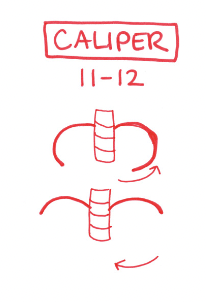
ribs […] have caliper motion, meaning that […]
11-12
they move laterally during respiration, except for the posterior portion which remains fixed
primary respiratory muscles are used during […] and include the […]
relaxed respiration
diaphragm, intercostals
secondary respiratory muscles are used during […] and include the […]
times when pt needs more air - exercise, sports
latissimus dorsi, serratus anterior, pectoralis minor, scalenes
exhalation dysfunction of rib 1 can be treated with ME to the […]
anterior scalene, middle scalene
exhalation dysfunction of rib […] can be treated with ME to the posterior scalene
posterior scalene
exhalation dysfunction of rib […] can be treated with ME to the pec minor
3-5
exhalation dysfunction of rib […] can be treated with ME to the serratus anterior
6-8
exhalation dysfunction of rib […] can be treated with ME to the latissmus dorsi
9-10
inhalation dysfunctions should be treated with […] and exhalation dysfunctions should be treated with […]
direct pressure to the rib
ME to secondary muscles of respiration
for a group of inhaled ribs, treat the […] rib first, and for a group of exhaled ribs, treat the […] rib first
bottom
top
BITE - bottom inhaled, top exhaled
what four muscles comprise the rotator cuff?
- supraspinatous
- infraspinatous
- teres minor
- subscapularis
supraspinatous
- location
- innervation
- action
- posterior scapula, superior to scapular spine
- suprascapular nerve (C5 - C6)
- aBduction
infraspinatous
- location
- innervation
- action
- posterior scapula, inferior to scapular spine
- suprascapular nerve (C5-C6)
- EXternal rotation
teres minor
- location
- innervation
- action
- posterior scapula, inferior to teres minor
- axillary nerve (C5-C6)
- EXternal rotation
what rotator cuff muscles are on the posterior scapula and what origin / insertion do they all share?
supraspinatous, infraspinatous, teres minor
medial border of scapula → greater tubercle of humerus
subscapularis
- location
- innervation
- action
- anterior scapula
- C5, C6, C7
- INternal rotation
posterior rotator cuff muscle tenderpoints - counterstrain position
supraspinatous, infraspinatous, teres minor
- ABduction
- EXternal rotation
- Flexion
(their collective actions)
subscapularis tenderpoint - counterstrain position
internal rotation + extension




