Upper Limb Flashcards

(88 cards)

1
Q

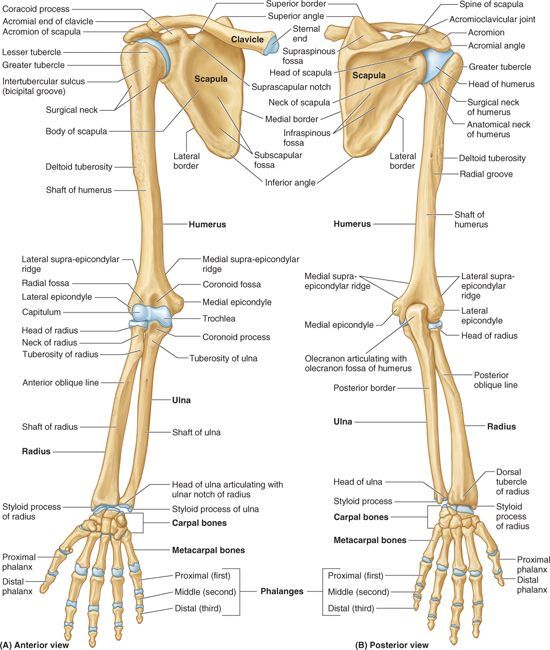
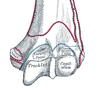
Name the key bony landmarks of the bones of the upper limb

A

See diagram

2
Q

What passes in the radial groove of the humerus?

A

Radial nerve + Profunda brachii artery

3
Q

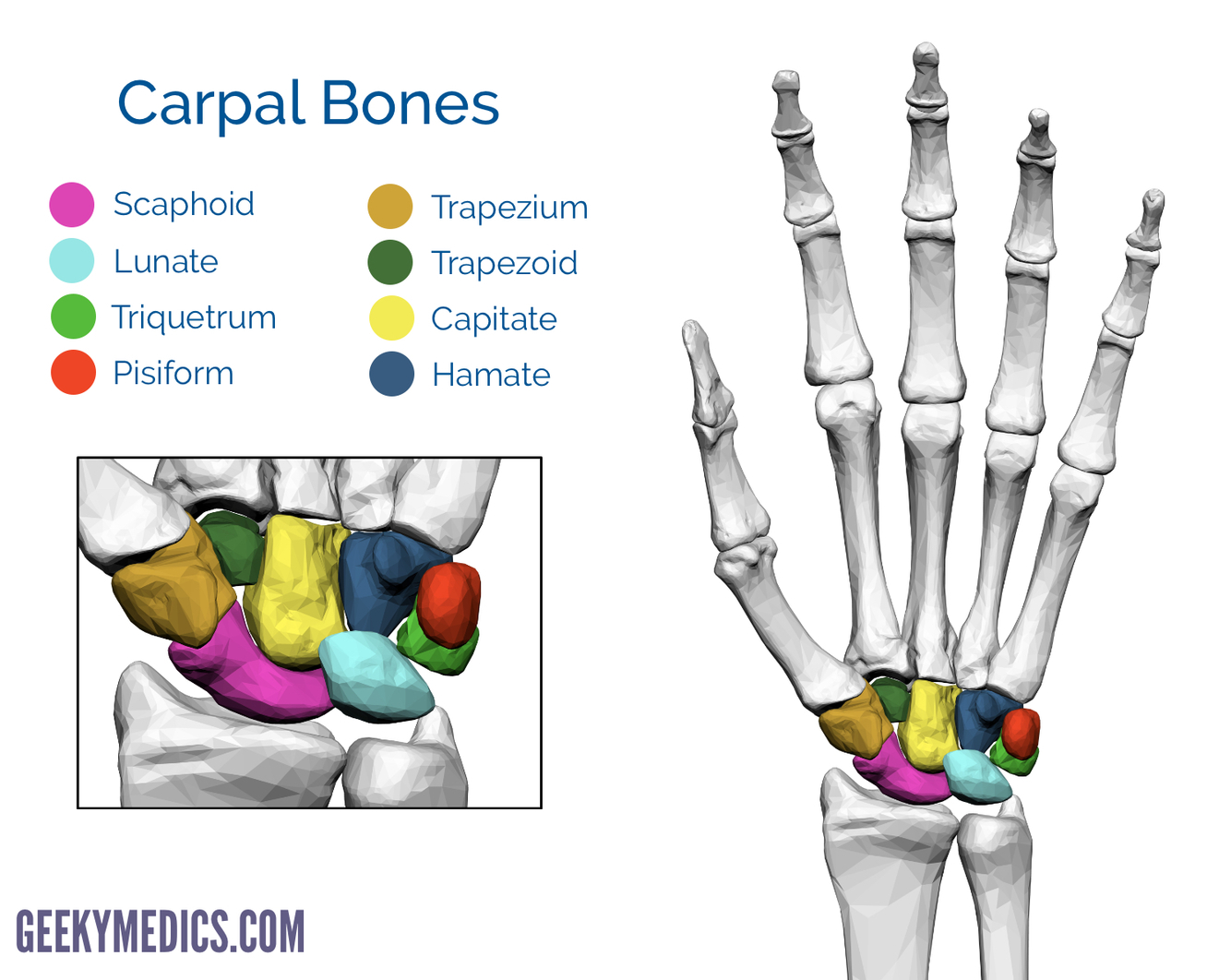
How many carpal bones are there? and what are the names?

A

There are 8 - First four proximal row, next four in the distal row

Some lovers try positions that they cant handle

Scaphoid, lunate, triquetrum, pisiform = Proximal row

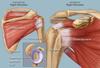
Trapexium, trapezois, capitate, hamat = Distal row
4
Q

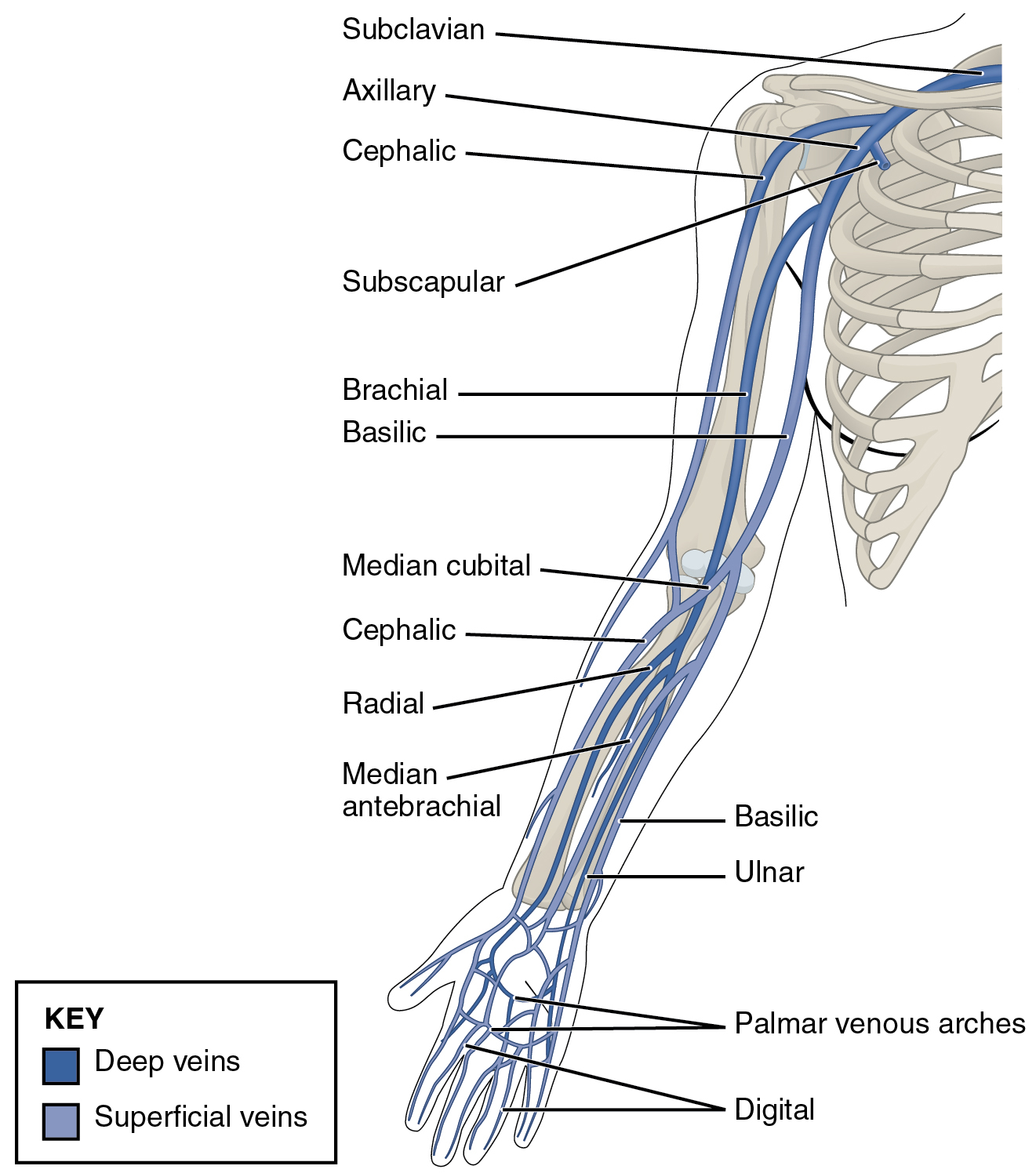
Anatomy of the key superficial veins of the upper limb

A

Cephalic vein = Lateral

Basilic vein = Medial

Median cubital = Joins these in antecubital fossa

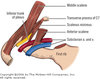
Basilic vein joins the rbachial vein to form the axillary vein

Then cephalic drains into axillary after it pierces between deltoid and pec major
5
Q

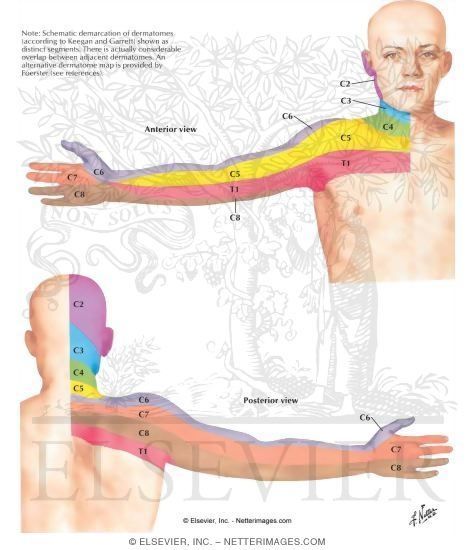
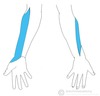
Dermatomes of the upper limb

A

See diagram

6
Q

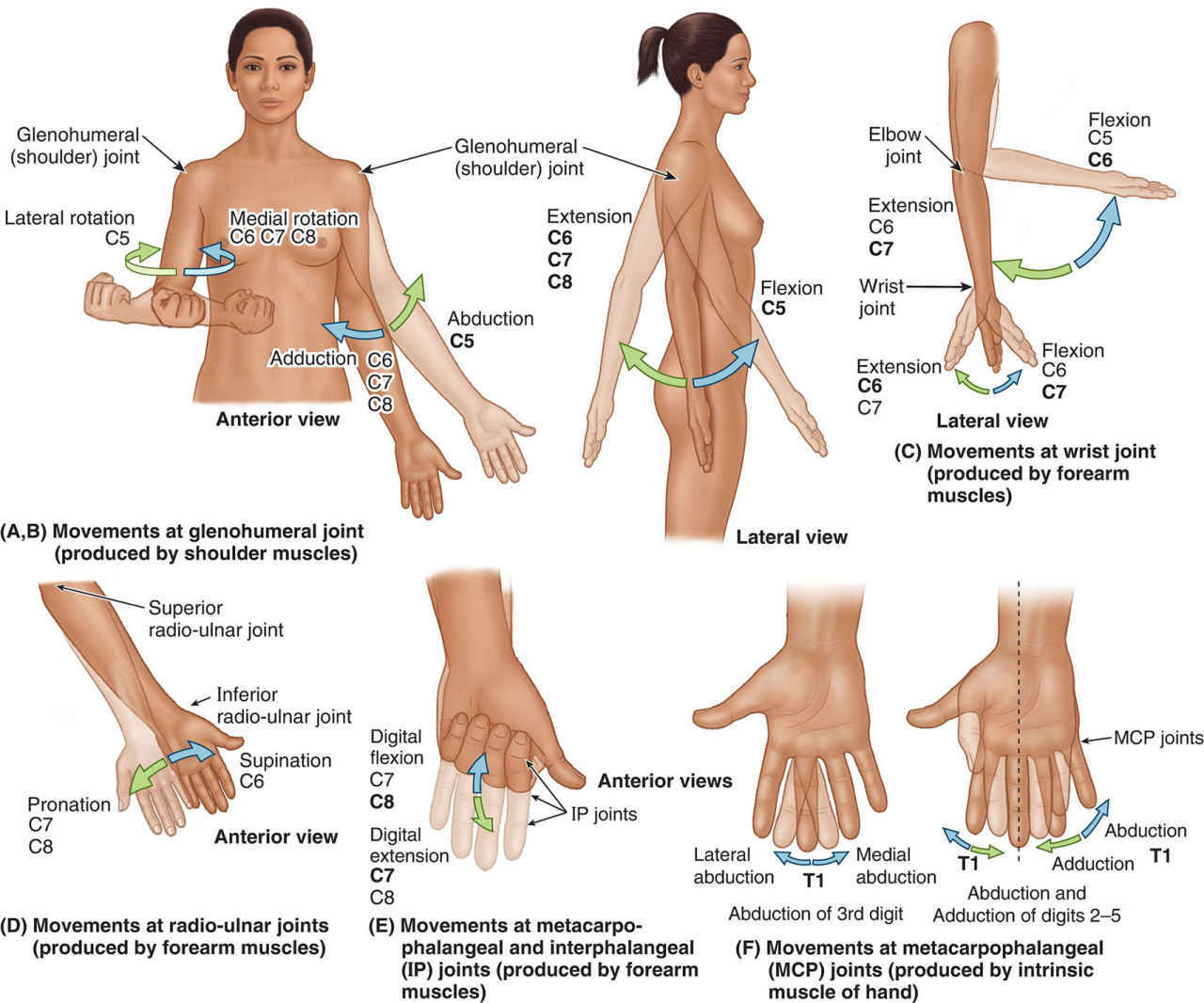
Myotomes of the upper limb

A

See table

7
Q

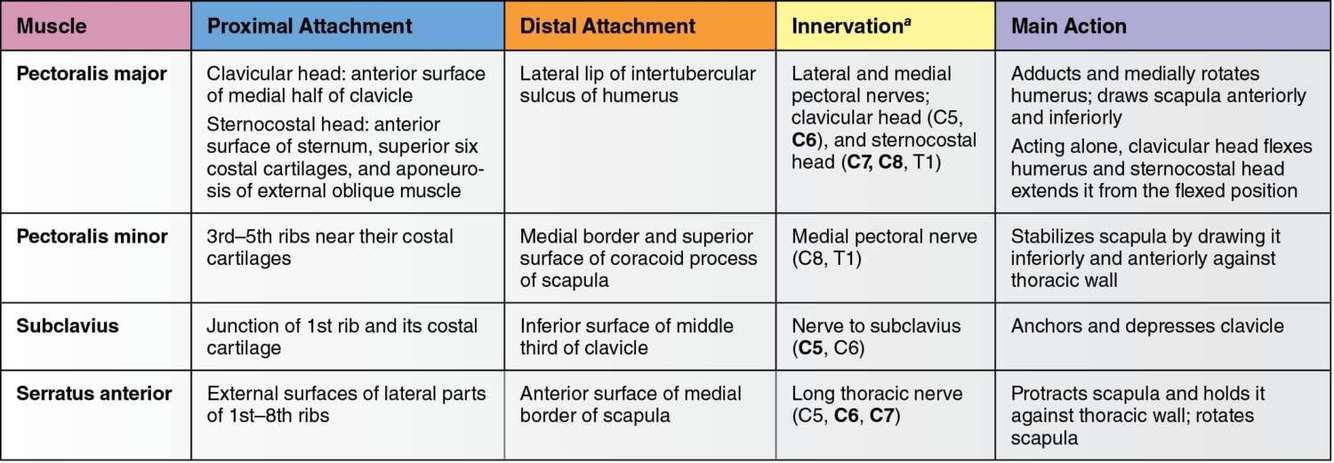
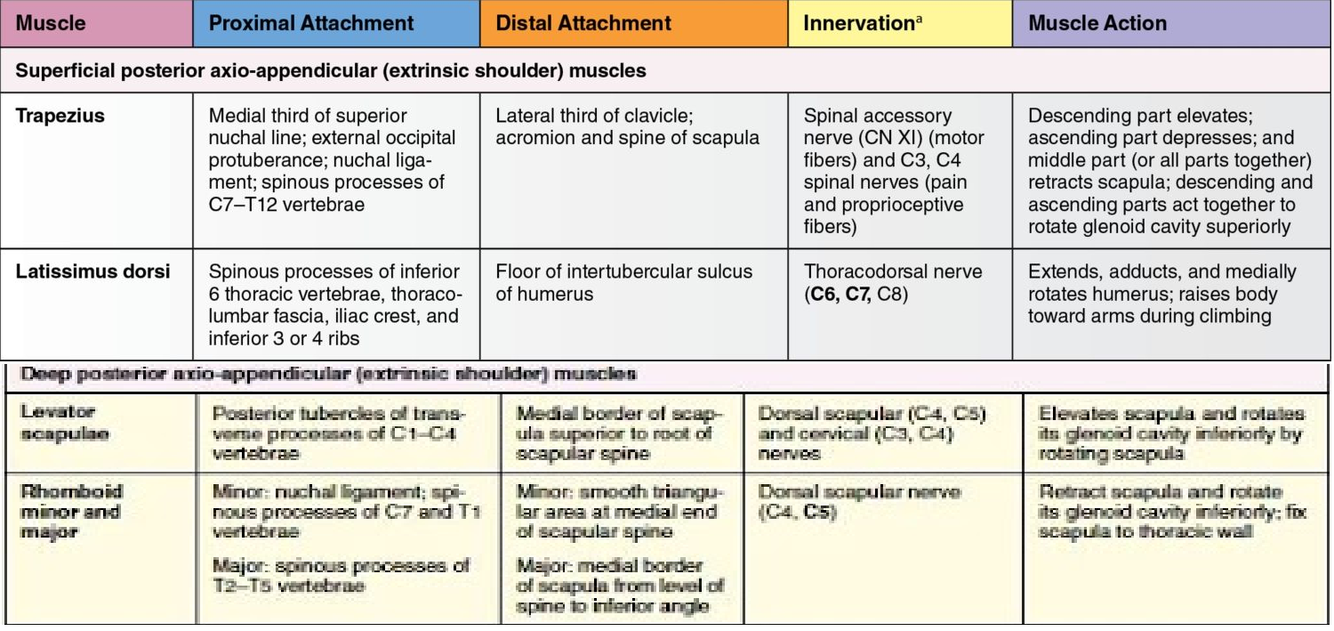
Name the 4 anterior axio-appendicular muscles, their attachment, innervation and main action

A

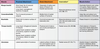
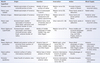
See table

8
Q

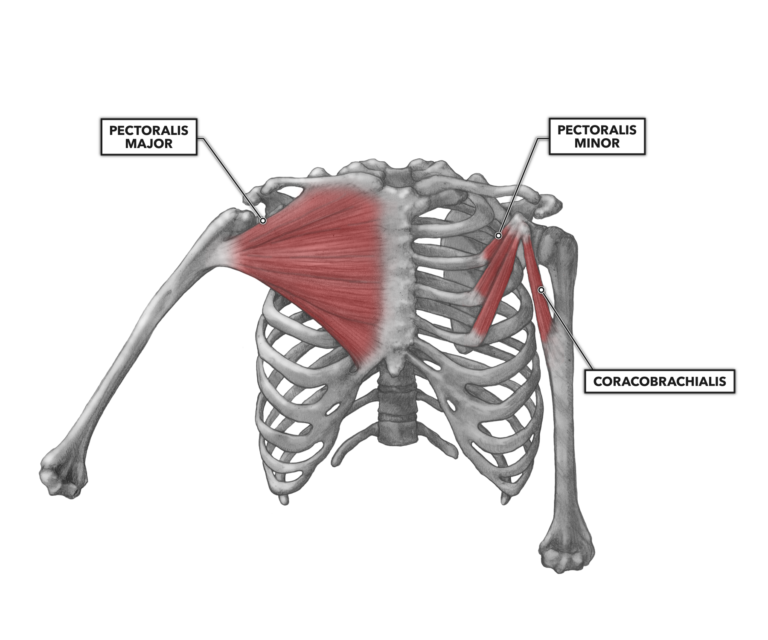
Pectoralis major + Minor anatomy

A

See diagram

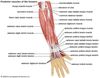
9
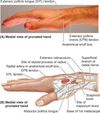
Q

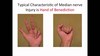
Innervation of pectoralis major + minor

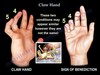
A

Pec Major = Lateral and medial pectoral nerves

Pec minor + medial pectoral nerve

Both from brachial plexus

10
Q

Innervation serratus anterior

A

Long thoracic nerve (from brachial plexus)

11
Q

Name the 4 posterior axio-appendicular muscles including attachments, innervation and main actions

A

See table

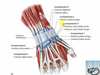
12
Q

Innervation of trapezius

A

Spinal accessory CN 11

13
Q

Innervation lattisimus dorsi

A

Thoracodorsal nerve (from brachial plexus)

14
Q

Muscle actions of lattisimus dorsi

A

Remember that this is like the pectoralis muscle but is on back

So it is also a strong ADDUCTOR

Also it is posterior = So it will extend the hip joint

It also medially rotates the humerus

15
Q

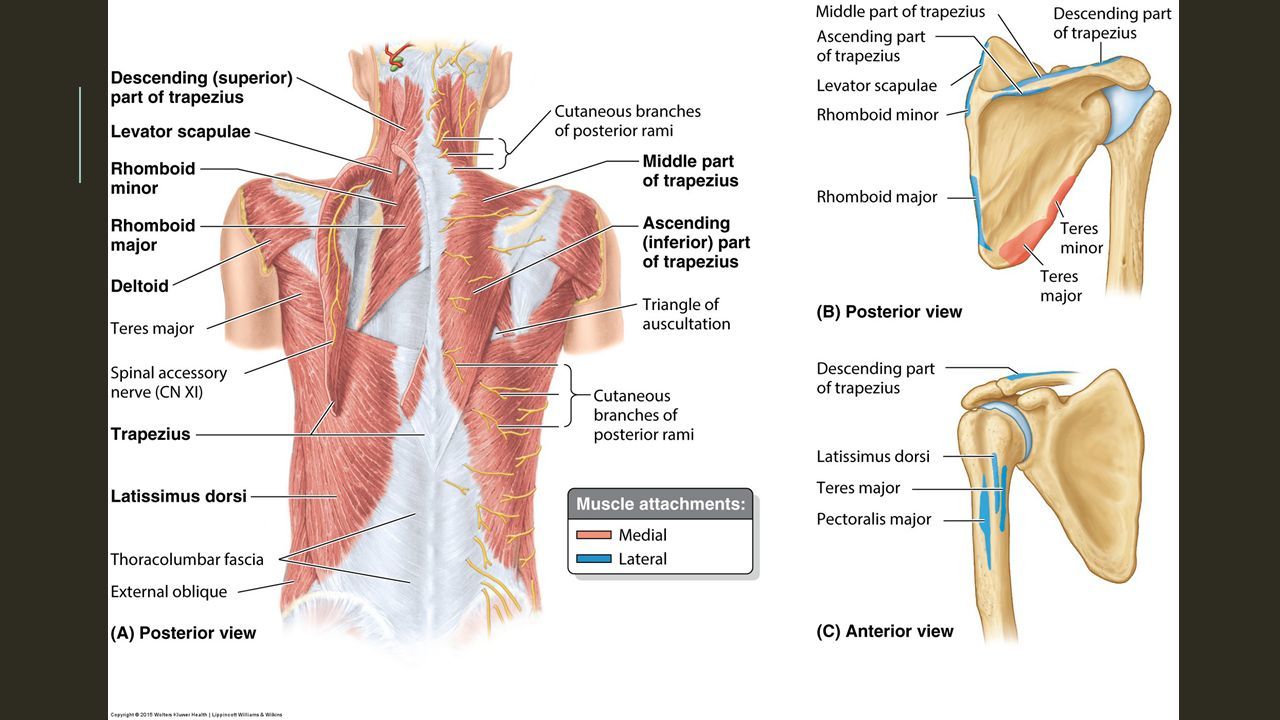
Anatomy of the posterior axio-appendicular msucles

A

Remember that trapezius = Has 3 fibre types, superior, middle and inferior ones that run in different directions.
16
Q

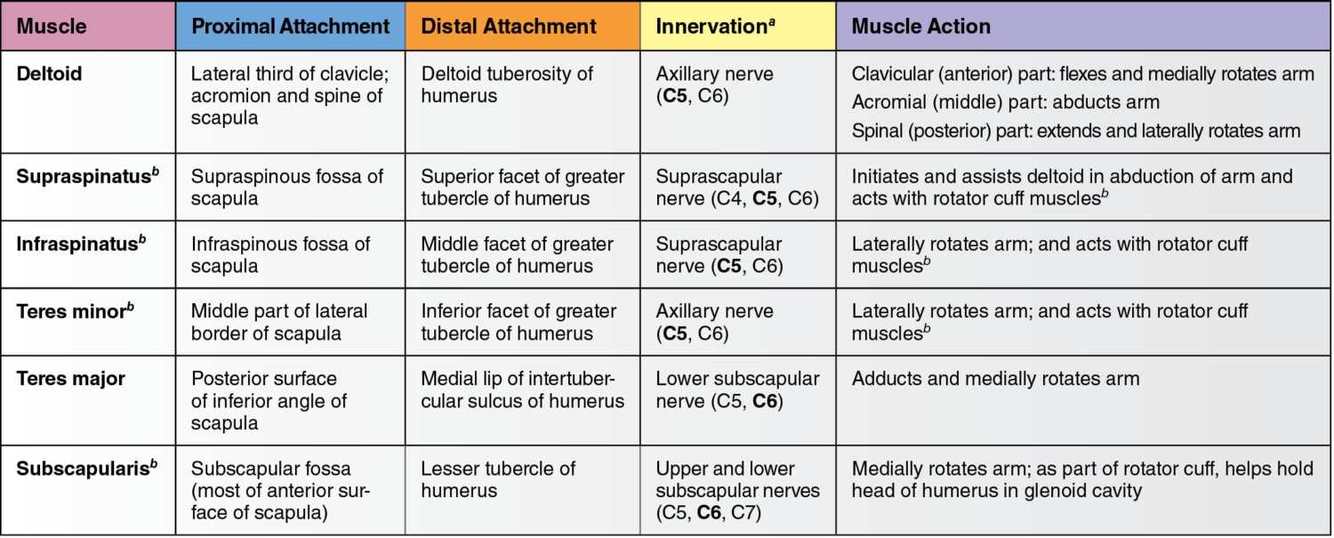
Name the 6 scapulohumeral muscles

A

These are the muscles that cross over the glenohumeral joint

See table
17
Q

How to test deltoid function?

A

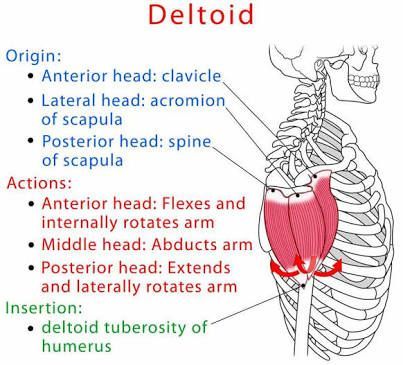
First 15 degrees abduction is done by supraspinatous, so move arm to 15degrees and then do resisted abduction
18
Q

How to test teres major, and its main actions

A

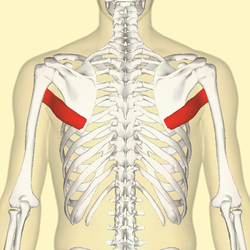
Remember this goes from bottom of scapula to intertubercular sulcus of humerus (same site as lattisimus dorsi)

It therefore can ADDUCT the humerus as well as medially rotating (same as lattisimus dorsi)
19
Q

What are the 4 rotator cuff muscles

A

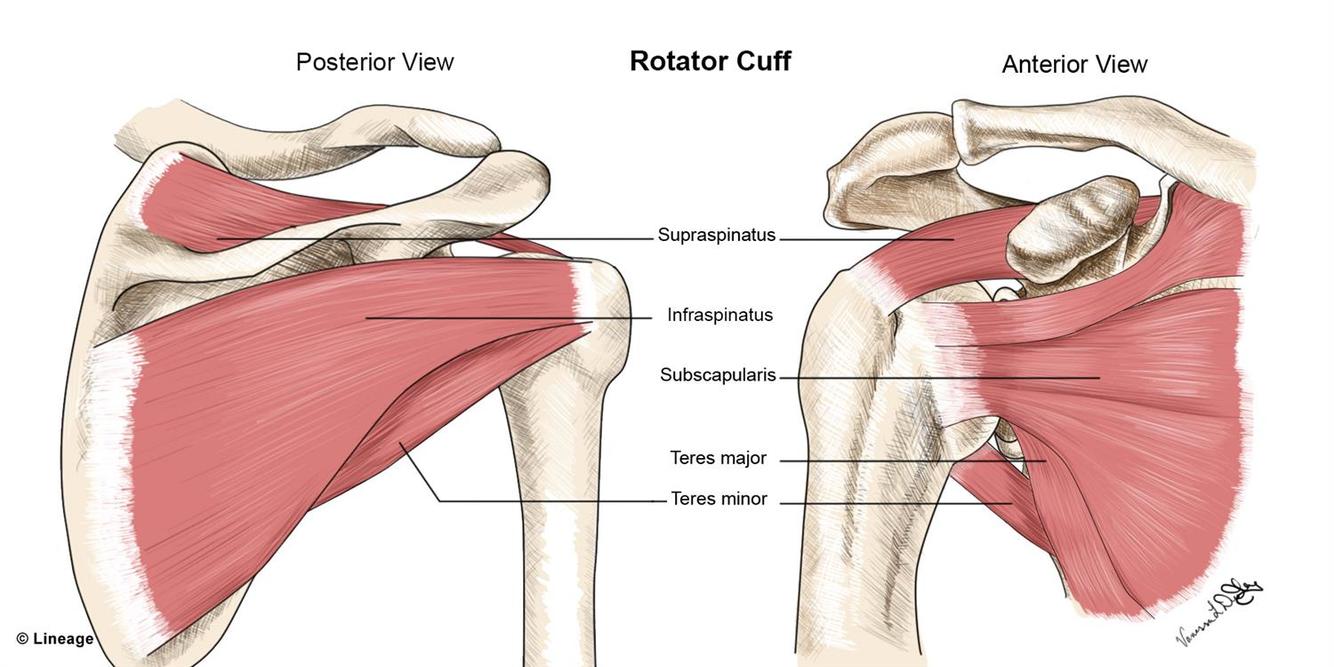
SITS

Supraspinatous

Infraspinatous

Teres MINOR

Subscapularis
20
Q

Function of rotator cuff muscles

A

These are all muscles that blend and reinforce the joint cpaulse of shoulder to protect and give further stability.

21
Q

Actions of all rotator cuff muscles

A

All are rotators of humerus except supraspinatous.

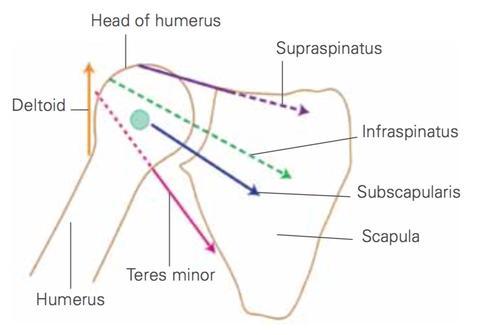
Suprapinatous = Asissts deltoid with first 15 abduction

Infraspinatous = Lateral rotator

Teres minor = Laateral rotator, adduction

Subscapularis = This passes to anterior humerus, and therefore is an external rotator, also adduction.
22
Q

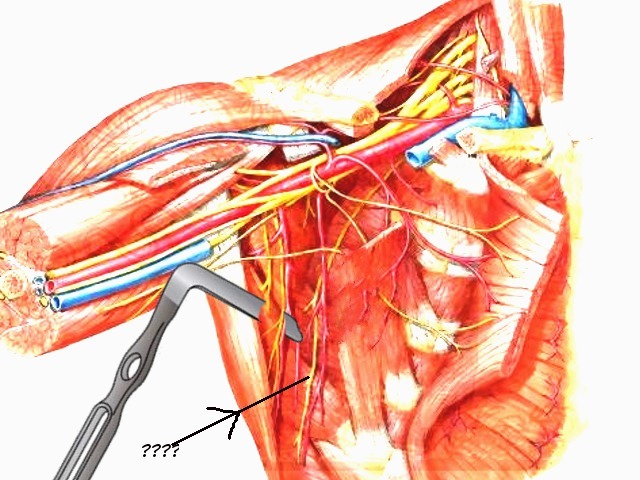
Cause of winged scapula

A

Brest surgery or other cause of trauma to long thoracic

=Loss of serratus anterior

Causes scapula to wing out when pushing against a wall.
23
Q

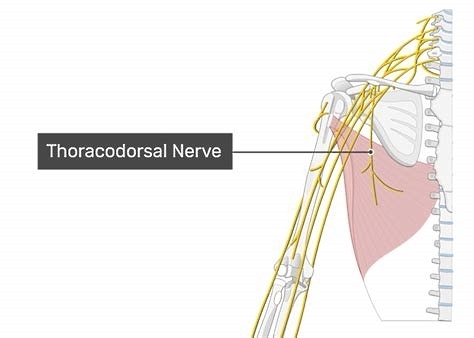
Damage to inferior axillary fossa, what nerve and what injury

A

Thoracodorsal nerve in inferior axillary fossa often in breast surgery

Supplies lattisimus dorsi

=Unable to raise trunk with the upper limbs (as needed in climbing)
24
Q

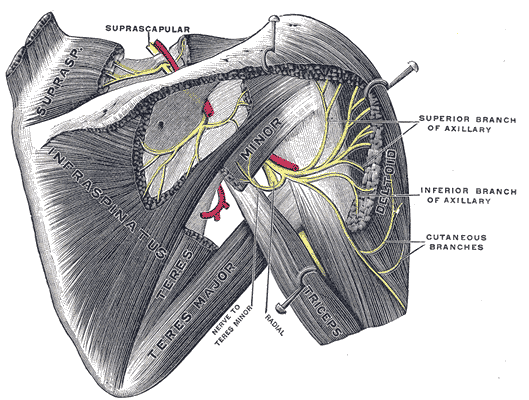
Injury to axillary nerve

A

Classically in anterior dislocation of glenohumeral joint or incorrect use of crutches.

Loss of deltoid

But also loss of sensation to regimental patch because of superior lateral cutaneous nerve of the arm = The superior lateral cutaneous branch of the axillary nerve.
25
Describe the anatomy of the axillary artery
Becomes the axillary artery at the lateral border of the 1st rib, and becomes the brachial aat the inferior border of teres major There are 3 parts to the axillary artery First part = 1st rib to medial border pec minor = Has only the superior thoracic branch Second part = Lies posterior to the pec minor = Has 2 branches = Thoracoacromial and lateral thoracic arteries = These pass medial and lateral to pec minor respectively Third part = From lateral border of pec minor to inferior border teres major = has 3 branches = Subscapular, anterior and posterior circumflex humeral arteries. **REMEMBER 1st 2nd 3rd parts correspond to number of branches**
26
Describe the lymphatic of the axilla
Remember it is like a pyramid There are 3 nodes a the base = Pectoral (anterior), Subscapular (posterior), and humeral (lateral) nodes. These all then feed up into central nodes Which further feed up into apical nodes Then ultimately to subclavian lymphatic trunk And then joined by other turnks to form the right lymphatic duct
27
What are the 5 parts of the brachial plexus
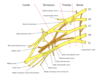
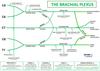
Spinal cord roots = C5,6,7,8,T1 Trunks Divisions Cords Terminal branches/Peripheral nerves
28
Describe the form of the brachial plexus
There are 5 spinal cords that come together to form 3 **trunks** first Superior trunk = C5+C6 Middle turnk = Just C7 Inferior trunk = C8+T1 Each trunk then splits into an anterior and posterior **Division** Anterior divisions then supply anterior (flexor) compartments of upper limb, and posterior does extensor/posterior compartments Anterior of superior + middle trunk = forms **lateral cord** Anterior of inferior turnk only = Forms **medial cord** All 3 posterior trunks = Forms **posterior cord** These then mix to form the 5 peripheral nerves
29
What are the spinal nerve levels of each of the upper limb peripheral nerves?
See table
30
Upper brachial plexus injuries
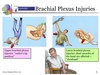
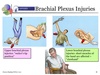
Mechanism Escess inrease in angle between neck and shoulder = Such as thrown from motorcyle.horse, lands on shoudler in a way that seperates head and shoulder distance. Also in neonates during delivery This avulses/tears the superior roots from plexus Results in = Waiters tip position = Limb hangs by side and medial rotation Name = Erb palsy Muscles = C5 and C6 so deltoid, biceps and brachialis
31
Inferior brachial plexus injury
Name = Klumpe paralsysis is less common. Mechanism = When upper limb suddenly pullsed superiorly such as when person grasps something when falling or babys upper limbs being pulled up. Avulses the inferior spinal nerves from cord. Effect = Affets the short muscles of the hand resulting in claw hand, loss of wrist flexors, horners syndrome.
32
Acute brachial plexus neuritis
Sudden onset pain around shoulder followed by muscle weakness and later atrophy Inflammation fo brachial plexus normally preceeded by URTI or vacciantion or non specific trauma
33
Compression of brachial plexus cords
From prolonged hyperabduction (arm abovehead) like painting a ceiling. Cords are impinged between coracoid process of scapula and pectoralis minor tendon. Symptoms = Pain radiating down arm, numbness, parathesia, erythema. Can also get compression of axillary vessels causing hyperabduction syndrome.
34
Describe the msucles of the arm including attachments, innervation and muscle actions
See table
35
Innervation of the three anterior arm muscles
Biceps Brachii = Musculocutaneous (C5,C6,C7) Corachobrachialis = Same as above Brachialis = Also musculocutaneous, but also radial nerve
36
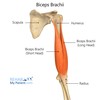
Attachment/insertion biceps brachii
Long head = Passes the shoulder joint. From coracoid process to radial tuberosity (via bicipital aponeurosis) Short head = Supraglenoid tubercle on scapula to same place
37
Attachments/insertions of the triceps muscle
Long head = infraglenoid tubercle of scapula to olecranon Lateral head = Posterior humerus superior to radial groove to same place Medial head = Posterior humerus inferior to radial groove to same place
38
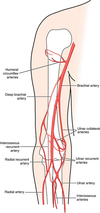
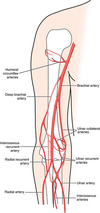
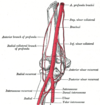
What is the course of the brachial artery
Remember axillary to brachial at inferior border of teres major Travels first medially along humerus in the medial bicipital groove (can palpate here) Then passes anteriorly over the trochlear of humerus. It accompanies the median nerve Then divides into ulnar + radial arteries opposite the neck of the radius
39
What are the main branches of the brachial artery, where?
3 main branches = Profunda brachii, superior ulnar collateral, inferior ulnar collateral
40
Describe anatomy of the profunda brachii artery
Comes of the brachial artery most superiorly of the 3 branches of brachial Travels with radial nerve along the spiral/radial groove posteriorly around humerus. Then terminates by dividing into middle and radial collateral arteries which anastamosis around and supply the elbow
41
Course of musculocutaneous
Supplies muscles of anterior arm Travels between biceps brachii and brachialis in the arm The nerve then pierces the deep fascia lateral to biceps brachii to emerge lateral to the biceps tendon and brachioradialis. Here it continues as the lateral cutaneous nerve and provides sensory innervation to the lateral aspect of the forearm
42
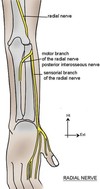
Describe course of radial nerve
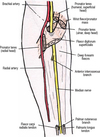
Travels in spiral groove with profunda brachii (remember the branch of radial nerve to triceps comes from this groove) Supplies posterior arm extensors Then travels down anterior compartment Just anterior to lateral epicondyle = Divides into deep and superficial branches Deep branch of radial (later becomes posterior interosseous) = Entirely muscular Superficial branch of radial = Entirely sensory to dorsum of hand+fingers = This passes superficial to radial side of the extensor retinaculum, so damage to this can damage this branch
43
Describe course of median nerve
Runs together with brachial artery (lateral to brachial artery) Until it reaches middle of arm then passess anteriorly to lie on the medial side of brachial artery Then descends into cubital fossa where it is deep to biceps tendon Later gives of 3 branches 1) Muscular branches = flexor carpi radialis, palmaris longus, and flexor digitorum superficialis 2) Anterior interosseous branch (opp of radial) = flexor pollicis longus and the lateral half of flexor digitorum profundus 3) Palmar cutaneous branch = Innervation to thenar eminence
44
Course of ulnar nerve and branches
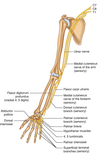
Also passes with brachial artery until middle of arm Until passing posterior to the medial epicondyle (funny bone) In forearm it gives off palmar and dorsal branches = For sensation over hypothenar and webbing between 1st+2nd fingers In the hand = Enters the hand through the **Guyons canal and is on the ulnar side of the ulnar artery** Then branches into: * *Deep Ulnar** = abductor digiti minimi, flexor digiti minimi, and opponens digiti minimi, 3rd and 4th lumbricals, all the palmar interossei muscles and dorsal interossei of the hand, and adductor pollicis (MOTOR) * *Superficial ulnar** = digital branches to the medial one and a half fingers (SENSATION)
45
Compartments, general function, and general innervation rules in the forearm
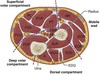
Anterior comaprtment = Flexors and pronators of the forearm -These are mainly servied by median nerve, except one and a half rules which are by ulnar nerve Posterior compartment = Extensors and supinators -All by radial nerve, either directly or by its deep branch/posterior interosseus
46
How is the volar compartment of forearm further divided and what muscles are in each one
Superficial volar group = 4 muscles = Flexor carpi radialis, flexor carpi ulnaris, pronator teres, pamaris longus. These are all attached proximally by the same common flexor tendon to the medial epicondyle of humerus Intermiediate group = 1 muscle = Flexor digitorum superficialis Deep group = 3 muscles = Flexor digitorum profundus, flexor pollicis longus, pronatory quadratus
47
Action of the FCR/FCU and FDS/FDP
FCR and FCU = These are both flexors of the wrist and will ab/adduct the hand depending on if it is ulnaris/radialis FDS = This will flex middle and proximal PIP joints FDP = Flex distal PIP joints
48
Innervation of anterior forearm muscles
Pronator teres, palmaris longus = Median All of FCR = Median nerve All of FCU = Ulnar nerve All of FDS = Median nerve FDP = medial 1/5 digits by ulnar, distal 1.5 by median (anterior interosseus) FPL + pronator qudratus = Anterior interosseous nerve from median
49
Name the important muscles of the extensor/posterior compartment of forearm
Brachioradialis = Weak flexion when forearm mid-pronated Extensor carpi radialis + ulnaris muscles = Extension of wrist and ab/aduction of hand depending on which muscle Extensor digitorum = Extending at MCP and IP joints Extensor digiti minimi Supinator Extensor indicis Abductor pollicis longus = Abduction of thumb + extension at MCP Extensor pollicis longus + brevis muscles = Extension of thumb MCP + PIP
50
Surface anatomy of medial view of pronated hand
EPL on top of anatomical snuffbox EPB below anatomical snuffbox APL below EPB
51
Median nerve injury
When asked to make fist = Hand of benediction Unable to flex 2/3 digits as these are median nerve parts
52
Ulnar nerve injury
Compression of ulnar nerve at elbow = Cubital tunnel syndrome Injury causes loss of most intrinic muscles of hand + sensory loss Closure of fist = Produces claw hand, where you are unable to flex 4/5th digits as these are the ones supplied by ulnar.
53
What are the compartments in the hand and what do they contain?
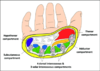
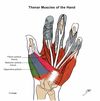
5 compartments 1) Thenar compartment = Abductor policis brevis, flexor pollicis brevis, opponens opllicis 2) Adductor compartment = Adductor pollicis 3) Hypothenar compartment = Abductor digiti minimi, flexor digiti minimi brexis, opponens digiti minimi 4) Central compartment = Short muscles of the hand, the lumbricals 5) Interosseous compartments = The interossei muscles
54
Thumb movements and the muscles responsible
Extension = EPL, EPB Abductor pollicis longus Flexion = FPL and FPB Abduction = Abductor pollicis longus + brevis Adduction = Addutor policis and 1st dorsal interossei Opposition = Opponens policis
55
Action of short muscles of hand
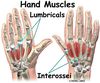
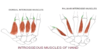
1st,2nd,3rd,4th lumbiricals = These all flex MCP and extend IP joints 1st-4th dorsal interossei = Abduct fingers away from axial line 1st to 3rd palmar interossei = Adducts the fingers to axial line DAB + PAD = Dorsal ABduct and palmar ADduct
56
Innervation of short muscles of the hand
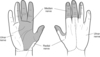
1st and 2nd lumbrical = median nerve 3rd and 4th lumbrical = Deep branch of ulnar nerve 1st-4th Dorsal interossei = Deep branch ulnar 1st-3rd palmar interossei = Deep branch ulnar
57
Damage to median nerve in hand and clinical features
Causes the simian hand = Where thumb movements limited to flexion and extension of the thumb.
58
Ligaments of elbow joint
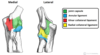
Radial collateral ligament (lateral) = Extends from lateral epicondyle of humerus and blends with annular ligament of radius Ulnar collateral ligament (medial) = Triangular in shape
59
Laceration jsut lateral of piriformis bone likely to injure?
Ulnar artery or nerve
60
Describe course of subclavian artery vs vein, and what structures travel with them
Subclaviana artery + brachial plexus = Passes posterior to scalenus anterior Subclavian vein + Phrenic = PAsses anterior to scalenus anterior
61
With a supracondylar fracture Location fo radial nerve at this location
Radial nerve will be anterolateral of the humerus
62
Which bone is a sesamoid bone for the FCU muscle
Piriformis = Remember this as it is most medial of the first row of carpal bones.
63
What does radial head articulate with?
The capitulum of the humerus Remember ulnar articualtes with the ulnar trochlear
64
Damage to anterior interosseous nerve
Means loss of flexor pollicis longus + lateral part of FDP Means you lose the pincer grip Remember this is a motor only branch of median nerve = So now sensory losses
65
What does the long thoracic innervate Damage to this nerve?
Serratus anterior Can be damaged in axillary surgery = Winging of scapula Cannot push against wall
66
How many sheaths are there in the extensor retinaculum of the hand, and what are the names/contents
There are 6 = Going from radial to ulnar side 1) EPB + abductor policis longus (rememebr these form anterior border of snuffbox) 2) ECR longus and brevis 3) EPL 4) Extensor indicis + Extensor digitorum 5) Extensor digiti minimi 6) ECU
67
Loss of thumb adduction, what muscle and what nerve
Adductor policis brevis = Intrinsic hand muscle Innervated by the deep branch of the ulnar nerve
68
What is the gantzer muscle and what pathology can it cause
Gantzer muscle = Abberant accessory long head of flexor pollicis longus Pathology = This can cause compression of the anterior interosseous nerve (Branch of the median)
69
Froment sign = What is this What nerve
Peice of paper between thumba nd finger = Have to flex IP joint to keep paper, because unable to adduct Adductor policis = Intrinsic hand muscle innervated by deep branch of ulnar So lesion to deep branch of ulnar = Froment's sign
70
After breast surgery pain on painting ceiling
Injury to thoracodorsal = innervates lattissimus Thoracodorsal comes of the rbachial plexus So raising arm above head repeatedly causes pain
71
Course of the axillary artery, espo in relation to other structures
Becomes the axillary when crossing first rib becomes brachial when crossing inf border of teres major There are 3 parts that are divided by pec minor First part = medial to pec minor = 1 branch Sceond part = Under pec minor = 2 branches Third part = Lateral to pec minor = 3 branches branches = Screw the lawyer, save the patient = Superior thoracic, thoracoacromia, lateral thoracic, subscapularis, ant + post humeral circumflex Relations = In axilla it is sorrounded by the brachial plexus
72
Flexor pollicis brevis Vs Flexor pollicis longus
Remember that brevis is an intrinsic muscle of hand, while longus is a long muscle in forearm Longus innervation = Anterior interosseous branch of median nerve Brevis innervation = Median nerve also Longus action = Flex IP joint Brevis action = Flex thumb at MCP
73
What muscles in the hand does the median nerve innervate?
The thenar muscles = flexor pollicis brevis, abductor pollicis brevis, and opponens pollicis NOTE ADDUCTOR POLICIS + ABDUCTOR POLLICIS LONGUS (ULNAR NERVE)
74
Innervation of rotator cuff muscles
Supraspinatous + Infraspinatous = Suprascapular nerve Teres minor = Axillary nerve Subscapularis = Subscapular nerve
75
Innervation of pectoralis major + Minor
Major = lateral and medial pectoral nerves Minor = Only medial pectoral nerve
76
Insertion point of all rotator cuff muscles
Supraspinatous, infraspinatous, teres minor = All insert onto posterior of humerus on the greater tubercle and therefore do lateral rotation Except the subscapularis which actually goes anteriorly to lesser tubercle so does internal rotation.
77
Which finger has no attachment for the palmar interossei
Remember there are 4 dorsal and palmar interossei The middle finger is skipped and has no attachement for the palmar interossie
78
fracture at surgical neck of humerus, what nerve is at risk
Axillary
79
Describe crutch palsy
When crutch is used wrongly Causes inferior brachial plexus/radial nerve injury = Wrist drop
80
Blood supply to scaphoid
Retrograde blood supply from the dorsal carpal branch vessels
81
Sensation to nailbed of first finger
Median nerve
82
Anatomy of the antecubital fossa
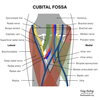
Lateral to medial Radial nerve, biceps tendon Brachial artery, brachial vein Median nerve
83
What passes through quadrangular space
Axillary NERVE posterior circumflex humeral arteries
84
What does median nerve travel through flexor retinaculum between?
Between tendons of Flexor pollicis longus + flexor digitorum superficialis
85
Nerve roots of supraspinatous nerve and what it supplies
Supplies the supra and infraspinatous muscles Root origins = C5 and C6
86
Innervation of flexor pollicis longus
Usually would have thought ulnar, but actually depends Superficial head = median nerve (anterior interosseous, superficial is also anterior) Deep head = deep branch of ulnar nerve (BOTH DEEP)
87
What passes through suprascapular foramen
The suprascapular nerve + Vein Note suprascapular artery goes superior Suprascapular nerve = Supraspinatous + infraspinatous muscles
88
Borders of antecubital fossa
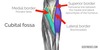
Lateral = The medial side of brachioradialis Medial = Pronator teres Superior = Line between epicondyles Floor = Supinator + Brachialis