overview of kidney physiology
- how much fluid does it process
- how much O2 does it consume
- what does it form
- process 180-200L flid/day but only product 1.5L of urine
- kidneys filter bodys entire plasma volume 60 times/day
- consume 20-25% of oxygen used by body @ rest
- filtrate (produced by flomerular filtration) -> basically blood plasma minus proteins
- urine is produced form filtrate
what are the 3 processes involved in urine formation
- Glomerular filtration: produces cell and protein free filtrate
- Tubular reabsorption: selectively retuns 99% of substances from filtrate to blood in rental tubules and collecting ducts
- Tubular secretion: selectively move substances from blood -> filtrate in renal tubules and colelcting ducts
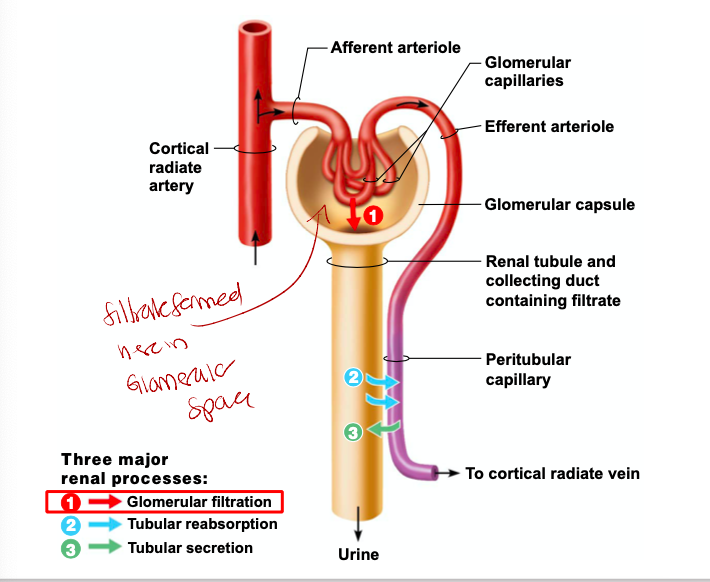
describe glomerular filtraiton
* step 1 of the three major renal processes
- passive process -> no metabolic energy required
- hydrostatic pressure forces fluids and solutes through filtration membrane into glomerular capsule
- no reabsorption into capillaies of glomerulus occurs
describe the filtration membrane
- determines what gets into the capsule
- porous mebrane between blood and interior glomerular capsule that allows water and solutes smaller than plasma prteins to pass
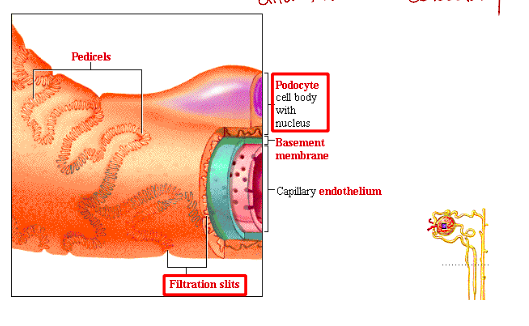
contains 3 layers: fenestrated endothelium, basement membrane, foot processes of pdocytes wth filtration slits
- macromolecules “stuck” in filtration membrane are englufed by glomerular mesangial cells
*allows molecules smaller than 3nm to pass: water, glucose, amino acids, nitrogenous wastes
describe the 3 layers of the filtration membrane
- Fenestrated endothelium: of glomerular capillaries
- Basemen membrane: fused basal laminae of two layers
- Foot processes of podocytes with filtraiton slits; slits diaphragms repal macromolecules
what maintains bolloid osmotic pressure
plasma proteins
*part of filtration membrane
- prvents loss of al water to capsular space
- proteins in filtrate indicate membrane problem
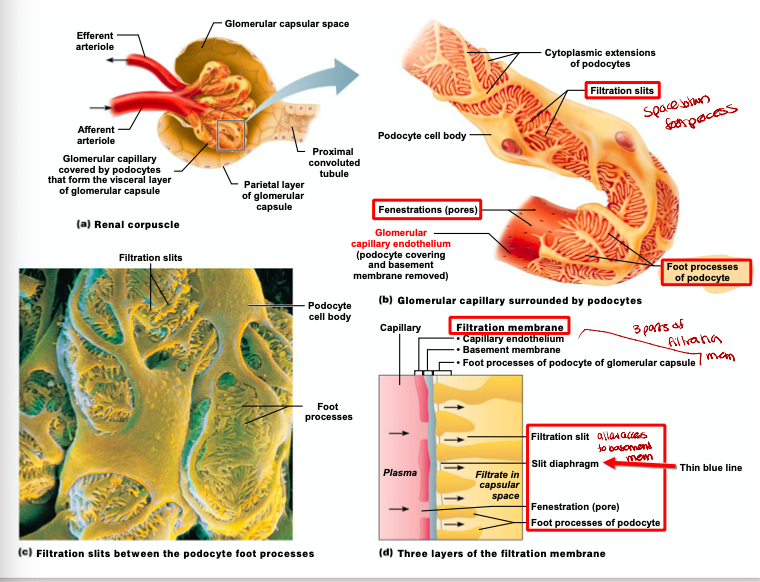
describe the glomerular capillary endothelium
- fenestrated epithelium allows for solute-rich, virtually protein free filtrate to pass from blood into glomerular capsule
* proteins and cells can get out
*first part of filtration membrane
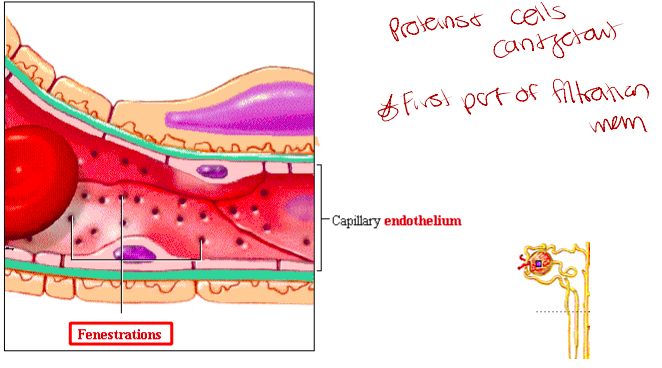
describe the basement membrane
- second aprt of the filtration membrane
- restricts all but smallest protteins while letting msot toher solutes pass
- gel-like membrane with negatively charegd glycoproteins to repel large plasma proteins
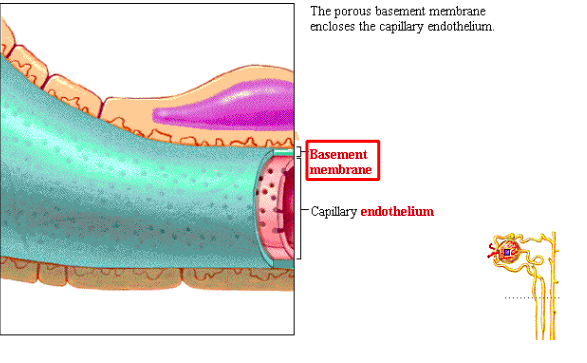
describe podocytes
basement membrane is surrounded by a layer of podocytes
- have foot processes (orpedicles) that fit together leaving small filtration slits
*allows for further selectivity
what are the outward pressures that affect filtraiton
- promote filtrate formation
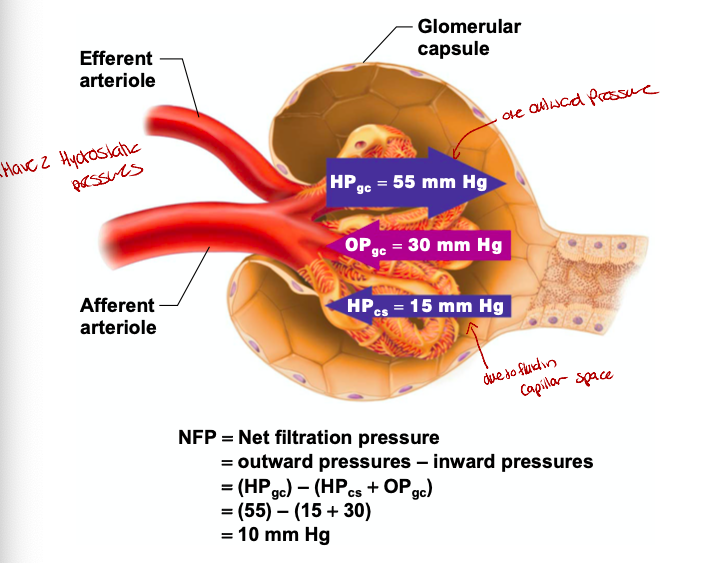
- hydrostatic pressure in glomerular capillaries HPgc -> essentialy glomerular BP
- chief force purshing water and solutes out of blood
- HIGH: 55mmHG (26mmHg seen in most capillary beds)
- reason is that efferent arteriole is a high resistance vessel w/ diameter smaller than afferent arteriole
what inward pressures affect filration
- forces that inhibit filtrate formation
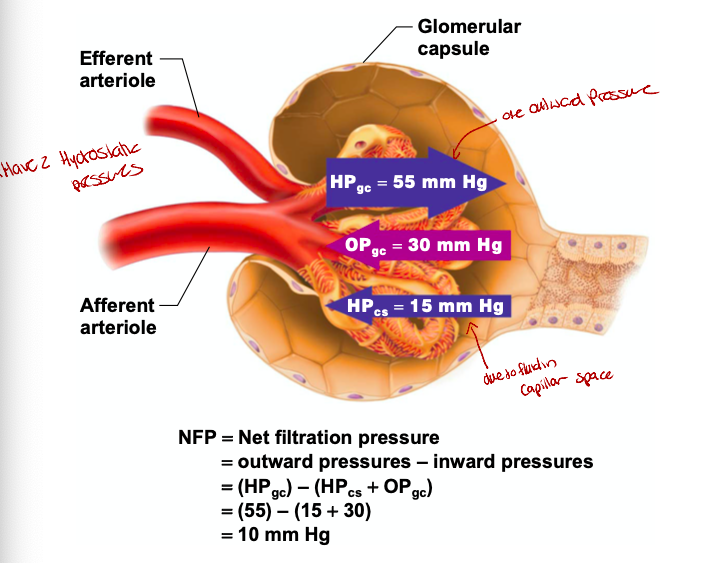
- hydrostatic pressure in capsular space (HPcs): filtrate presssure in capsule; 15 mmHg
- Colloid osmotic pressure in capillaries (OPgc): Pull of protiens in blood (30mmHg)
what is net filtartion pressure
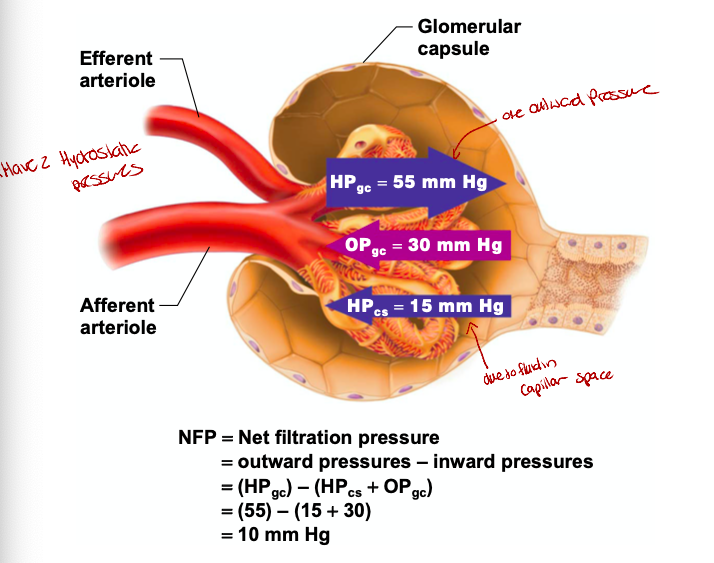
sum of inwards and outward forces
- 55mmHG forcing out - 45mmHg opposing = net outward force of 10 mmHg
- pressure resposible for filtrate formation
- main controllable factor in determining glomerular filtration rate (GFR)
what is glomerular filtration rate
volume of filrate formed/min by BOTH kidneys
*noraml = 120-125mL/min
- directly propertional to:
- > Net Filtration pressue (NFP): primary pressure = glomerular hydrostatic pressure
- > total surface area available for filtration: glomerular mesangial cells control by contracting
- > Filtration membrane permeability: much more permeable than other capillaries
why is it important to ahve constant GFR
allows kidneys to make filtrate and maintain extracellular homeostasis
*maintinance is the goal of local intrinsic controls (renal autoregulation
how does GFR relate to systemic BP
- increased GFR affects systemic BP
- increased GFR causes increase urine output -> lowers BP and vice versa
- goal of extrinsic controls = maintain systemic blood pressure
*Nervous system and endocrine mechanisms are main extrinsic controls
what are the two types of renal autoregualtion
* intrinsic controls
- maintains nearly constant GFR when MAP is in range of 80-180 mmHg
*autoregulation ceases if out of that range
- 2 types of renal autoreg:
- > myogenic mechanism
- > tubuloglomerular feedback mechanism
describe the myogenic mechanism
- local smooth muscle contracts when stretched
- inc bp causes muscle to stretch -> afferetn arterioles constrict
- Restricts blood flow into glomerulus
- protects glomeruli from dmaging high BP
- dec bp causes dilation of afferent arterioles
- inc bp causes muscle to stretch -> afferetn arterioles constrict
- helps maintain nomal GFR desipte normal fluctuations in BP
*helps to rotect nephrons and kidneys
describe the tubualr feedback mechanism
*regulation of glomerular filtration
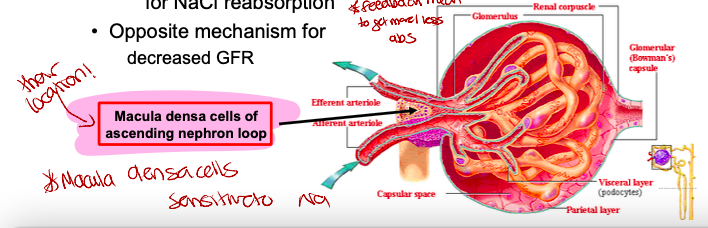
- flow dependent mechanism directed by macula densa cells
- responds to filtrates NaCl concentration
- if GFR increases, filtrate flow rate increases
- leads to dec reabsorption time -> high NaCl levels in filtrate
- sensed by macula densa, causes constriction of afferent arteriole which lowers NFP and GFR allowing more time for NaCl reabs
- opposite echanism for decreased GFR
how is GFR regulated extrinsically
- neural and hormonal mechanisms
- regulates GFR to maintain systemic blood pressure
- extrinsic controlls will override renal intrinsic controlls if blood volume needs to be increased
how deos the sympathetic enrvous system control glomerular filtration
- under normal conditions
- renal blood vessels dilated
- renal autoregulation mechanisms prevail
- Under abnormal conditions (extremely low ECF volume aka low bp)
- NE is released by SNS, epinephrine by adrenal medulla
- systemic vasoconstriction: inc BP
- Constriction of aferent arterioles: dec GFR
- blood volume and pressure increase
- NE is released by SNS, epinephrine by adrenal medulla
how does the renin angiotension aldosterone system regualte glomerular filtration
- method of extrinsic contorl
- main mechanism for incerasing bloop pressure
- 3 pathways to renin release by granular cells
- > direct stimulation of grnaular cells by SNS
- > stimulation activated macula densa cells when filtrate NaCl concentration is low
- > reduced stretch of granular cells
overview of internal mechanism to regulate GFR
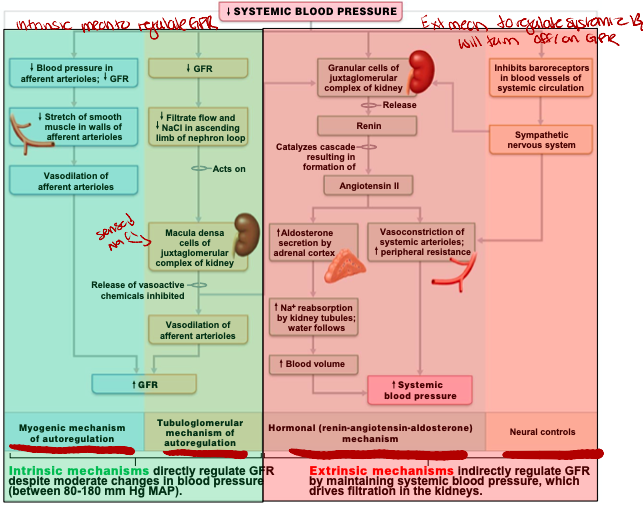
*directly regualtes GFR despite moderate changes in blood pressue
- Dec in bp in afferent arterioles -> dec GFR
- dec in stretch of smooth uscle walls of afferent arterioles
- vasodilation of afferent arterioles
- overall inc in GFR
- ***myogenic mechanism of autoregualtion
- Dec in GFR
- Dec filtrate flow and dec NaCl in ascening limp of nephron loop
- acts on macula densa cells of juxtaglomerular complex of kidney
- release of nasoactive chemicals inhibited
- dilation of afferent arterioles
- inc in GFR
- **tubuloglomerular mechanism of autoregulation



-
1.1 Blood, erythrocytes23
-
1.2 Blood (leukocytes)20
-
1.3 Blood clotting & Blood types26
-
2.1 Anatomy of Respiratory system41
-
2.2 Lungs anatomy20
-
2.3 Mechanics of Breathing42
-
2.4 Gas Exchange27
-
2.5 Cardbon dioxide transport28
-
3.1 GI general anatomy32
-
3.1 Oral Cavity & stomach26
-
3.3 Gastric enteroendocrine37
-
4.0 Digestive38
-
5.0 Gross anatomy of heart37
-
5.1 Microscopic anatomy of heart + contraction24
-
5.2 EKG25
-
5.3 Volumes & stuff21
-
6 BLOOD VESSELS0
-
6.1 BLOOD VESSELS0
-
6.3 BLOOD VESSELS0
-
7.1 Urinary39
-
7.2 Urinary49
-
7.3 Urinary40
-
8.1 Fluids53
-
9.0 Male reproductive system37
-
9.120
-
9.3 Female Cycles20
-
9.40
-
10.1 Nutrition Metabolism and Body temp regulation40
-
10.2 Glycogenesis and glycogen-lysis20
-
liver metabolism23
-
Microscopic Anatomy1



