how much water do __ have
infants
adult males
adult females
odler adults
infants: 73% water
Adult males: 60%
Adult females 50% (bc higher fat content, less skeletal msucle mass)
old age: 45%
if body weight is ~60% water, what proportion is occupied by intracellular fluid vs extracellular
- Intracellular
- 25L, 40% of body weight
- Extracellular
- 15L, 20% of bdoy weight
- interstitial fluid = 12L, 80% of ECF
- Plasma volume = 3L, 20% of ECF
- 15L, 20% of bdoy weight
how are solutes in the body classifies
- Electrolytes
- inorganic salts, all acids and bases, some proteins
- have greater osmotic power than non electrolytes (bc dissociates into ions, NaCl is worth 2 bc two ions)
- Nonelectrolytes:
- glucose, lipids, creatine and urea
hwo is the concentration of electrolytes described
- expressed in milliequivalences/L
*measure of number of electrical changes in 1 L of solution
mEq/L = mmoles/L x numebr of electrical charges on one ion
- > for single charged ions 1mEq = 1 mOsm
- > for bivalent ions, 2mEq = 1mOsm
describe electrolyte composition of sodium vs potassium
*Extracellular = blood plasa and interstitial fluid, intracellular fluid = intracellular
- Sodium
- higher in blood plasma and interstitial (extracellular)
- low in intracellular fluid
- Potassium
- Low in blood plasma and interstitial (extracellular)
- High in intracellular fluid
describe composiiton of Ca, Mg and, HCO3, and Cl in blood plasma, interstitial fluid, intracellular
- Ca2+
- higer in blood plasma and interstital fluid
- low in intracellular fluid
- Mg2+
- low in blood plasma and interstital fluid
- high in intracellular fluid
- HCO3-
- higer in blood plasma and interstital fluid
- low in intracellular fluid
- Cl-
- higer in blood plasma and interstital fluid
- low in intracellular fluid
describe composiiton of HPO42- and SO42- in blood plasma, interstitial fluid, intracellular
both low in blood plasna and intersitial fluid
high in intracellular fluid
describe composiiton ofprotein anions in blood plasma, interstitial fluid, intracellular
*abnormal dsitribution
- high in blood plasma, highest in INTRAcellular fluid
- low in interstitial
*helps pull fluid back into blood from interstitial lfuid
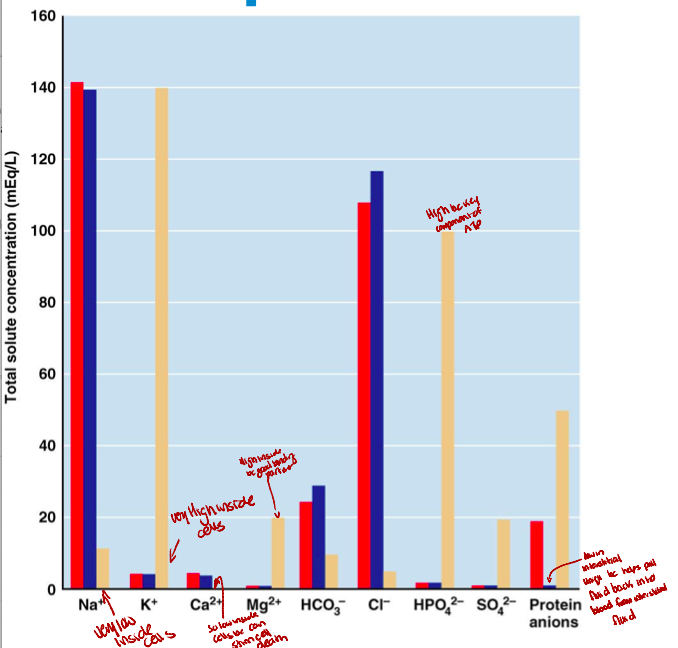
why are Na+ and K+ concentrations in ECF and ICF are nearly opposites
due to the activity of ATP-dependent Na+ -K+ pumps
what do roteins, phospholipids, cholesterol, and fats account for:
*plasma, interstitial fluid, intracellualr
90% of the mass of solutes in plasma
60% of the mass of solutes in interstitial fluid
97% of the mass of solutes in the intracellular
why dont ions accumulate in different organs
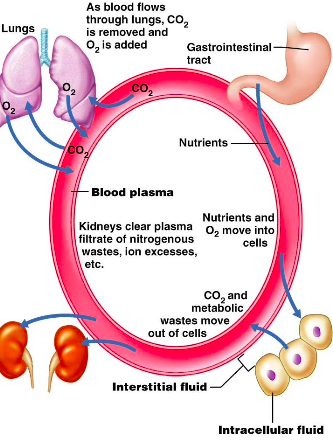
cardiovascular system is constantly puping fluid throughout body
-Nutrients, gases, and wastes move unidirectionally
Osmolalities of all body fluids are equal
*but differ einside vs outside cells
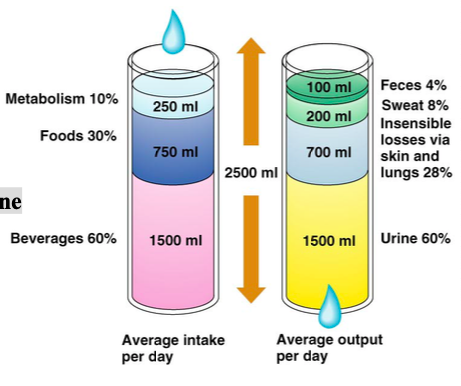
water intake vs output
Water intake must equal water output
Increases in plasma osmolality trigger thirst and release of antidiuretic hormone (ADH)
*most water lost in urine, second most via insensitble losses via skin and lungs then sweat and feces
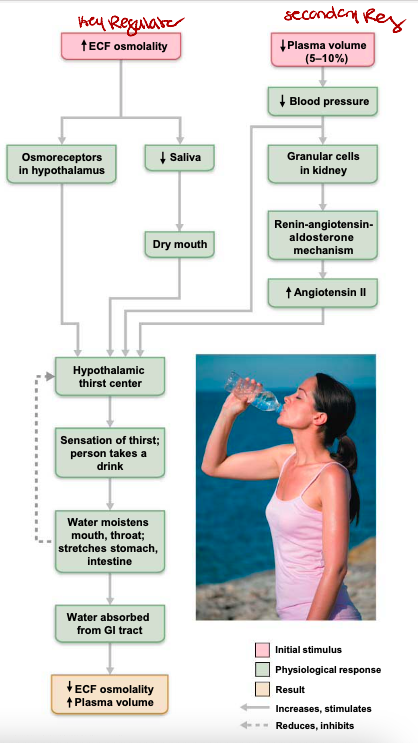
describet he thirst mechanism for water intake
* governed by hypothalamic thirst centre
- Inc ECF osmolarity (key regulator)
- derease in salive causing dry mouth
- osmoreceptors in hypothalamus
- Decrease in plasma volume (5-10%) (secondary reg)
- decrease bP -> gransular cells in kideny actiate renin angiotensin-aldosterone mechanism -> inc angiotensin
- Both these pathways converge to
- act on hypothalmic thrist center
- senation of thirst to drink
- water moistens mouth, thoat, strethc stomach, intestine (will inhibit hypothalic thirst centre)
- water is abs from GI tract
- GET DEC ECF AND INC PLASMA VOLUME
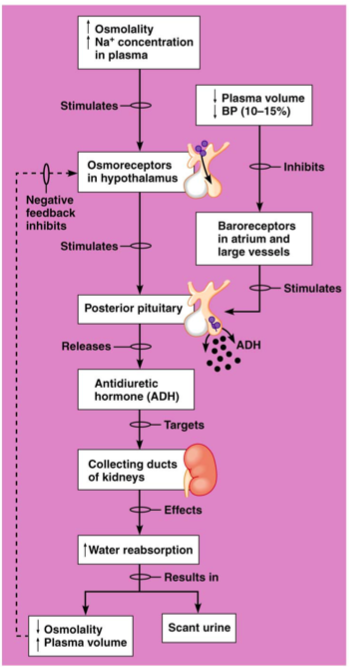
What does ADH do?
*osmolarity is much more ipm than changes in plasam volume
*can also be triggered by prolonged fever, excessive sweating, vomiting or diarrhea
- Inc osmolarity or inc Na conc in plasma
- stimualtes osmoreceptors in hypothalamus
- stim posterior pituitary
- Dec in plasma volume or dec in bp (10-15%)
- inhibts barreceptors in atrium and large vessels
- stim post pituitary
- Both converge to
- release ADH targeting collecting duct of isneys
- increae water reabs
- Dec osmolarity, Inc plasma volume and scant urine
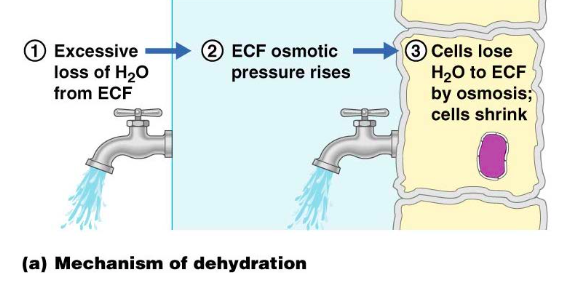
what are the signs and symptoms of dehydration
cottonmouth, thirst, dry flushed skin, and oliguria (low urinary output)
Prolonged dehydration: amy lead to weight loss, fever and mental confusion
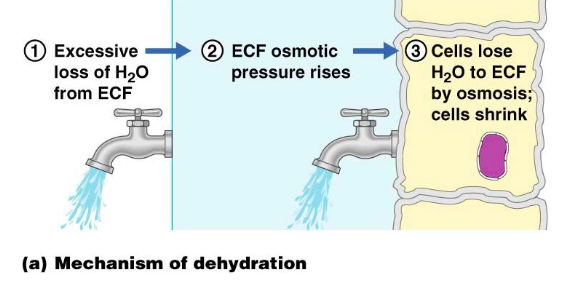
descritbe hypotonic hydration
**taking in pure water
- Renal insufficiency or an extraordinary amount of water ingested quickly can lead to cellular overhydration
- can happen from taking in too much pure
- Must be quickly reversed to prevent severe metabolic disturbances, particularly in neurons
what is edema
Fluid accumulation in the interstitial space (tissue swelling)
Caused by 1) increases flow of fluids out of the bloodstream and/or 2) hinders their return
- hinders fluid return
- key factor in fluid return is proein conc in blood
- usually reflects an imbalance in colloid osmotic (oncotic) pressures
- decreases colloid cosmotic pressure caused by
- hypoproteinemia (low level plasma proteins)
- filtered fluids out of capillary beds fail to return
- results from protein malnutrition and liver disease
- leaked protein accumualte in interstitial fluid drawing fluid from blood (chronic inflammation)
- blockes lymph vessels
how if fluid filtration increased
- increased capillary hydrostatic pressue
- intensifies filtration at capillary beds
- result from incompetent venous valves, localized blood vessel blockage or high blood volume
- INcreased capillary permeability
- due to ongoing inflammation
- inflammatroy chemicals cause local capillaries t become porous allowing large amounts of exudate
why is Na+ and electrolyte balance important
Na+ salts (NaHCO3 and NaCl) account for 90-95% of all solutes in ECF and contribute 280 mOsm of toal 300 mOsm ECF
*major role for Na+ in controlling ECF volume
- > Na exerts significant osmotic pressure
- changes in plasma Na affects: plasma volume, blood pressure, ICF and interstitial fluid volumes
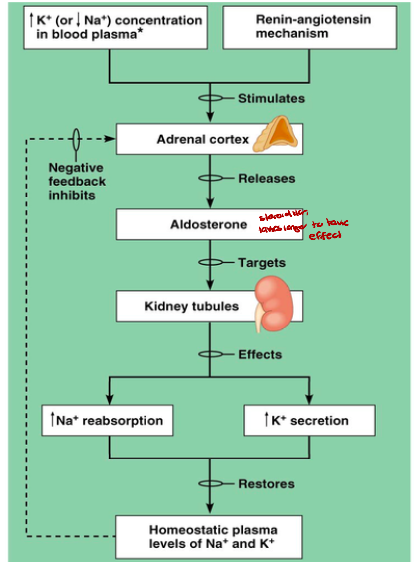
how does aldosterone regulate sodium and potassium
*aldosterone = steroid hormone that is secreted from adrenal cortex
*more sensitive to increased K than dec Na
- INC K+ or dec Na in blood plasma OR renin angiotensin mech stim aldreal cortex
- adreanl cortex releases aldosterone (note steroid hormone so longer to take effect)
- aldosterone targets the kidney tubules to get Na reabs and K secretion
- restors the plasma levels of Na and K, get negative inhibtion on adrenal cortex to stop releasing aldosterone
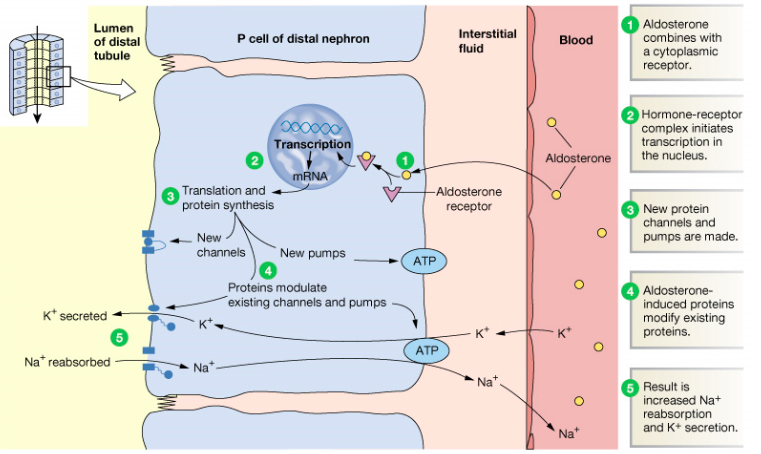
cellular basis of how Na and Alsosterone works
- Aldosterone combines a cytoplasmic receptor
- hormone receptor complex initiates transcription in the nucleus
- New protein channle and pumps are made
- alsosterone induced proteins modify existing proteins
- Result is increased Na reabsorption and K+ secretion
what do baroreceoptors do
Baroreceoptors alert the brain of increases in blood volume that cause a decrease in SNS impulses to kidney leadings to
- > arterioles dilation
- > increase glomerular filtration, increased Na+ and water output (pressure diuresis)
- since Na+ concentration determines fluid volume baroreceptors can be used as Na receptors
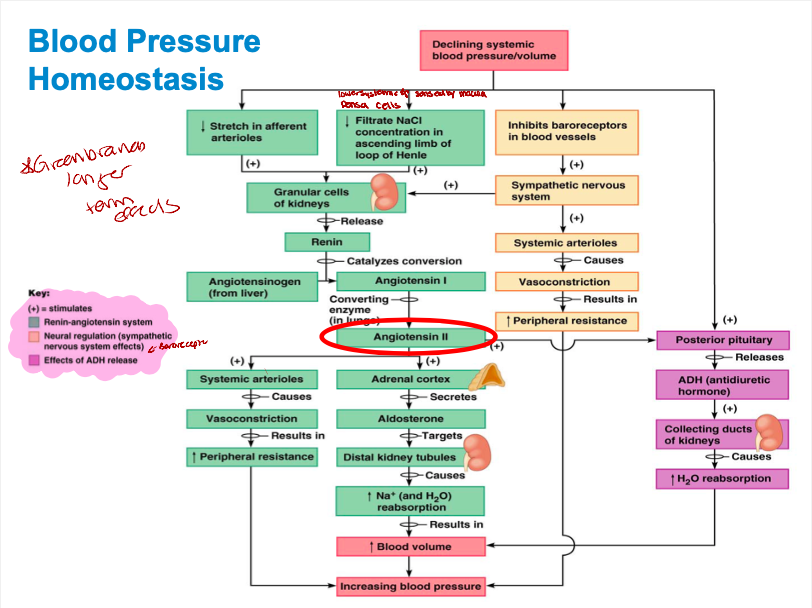
what are the mechanisms to increase blood pressure
- renin-angiotensin system
- neural regulation (sympatheitc NS_
- effect of ADH release




-
1.1 Blood, erythrocytes23
-
1.2 Blood (leukocytes)20
-
1.3 Blood clotting & Blood types26
-
2.1 Anatomy of Respiratory system41
-
2.2 Lungs anatomy20
-
2.3 Mechanics of Breathing42
-
2.4 Gas Exchange27
-
2.5 Cardbon dioxide transport28
-
3.1 GI general anatomy32
-
3.1 Oral Cavity & stomach26
-
3.3 Gastric enteroendocrine37
-
4.0 Digestive38
-
5.0 Gross anatomy of heart37
-
5.1 Microscopic anatomy of heart + contraction24
-
5.2 EKG25
-
5.3 Volumes & stuff21
-
6 BLOOD VESSELS0
-
6.1 BLOOD VESSELS0
-
6.3 BLOOD VESSELS0
-
7.1 Urinary39
-
7.2 Urinary49
-
7.3 Urinary40
-
8.1 Fluids53
-
9.0 Male reproductive system37
-
9.120
-
9.3 Female Cycles20
-
9.40
-
10.1 Nutrition Metabolism and Body temp regulation40
-
10.2 Glycogenesis and glycogen-lysis20
-
liver metabolism23
-
Microscopic Anatomy1



