what releases ADH? what does it cause
released by posterior pituitary gland in repsonse to high blood osmolarity
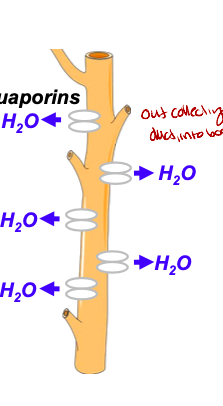
- causes principal cells of collecting duct to insert inducible aquaporins in apical membranes, increasing water reabsorption
what does aldosterone do?
Main function: increase blood pressure/volune and decrease K+ levels
- targets DCT and colelcting ducts to promote synthesis of apical Na+ and K+ channels and basolateral Na+, K+ ATPases for Na+ reabsorption
*net results Na reabs and K secretion
- without alsosterone, daily loss of filtered Na would be 2%, incompatible with life
Main functions: increases blood pressure/volume and dec K+ levels
what is atrial natriuretic peptide?
what releases it and what does it do
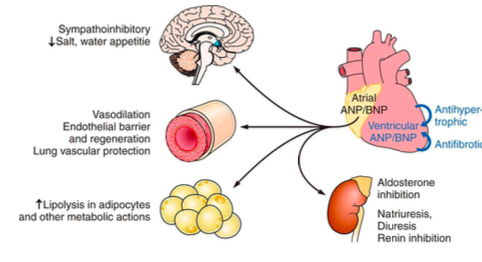
- released by cardia atrial cells in response to elevated bp/volume
- reduces blood Na+ (decreased aldosterone)
- causes vasodilation
- decreases water intake
*net: decrease blood volume/pressure
what does parathyroid hormone do
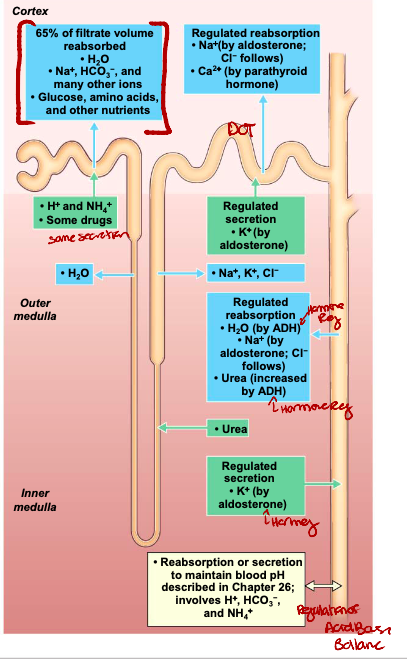
acts on DCT to increase Ca2+ reabsorption
where does tubular secretion occur? what substances are invovled
*last of 3 major renal processes
- occurs almsot completely in PCT
- selected substances moved from peritubular capillaries, throuhg tubule out into filtrate
*K+. H+, NH4, creatine, organic acids and basis
* Substances synthesized in tubule cells are secreted (e.g. HCO3–)
what is tubular secretion important for
– Disposing of substances, such as drugs or metabolites
– Eliminating undesirable substances that were passively reabsorbed (example: urea and uric acid)
– Ridding body of excess K+ (aldosterone effect)
– Controlling blood pH by altering amounts of H+ or HCO3– in urine
what is osmolarity?
how many osmol in NaCl and MgCL2
Osmolality = number of solute particles in 1 L of H2O
- 1 mole NaCl = 2 osmol (Na+ and Cl-)
- 1 mole MgCl2 = 3 osmol (Mg2+ and two Cl-)
* body fluid osmotic conc maintained aroind 300mOsm
what are the two types of countercurrent mechanisms
- countercurrent multiplier
- creates a gradient through interaction of filtrate flow in ascending/descenign limb of nephron loops of Juxtamedullary nephrons
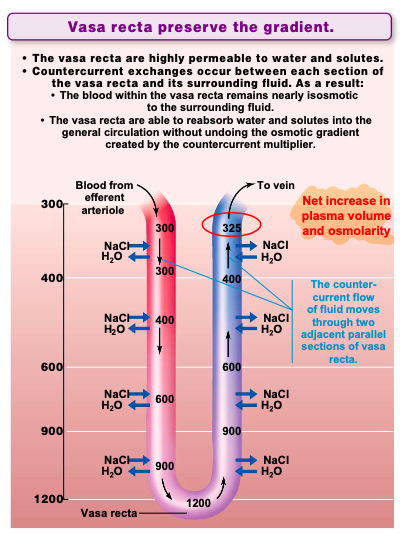
- Countercurrent exchanger
- preserves gradient using blood flow in ascening/descending limbs of asa recta
*work together to establish and maintian medullary osmotic gradietn from renal cort through medulla
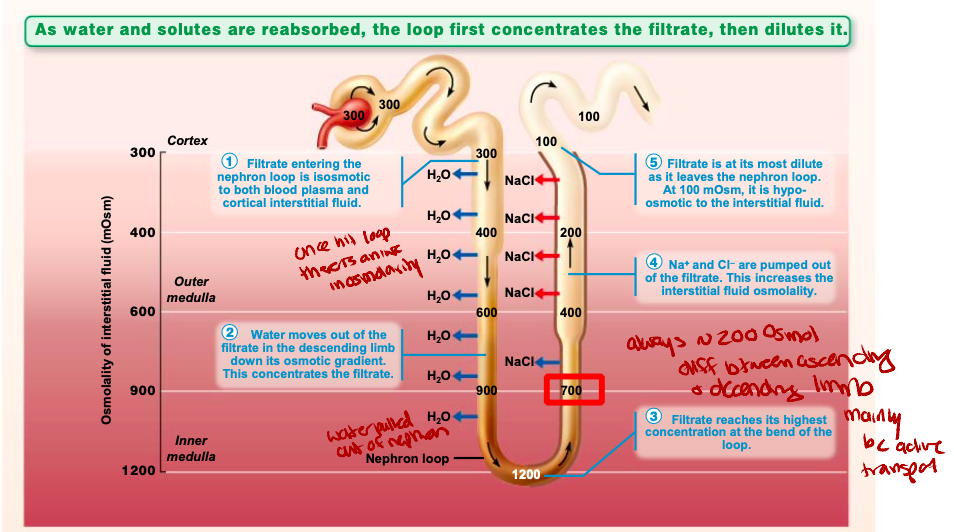
- gradient runs from 300 mOsm in crotex to 1200 mOsn at bottom of meducal
*Collecting ducts can then use gradient to vary urine concentration
what are the 3 key players that interact with the medullary osmotic gradient
- long nephron lops of juxtamedullar nephrons -> create gradient & act as countercurrent multipliers
- Vasa recta preserve the gradient. They act as countercurrent exchanges
- the collecting ducts of all nephrons use the gradient to adjust urine osmolarirty
*Juxtamedullary nephrons create as osmotic gradient w/ renal medulla. Allows kidney to produce urine of varying conc
how does countercurrent multiplier work in ascending vs descending limb
- whats the main idea of it
- limbs of nephron loop are not in deict contact but are close enough to influence exchanges with surrounding interstitial fluid
- ascening limb of loop is impermeable to H2O and selectively permeable to solutes
*Na and Cl actively reabs in thick segment, some passive reabs in thin seg
- Descening limb freely perable to H2O but impermeable to solutes
*H2) passes out filtrate causes remaining filtrate osmolarity to increase to 1200mOsm
describe the mechanism of countercurrent multiplier
- the more NaCl the ascening limb actively transports out into interstitial fluid the more water diffuses out descenidng limb
- more water that diffuses out descing that saltier the filtrate becomes
- ascening limb uses the salty filtrate to further raise osmolarity of medulary interstital fluid
*constant diff of 200 mOsm exists btwn two limbs of nephron loop and between ascening limb and interstitial fluid
*difference is “multiplied” along length of loop
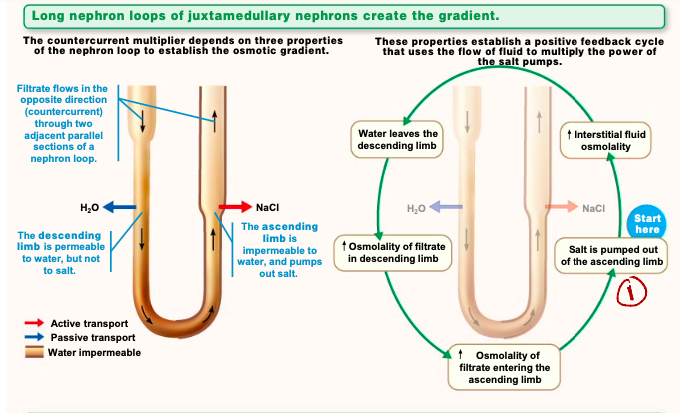
why is it called counter current multiplier
“Multiplier” refers to the ability of this countercurrent system to increase this small gradient into a much larger one
what is the countercurrent exchanger
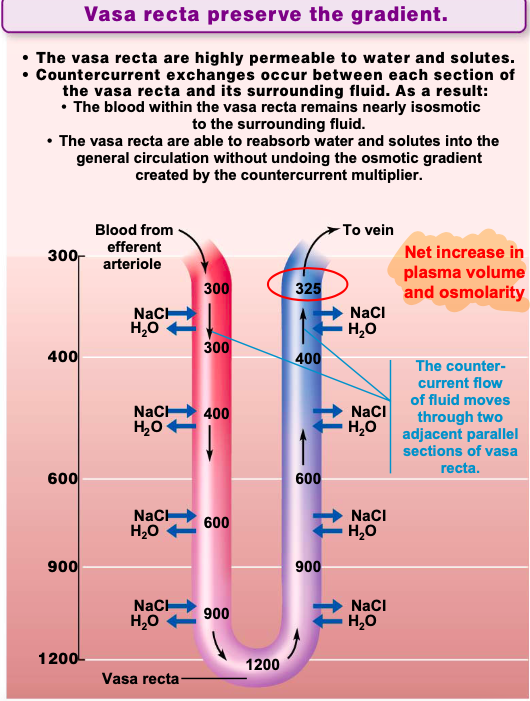
- preserved medullary gradient by
- > prevenign rapid removal of salt from interstital space
- > removing reabsorbed water
- water in ascending vasa recta comes from descening vasa recta or is reabs from nephron loop and colelcting duct
result: volume of blood at en fo vasa recta > than at beginning
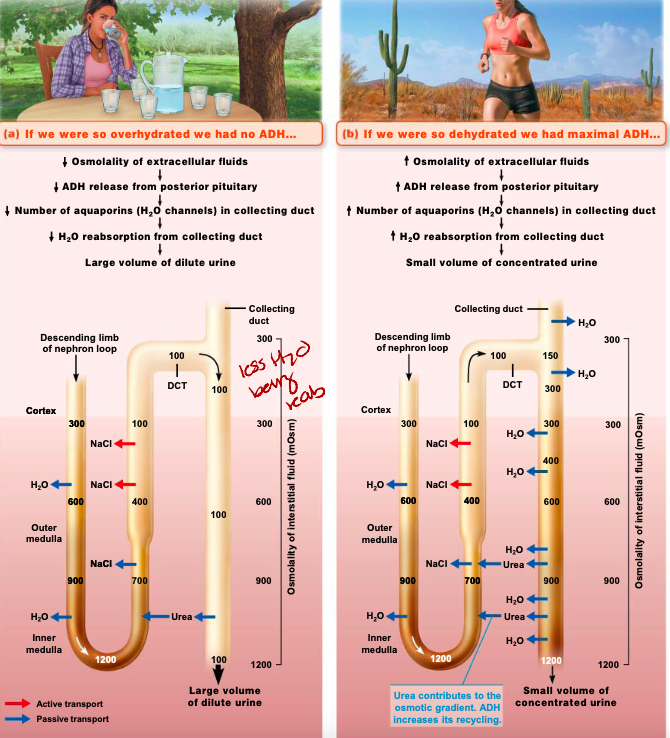
formation of urine durign dehydration or overhydration
* edullary osmoti gradient used to form dilute or conc urine
- Dehydration
- produces small volume of conc urine
- at maximal ADG ~1200 mOsm
- severe dehydration: 99% of water is reabs
- Overhydration:
- products large vol of dilute urine
- ADH decreases: urine ~100 mOsm
- Alsosterone: can cause more ions to be removed causing urien to reach ~50 mOsm
- products large vol of dilute urine
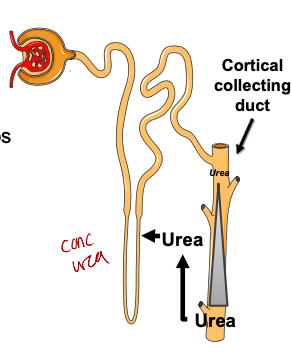
how does urea help form the medulalry Osmotic Gradient
- Urea enters fitrate in descending limb and ascending thin limb of nephron loop by facilitated diffusion
- cortical colelcting duct reabs water, leading uea behind
- in deep medulalry region, now have highly conc yrea
- leaves colelcting duct and enters interstitial fluid of medulla
- urea moves back into ascening thin limb
- contributes to high osmolality in medulla (called urea recycling)
what is diruesis
what diff substances are diuretics
homeostatic process in which urine production is increased
*many common sub are diruetics, but can have diff MOA
- Alcohol: inhibst ADH
- Na+ reabs inhibtors (reduced H2O reabs) like caffeine or drugs for hypertension or edema
- loop diruetics interfere w/ formation of medullary osmotic gradietn
- osmotic diuretics not reabs, so water remains in urine
what is renal clearance
volume of plasma kidneys can clear of a particular substance in a given time
- to determine renal clearance: both blood and urine are required
*can help detect glomerular damage and follow progress of renal disease
C = V* (U/P)
– C = renal clearance rate (ml/min)
– U = concentration (mg/ml) of substance in urine
– V = flow rate of urine formation (ml/min)
– P = concentration (mg/ml) of same substance in plasma
what does it mean if
C= 125mL/min
C < 125mL/min
C= 0
C > 125mL/min
C= 125mL/minL no net reabs or secteion (ex: inulin a plant by prpduct)
C < 125mL/min, substance reabsorbed
C= 0, substance completely reabsorebd or not filtered
C > 125mL/min, substance was secreted (most drug metabolines)
what can you use renal clearance tests to determine
GFR
what is chornic renal disease
defined as a GFR < 60 ml/min for 3 months
- filtrate formation decreases, nitrogenous wastes accumulate in blood, pH becomes acidic
- seen in daibetes mellitus and hypertension
what is renal failure
– Causes uremia: ionic and hormonal imbalances, metabolic abnormalities, toxic molecule accumulation
– Symptoms: fatigue, anorexia, nausea, mental changes, cramps
– Treatment: hemodialysis or transplant
what is the chemical composition of urine?
what nitrogenous wastes are present?
what other solutes present?
chemical comp: 95% water, 5% solutes
nitrogenous wastes: urea (largest solute comp), ruic acid, creatine
also Na+, K+, PO43–, and SO42–, Ca2+, Mg2+ and HCO3–
* Abnormally high concentrations of any constituent, or abnormal components such as blood proteins, WBCs, and bile pigments, may indicate pathology
describe olour/transparecy of urine
and odor
- colour/transparence
- clear, cloudy can indicate UTI
- pale to keep yellow from urochrome (pigment from hemoglobin breakdown)
- absnoraml colour (pink, brown, smoky)
- can be caused by food, bile pigments, blood or drugs
- Odor
- slghilty aromatic when fresh
- ammonia odor upon standing bc bacteria metabolize urea
- may be altered by some drugs/veg
- disease may alter small



-
1.1 Blood, erythrocytes23
-
1.2 Blood (leukocytes)20
-
1.3 Blood clotting & Blood types26
-
2.1 Anatomy of Respiratory system41
-
2.2 Lungs anatomy20
-
2.3 Mechanics of Breathing42
-
2.4 Gas Exchange27
-
2.5 Cardbon dioxide transport28
-
3.1 GI general anatomy32
-
3.1 Oral Cavity & stomach26
-
3.3 Gastric enteroendocrine37
-
4.0 Digestive38
-
5.0 Gross anatomy of heart37
-
5.1 Microscopic anatomy of heart + contraction24
-
5.2 EKG25
-
5.3 Volumes & stuff21
-
6 BLOOD VESSELS0
-
6.1 BLOOD VESSELS0
-
6.3 BLOOD VESSELS0
-
7.1 Urinary39
-
7.2 Urinary49
-
7.3 Urinary40
-
8.1 Fluids53
-
9.0 Male reproductive system37
-
9.120
-
9.3 Female Cycles20
-
9.40
-
10.1 Nutrition Metabolism and Body temp regulation40
-
10.2 Glycogenesis and glycogen-lysis20
-
liver metabolism23
-
Microscopic Anatomy1



