Steps of anaphylaxis management
- Shout for help
- Call anaesthetist and request difficult airway trolley
- If necessary put out 222 call - cardiac arrest
- Remove allergen if possible
- Lie patient flat and raise legs
- Give adrenaline - 0.5mL 1:1000 IM (adults)
- ABCDE assessment
- Maintain patent airway: manouevres, adjuncts, supraglottic or definitive airway as indicated
- Evidence of impending airway compromise: give nebulised adrenaline
- Maintain sats 94-98%
- Attach monitoring: BP cuff, oximeter, 3 lead ECG
- IV access: take blood, give fluid challenge (500-1000mL crystalloid)
- Give chlorphenamine and hydrocortisone IM or slow IV
- Consider nebulised salbutamol or ipatropium bromide if evidence of wheeze
Define anaphylaxis
A severe, life threatening, generalised or systemic type 1 hypersensitivity reaction characterised by rapidly devloping life thretening airway and or breathing and or circulatory problems
What is biphasic anaphylaxis?
After complete recovery of anaphylaxis a recurrence of symptoms within 72hrs occurs following no further exposure to the allergen
What is suspected anaphylaxis?
The diagnosis prior to assessment by a specialist allergist for people who present with symptoms of anaphylaxis
Common anaphylaxis triggers
- Insect venom
- Food
- Latex
- Drugs
- Idiopathic
*Presentation and timing depends on the route that the allergen has been encountered via
Pathophysiology of type 1 hypersensitivity reactions
Type 1 hypersensitivity is IgE mediated
AKA immediate hypersensitivity
Allergies occur in 2 phases:
- first exposure/ sensitisation
- subsequent exposure
- Individual exposed to allergen
- Allergen taken up by APCs and presented to a T-cell which changes it into a Th2 cell (type of CD4+ cell)
- Th2 cell makes cytokines which cause B-cells to class switch and produce IgE antibodies rather than IgM
- Th2 also causes eosinophils to degranulate, they release substances that can damage host and invading cells
- IgE attaches to mast cells via Fce receptor
- Second exposure: specific IgE antibodies bound to mast cells bind the allergen and cause mast cells to degranulate and release inflammatory mediators
Pro inflammatory mediators:
- Histamine: binds to H1 receptors, causes smooth muscle contraction in airway and increases vessel permeability causing swelling, oedema and urticaria
- Mediatorys that activate eosinophils
- Proteases
Cytokines are produces and more immune cells are recruited
- Leukotrienes also cause smooth muscle contraction and attract even more immune cells
- Eosinophils release peroxidases which cause further tissue damage
What happens when mast cells degranulate following 2nd exposure to allergen?
GI tract: increased fluid secretion, increased peristalsis >> diarrhoea and vomiting
Eyes, nose and airways: decreased airway diameter, increased mucous secretion >> congested, constricted airways
Skin: vasodilation + histamine release >> itching and flushing
Blood vessels: increased blood flow, increased permeability, increased fluid and protein in the tissue >> BP drops because effective crculating volume is low
Cardiac: hypotension, tachycardia, syncope
The above culminate in an allergic reaction which, if severe enough, results in anaphylactic shock
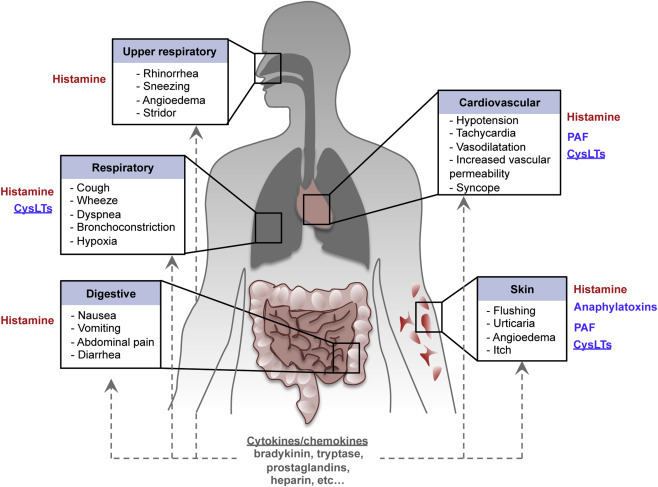
Which factors may modulate the onset of allergic and non-allergic immediate hypersensitivity
- Stress
- Infection
- Dose of allrgen
- Rate of drug injection
- Host factors
What is the ring and mesmer grading scale?
Scale used to grade anaphylactic reactions
Grade 1:
Skin itching, flushing, urticaria, angioedema
Grade 2:
Skin + nausea, cramps
Grade 3:
Skin+ N&V, defecation, laryngeal oedema, brochospasm, cyanosis, shock
Grade 4: cardiac arrest
Skin + N&V and defecation, repsiratory arrest, circulatory arrest
Patients can rapidly progress along the scale hence rapid treatment being essential
Factors that indicate anaphylaxis is severe
- Sudden onset + rapid progression
- Life threatening ABC problems
- Skin and or mucosal changes (flushing, oedema)
Important to document re anaphylaxis
Document acute clinical features of suspected reaction
Record the circumstances immediately before the onset of symptoms
Record time of onset
Airway considerations during anaphylaxis
Swelling: tongue or throat
Difficulty breathing/ swallowing
Hoarse voice
Stridor
Patient reporting they feel throat is closing
Breathing considerations during anaphylaxis
SOB
RR
Wheeze
Patient becoming tired
Confusion due to hypoxia
Cyanosis - central cyanosis is a late sign
Respiratory arrest
Circulatory considerations during anaphylaxis
Signs of circulatory shock: pale and clammy
Tachycardia
Low BP
Decreased consciousness
MI due to loss of circulating volume
Cardiac arrest
**DO NOT STAND PATIENT UP - can cause dangerous BP drop**
Disability considerations during anaphylaxis
Sense of impending doom
Anxiety and panic
Decreased consciousness
Exposure considerations during anaphylaxis
Sking changes are often the first feature
80% show skin changes
Erythema/ rash
Urticaria
Angioedema: swelling of deeper tissue e.g. throat, lips, eyelids
Dose of adrenaline in anaphylaxis
Give 0.5ml of 1 in 1000 INTRAMUSCULAR
This means 1g of adrenaline in 1000mls (i.e. 1g in 1L) but we give 0.5ml of this solution
>> Repeat after 5 mins if no response <
LEAVE IV TO EXPERTS
Management of a patient with anaphylaxis
Call for help
Lie patient flat
Raise their legs
GIVE ADRENALINE BEFORE O2 AND FLUID
Airway: establish
B: O2 sats probe, 15L O2 non-rebreathe
C: BP cuff, ECG, IV access, adrenaline (1:1000 0.5mL)
Fluids
ADULT - 500-1000mL bolus crystalloid (0.9% w/v sodium chloride)
CHILD - 20mL/ kg bolus crystalloid (0.9% w/v sodium chloride)
**Avoid colloids because they can be a source of reaction**
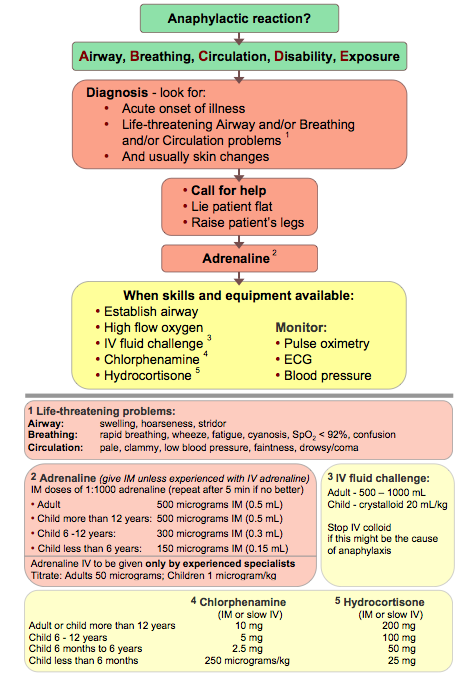
Use of chlorphenamine and hydrocortisone in anaphylaxis
Take longer to act, these drugs can wait - adrenaline and ABC is priority
Chlorphenamine = antihistamine >> given for 24-48hrs after adrenaline to reduce severity & duration of symptoms and to prevent relapse
Hydrocortisone >> dampens down immune response, reduced swelling and inflammation >> reduces risk of relapse/ biphasic anaphylaxis
Differentials for anaphylaxis
Asthma attack
Sepsis
Vasovagal
Panic attack
Idiopathic urticaria/ angioedema
What is mast cell tryptase testing?
Tryptase is an enzyme released when mast cells degranulate - the level of tryptase is used to indicate the level of mast cell activation
The test is used to confirm diagnosis of anaphylaxis and to diagnose mastocytosis (too many mast cells)
When are samples taken for mast cell tryptase testing?
1st sample: after initial resus started
2nd sample: 1-2hrs after symptom onset
3rd: 24hrs later or at follow up
What are auto injectors?
Used by patients or carers with severe reactions or those who have trouble avoiding triggers
Management of a patient following anaphylaxis when stable
Adults and those 16+: observe for 6-12hrs from symptom onset
Children <16hrs: admit under paeds

-
Diabetic ketoacidosis10
-
Sepsis39
-
Acute coronary syndrome29
-
Anaphylaxis27
-
Acute haemorrhage39
-
Major trauma89
-
Head and spinal injury75
-
Burns36
-
Crush syndrome6
-
PPT68
-
Altered consciousness7
-
Seizures23
-
Overdose and poisoning72
-
Organ failure and referral52
-
Preoperative assessment15
-
Intraoperative care47
-
A-E, ABG, consent39
-
Postoperative care17
-
CPR25
-
Shock4
-
Upper and lower limb injury136
-
Asthma attack0



