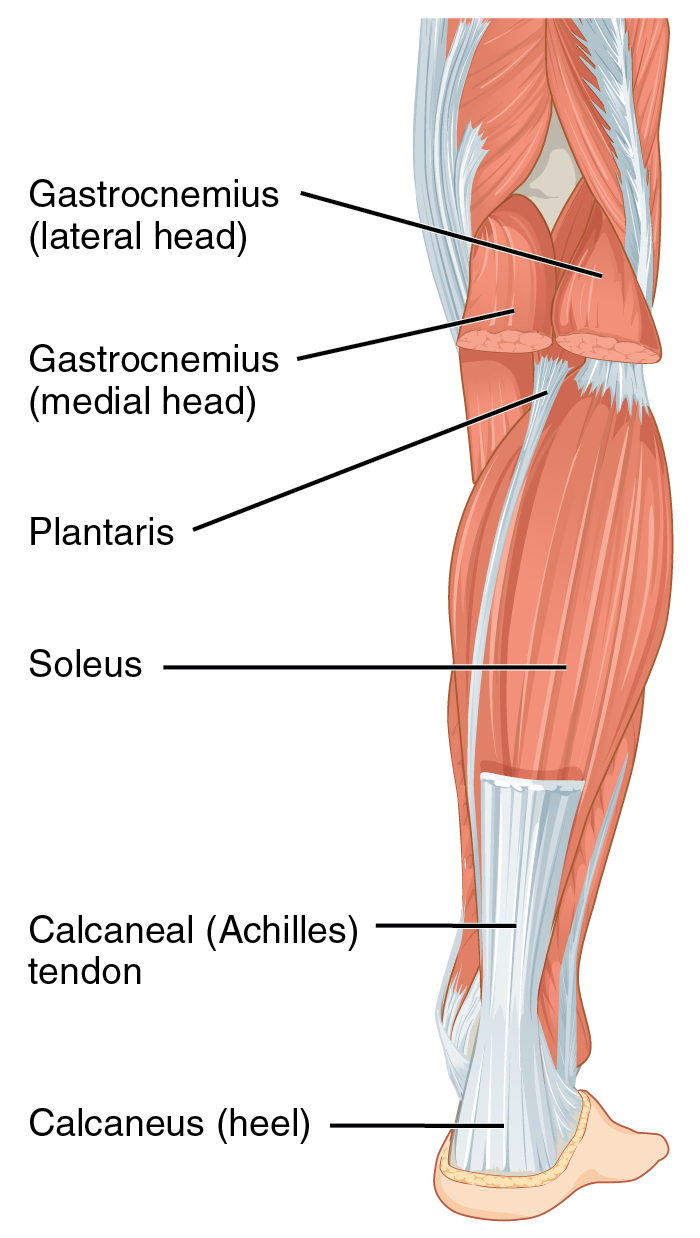
Remind yourself which tendons make up the achilles tendon
- Gastrocnemius
- Soleus
*Plantaris inserts into achilles tendon
State the pathophysiology of achilles tendonitis
- Repetitive action results in microtears
- Microtears lead to localised inflammation
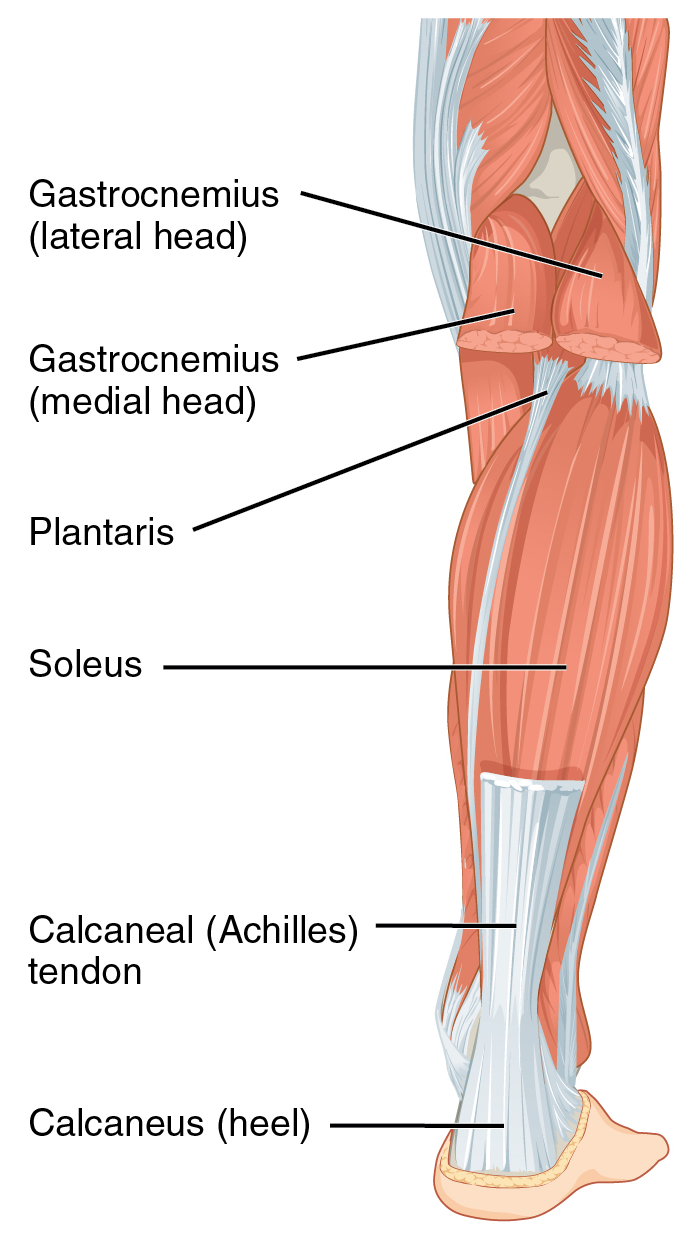
With repeated episodes, tendon can become thickened, fibrotic and loses elasticity with repeated episodes
Describe the typical presentation of achilles tendonitis
- Gradual onset of pain & stiffness
- ^^ worse with movement
- Usually improved with mild exercise or heat application
- Tenderness over tendon on palpation
Describe the typical presentation of achilles tendon rupture
- Sudden onset of severe pain in posterior calf
- Audible popping/feeling that something ‘went’
- Weak plantar felxion
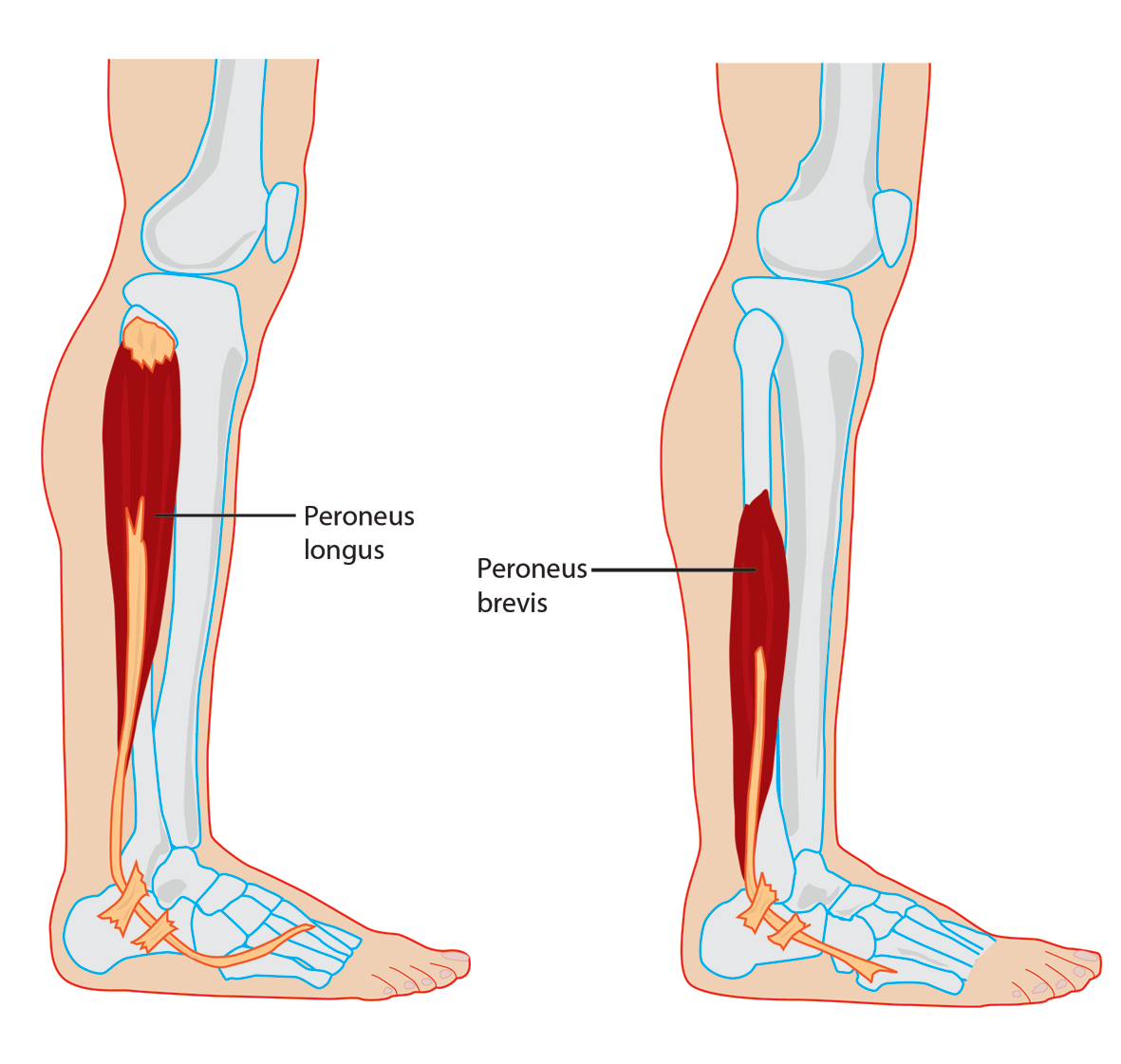
Explain why ankle plantar flexion is only weakened, not absent, in achilles tendon rupture
Peroneal muscles still intact and contribute to plantar flexion
What test can be used to assess for achilles tendon rupture?
Simmonds test
Discuss if any, and what investigations, are required for achilles tendonitis and rupture
- Both are clincial diagnoses.
- May do USS if unsure on diagnosis
Discuss the management of achilles tendonitis
Supportive
- Stop precipitating exercise
- Ice
- Anti-inflammatories e.g. NSAIDs
Chronic cases may require physiotherapy.
Discuss the management of achilles tendon rupture, consider:
- If present <2 weeks since injury
- If present >2 weeks since injury
<2 weeks
- Analgesia
- Hold (two options see below)
- Hold in full equinus for 2 weeks
- Hold in semi-equinus for 4 weeks
- Hold in netural position for another 4 weeks
**Options for holding: Either with plaster, give crutches and no weight bearing. Or with moonboot with large heel raise insert and can weight bear immediately
>2 weeks since injury or reoccurence
- Surgical fixation with end to end repair
What is meant by equinus?
- Equinus= condition in which dorsiflexion of foot is limited
- When put ankle in equinus position to treat achilles tendon rupture we are referring to holding the ankle in a position with the ankle and toes maximally pointed
What is a Lisfranc injury?
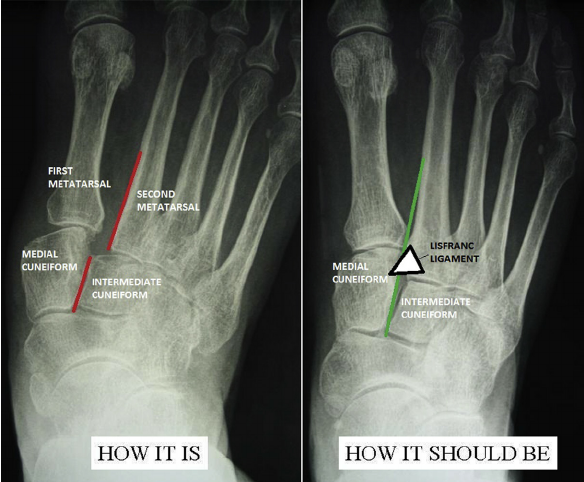
Injury to tarsometatarsal joint between the medial cuneiform and the base of the 2nd metatarsal; can be solely ligamentous injuries or involve the bony structures of the midfoot (in which case called a fracture dislocation)
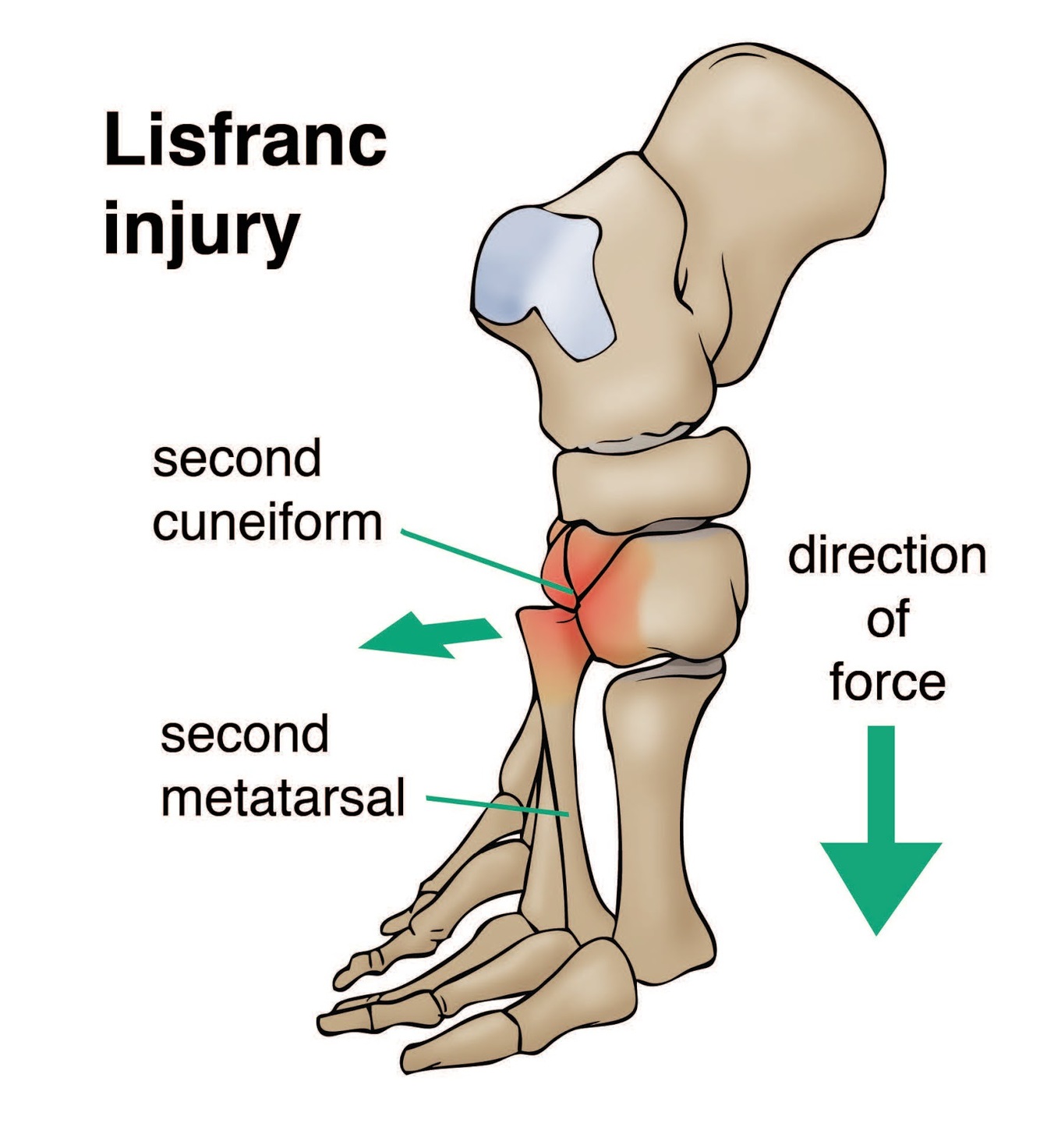
Why does a lisfranc injury occur between medial cuneiform & 2nd metatarsal
- Stability of this joint comes from keystone configuration in which base of 2nd metatarsal fits into mortise created by medial & middle cuneiforms
- Multiple interosseous ligaments support this area
- The largest & strongest ligament is the Lisfranc ligament
- Lisfranc ligament goes form medial cuneiform to base of 2nd metatarsal
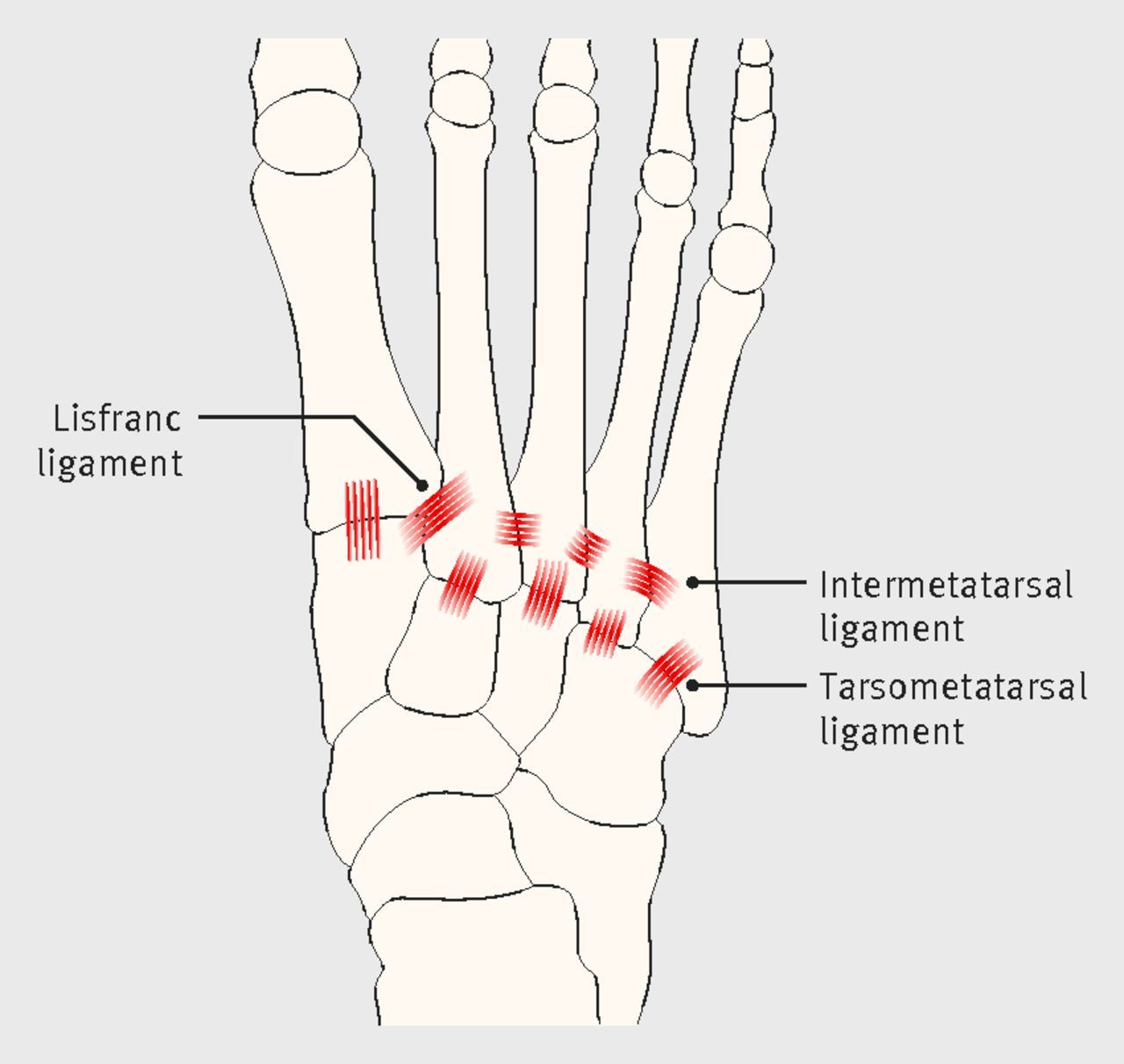
State the typical mechanism of injury for Lisfranc injuries
Rotational forces or axial load through plantar flexed foot
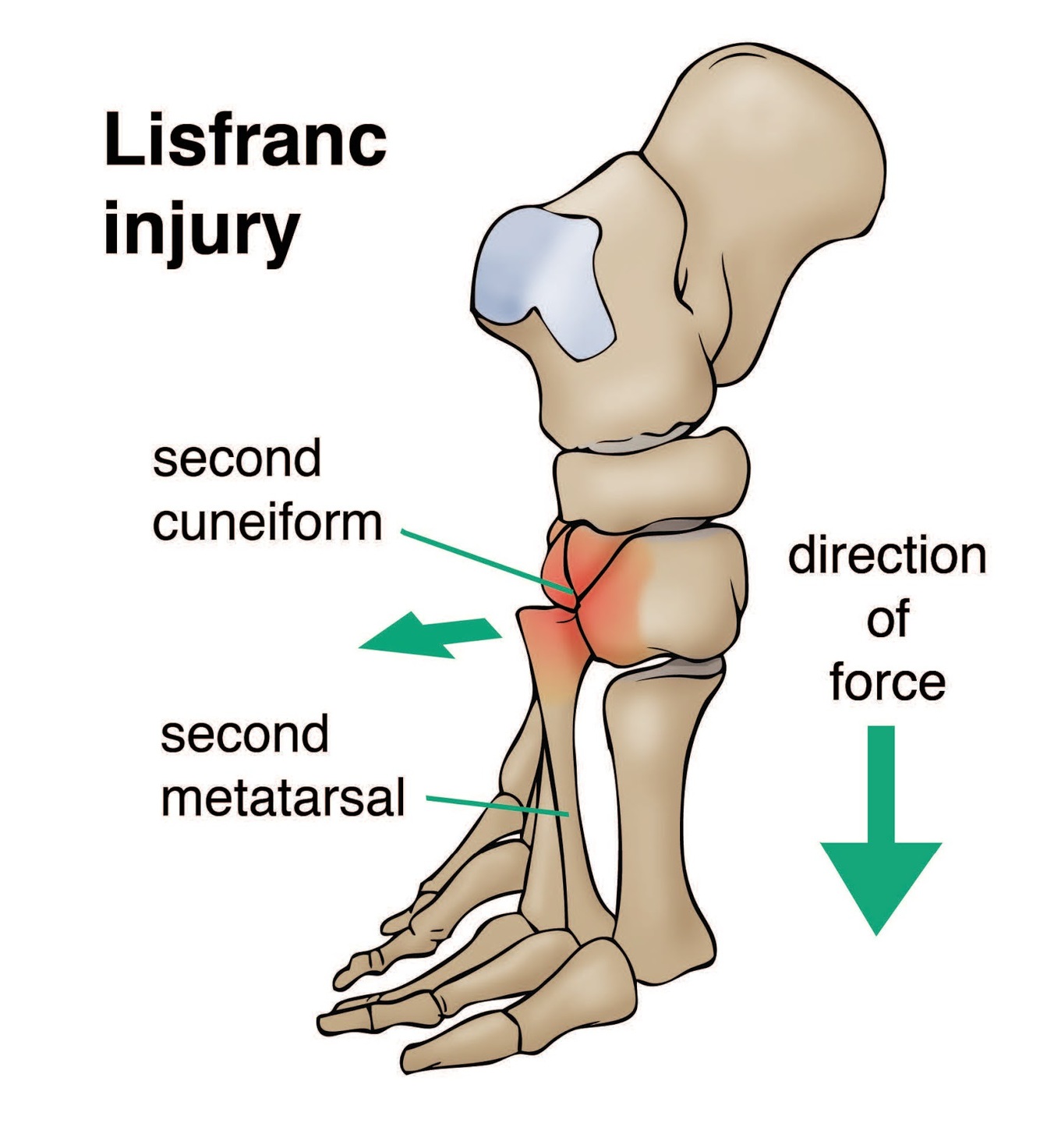
Describe typical presentation of Lisfranc injury
- Midfoot swelling
- Midfoot tenderness
- Plantar bruising
- Midfoot pain
- Piano key sign
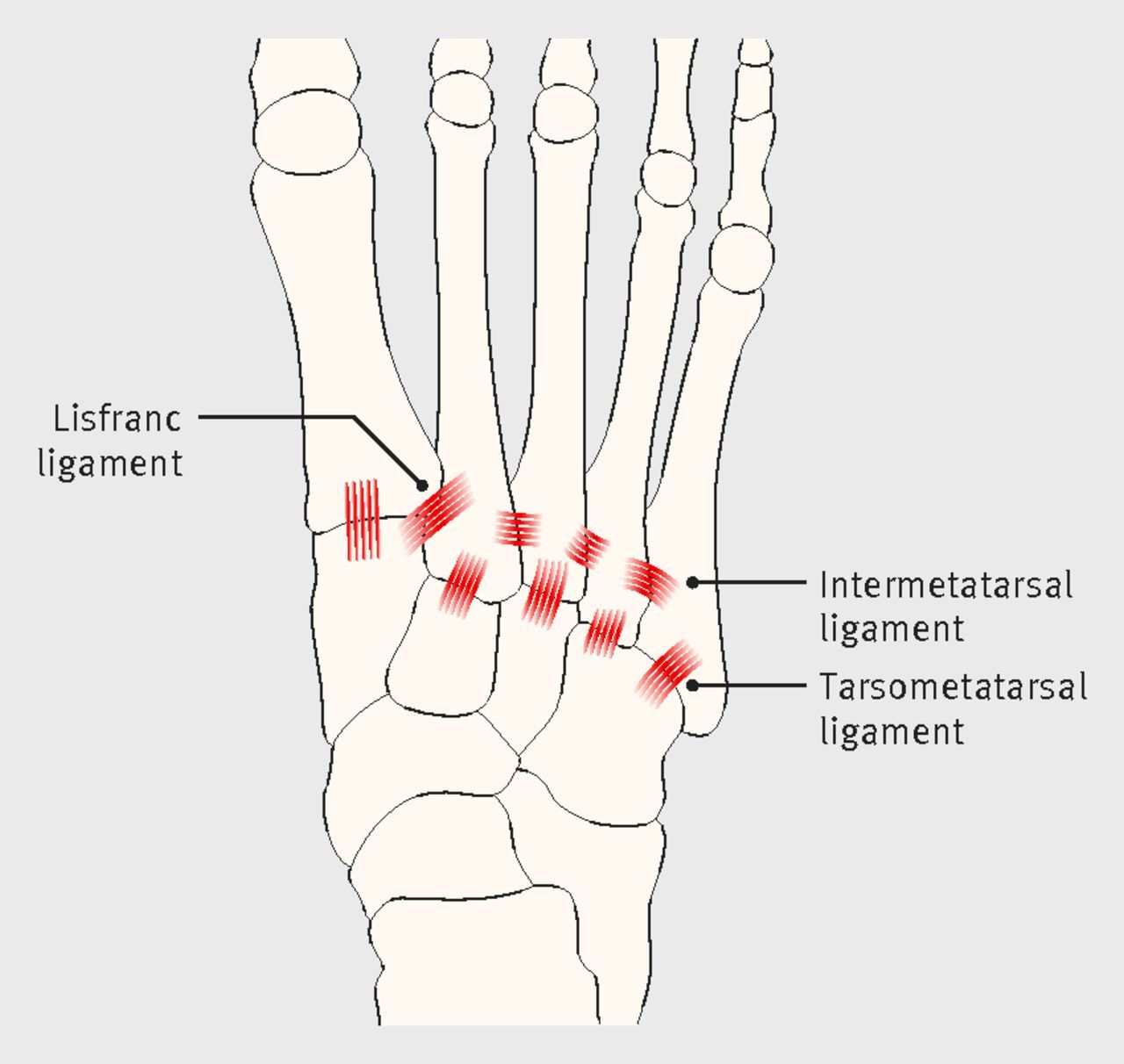
What investigations are required for a suspected Lisfranc injury?
- Plain film radiographs (AP, lateral & oblique)
- ?CT fo pre-operative planning
- ?MRI for purely ligamentous injuries
Signs of Lisfranc injury are subtle on radiographs; state at least one possible sign
- Widening of interval between base of 1st & 2nd metatarsal
- Dorsal displacement of proximal bases of 1st or 2nd metatarsals on lateral view
- Bony fragment between 1st& 2nd metatarsal
- Malalignment of medial border of lateral cuneiform and medial edge of 3rd metatarsal
What classification is used to classify Lisfranc injuries?
Hardcastle & Myerson
Discuss the management of Lisfrance injuries, consider management of:
- Injuries without significant displacement
- Injuries with significant displacement
Without significant displacement
- Conservatively with cast immobilisation and non-weight bearing mobilisationfor 6-12 weeks
With significant displacement
- ORIF (often with screw fixation between medial cuneiform & 2nd metatarsal)
- Or athrodesis (if severly comminuted or displaced)
State some potential complications of Lisfranc injuries
- Post-traumatic arthritis
- Midfoot compartment syndrome
What is hallux valgus?
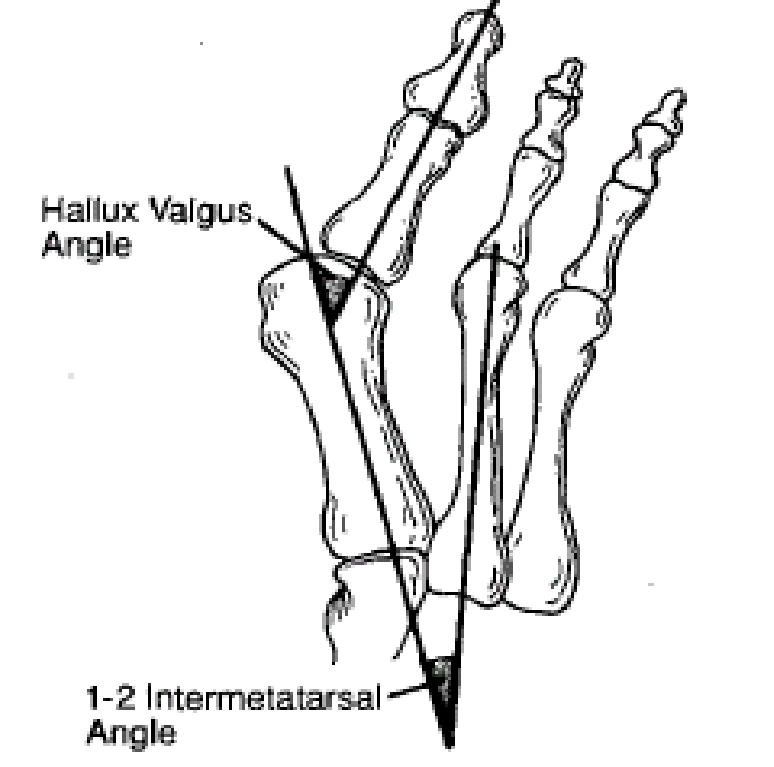
Deformity in which there is medial deviation of the 1st metatarsal and lateral deviation +/- rotation of the hallux with associated joint subluxation
State somr risk factors for hallux valgus
- Female
- Connective tissue disorders
- Hypermobility syndromes
- Flat feet
*wearing high heeled for narrow fitting footwear can aggravate condition by keeping hallux in valgus position
Describe typical presentation of hallux valgus
- Painful medial prominece
- Lateral deviation of hallux
- Skin breakdown over prominence
- Excessive keratosis in regions of foot due to abnromal weight distribution
What investigations are done if you suspect hallux valgus?
Plain radiographs (AP, lat & oblique- weight bearing) to help assess severity
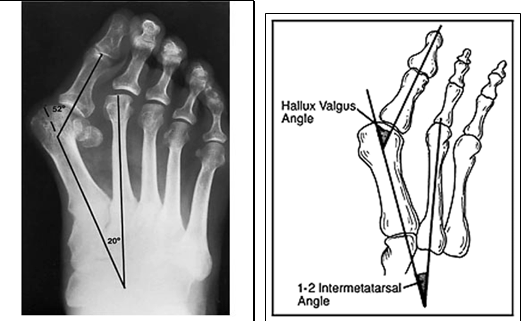
We can measure the degree of lateral deviation of hallux; measure angle between first metatarsal & first proximal phalanx. What is a normal angle?
<15 degrees