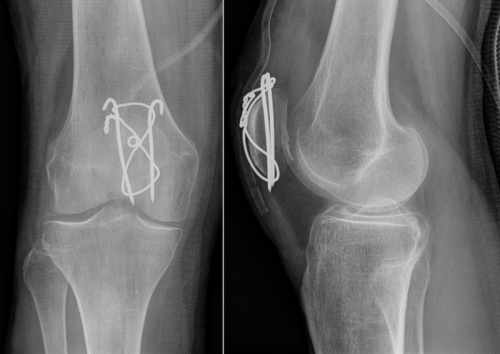
Remind yourself of the bony anatomy of the tibia
*On posterior have soleal line
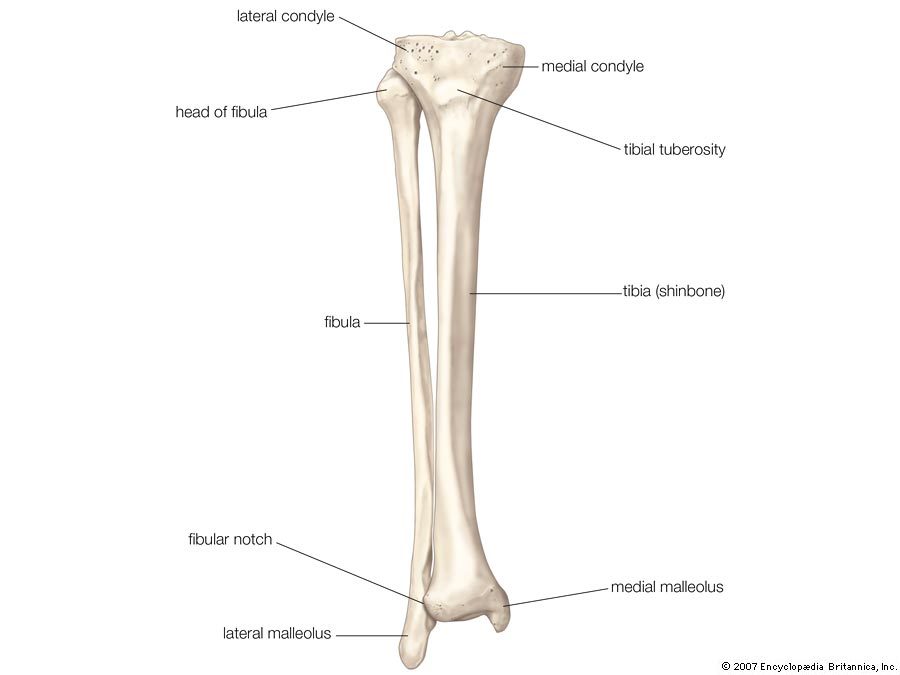
Remind yourself of the ligaments of the knee
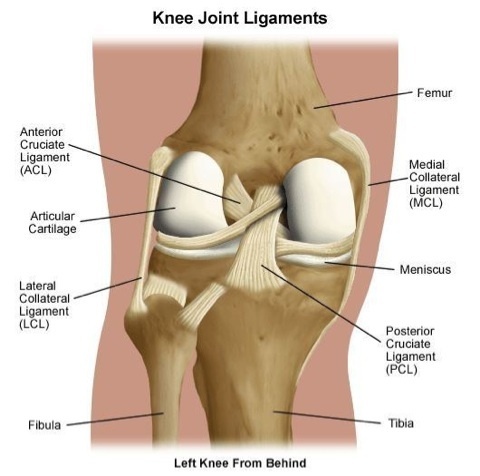
Tibial shaft fractures often ocur through which two types of injury?
- Direct force e.g. axial loading froma fall, drect blow
- Indirect force e.g. twisting or bending
Why is there increased risk of open fractures and compartment syndrome with tibial fractures?
- Open fractures: lack of soft tissue envelope (especially anteromedially)
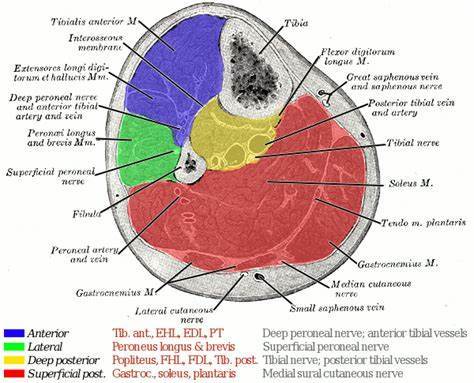
- Compartment syndrome: many fascial compartments
Describe the clinical presentation of a tibial shaft fracture
- History of trauma
- Pain
- Inability to weight bear
- Deformity
- Swelling
- +/- Associated soft tissue injury
What investigations would you do if you suspect a tibial shaft fracture?
- Plain film radiograph (full length AP and lateral views of tibia & fibula which include knee and ankle)
- ?CT (if intra-articular extension or if there is spiral fracture of distal tibia as may also be fracture of posterior malleolus)
- Urgent bloods (if ATLS)
Discuss the management of tibial fractures, include:
- Initial management
- Definitive management
Initial Management
- Reduction (under analgesia/conscious sedation) & then repeat NV status
- Following reduction:
- Above knee backslab (with knee in slight flexion)
- Limb must be elevated immediately and monitored for signs of compartment syndrome
- Repeat x-ray and NV status
Definitive management:
- Most managed operatively:
- IM nail (most common)
- Plates
- Non-operative: Sarmiento cast (in closed stable tibial fractures)
*NOTE: associated fibula fractures can usually be left alone as they heal when once tibia is stabilised
High energy tibial fractures often result in fibula fracture at ____ level.
Low energy tibial fractures often result in fibula fracture at ______ level
State some potential complications of #tibial shaft
- Compartment sydnrome
- Ischaemic limb
- Open fractures
- Malunion
State the typical mechanism of injury for a tibial plateua fracture
- High energy trauma e.g. fall from height or RTA
Results in impaction of femoral condyle into tibial plateau
Which side of tibial plateua is more commonly injured in tibial plateau fractures & why?
- Lateral tibial plateau
- The force of injury is typically a varus deforming force meaning that the lateral tibial plateau is more frequently affected than the medial
Describe the clinical presentation of tibial plateau fractures
- History of trauma
- Pain
- Inability to weight bear
- Swelling
- Tenderness
- +/- associated soft tissue injuries (e.g. ligament instability- BUT would not test initially due to pain)
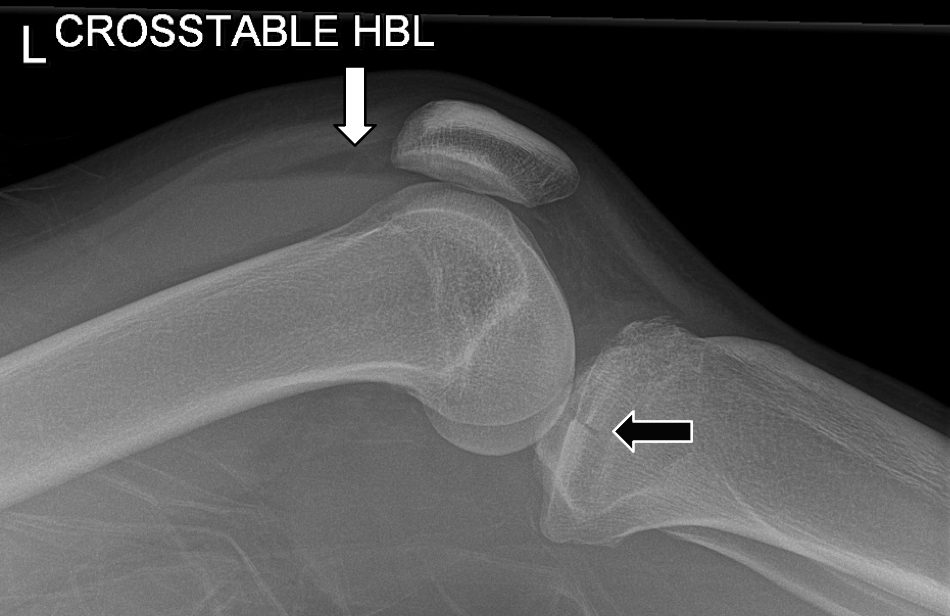
The significant swelling that is seen in tibial plateau fractures is due to lipohaemarthrosis; what is lipohaemarthrosis?
Lipohaemarthrosis results from an intra-articular fracture with escape of fat and blood from the bone marrow into the joint
What investigations would you do if you suspect a tibial plateau fracture?
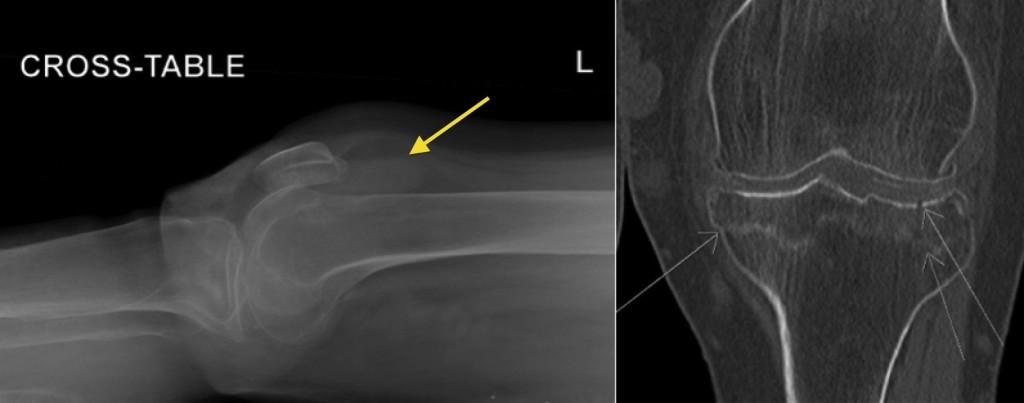
- Plain film radiographs (AP & lateral)- look for fracture & lipohaemarthrosis
- CT scanning (almost always needed to assess severity and aid surgical planning)
Describe the appearance of lipohaemarthrosis on x-ray
You will notice that there is a very straight line (arrow) at the superior aspect of the fluid, above which there is some low density material. This is fat floating on blood, and makes this a lipohaemarthrosis. The reason this is significant is that it means that there must be an underlying fracture, even if one cannot be seen on the radiograph (because the fat is actually marrow fat, and must have leaked into the joint through a fracture).
What classification system can be used to classify tibial plateua fractures?
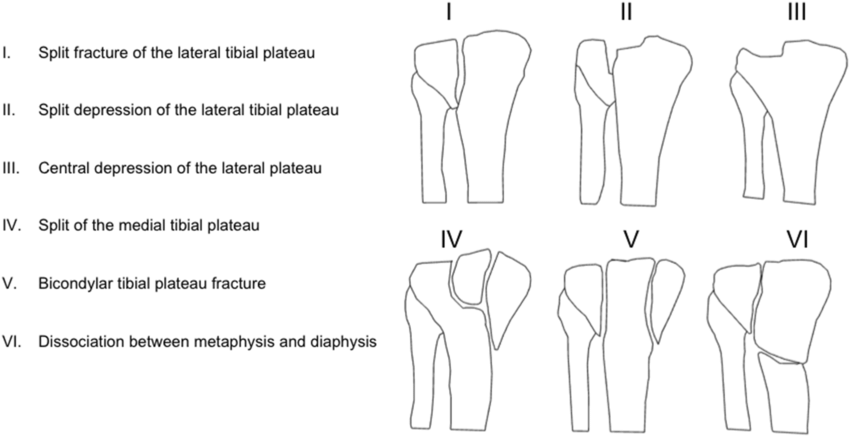
Schatzker
*don’t learn in’s and out’s
Discuss the management of tibial plateau fractures, include management of:
- Non-complicated
- Complicated
Un-complicated (no ligamentous damage, no tibial subluxation or articular step <2mm)
- Hinged knee brace with non or partial weight bearing for 8-12 weeks
- Ongoing physio
Complicated (articular step =/>2mm, angular defomrity =/>10 degrees, metaphyseal-diaphyseal translation, ligametnous injury requiring repair, associated tibial fractures)
- ORIF
- Post-operative hinged knee brace with limited or no weight bearing for 8-12 weeks
What is the main potential complication of tibial plateau fractures?
Post-traumatic OA
What is the typical mechanism of injury of patella fractures? (2)
- Direct trauma (most common)
- Rapid eccentric contraction of quadriceps
Describe the typical presentation of patella fractures
Pain
Swelling
Deformity
Difficulty extending knee
Bipartite patella may be incidentally picked up on imaging; what is bipartite patella?
- Congenital condition
- 2-3% population
- Males > females
- Failure of patella fusionso two separate bone fragments joined by fibrocartilaginous tissue
- Typically asymptomatic but rarely can be symptomatic with anterior knee pain after exercise or overuse

What investigations would you do if you suspect a patella fracture?
- Plain film radiographs (AP, lateral & skyline)
*Skyline view often not possible if pt has #patela as pain inhibits knee flexion; skyline requires 30 degrees knee flexion
The AO Foundation Classification classifies patella fractures intwo three groups: 1, 2 and 3. Describe these 3 groups
- 1= extra-articular or avulsion
- 2= partial articular
- 3=complete articular
Discuss the management of patella fractures, include management of fractures which are:
- Non-displaced or minimally displaced
- Significantly displaced or disruption to extensor mechanism
Non-displaced or minimally displaced
- Brace or cyclinder case with early weight bearing in extension
Significatn displacement or disruption to extensor mechanism
- ORIF
- with tension band wiring (aims to convert tensile force applied to patella via extensor mechanism into compressive force to assist fracture reduction and healing)
- with screw
- Partial or total patellectomy