Kerchoffs’ principle on Cryptography’s strength
If keys are:
- Kept secret
- Managed only by trusted systems
- Adequate length
Then it has no importance that the encryption and decryption algos are keps secret.
It is better that those algos are public so that they can be widely studied and weaknesses are identified and fixed.
Secret key / symmetric cryptography
- single key, shared only by the two parties.
- low computational loas > used for data encryption.
- Problem: how do we securely share the key among interested parties?
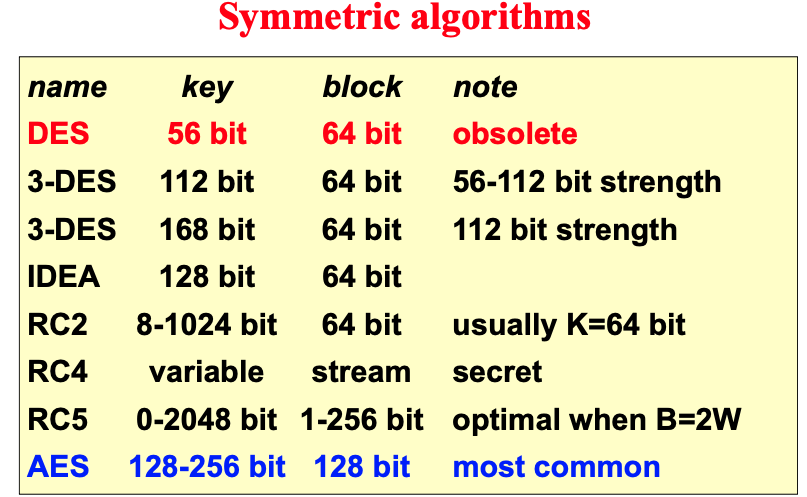
EX-OR function
The ideal confusion operator.
If the input is random the output will be equally random.
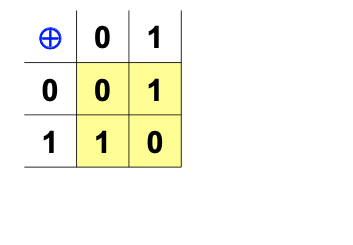
DES
- Data Encryption Standard
- Standard Federal Information Processing Standard 46/2 (FIPS)
- Key size: 56 bits + 8 parity bits.
- Datablock size: 64bits.
- Designed to be hardware efficient:
- requires only XOR/SHIFT/Permutation.
Triple DES (3DES, TDES)
- Repeated application of DES.
- Uses 2 of 3 56bits keys.
- MODES:
- DES - EEE3: 3-DES -> 3 different keys
- DES - EDE3: -> 3 different keys: E(k1, D(k2, E(k3, msg) ) ) [used for when compatibility with DES is wanted, in that case all keys are the same].
- DES - EEE2: Similar to DES-EEE3 but the first and third keys are the same
- DES - EDE2: Similar to DES-EDE3 but the first and third keys are the same
- Stanard FIPS 46/3 and ANSI X9.52 (X9 is prefix for banking and finance standards)
Double DES
- Double application of encryption algorithms is subject to known-plaintext attack named meet-in-the-middle.
- allows to decrypt data by attempting 2N+1 combinations (N = key size in bits)
- this is why double usage of encryption algos isn’t used often.
- computation time doubles, but the effective key-length is just another bit.
- Note that if the base symmetric algorithm would be a group, then it would exist K3 so that E(K2, E(K1, msg) = E(K3, msg).
- DES is not a group, otherwise 3DES = DES.
Meet-in-the-Middle attack
- Hypothesis
- N bit keys
- known P and C such that C = E(k2, E(k1, P) )
- Note:
- ∃ M such that M = E(K1, P) and C = E(K2, M)
- Actions:
- Compute 2N values Xi = E(Ki, P)
- Compute 2N values Yj = D(Kj, C)
- Look for Kj and Ki such that Yj = Xi.
- False positive can be discarded easily.
IDEA
- International Data Encryption Algorithm
- Patented with low royalty (commercial use)
- 128 bits key
- 64 bits data block
- Famous because it is used in PGP
- Operations:
- XOR
- ADDITION mod 16
- MULTIPLICATION mod 216 + 1
RC{2,4}
- Ron Rivest invention
- RC = RON’S CODE
- Proprietary algorithm (owned by RSA) but not patented
- 3-10x faster than DES
- RC2 is a block algo
- RC4 is a stream algo
- Key length is not fixed
RC2 was published as RFC-2268 in 1998, 8 to 1024 bits keys (usually 64bits), 64b datablock.
RC4 reverse engineered (ARCFOUR).
Application of block algorithms to data blocks of size != algorithm’s block size.
- To encrypt data size > algo’s block size
- ECB (Electronic Cod Book)
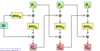
- CBC (Cipher Block Chaining)
- To encrypt data size < algo’s block size
- Padding
- CFB (Cipher FeedBack), OFB (Output FeedBack)
- CTR (Counter mode)
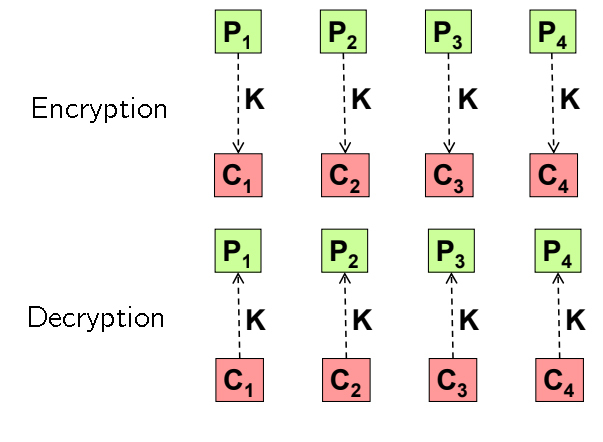
ECB
Electronic Code Book
- Encryption:
- Formula: Ci = enc(K, Pi)
- Can’t be used on messages > algo block size because swapping of blocks goes undetected.
- Identical blocks generate identical cyphertext, thus it is vulnerable to known-plaintext attack
- Decryption:
- Formula = Pi = dec(K, Ci)
- A trasmission error generates an error at decription of the block.
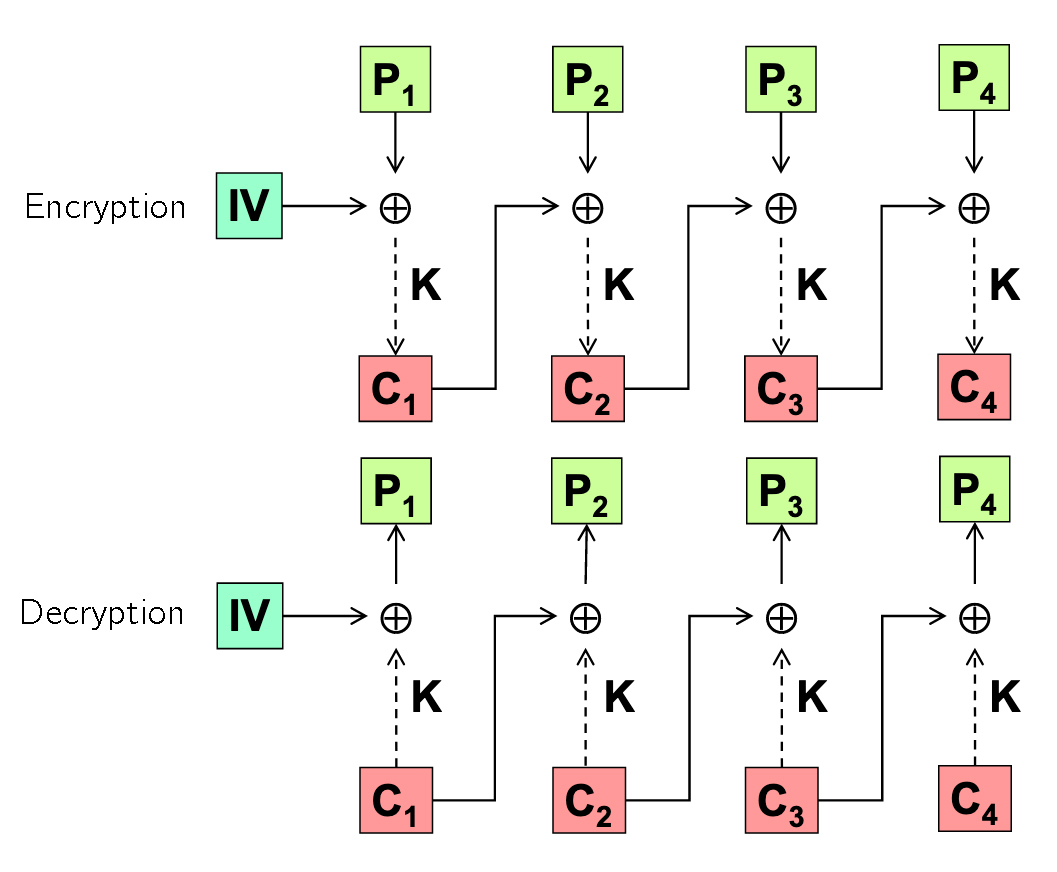
CBC
Cipher Block Chaining
- Encryption
- Formula: Ci = enc(K, Pi xor Ci-1)
- Requires C0 = IV (Init. Vector)
- IV changes at every message, so that pre-computation cannot be performed
- IV is sent in clear to the receiver
- IV should be a nonce (number used once)
- Decryption:
- Formula: Pi = dec(K, Ci) xor Ci-1
- An error in trasmission generates and error at the decryption of two blocks.
Padding
- B = size of algo block
- D = size of data to process
- Used for aligning and filling
- Padding: add bits until a multiple of the algo block size is reached.
- Problems:
- We store/transmit more data than needed.
- What value do we use to do padding?
- Padding Techniques:
- If message length is known: add null bytes
- Original DES: one 1 bit followed by many zeros
- one byte with value 128 followed by null bytes: 0x80 0x00 0x00
- last byte’s value equal to the length of padding: 0x?? 0x?? 0x03
- Padding with exlicit length L:
- (Schneier) NULL bytes eg.: 0x00 0x00 0x03
- (SSL/TLS0 bytes with value L, e.g.: 0x03 0x03 0x03
- (SSH2) random bytes, e.g.: 0x05 0xF2 0x03
- (IPSec/ESP) progressive number, e.g.: 0x01, 0x02, x03
- byte with value L-1, e.g.: 0x02 0x02 0x02
Notes:
- Some offer minimal integrity control:
- if key is wrong or data is manipulated, the padding bytes are incoherent (e.g. Padding length > Block size, or wrong padding values)
- Don’t design your own padding, read books instead.
- Typically applied to large data, on last fragment.
- if |D| < |B| we prefer ad-hoc techniques (CFB, OFB, CTR, …)
- padding is always added to avoid interpretation errors, even if |D| is a multiple of |B|
- The type of padding used in algorithms determines some of the possible attacks

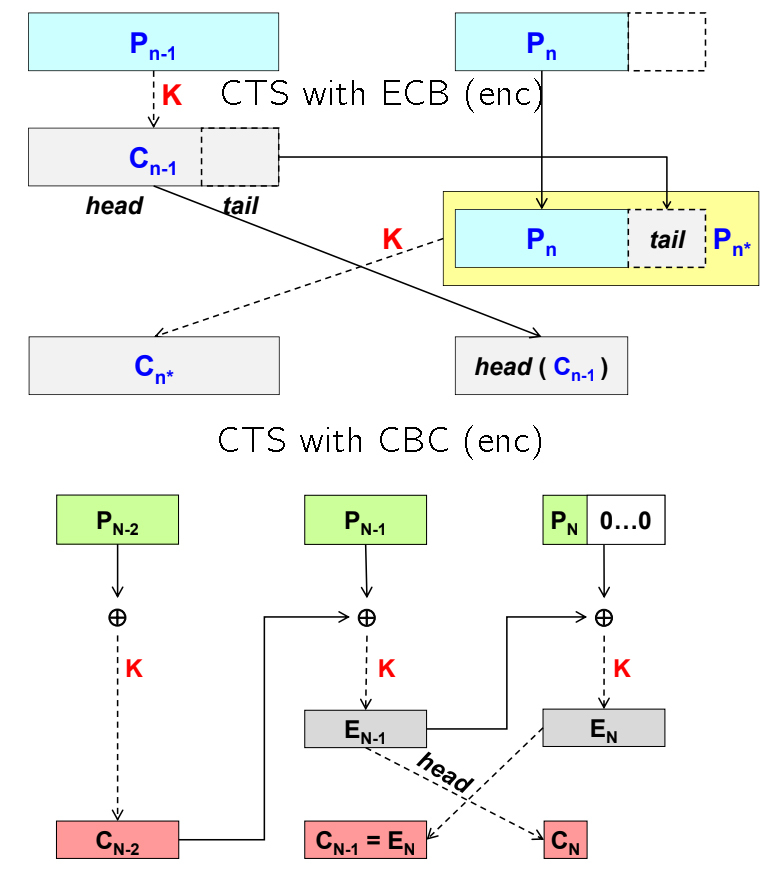
CTS
Ciphertext Stealing
- CTS permits to use block algorithms without padding
- last (partial) block filled with bytes from the second-to-last-block
- these bytes are removed from the second-to-last block (which becomes a partial one)
- after encryption, exchange the position of the last and second to last blocks
- useful when we cannot increase the size of the data after encryption: when the HDD is full you can’t use padding.
- the computation time slightly increases
In CBC the tail of the second-to-last block got xored with the padding of the last block, so we have it.
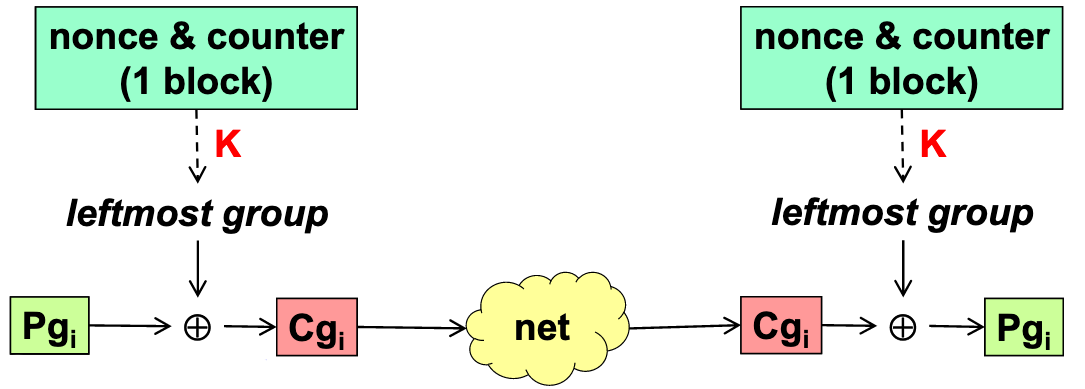
CTR
Counter mode
- Uses a block algorithm to encrypt N bits at a time (a “group”, often a byte)
- random direct access to any ciphertext group
- requires a nonce and a counter (concatenated, summed, XORed, …)
- trasmission error results in having an error only in one group
- Enables encryption/decription of a specific block without performing it for the whole message.
*
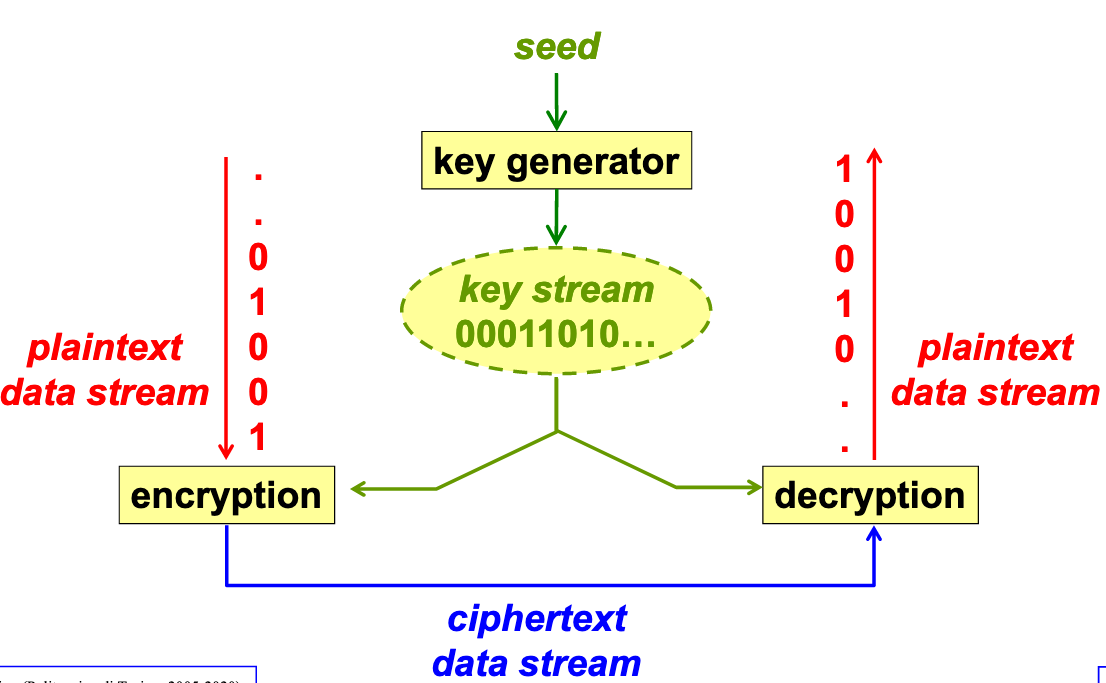
Symmetric stream algorithms
- operate ona a stream of data without requiring the division on blocks, typically on one bit or byte at a time
- ideal algorithm:
- one-time pad (requires a key as long as the message to protect)
- real algorithms:
- use pseudo-random key generators, syncrhonized between sender and receiver
- if an attacker deletes a message sync. is lost -> communication is broken
- example: RC4, SEAL
- EU sponsored a competition for stream cipher in 2008, that resulted in the selection of an algorithm portfolio for software and hardware.
Salsa20, ChaCha20
Symmetric stream algorithms invented by DJ Bernstein
128 or 256 bit keys
- ChaCha20 is an improvement of Salsa20
- more diffusion of bits
- faster on some archs.
- base operation: 32bit ARX (add - rotate - xor)
- base function: f(key256, Nonce64, Counter64) = 513-bit keystream block
- permits O(1) decryption of any block at random
- Salsa20 performs 20 mixing rounds of the input
- Salsa 20/12 and Salsa20/8 make 12 and 8 mixing rounds (faster but less secure)
- ChaCha20 was standardized and adopted (IETF has slightly modified the original specification)
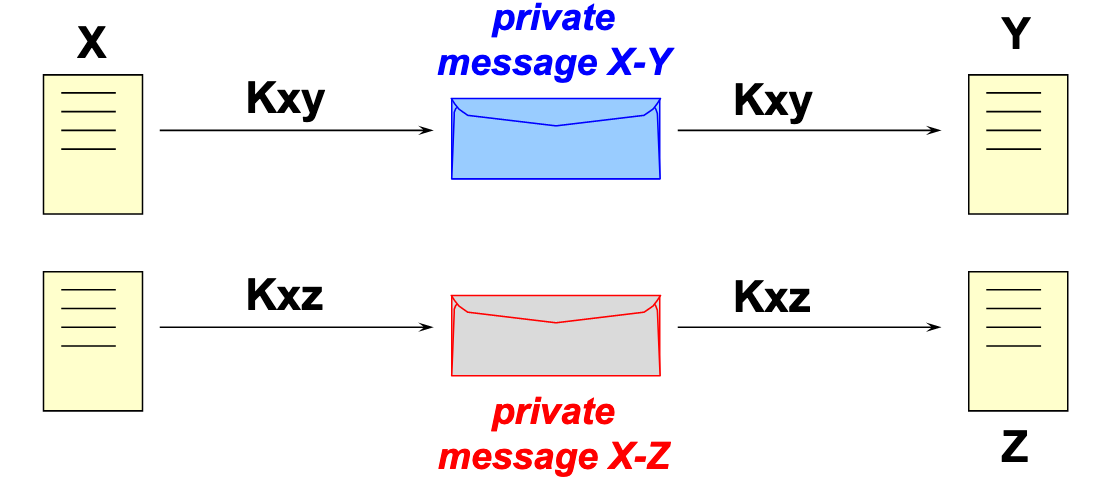
Symmetric encryption
- single and secret key
- one for each couple (or group!) of users
- Key distribution:
- for N parties, N(N-1)/2 keys are necessary.
- distribution can be Out Of Band or by meanch of key exchange algorithms.
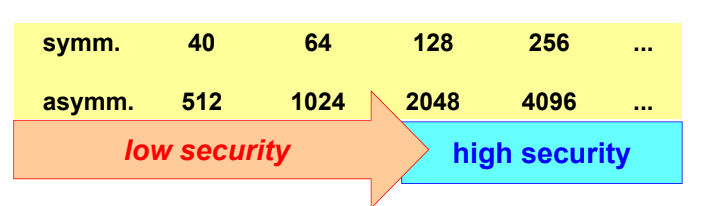
- Length of secret keys:
- if the encryption algo was well designed and the keys are kept secret, then the only possible attack is brute force, that requires 2Nbit attempts.
Length of cryptographic keys in relation with security
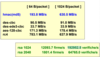
DES challenges
- Total of 3
- 1st took 5 months to break (distributed computing)
- 2nd 1 month (distributed computing)
- 3rd 2 days: 1 special-purpouse sysem (deep crack) developed by EFF at the cost $250k
- there was an assumption about the encoding (ASCII)
- 4th: 22 hours
- DEEP CRACK + a few thousands workstations
- Doesn’t mean that DES is weak, just that the key is short.
- 3DES could not be decrypted by DEEP CRACK
IETF changed all RFC advising not to use DES, but 3DES.
AES
US competition called for selecting a new symmetric algorithm.
AES (Advanced Ecryption Standard)
- key length up to 256 bits.
- block size of at least 128 bits.
5 finalists, RIJNDAEL won in 2000, published in 2001 a FIPS-197 => AES = RIJNDAEL.
Gradually being adopted since 2010, encryption algos are like wine, the bests are the one that ages.
Public key criptography
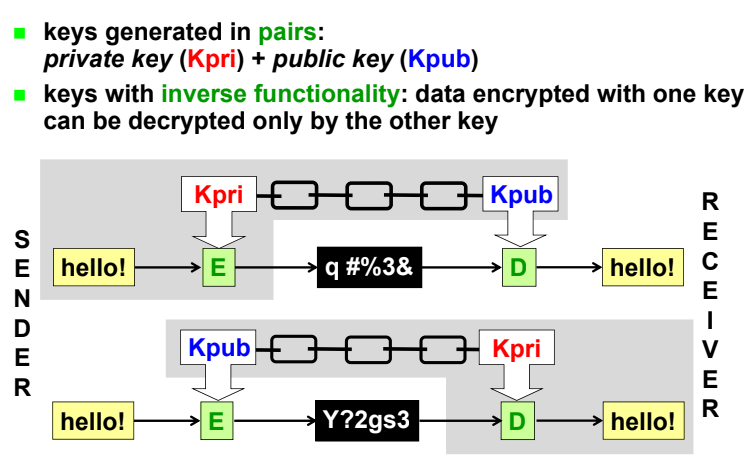
- k1 != k2
- asymmetric algorithms
- pair of keys (public and private): one used for decription and the other for encryption.
- high computational load
- used to distribute secret keys and create electronic signature (with hashing)
- main algos:
- Diffie-Hellman, RSA, DSA, El Gamal
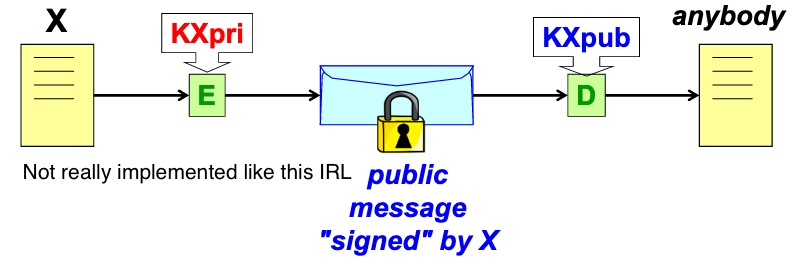
Digital Signature
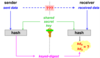
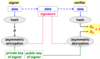
- Digital signature asymmetric encryption of data made with the private key of the author
- Since asymmetric encryption is very slow, usually only a summary of the message is encrypted
- provides data authentication and integrity
Confidentiality without a shared secret
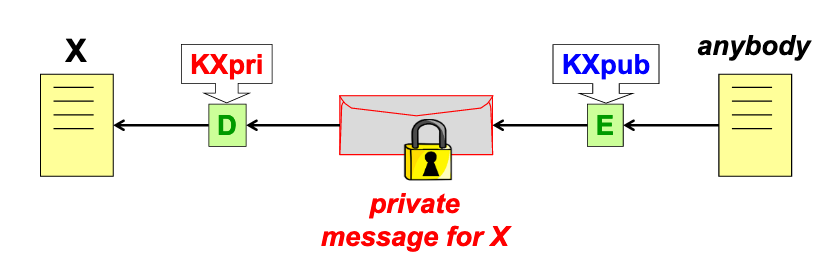
- Given the public key of a receiver, it is possible to create a secret message that only the receiver can decrypt.