Benign breast disease that may need excision after core biopsy
- Fibroepithelial lesion suspected fibroadenoma -> excise -> To rule out phyllodes
- Radial scar/CSL >>>Vacuum/ excise>>>Associated with DCIS/Ca
- Phyllodes >>> excise >>> 1cm margin for malignant phyllodes, clear margin for benign
- ADH >>> Excise to clear margin >>> Associated with DCIS/Ca
- ALH/LCIS >>> No need to excise unless pleomorphic LCIS … LCIS = increased cancer risk
- Papilloma >>> Vacuum/excise >>> Core cannot differentiate benign vs malignant
- Granular cell tumour >>> Excise to clear margin >>> Uncertain imaging and histological features
- Desmoid >>> Excise to clear margin >>> Locally invasive
How do you classify fibroadenoma?
Classification is based on histological features. Complex fibroadenoams have a slightly higher risk for breast cancer 3.5/1000 compared to 1/1000 for simple fibroadenomas.
SIMPLE - low cellularity and no atypia
COMPLEX - presence of
- epithelial micocalcification
- apocrine duct metaplasia
- sclerosing adenosis
- duct hyperplasia
GIANT - >5cm (juvenile, pregnancy, lactation)
Indications of surgery in fibroadenoma
size >3cm
symptomatic
growing
uncertain diagnosis
What is the cancer risk for fibroadenoma
SIMPLE - 1/1000, COMPLEX 3.5/1000 will become malignant. for simple fibroadenoma, the risk is same as the rest of un-involved breast tissue.
Management of breast cyst
Simple cyst + asymptomatic -> no action
Simple and symptomatic -> aspirate -> if blood stained then cytology
Complicated cysts (homogenous low level internal echo c.f. fluid in simple cysts) -> manage as simple cysts
Complex cyst ->aspirate and biopsy any wall projections
Simple cysts do not increase breast cancer risk. The risk with Complex cysts/ complicated Cysts is not well established but appears to have a slightly higher breast cancer risk hence it is important to ensure imaging and pathology concordance and (particularly for complex cysts), ensure stability with US scan in 6-12 months.
What are the types of phyllodes tumor?
Classified into benign, borderline or malignant based on
- stromal cellularity and atypia
- mitosis per 10 hpf
- infiltrative margins
- stromal overgrowth
Benign - mild to moderate stromal cellularity and atypia, pushing margins, mitosis <5 per 10 hpf, no stromal overgrowth
borderline - more stromal cellular atypia, mitosis 5-9 per 10 hpf, no stromal overgrowth, microscopic infiltrative margins
Malignant - marked atypia, macroscopic infiltrating margins, mitosis >10 per 10 hpf, stromal overgrowth present
What is the management of phyllodes tumor? What is the role of sentinel node biopsy in phyllodes tumor?
Definitive management is excision - aim for 1-2 cm margin. for benign phyllodes we only need clear margins (recurrence 0%)
for malignant phyllodes - 1-2 cm margin needed
Phyllodes usually does not spread to Lymph nodes hence SNB/axillary dissection is not indicated.
Malignant phyllodes tumour should be treated with adjuvant radiation. Chemotherapy is indicated for large or aggressive phyllodes on a case-by-case basis. Chemotherapeutic agents are similar to sarcoma. Hormonal therapy is not indicated.
You biopsy a breast lesion and histology comes back showing LCIS involving the margins. What is the significance of LCIS, would you re-excise to a clear margin here?
LCIS is epithelial hyperplasia of the lobular unit with atypia involving >50% of acini (ALH if <50% acini involved).
Both LCIS and ALH are benign but signifies increased risk of breast cancer including in the contralateral breast. the patient will need to be counselled and ongoing surveillance arranged.
LCIS does not need re-excision to clear margins unless it is pleomorphic LCIS which behaves like DCIS and hence clear margins are necessary.
Describe the findings and significance of NSABP B32 trial
The NSABP B32 trial provided evidence for adequacy of axillary staging for breast cancer in patients with clinically negative axilla.
N = 5611, patients with breast cancer whoc are clinically node negative.
Arms
- Routine SNB and then AND vs
- AND if SNB positive
Findings
- 26% in each arm had positive SNB
- 71% (n=3986) with -ve SNB -> there was no difference in OS, DFS or local recurrence between 2 groups.
- The study also examined the optimum way to evaluate sentinel nodes. nodes that were HE stain negative underwent IHC fro cytokeratin to identify occult mets. 5 year DFS and 5 yr OS were 3% and 1% lower in occult mets group.
Conclusion
- for clinically node negative patients, SNB is an adequate way to stage axilla. This has been validated by multiple other studies since.
- the small benefit from IHC for nodes was due to the large numbers in the study and presence of occult mets diagnosed by IHC is not clinically significant. This has been reconfirmed by Z10 trial.
What proportion of biopsy confirmed DCIS are diagnosed with invasive cancer after excision? When would you perform SNB for DCIS?
Up to 20% patients with DCIS are found to have invasive cancer after excision, rates of positive sentinel node would be much lower (approx 4-5%). By definition DCIS should not involve nodes.
I would perform SNB for DCIS in
- patients undergoing mastectomy
- I would offer it to patients with suspicious features i.e. palpable mass or DCIS>5cm, but this is controversial. Alternative would be to perform SNB if final histology confirms invasive cancer.
What are the contraindications to SNB?
Absolute
- Clinically involved axilla
- Inflammatory breast cancer
Relative
- Locally advanced breast cancer T3 and above (AND maximises locoregional control)
- if nodal information is unlikely to affect future management
- T1 ER+ cancer in >70yrs won’t need further chemo or radio due to excellent prognosis
How would you approach SNB in the following situations:
- Patients with involved nodes undergoing neoadjuvant Rx
- Previous benign breast resection/SNB
- previous axillary dissection
- Pregnant patients
- Neoadjuvant - there is controversy around timing of SNB (pre vs post neoadjuvant) in clinically positive axilla. Pre - improves prognostications and allows planning for adjuvant therapy but adds an extra surgical insult. Post - can make identification of involved nodes difficult and can make prognostication for radiotherapy more challenging.
I would place a radiopaque marker clip in the involved nodes at the time of biopsy and perform a SNB post neo-adjuvant ensuring the clipped node is removed.
- Prev benign resection/SNB - patients with extensive resections/reconstructions may have altered lymphatic channels. I would get a pre-op lymphoscintigraphy in these situations. (alternative is to progress to AND if no nodes identified).
- Previous Axillary dissection - preop lymphoscintigraphy
- Pregnancy - Isosulfan blue is teratogenic. SNB should ideally be avoided in pregnancy due to a lack of safety studies on other tracers and radioactive colloid. However small studies have reported safety while using methylene blue and radioactive colloids.
Some Important stats in breast cancer -
Lifetime risk of breast cancer =11%
% of patients diagnosed with DCIS who have occult invasive CA - 20%
+snb in clinically -ve axilla = 25%
+ve residual axillary dis after SNB = 40%
False -ve SNB rate = 3-10%
Int mammary node +vity = 20%
Int Mam node +ve rate with -ve Axilla = 10%
Radiation reduces local recurrence by 50% in 10 yrs compared to BCS alone
Patient undergoing WLE for invasive breast cancer. IMA node lights up on lymphoscintigraphy - will you excise it? why?
Internal mammary node may be positive in presence of an otherwise -ve axilla in only 10% of patients and there is no evidence that removal of the node affects overall survival.
Internal mammary node may be positive in presence of an otherwise -ve axilla in only 10% of patients and there is no evidence that removal of the node affects overall survival.
Disadvantages of removal
- technically challenging with significant complications like pneumothorax, pleural effusions and bleeding.
- In BCS it requires a second incision and this typically needs to be placed over an area that is visible through a variety of clothing which undermines cosmesis.
- A hot node doesn’t necessarily mean an involved node
Advantage
- Internal mam node involvement is a poor prognostic indicator
- Identification of mets in this node may mean alternation in adjuvant therapy, particularly radiation.
What are some important features of invasive lobular cancer?
Second most common breast ca - 5-10%
Associated with post-menopausal HRT
commoner in older age
Often palpable mass lesion not present
Microscopic size often larger than measured
Lack of staining for e cadherin
Higher frequency of bilateral and multicentric disease
Typically ER+
Metastasize later and to unusual locations e.g. meninges, peritoneal cavity
Who should be referred for genetic testing for breast cancer?
Assess risk using CanRisk or Manchester score. Refer anyone over CanRisk score >10% (EVIQ guidelines)
KNOWN GENETIC HISTORY - Adult untested relatives of
- BRCA1 (breast, ovarian, tubes, pancreas, peritoneal)
- BRCA2 (all BRCA1 plus prostate, AML)
- P53 (Li Fraumeni - sarcoma, breast, brain, leukaemia)
- PTEN (Cowden - breast, thyroid, hamartomatous polyp)
- STK11 (Peutz-Jehgers)
PERSONAL HISTORY OF
- triple negative cancer at age <50
- any breast ca <40yrs
- 2 primary breast with first at age <50
- Breast and ovarian primary any age
- High grade non-mucinous ovarian, tubal or peritoneal ca
- male breast ca
- Lobular Ca PLUS fam h/o lobular or diffuse stomach ca
- Breast Ca plus fam H/o
- Peutz Jehgers
- Li Fraumeni
- PTEN
FAMILY HISTORY - 2 first- or second-degree relatives with breast or ovarian cancer plus
- additional breast/ovarian ca
- one relative with breast Ca <50yrs
- >1 breast ca in same person
- breast and ovarian ca in same person
- male breast ca
- Ashkenazi (eastern European) Jews
Contraindications for radiation in breast cancer
ABSOLUTE
- pregnancy
RELATIVE
- Scleroderma
- SLE
- previous chest wall radiation
- severe cardiac/pulmonary disease
- p53 mutations (these pts are very susceptible to radiation induced cancers)
- Inability to lie flat
Indications for adjuvant radiotherapy for breast cancer
POST BCS
- most patients with invasive ca
- controversial in >65yrs with <3cm ca, ER+/HER2-ve and No nodal involvement - here the benefits are marginal and a nuanced discussion with the patient is needed (2014 metanalysis shows some benefit in reduction of local recurrence 2.2% vs 6.4%, with NNT of 24; but no benefit in OS)
- After DCIS usually if Van Nuys Prognostic score 7-9
POST MASTECTOMY
- T4
- T2/T3 with high-risk features (triple negative, high grade, LVI) - controversial
NODAL DISEASE (without AND)
- N2 (4 or more nodes)
- Macroscopic N1 (controversial. In BCS* EORTC and MA20 studies show decrease recurrence but no difference in OS; in *Mastectomy - EBCTCG (early breast cancer collaborative group) systematic review shows decrease in recurrence)
NODAL DISEASE POST AND
- Extracapsular extension, large proportion (50%) of involved nodes, axillary fat invasion
POST NAC
- Stage 3 disease
- residual nodal disease post NAC
What is Van Nuys prognostic score and it’s utility?
VN prognostic score is used for DCIS prognostication and is based on tumor grade, tumor size, age, margins.
Tumor grade
- 1 = low grade, no necrosis
- 2 = low grade + comedo necrosis
- 3 = high grade
Size
- 1 = <15mm
- 2 = 16 -40 mm
- 3 = >40 mm
Age
- 1 = <60
- 2 = 40 -60
- 3 = <40
Margins
- 1 = >1cm
- 2 = 1-9 mm
- 3 = <1mm
Recommendation:
4-6 = low risk
7-9 = consider radiation
10-12 = consider mastectomy
Indications for neo-adjuvant therapy in breast cancer
NAC is usually indicated in
- Stage 3 or T3 breast cancer
- Stage 2 HER2+ and triple negative cancers
- patients with temporary contraindications to surgery e.g., pregnancy
NAC is sometimes considered in
- downstaging axillary disease especially cN1 disease to avoid axillary dissection (SNB done if response)
- downstage breast disease in early breast cancer where tumour to breast ratio prevents BCS and patient desires BCS
- select early breast cancer (T1c i.e. >1cm but <2cm) if they are triple negative or HER2 +ve can also given NAC particularly given that their cancers typically respond well to NAC and they will need chemotherapy at some stage of treatment for thier current tumor.
What are the benefits and disadvantages of neoadjuvant therapy in breast cancer
Data to date does not show that NACT has any survival advantage over adjuvant therapy for breast cancer. However, there are some benefits:
- small subgroup of patients who respond to NACT have a distinct survival advantage
- allows assessment of tumour response in vivo and thus helps prognostication
- can downstage breast disease thus increasing frequency of BCS
- can downstage axillary stage and in cN1 disease may change axillary surgery from AND to SNB
Disadvantage
- there is a distinct lack of high-quality data for adjuvant radiation in the setting of NACT - thus in patients needed adjuvant radiation in NACT setting, data is often extrapolated from non-NACT studies
How can you ensure reliability of SNB post NACT?
SNB quality can be improved my
- using dual tracers
- removing 2- 3 nodes
- documented removal of any clipped positive nodes
- changing the definition of positive nodes to include isolated tumor cell deposits and micromets detected by IHC
Indications and choice of staging investigations for breast cancer
All patients with Stage IIIa and above need staging
- CT CAP + bone scan or
- PET CT
Any stage with symptoms
- cough -> chest CT
- bone pain -> Bone scan -> PET CT
- abdo pain/ascites/deranged LFT ->CT AP
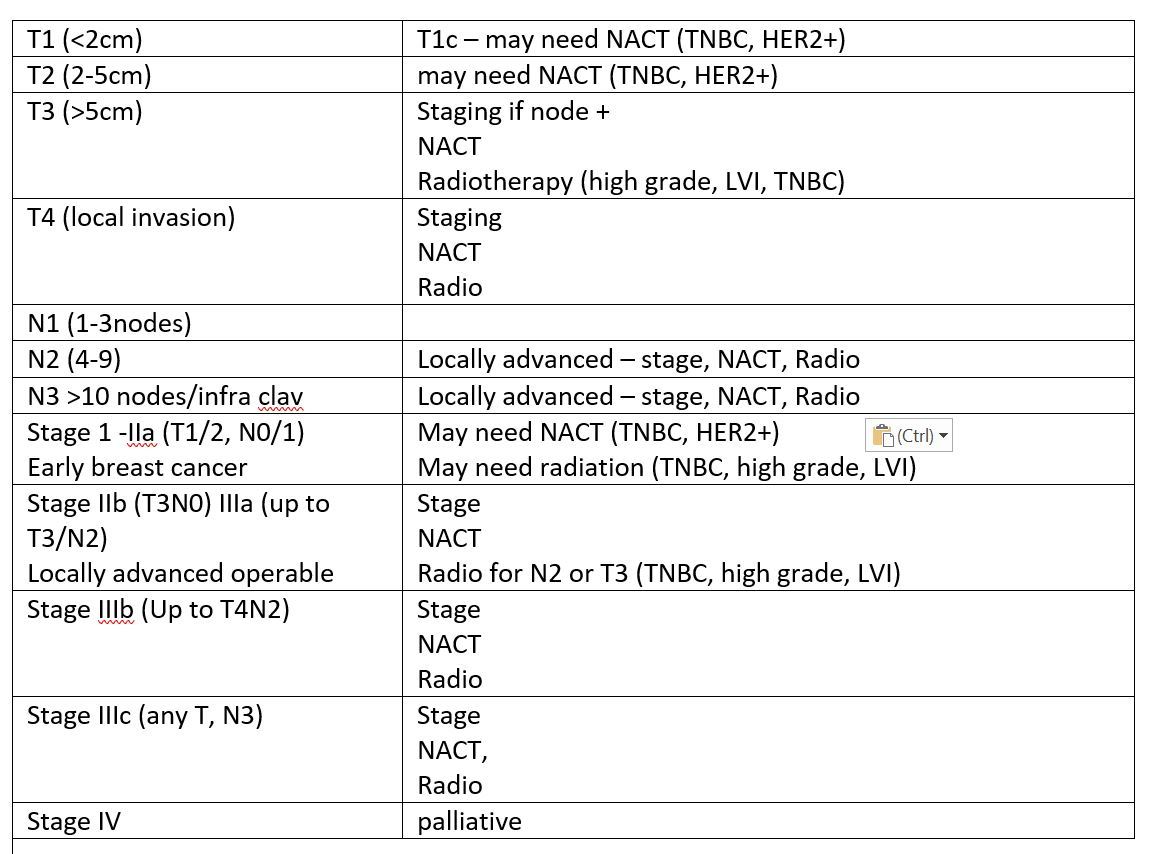
Describe the staging of breast cancer and significant branch points in management