What are some important branch points (based on T stage) in gastric cancer treatment?
>T1a
- staging lap (unless proven mets)
T1b
- straight up surgery (usually vs neoadjuvant for T2)
T2
- Neo-adjuvant (chemotherapy). Multimodal therapy better than surgery alone
- Chemoradiation (rather than chemo alone) used for oesophageal and cardia tumours
T3 or N1
- Adjuvant (chemoradio vs chemo)
Neoadjuvant options for esophageal cancer
- Chemorad (for fit patients)
- (CROSS) Carboplatin and paclitaxel + 50 gy radiation
- Chemotherapy
- FLOT
- ECF (MAGIC trail)
Indications for neo-adjuvant imatinib in GIST
- Borderline resectable GIST
- Potentially resectable metastatic GIST (liver, peritoneal mets)
- Gist in
- esophagus
- EG junction
- duodenum
- lower rectum
Total recommended duration for imatinib is not clear, US FDA advised a total of 3 years
Grade caustic and burn injuries for esophagus
Can be graded endoscopically or with CT Endoscopic grade for burns: Grade 1 - mucosal hyperaemia grade 2 - Ulceration (superficial 2A, deep 2B) Grade 3 - Necrosis (focal - 3A; extensive 3B) Endoscopic grade for corrosive injuries (within first 24 hrs) grade1 - hyperaemia, mild oedema grade 2 - moderate edema, mucosal ulcers (superficial) grade 3 - moderate oedema, deep ulcers differentiating between grades 2 and 3 difficult and may need repeat endoscopy CT grading of oesophageal injuries grade 1 - normal grade 2 - wall oedema and increased enhancement grade 3 - absence of wall enhancement or mural necrosis
What are the endoscopic features of GIST? how are they identified immunohistochemically? Outline investigation and treatment
Endoscopic features - smooth submucosal nodule with central ulceration.
Immmunohisto - c-kit positive (95%), CD34 (70%), and DOG1 (discovered in Gist- 1)
GISTs are sarcomatous tumors of GI tract that arise from interstitial cells of Cajal. They Can occur anywhere in GI tract but most common in stomach and SB. Histologically they have polymorphic spindle cells.
Can be asymptomatic but may present with abdo pian / bleeding.
Diagnosis is usually incidental on endoscopy or imaging.
Investigation:
Endoscopy and biopsy (often negative due to submucosal nature) - well biopsy has better yield.
EUS - and FNA
Immunohistochemistry - c-kit
CT - staging
Difficult to differentiate beningn vs malignant (size >10 cm and mitosis >5 per 50 hpf are predictors along with obvious invasion)
TREATMENT
<2cm no high risk features - can be monitored
<2cm with high risk features or >2cm- resect (with no tumour on ink)+ adjuvant imatinib (Gleevac) tyrosine kinase inhibitor (for 1 year). Sunitinib is used for lesions that progress on imatinib. Radiation and chemotherapy do not have significant affect.
what are the acute surgical options in corrosive esophageal injury?
Emergency surgery is needed in patients with transmural necrosis.
Usually, the stomach is also non-viable. Sometimes other organs viz. colon, spleen, liver, pancreas may also be damaged. Aim is to resect all necrotic tissue and secure nutritional access.
Most commonly (80%), esophago-gastrectomy with cervical esophagostomy (spit fistula), duodenal defunctioning and feeding jejunostomy is performed.
In some patients due to associated injury esophagogastrectomy with pancreaticoduodenectomy and feeding jejunostomy may be needed.
What is Barretts esophagus and what are the symptoms?
Barrett’s is a histopathological diagnosis where by the stratified squamous epithelium of the lower oesophagus undergoes columnar metaplasia due to acid reflux.
(American definition requires presence of goblet cells, UK definition doesn’t)
Barrett’s usually doesn’t cause any symptoms and most patients are diagnosed during investigation of GERD. In advanced cases patients may complain of odynophagia and can have strictures and ulceration
Surgical options for perf. DU
Perf < 1cm >> Graham Patch
Perf > 3cm
- Jejunal serosal patch + pyloric exclusion
- Antrectomy and Bilroth II
- Tube drainage of duodenum
How is H. Pylori infection diagnosed
Invasive tests
- Rapid Urease test (>90% sensitivity and 99-100% specificity)
- Microscopy with HE stain
- Culture (80% sensitive, allows antibiotic sensitivity testing)
Non-invasive tests
- Urea Breath test (sensitivity and specificity >95%), samples entire stomach
- serology (sens 90%, spec 75-95%) - titres are positive up to an year after infection
- Stool antigen (sens and spec >90%) - cheap and easy to assess eradication
Name some mesenchymal tumors of G tract. What is the differentiating molecular feature of GIST
Mesenchymal stromal tumours are spindle cell tumours
- GIST
- Leiomyoma
- Leiomyosarcoma
Nearly all (80-90%) GIST will have CKIT (CD117) mutation, most of the rest (10%) will have PDGFRA mutation that differentiate it from other mesenchymal tumours.
What factors are used to prognosticate GIST
Prognosis depends on
- Tumour size (<2cm vs >10 cm)
- Mitotic count (<5 per 50HPF vs >50)
- Location (SB worse than stomach)
- Obvious metastatic disease
Acute management of caustic burns to esophagus
Simultaneous resuscitation and assessment while organizing CT or endoscopy to assess for perforation and depth of injury
Particularly look for airway oedema and intubate if needed.
Look for caustic injury to eyes -> wash.
If no signs of full thickness necrosis, then - NG tube (endoscopically).
If any signs of necrosis (on CT or endoscopy) or perforation (mediastinitis or peritonitis) then surgery
Others - 1. start slow oral fluids after 48 hrs 2. Stomach is often non-viable in severe injuries 3. Abx only in proven infection or perforation 4. No role for induced vomiting/gastric lavage/neutralising agents 5. NGT possibly protects against strictures 6. If patient being managed non-operatively and becomes unstable - revaluate with CT for surgery
How are gastric cancers staged?
CT CAP
EUS +/- FNA
- assess T stage and N stage, perform FNA of lymph nodes and biopsy gastric lesion if needed
PET/CT
- if no mets seen on CT CAP
Staging Laparoscopy
- if >T1a and no mets seen on PET/CT and patient being considered for neoadjuvant/ surgical therapy
What are typical and atypical symptoms of reflux
Typical
- Heartburn
- Regurgitation
- Possibly dysphagia/odynophagia
Atypical
- Chest pain
- Epigastric pain
- Resp symptoms
- Hoarseness/ laryngitis
Treatment of Barretts
GENERAL MEASURES
- PPI - once daily
- weight loss
- quit smoking
- quit alcohol
METAPLASIA
- discuss surveillance (0.5% cancer risk per year but 30 times the basal risk but still low risk). ongoing surveillance related issues and scope related complications plus therapeutic procedures as needed
- Surveil every 3-5 yrs with 2 cm quadrantic biopsies
LOW GRADE DYSPLASIA
- expert pathology review
- surveillance every 6 months with quadrantic biopsies every 1 cm until 2 negative dysplasia. then increase interval to 2-3 yrs (>3cm) or 3-5 yrs (<3cm)
INDEFINITIE FOR DYSPLASIA
- Repeat endoscopy in 2 months with 1 cm quadrantic biopsies
HIGH GRADE DYSPLASIA
- expert pathology review
- treat with EMR/RFA and resect any irregular areas of metaplasia.
Describe Siewert classification of esophageal cancers
Siewert classification is used for cancers of the GEJ.
S1 - 5cm to 1 cm proximal to GEJ
S2 - 1 cm prox to 2 cm distal to GEJ
S3 - 2 cm - 5 cm distal to GEJ
S1 and S2 treated as distal esophageal cancers
S3 treated as gastric cardiac cancer
Indications for operative inetervention in GORD
- Gastrointestinal reason
- failure of medical management - after double dose PPI
- progression of esophagitis despite being on PPI
- patient prefers surgery to lifelong PPI
- Volume reflux - often manifested as extra intestinal complications - cough, laryngeal irritation, hoarseness.
- Extra intestinal - cough, hoarseness, laryngitis attributed to reflux and persistent despite PPI therapy
What are surgical options for post corrosive esophageal injury reconstruction or stricture treatment?
Bypass vs resection vs stricturoplasty
Bypass - colonic interposition graft (left or right colon, retrosternal tunnelled). But this can lead to bacterial overgrowth, mucocele and cancer in the retained segment. Advantage - avoids dissection through scarred mediastinal planes.
Resection of stricture (best but more extensive surgery).
Reconstruction options - gastric transposition (if stomach viable) or colonic transposition (no stomach). Stricturoplasty with vascularised colonic graft (but this retains the cancer risk)
What are indications of surgery in duodenal and gastric ulcers?
Perforation
Bleeding
Stricture
Non-healing ulcer
HOW CAN YOU CLASSIFY BLEEDING PEPTIC ULCER
This is done during endoscopic evaluation.
FORREST CLASSIFICATION
1 - actively bleeding (a= spurting, b = ooze)
2 - recent bleed (a = naked vessel, b = clot, c = pigment spot)
3 - No bleeding (clean ulcer base)
What are D1 and D2 gastrectomies
Adequate resection of gastric cancer mandates removal of 4 cm of healthy tissue on proximal and distal margin of resection along with harvest of at least 15 lymph nodes.
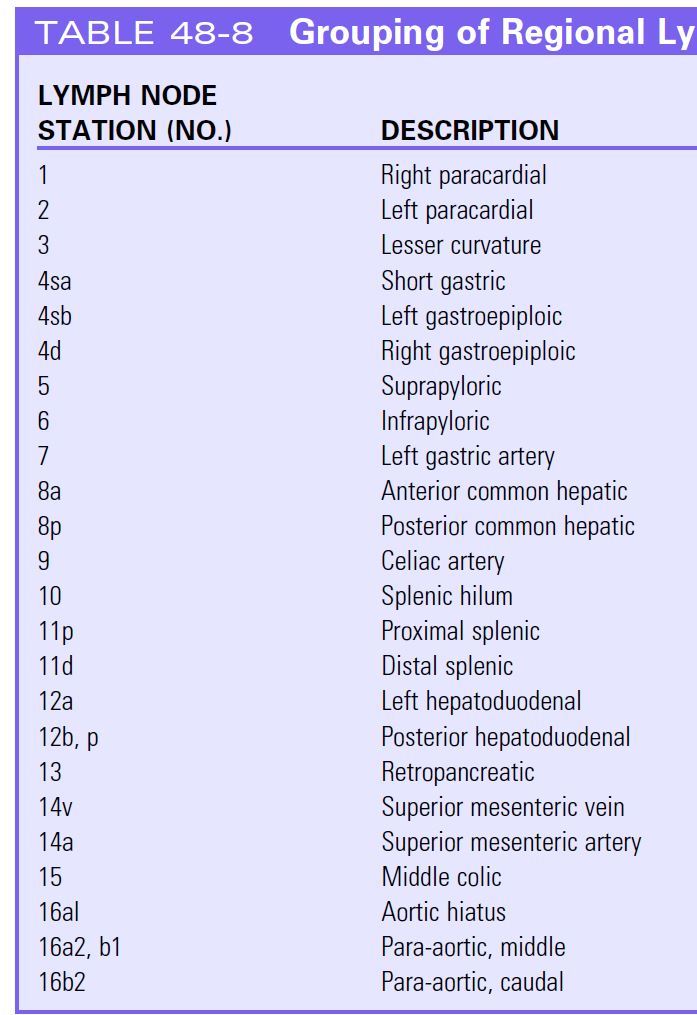
D1 gastrectomy involves R0 resection of stomach and removal of peri gastric (lesser and greater curve nodes) nodes (stations 1-6)
D2 gastrectomy involves R0 resection, all D1 nodes (stations 1-6) plus left gastric, common hepatic, coeliac, splenic and splenic hilar nodes (station 7-11)
There is controversy regarding the appropriate degree of lymphadenectomy. D2 is an oncologically superior resection but has more morbidity. The spleen should be preserved even on D2 resections unless it is involved.
Aims of surgery for GORD
- Reduce hiatus hernia
- Tighten the hiatus
- Protect vagus
- Augment lower esophageal sphincter
- Wrap
- 2-3 cm of intraabadominal esophagus
- Acute angle of HIS
What are the long term outcomes of esophageal corrosive injuries?
Strictures in up to 50 % (may take several weeks or months to develop). Most strictures can be managed with serial dilations. However risk of perf. is up to 17 % (much higher than benign strictures 4%) and cumulative. Hence patients with grades 3 or 4 strictures should be evaluated for surgical options.
Squamous cell cancer (16%) - develops 15 - 40 yrs later.
What is Marchand Classification of esophageal stricture
Grade 1 - incomplete stricture
grade 2 - complete but string like, elastic
Gr 3 - complete <1cm
Gr 4 - complete > 1cm (4a - easy to dilate, 4b difficult to dilate)






