What are D1 and D2 gastrectomies
Adequate resection of gastric cancer mandates removal of 4 cm of healthy tissue on proximal and distal margin of resection along with harvest of at least 15 lymph nodes.
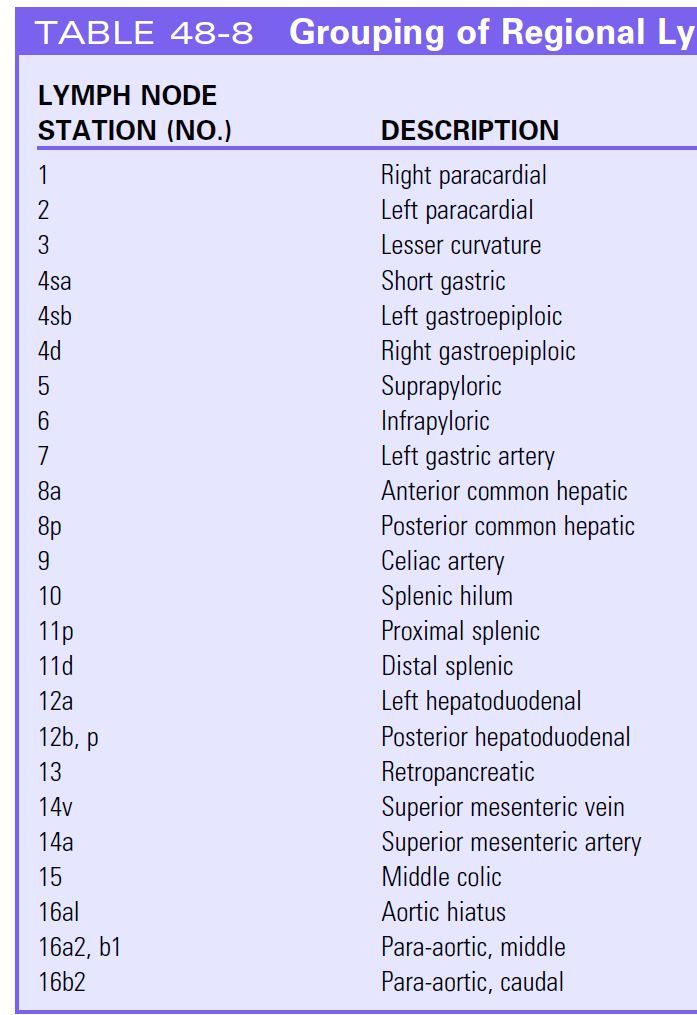
D1 gastrectomy involves R0 resection of stomach and removal of peri gastric (lesser and greater curve nodes) nodes (stations 1-6)
D2 gastrectomy involves R0 resection, all D1 nodes (stations 1-6) plus left gastric, common hepatic, coeliac, splenic and splenic hilar nodes (station 7-11)
There is controversy regarding the appropriate degree of lymphadenectomy. D2 is an oncologically superior resection but has more morbidity. The spleen should be preserved even on D2 resections unless it is involved.
What proportion of biopsy confirmed DCIS are diagnosed with invasive cancer after excision? When would you perform SNB for DCIS?
Up to 20% patients with DCIS are found to have invasive cancer after excision, rates of positive sentinel node would be much lower (approx 4-5%). By definition DCIS should not involve nodes.
I would perform SNB for DCIS in
- patients undergoing mastectomy
- I would offer it to patients with suspicious features i.e. palpable mass or DCIS>5cm, but this is controversial. Alternative would be to perform SNB if final histology confirms invasive cancer.
Indications for adjuvant radiotherapy for breast cancer
POST BCS
- most patients with invasive ca
- controversial in >65yrs with <3cm ca, ER+/HER2-ve and No nodal involvement - here the benefits are marginal and a nuanced discussion with the patient is needed (2014 metanalysis shows some benefit in reduction of local recurrence 2.2% vs 6.4%, with NNT of 24; but no benefit in OS)
- After DCIS usually if Van Nuys Prognostic score 7-9
POST MASTECTOMY
- T4
- T2/T3 with high-risk features (triple negative, high grade, LVI) - controversial
NODAL DISEASE (without AND)
- N2 (4 or more nodes)
- Macroscopic N1 (controversial. In BCS* EORTC and MA20 studies show decrease recurrence but no difference in OS; in *Mastectomy - EBCTCG (early breast cancer collaborative group) systematic review shows decrease in recurrence)
NODAL DISEASE POST AND
- Extracapsular extension, large proportion (50%) of involved nodes, axillary fat invasion
POST NAC
- Stage 3 disease
- residual nodal disease post NAC
What are the cancers associated with Lynch syndrome?
Large bowel (30-75%)
Endometrial (30-75%)
Ovarian (10%)
Stomach (10%)
urothelial (renal pelvis, ureter bladder) (5%)
Others (SB, panc, brain) (5%)
Skin (Muir-Torre) sebaceous adenoma, sebaceous carcinoma, epithelioma and keratoacanthoma
how are pancreatic neuroendocrine tumors graded?
Several systems exist. I use the WHO system which uses degree of differentiation, Ki67 and mitotic index.
Well differentiated
- Pan NEN Grade 1 (low) - Ki 67 <3%, Mitotic index (per 50 hpf) <2
- Pan NEN Grade 2 (intermediate) - Ki 67 3- 20%, Mitotic index 2-20
- Pan NEN Grade 3 (high) - Ki 67 >20%, mitotic index >20
Poorly differentiated
- Pan NEC Grade 3 (high) Ki 67 >20%, mitotic count >20
What is Barretts esophagus and what are the symptoms?
Barrett’s is a histopathological diagnosis where by the stratified squamous epithelium of the lower oesophagus undergoes columnar metaplasia due to acid reflux.
(American definition requires presence of goblet cells, UK definition doesn’t)
Barrett’s usually doesn’t cause any symptoms and most patients are diagnosed during investigation of GERD. In advanced cases patients may complain of odynophagia and can have strictures and ulceration
What chemotherapeutic agents used for colorectal cancer?
The options are
5 FU - this is IV form, oral form is capecitabine. This is main stay but not very effective in MSI patients (patients with MMR mutation).
Folinic acid (also called leucovorin) - potentiates 5FU
Oxaliplatin - further reduces recurrence when added to 5FU
Other agents used to potentiate 5FU particularly in metastatic disease - Irinotecan (IRI)
EGFR inhibitors (monoclonal antibodies) - e.g. bevacizumab (Avastin), Cetuximab - these bind to EGFR which are expressed in 60-80% of all colorectal cancers. These are not good in presence of KRAS mutation and have increased risk of perforation when used with stents in situ.
For rectal cancer there is lack of consensus for adjuvant chemo. But recommendations are extrapolated from colon cancer and are broadly the same. Adjuvant chemo is poorly tolerated in rectal cancer and many patients never finish the recommended course due to multiple factors like - treatment delay (longer convalescence after rectal surgery than colon surgery); presence of defunctioning stoma increases severity of diarrhoea.
Duke’s and TNM staging for colorectal cancer
Dukes A = muscularis propria
Duke’s B = through muscle laer but No nodes
Duke’s C = node positive (Same as Stage 3 cancer)
T1 = submucosal invasion
T2 = muscularis propria
T3 = subserosa
T4 = perforates serosa
N0 = no nodes
N1 = <3 nodes
N2 = 4 or more nodes
Investigations for gynaecomastia
In neonates - no investigation
Pubertal - review in 6 months
Adults -
LFT/Renal function/AFP/LDH
bHCG/estradiol/testosterone/LH/FSH
Mamo + US
US of liver/testis (if needed)
polyp surveillance protocol
- Low Risk = 5 yrs
- <2 small adenomas (<1cm)
- low grade dysplasia
- Intermediate = 3 yrs
- 3-4 small adenomas
- 1 adenoma >1cm
- villous adenoma
- High grade dysplasia
- High risk = 1 yr
- 5 or more small adenomas
- >3 adenomas with 1 >1cm
Pathogenesis and treatment for radiation proctitis
Acute - mucosal damage
chronic - endarteritis obliterans -> chronic mucosal damage
Treatment
- hydration
- antidiarrheals
- Bleeding
- sucralfate enema
- Argon plasma coag
- Pain
- Sucralfate
- Obstruction
- stool softeners
- endoscopic dilatation
- surgery
How are esophageal motility disorders classified, what are the manometric/ imaging abnormalities and what are the treatment options
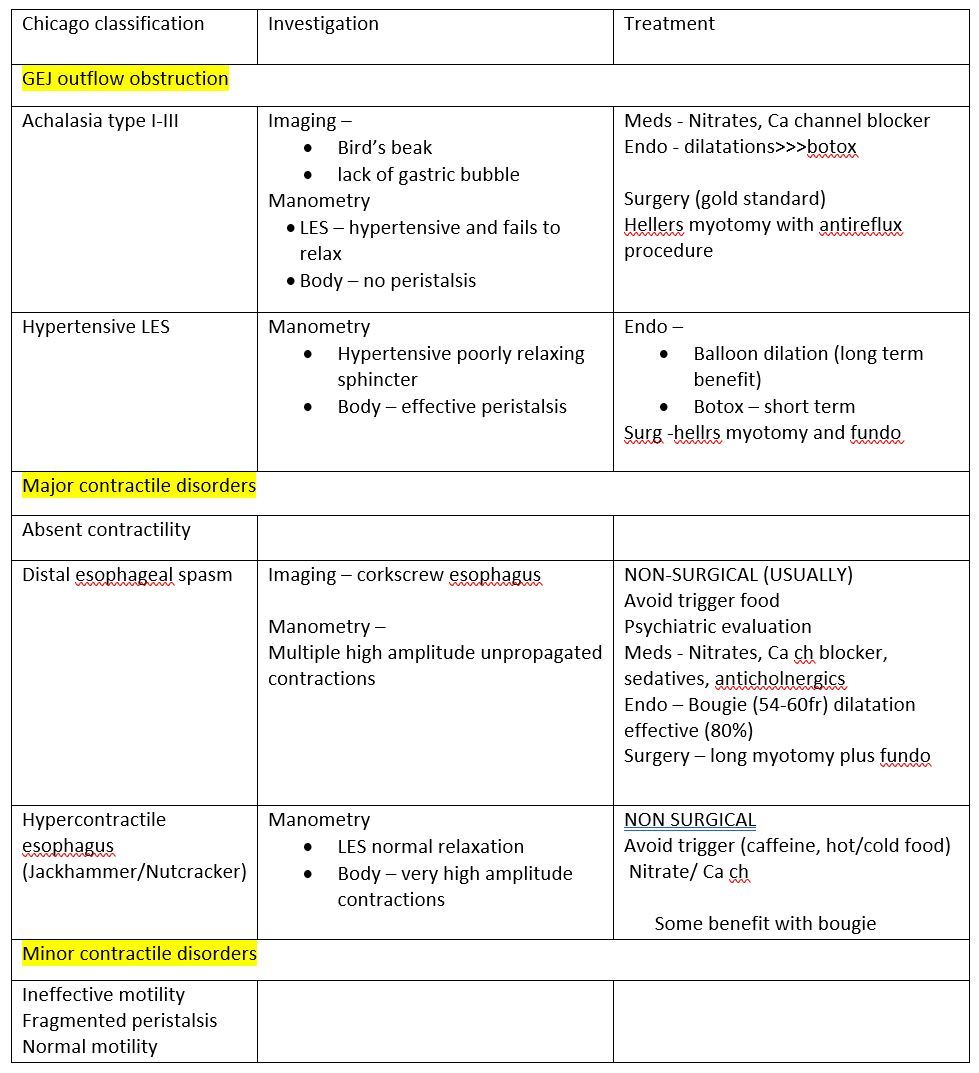
Chicago classification
- Gastroesophageal outflow obstruction
- Achalasia types I – III (hellers myotomy + anti-reflux procedure)
- Hypertensive lower oesophageal sphincter (balloon dilation or surgery)
- Major motility disorders
- Absent motility
- Diffuse oesophageal spasm (uncoordinated contraction, medical therapy)
- Hypercontractile (nutcracker) oesophagus (normal LES relaxation, very high amplitude coordinated contraction, medical therapy)
- Minor
- Ineffective/fragmented contractions
Child Pugh score
classifies severity of liver disease according to the
- albumin
- bilirubin
- INR
- Ascites
- Encephalopathy
score of 5 to 6 is considered Child-Pugh class A (well-compensated disease);
7 to 9 is class B (significant functional compromise)
10 to 15 is class C (decompensated disease).
These classes correlate with one- and two-year patient survival: class A: 100 and 85%; class B: 80 and 60%; and class C: 45 and 35%
Describe the lymph node levels in neck? What are radical, modified radical and selctive neck dissection?
There are 7 levels
- submental (1a) and submandibular (1b)
- Upper third of IJV (hyoid to base of skull (2a = anterior to XI nv; 2b = posterior to XI nerve)
- midddle third of IJV (Hyoid to Cricoid)
- Lower third of IJV (Hyiod to clavicle)
- posterior to SCM (5a= above cricoid; 5b = below cricoid)
- Central (between carotids and innnominate)
- Superior mediastinum
Radical neck dissection = removal of all fibrofatty tisssue on levels 1 -5 plus SCM, IJV and XI nerve
Modified radical = all fibrofatty tissue in levles 1-5 but any or all of SCM, IJV and XI preserved
Selective neck dissection = dissection of all fibrofatty structures ina selected compartment, preserving all critical structures
How are enterocutaneous fistula classified based on output volume?
Low <200mls/day
Moderate 200-500 mls/day
High >500 mls/day
What are some commonly used chemotherapy options for gastric cancer?
Neoadjuvant
- FLOT - 5FU, Leucovorin, oxaliplatin, docetaxel - for fit patients who can tolerate intense chemo
- ECF - Epirubicin, cisplatin, 5FU - used in MAGIC trial for fit patients
- FOLFOX - 5FU, folic acid, oxaliplatin - less fit patients
- CAPOX - capecitabine (oral FU) and oxaliplatin - less fit patient
Adjuvant
- ECF
- FOLFOX
How are gastric cancers staged?
CT CAP
EUS +/- FNA
- assess T stage and N stage, perform FNA of lymph nodes and biopsy gastric lesion if needed
PET/CT
- if no mets seen on CT CAP
Staging Laparoscopy
- if >T1a and no mets seen on PET/CT and patient being considered for neoadjuvant/ surgical therapy
Outline the treament for patients with Lynch syndrome
This depends on whether patient is being assessed for prophylactic vs therapeutic intervention.
Prophylactic
- For colon -
- Non-operative (adds 13.5 yrs life expectancy)
- 1-2 yearly high-quality colonoscopy with chromoendoscopy
- High dose aspirin (600 mg/d) CAPP2 RCT demonstrated substantial reduction in CRC rates
- Operative
- Restorative Proctocolectomy (adds 15.6 years life expectancy)
- TAC-IRA (adds 15.3 yrs) - cancer risk in retained rectum 1-1.5% per year
- Non-operative (adds 13.5 yrs life expectancy)
- For Tubes and ovaries
- Non-operative - annual TVS scan and endometrial sampling
- Operative - TAH + BSO
Therapeutic treatment
- Segmental colectomy / TAC-IRA / RPC (particularly if rectal Ca) - discuss risks of metachronous tumour 16% @10 yrs
- Adjuvant - 5FU less effective but otherwise indications and regimes are similar as sporadic CRC
What are the endoscopic features of GIST? how are they identified immunohistochemically? Outline investigation and treatment
Endoscopic features - smooth submucosal nodule with central ulceration.
Immmunohisto - c-kit positive (95%), CD34 (70%), and DOG1 (discovered in Gist- 1)
GISTs are sarcomatous tumors of GI tract that arise from interstitial cells of Cajal. They Can occur anywhere in GI tract but most common in stomach and SB. Histologically they have polymorphic spindle cells.
Can be asymptomatic but may present with abdo pian / bleeding.
Diagnosis is usually incidental on endoscopy or imaging.
Investigation:
Endoscopy and biopsy (often negative due to submucosal nature) - well biopsy has better yield.
EUS - and FNA
Immunohistochemistry - c-kit
CT - staging
Difficult to differentiate benign vs malignant (size >10 cm and mitosis >5 per 50 hpf are predictors along with obvious invasion)
TREATMENT
<2cm no high risk features - can be monitored
<2cm with high risk features or >2cm- resect (with no tumour on ink)+ adjuvant imatinib (Gleevac) tyrosine kinase inhibitor (for 1 year). Sunitinib is used for lesions that progress on imatinib. Radiation and chemotherapy do not have significant affect.
Surgical options for perf. DU
Perf < 1cm >> Graham Patch
Perf > 3cm
- Jejunal serosal patch + pyloric exclusion
- Antrectomy and Bilroth II
- Tube drainage of duodenum
MELD score
Statistical score that was originally used to predict mortality after TIPS but studies have validated it use as a reliable scoring system for selecting patients for liver transplant and risk prediction for other surgical interventions in patients with cirrhosis.
Components
- Bilirubin
- INR
- Creatinine
- more recently Na has been added
It has been suggested that patients with a MELD score below 10 can undergo elective surgery, those with a MELD score of 10 to 15 may undergo elective surgery with caution, and those with a MELD score >15 should not undergo elective surgery
What are some important branch points (based on T stage) in gastric cancer treatment?
>T1a
- staging lap (unless proven mets)
T1b
- straight up surgery (usually vs neoadjuvant for T2)
T2
- Neo-adjuvant (chemotherapy). Multimodal therapy better than surgery alone
- Chemoradiation (rather than chemo alone) used for oesophageal and cardia tumours
T3 or N1
- Adjuvant (chemoradio vs chemo)
What factors are used to prognosticate GIST
Prognosis depends on
- Tumour size (<2cm vs >10 cm)
- Mitotic count (<5 per 50HPF vs >50)
- Location (SB worse than stomach)
- Obvious metastatic disease
Which part of the intestine absorbs which nutrient?
- Carbohydrate, protein and water soluble vitamins - upper 200 cm of jej
- Fat and fat soluble vitamins - entire SB
- Bile salt/ acid - terminal ileum
- Iron, calcium and other minerals - duodenum
- Water and sodium - entire SB and colon
- K and short chain fatty acid - colon






