List of benign breast masses
Fibroadenoma Cyst Fat necrosis Fibrocystic changes Phylloides tumor
Elements of breast mass history
timing
meds history (hormones)
Risk factors (age of menstruation, pregnancies, previous biopsies)
Family history
Bi-RAds
1: Negative for mass 2. Benign 3. Probably benign (6 mo follow up) 4: Suspicious (tissue dx) 5: Highly suspicious (tissue dx) 6. Known malignancy.
How to deal with palpable lymph nodes on initial examination
FNA
Diagnostic mammogram views
Cradiocaudal mediolateral oblique
Immunohistochemistry equivicol for Her2 then request…
FISH testing.
Requirements for SLNB in patient with clinically positive nodes prior to neoadjuvant chemotherapy. (ACOSOG 1071)
- Dual tracer
- 2, and ideally, 3 SLN
- Removal of clipped, clinically positive node. (If residual disease identified in SLN, then completion ALND)
SLNB removal criteria
Highest radioactivity - get number palpable blue > 10% of max SLN.
Post op considerations regarding cancer treatment
- Multidisciplinary approach 2. Hormones 3. Radiation 4. Chemotherapy (typically prior to radiation) 5. Mammogram 6 months after completion of therapy 6. Annual visit, exam, and mammogram
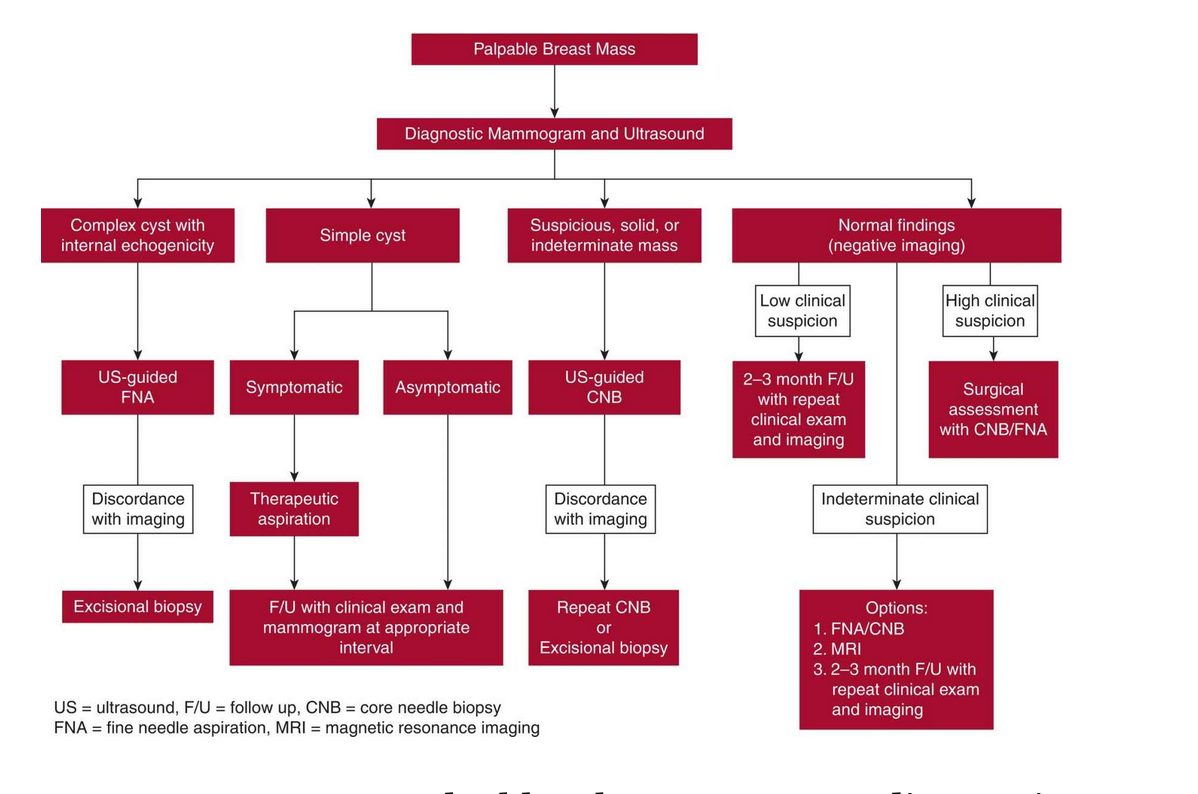
Breast mass algorithm
Findings on CNB that confer increased risk of breast cancer
- Atypical ductal hyperplasia
- Lobular neoplasia
- Papillomas with or without atypia
Margin required for DCIS
2 mm
Contraindications for radiation therapy
- Collagen vascular dissease
- Previous radiation
- Pregnancy
Extent of dissection in mastectomy
- clavicle superiorly
- sternum medially
- Latissimus laterally
- inframammary fold inferiorly.
Length of adjuvant hormonal therapy to achieve risk reduction
5 years
consideration for SLNB in DCIS
lesions > 4 cm
comedonecrosis
Mastectomy
Benefits of adjuvant radation in DCIS partial mastectomy
Decreased local recurrance. No survival benefit.
Size of needle for core needle biopsy
14 or 16 gauge (must place clip if doing it yourself)
Breast cancer risk for LCIS
1% per year (need tamoxifen or raloxifene for 5 years)
Side effects of estrogen receptor antagonists
tamoxifen (night sweats, hot flashes, increased uterine cancer risk in post menopausal women)
Treatment for DCIS
- Biopsy with determiniation of receptor status
- discussion at MD conference
- Lumpectomy with whole breast radiation
- Risk reduciton with tamoxifen
- H&P Q6 mo for 5 years, then annually with annual mammogram
Work up when diagnosis of breast cancer made
- Receptor status
- MD conference meeting
- consider genetic counseling
- pregnancy test
- Focused H&P looking for abdominal symptoms or neurological symptoms, and LN exam, followed by possible labs, CXR, head MRI
When should neoajuvant chemotherapy be considered
T2 (greater than 2 cm) or N1 lesions
What to do if nodes found on SLNB
ZII trial?
Consider staging work up if not obtained before.

-
Core Operations149
-
Cancer29
-
Pregnancy3
-
Infectious Disease21
-
Colon116
-
Liver8
-
Breast53
-
Endocrine81
-
Skin and soft tissue27
-
Stomach40
-
Hepatobiliary53
-
Pancreas47
-
Small bowel4
-
Esophagus23
-
Lung26
-
Pediatric29
-
Head and Neck5
-
Trauma/Burn9
-
Critical Care/Nutrition35
-
Hernia5
-
Transplant8
-
Pre and Post op care10
-
Vascular9



