tx options for missing tooth/teeth
- no tx/leave spapce
- replace tooth/teeth
- close space (orthodontics)
reasons for treating tooth loss (4)
- Aesthetics
- Function
- Speech
- Maintenance of dental health
tooth replacement options
- denture
- bridgework
- implants
define bridge
“A prosthesis which replaces a missing tooth or teeth and is attached to one or more natural teeth (or implants)”
- “Fixed partial denture” USA*
- Compared with a removable partial denture which replaces soft tissue and bone (bridges do not replace soft tissue usually - limited)
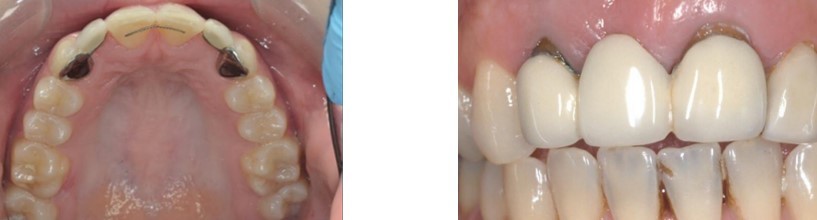
2 types of bridgework
adhesive
- most common, held by wings on palatal surface
‘conventional’
- held by crowns
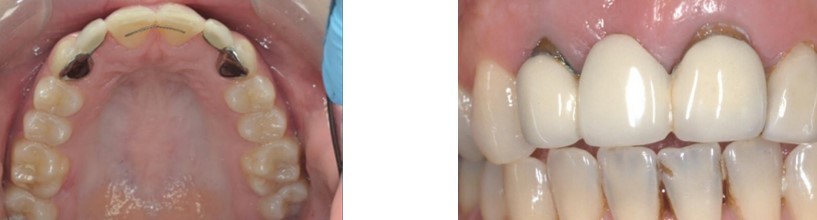
general indications for bridgework (6)
- Function and stability
- Appearance
- Speech
- Psychological reasons
- Systemic disease e.g. epileptics
- Co-operative patient – plaque control, no active disease, motivated
4 local indications for bridgework
- Big teeth
- Heavily restored teeth (for ‘conventional’ bridge)
- Favourable abutment angulations
- Favourable occlusion
6 general contraindications for bridgework
- Uncooperative patient
- Medical history contra-indications (e.g. allergies to metals)
- Poor oral hygiene
- High caries rate
- Periodontal disease
- Large pulps esp in primary teeth (conventional bridge
- Turkey teeth
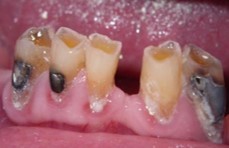
8 local contraindications for bridge work
- High possibility of further tooth loss within arch
- Prognosis of abutment poor
- Length of span too great
- Ridge form and tissue loss
- Denture tend to be better
- Gingival architecture concern with aesthetics not just tooth loss
- Tilting and rotation of teeth
- Degree of restoration (how much of tooth is left after preparation)
- Periapical status
- Periodontal status (bone loss) – active or advanced
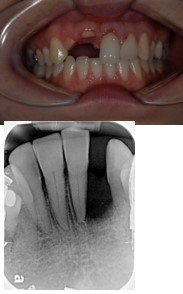
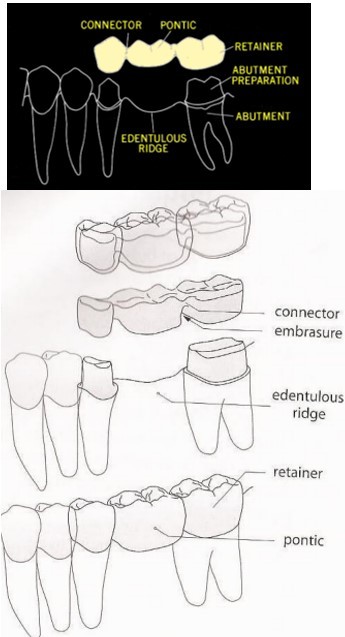
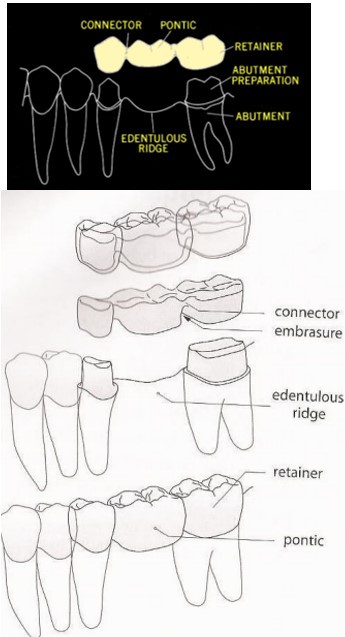
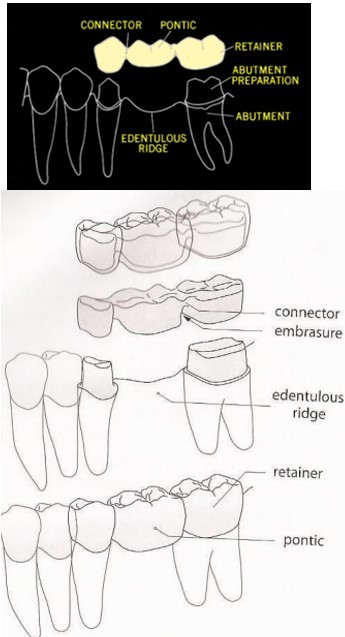
abutment
a tooth which serves as an attachment for a bridge
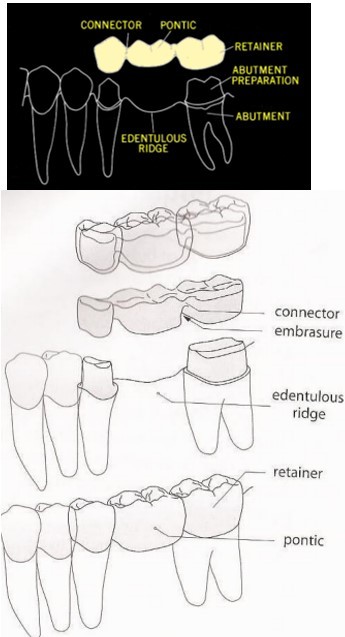
pontic
the artificial tooth which is suspended from the abutement teeth/tooth
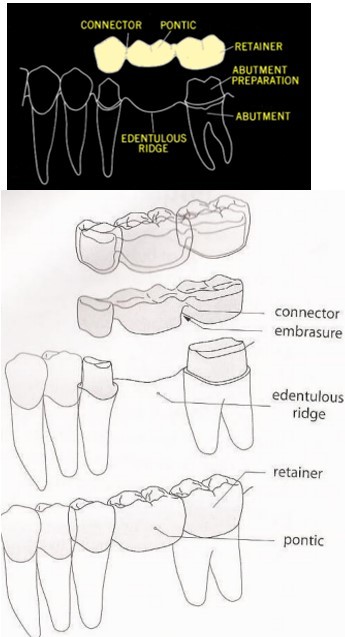
retainers
the extracoronal or intracoronal restorations that are connected to the pontic and cemented to teh prepared abutment teeth
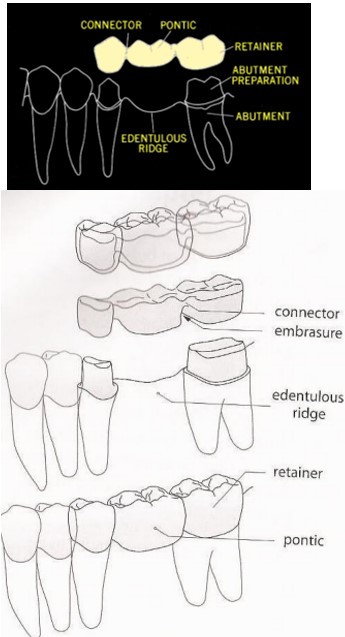
connectors
component which connects the pontic to the retainer(s)
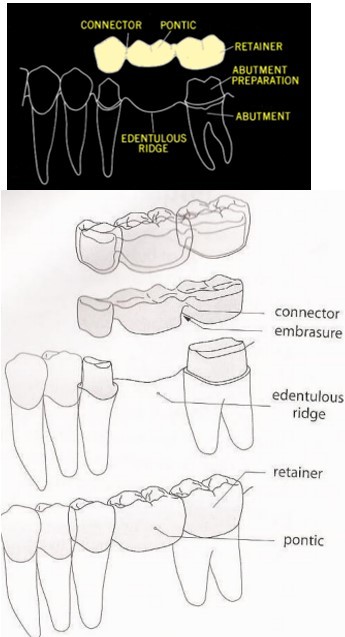
edentulous span
space between natural teeth that is to be filled by a bridge
saddle
area of the edentuolous ridge over which the pontic will lie
pier
an abutment tooth which stands between and is supporting two pontic - each pontic being attached to a further abutment tooth
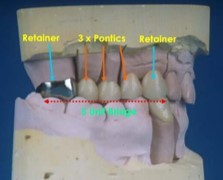
unit
either a retainer or a pontic
e.g. a bridge with two retainers and one pontic = 3 unit bridge
2 types of bridge design
fixed-fixed
cantilever
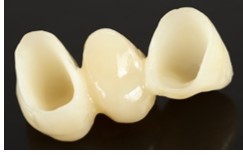
fixed-fixed bridge
This type of bridge has a retainer at each end with a pontic in the middle joined by rigid connectors.
- E.g. (Retainer)-(pontic)-(Retainer)
Can be:
- Adhesive/resin retained
- Conventional
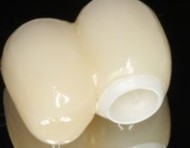
cantilever
This type of bridge has a retainer (or retainers) at one side of the pontic only
- E.g. (Retainer)-(pontic)
Can be:
- Adhesive/resin retained
- Conventional
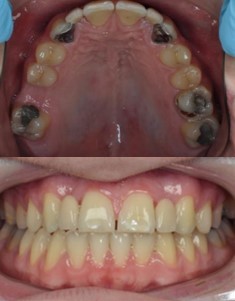
resin bonded bridgework (RBB) a.k.a
- Resin retained bridgework (RRB)
- Adhesive bridgework
- Minimal preparation bridgework
- Maryland bridge
- Resin bonded fixed partial denture (RBFPD)
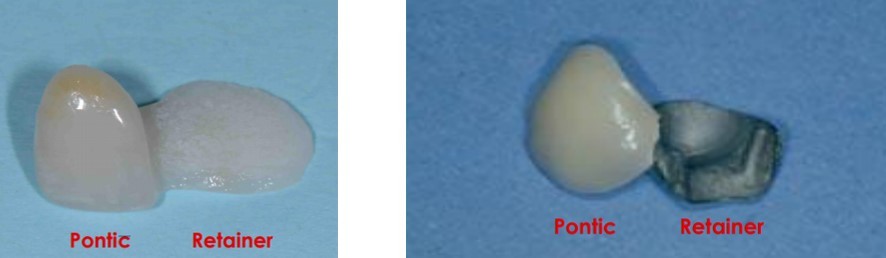
2 options for adhesive cantilever bridges
all ceramic adhesive bridge
or
traditional adhesive bridge with metal (CoCr) wing
can be nickel chromium oness too
6 advantages of RBB
- Minimal or no preparation
- Occlusal contact can be high but tend to resolve in 10-14 days due to DAAL movements
- No anaesthetic needed
- Less costly
- Less surgery time
- Can be used as a provisional restoration
- Hypodontia pt. – long term implant work, but wont want to provide till fully grown 18/19 girls and 20 boys
- Easy and quick to provide in teens and then can give implants when fully grown or when fails and then re-discuss options
- Hypodontia pt. – long term implant work, but wont want to provide till fully grown 18/19 girls and 20 boys
- If fails - usually less destructive than alternatives
6 disadv of RBB
- Rigorous clinical technique
- Need to be completely dry
- Metal shine-through
- See on 21 – poor cementation or design so metal seen at incisal edge
- Be careful not to overextend retainer
- See on 21 – poor cementation or design so metal seen at incisal edge
- Chipping pocelain
- Can debond
- High chance of it debonding again
- First bond will be best bond
- High chance of it debonding again
- Occlusal interferences – less of issue, DAAL concept
- No trial period possible






