bridge designs with ‘conventional’ component
- conventional’ component
- Retainer(s) = crown
- Fixed-fixed designs
- Fixed cantilever designs
- Retainer(s) = crown
- Fixed moveable bridge
- Hybrid bridge rare
- Fixed retainer and adhesive retainer Spring cantilever bridge
- Spring cantilever briidge
fixed-fixed bridges
This type of bridge has a retainer at each end with a pontic in the middle joined by rigid connectors
e. g. (retainer)-(pontic)-(retainer)
* Class II incisor relationship suited for this or AOB as pontics clear of occlusion*
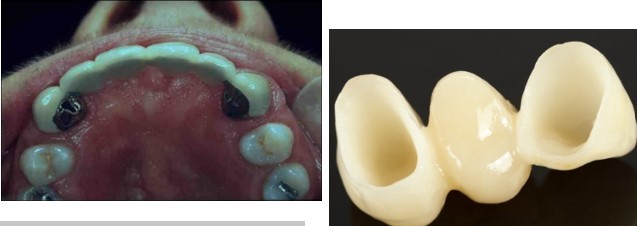
5 advanatgaes of fixed-fixed
- Robust design
- Maximum retention and strength
- Abutment teeth splinted together ?
- Perio cases with mobile teeth, provided the disease is stable
- Can be used in longer spans
- Laboratory construction straightforward
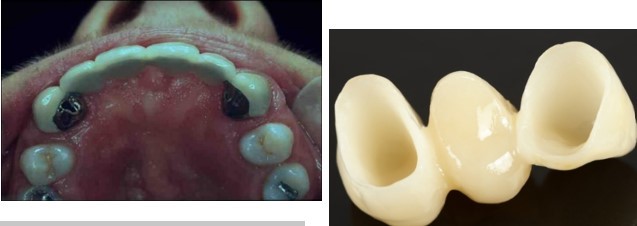
4 disadvantages of conventional fixed-fixed
- Preparation difficult (parallel tooth preparations needed)
- Preparation must be minimally tapered – over tapered will reduce retention (aim 5-7 degree, max of 10)
- Common path of insertion for abutments
- Removal of tooth tissue (danger to pulp)
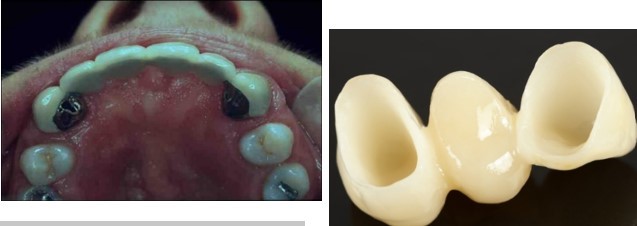
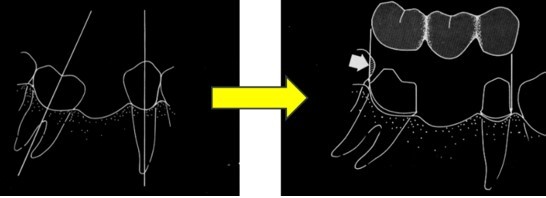
problems with abutment teeth
Preparations/teeth not parallel
Differing POIs for 7 and 5, marginal cusp of 8 in the way
cantilever bridge
This type of bridge provides support for the pontic at one end only
- Conventional/crown retainer OR
- Adhesive/resin retained – metal wing
At this end, the pontic may be connected to one or more retainers
There is no retainer at the other end of the Pontic
e.g. (Retainer)-(Pontic)
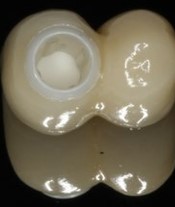
3 advanategs of conventional cantilever
- Conservative design
- Compared to fixed-fixed conventional design
- Laboratory construction straightforward
- No need to ensure multiple tooth preparations are parallel
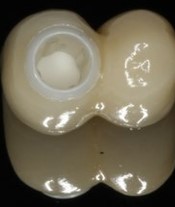
3 disadvanatges of conventional canitlever
- Short span only
- Rigid to avoid distortion - # risk
- Mesial cantilever preferred
- All types – adhesive, resin bonded, conventional
- More likely to contact anterior teeth first (which is heavier) so on abutment not on pontic
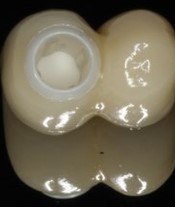
solution for problem that teeth/preps not parallel
fixed-moveable bridge
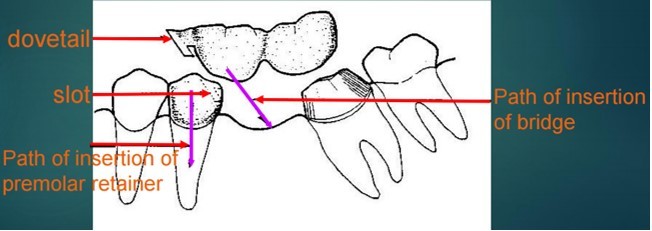
fixed- moveable bridge
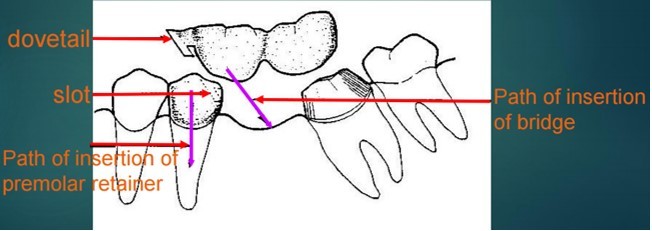
Retainers with separate paths of insertion
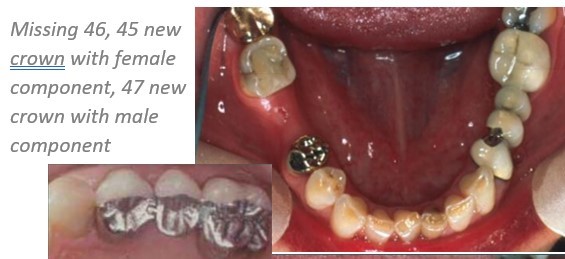
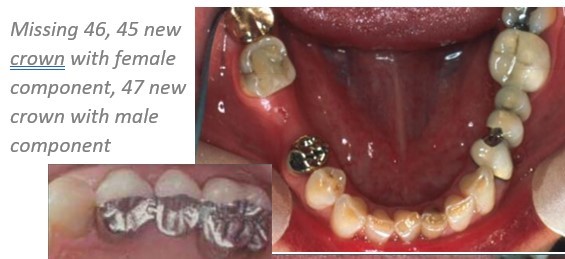
The bridge is united by a moveable connector
- slot together
This type of bridge has a rigid connector usually at the distal end of the pontic and a moveable connector mesially
- Allows some vertical movement at the mesial abutment tooth
5 adv fixed-movebale bridge
- Preparations don’t require a common path of insertion
- Each preparation designed to be retentive independent of others
- More conservative of tooth tissue
- Allows minor tooth movement
- May be cemented in two parts
4 disadvanategs of fixed-moveable bridges
- Length of span limited – only 1 pontic
- Laboratory construction more complicated
- Possible difficulty in cleaning beneath moveable joint – possible plaque trap, need meticulous OH to prevent secondary caries or perio
- Can’t construct provisional bridge
- Can do provisional crowns
hybrid bridge
OT RECOMMENDED
One retainer = ‘Conventional’ preparation (crown)
Other retainer = minimal preparation (adhesive/ resin retained/ resin bonded)
15 crown retainer, 14 pontic, 13 wing retainer – wing on 3 is likely debond first so rather redundant (cause leaking and failure) – NOT RECOMMENDED
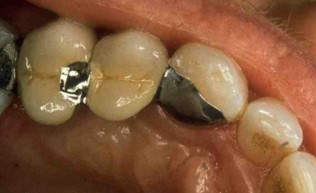
conventional spring cantilever bridge
NOT RECOMMENDED
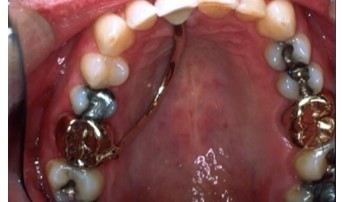
One pontic attached to the end of a metal arm that runs across the palate to a rigid connector on the palatal side of a retainer
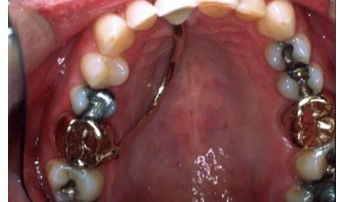
advantage of conventional spring cantilever
- Useful if spacing present between upper incisors
- Where adjacent teeth are unrestored
- Where a posterior tooth would provide a suitable abutment (i.e. already has a crown/large direct restoration)
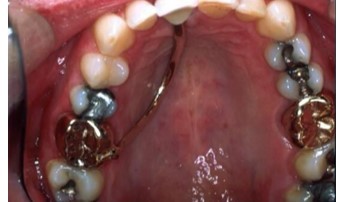
4 disadvantage of conventional spring cantilever
- Can only be used to replace upper incisor teeth
- Difficult to clean beneath palatal connector
- May irritate the palatal mucosa
- Difficult to control movement of pontic, due to springiness of metal arm and displacement of palatal soft tissues
3 points for abutment evaluation
- Must be able to withstand the forces previously directed to the missing teeth
- Supporting tissues should be healthy and free of inflammation
- i.e. periapical disease and periodontal disease
- Crown to root ratio
- length of tooth coronal to alveolar crest compared to length of root embedded in bone. Optimum ratio 2:3.
- Minimum ratio 1:1
- length of tooth coronal to alveolar crest compared to length of root embedded in bone. Optimum ratio 2:3.




